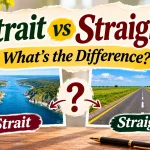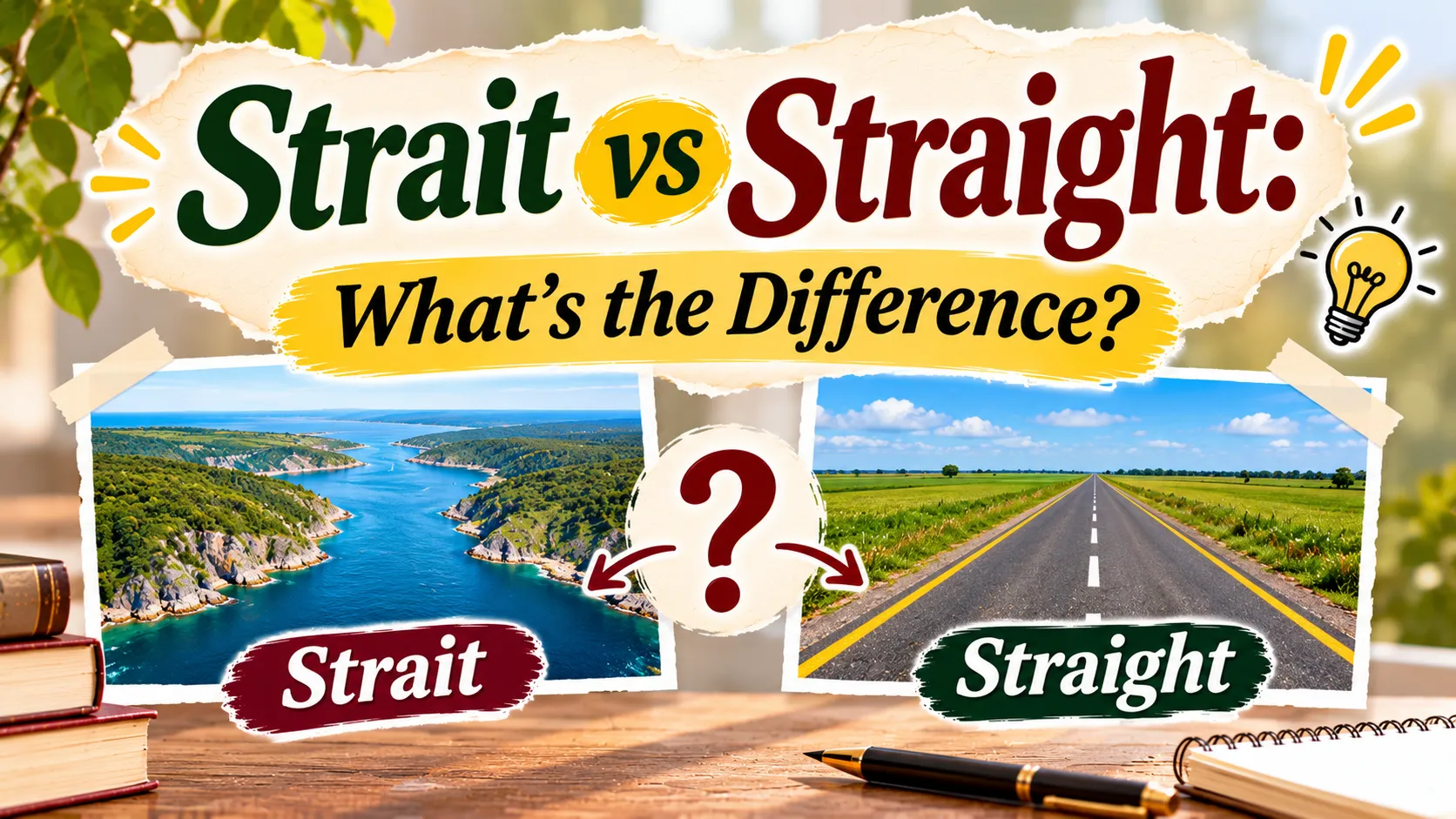
The words “strait” and “straight” sound identical, differ by just two letters, and appear in completely different contexts. The strait vs straight confusion ranks among the most common spelling errors in English, appearing in everything from geography discussions to fashion advice and financial writing.
“Strait” is a noun referring to a narrow passage of water connecting two larger bodies, or a plural noun meaning a difficult situation. “Straight” is an adjective and adverb meaning direct, not curved, honest, or heterosexual. These words share identical pronunciation but no shared meaning. This comprehensive guide explains the difference, explores their origins, provides practical examples, and helps you choose the correct word every time you write.
Quick Answer
“Strait” refers to a narrow waterway between two land masses, as in “the Strait of Gibraltar,” or a difficult situation, as in “dire straits.” “Straight” means direct, not curved, or honest, as in “a straight line” or “straight answer.” Remember: strait has “ai” like “sail” (water); straight has “aigh” like “eight” (direction). They sound the same but mean completely different things.
Meaning Overview Table
| Aspect | Meaning |
|---|---|
| Definition | Strait: a narrow waterway; a difficult situation. Straight: direct, not curved; honest |
| Pronunciation | Both: /streɪt/ |
| Part of Speech | Strait: noun. Straight: adjective, adverb, noun |
| Usage | “The Strait of Gibraltar” vs. “a straight line” |
| Context | Strait: geography, maritime navigation, financial difficulty. Straight: geometry, honesty, sexuality, everyday descriptions |
Main Meaning
Definition
Strait functions primarily as a noun. It refers to a narrow passage of water connecting two larger bodies of water, such as the Strait of Gibraltar or the Bering Strait. In the plural form “straits,” it means a difficult or desperate situation, as in “dire straits.” Straight functions as an adjective, adverb, and noun. As an adjective, it means extending in one direction without curves, honest, or heterosexual. As an adverb, it means directly or immediately. And As a noun, it refers to a straight line or a straight part of a track.
Origin
“Strait” comes from the Old French estreit, meaning “narrow” or “tight,” from the Latin strictus, the past participle of stringere (“to draw tight”). The word entered English in the 14th century. “Straight” comes from the Old English streht, the past participle of streccan (“to stretch”). Both words share a distant Latin root but developed distinct spellings and meanings in English.
Context
The distinction matters across several contexts:
- Geography: “Strait” refers to narrow waterways
- Finance: “Dire straits” describes financial difficulty
- Geometry: “Straight” describes lines and angles
- Honesty: “Straight answer” means an honest one
- Fashion: “Straight-leg jeans” describes a cut
- Everyday Writing: Confusing the two creates embarrassing errors in emails, essays, and news reports
Modern Usage
Today, “strait” appears primarily in geographic names and the phrase “dire straits.” “Straight” appears constantly in descriptions of direction, honesty, and physical appearance. The confusion persists because the words sound identical and spell-check often fails to catch the error.
Detailed Explanation
Literal Meaning
Literally, “strait” means narrow or tight. “Straight” literally means stretched out or direct.
Common Meaning
Commonly, people use “strait” in geographic contexts. “The Strait of Hormuz” refers to a narrow waterway. “Straight” describes anything direct or without curves. “Go straight home” means go directly.
Geographic Meaning
In geography, a “strait” is a narrow passage of water connecting two larger bodies of water. The Strait of Gibraltar connects the Atlantic Ocean and the Mediterranean Sea. The Bering Strait separates Asia and North America. These waterways are crucial for navigation and trade.
Financial Meaning
In finance, “straits” describes a difficult or desperate situation. “Dire straits” means severe financial trouble. “The company was in dire straits after losing its biggest client.” The plural form appears almost exclusively in this context.
Geometric Meaning
In geometry, “straight” describes a line that extends in one direction without curving. A straight angle measures 180 degrees. Straight lines are fundamental to geometry and design.
Honesty Meaning
In everyday language, “straight” means honest or direct. “Give me a straight answer” means tell me the truth directly. “Straight talk” means honest, frank communication.
Examples Table
| Example | Meaning |
|---|---|
| The Strait of Gibraltar connects two seas. | A narrow waterway |
| Draw a straight line from A to B. | A direct, unbent line |
| The company is in dire straits. | A difficult financial situation |
| She gave a straight answer to the question. | An honest, direct answer |
| The Bering Strait separates two continents. | A narrow waterway |
| He walked straight to the door. | Directly, without stopping |
| Many boats navigate the strait each day. | A narrow waterway |
| She has straight hair. | Hair without curls |
| The economic crisis left many families in straits. | Difficult circumstances |
| Go straight home after school. | Directly |
Related Meanings Table
| Related Term | Meaning |
|---|---|
| Strait | A narrow waterway; a difficult situation |
| Straight | Direct, not curved; honest |
| Straits | Plural; a difficult situation |
| Straitjacket | A garment that restricts movement (also “straightjacket”) |
| Strait-laced | Strict or conservative (also “straight-laced”) |
| Straightforward | Simple and clear |
| Straightaway | Immediately |
| Straightedge | A tool for drawing straight lines |
| Straighten | To make straight |
| Straightness | The quality of being straight |
| Dire straits | A desperate situation |
| The Strait of Hormuz | A strategically important waterway |
| Straight line | A line without curves |
| Straight answer | An honest response |
| Straight face | An expression without emotion |
Common Uses
People use “strait” and “straight” across numerous contexts:
Geography and Navigation: “Strait” appears in names of waterways like the Strait of Malacca, the Strait of Magellan, and the Cook Strait. These passages are crucial for shipping and trade.
Financial Reporting: “Straits” appears in discussions of financial difficulty. “The airline was in dire straits after the pandemic.” This usage is common in business news.
Everyday Directions: “Straight” appears constantly in directions. “Go straight, then turn left.” The word describes movement without deviation.
Honesty and Communication: “Straight” describes honest, direct communication. “Let’s be straight with each other” means let’s be honest.
Fashion and Appearance: “Straight” describes hairstyles, clothing cuts, and sexual orientation. “Straight-leg jeans” and “straight hair” are common phrases.
Common Mistakes
| Mistake | Correction |
|---|---|
| Writing “the Straight of Gibraltar” | Write “the Strait of Gibraltar” (a waterway) |
| Writing “dire straights” | Write “dire straits” (a difficult situation) |
| Writing “a strait line” | Write “a straight line” (direct, unbent) |
| Writing “go strait home” | Write “go straight home” (directly) |
| Writing “strait answer” | Write “straight answer” (honest) |
| Writing “strait hair” | Write “straight hair” (not curly) |
| Writing “straitjacket” as “straightjacket” | Both are accepted, but “straitjacket” is standard |
| Writing “in dire straights” | Write “in dire straits” (a difficult situation) |
| Assuming spell-check will catch the error | Spell-check often misses homophones; proofread manually |
| Writing “straight-laced” | Both “strait-laced” and “straight-laced” appear, but “strait-laced” is standard |
Related Questions
Is it “strait” or “straight”?
It depends on meaning. Use “strait” for a narrow waterway or a difficult situation. Use “straight” for direct, not curved, or honest.
What does “strait” mean?
“Strait” is a noun referring to a narrow passage of water connecting two larger bodies of water, or in plural, a difficult situation.
What does “straight” mean?
“Straight” is an adjective and adverb meaning direct, not curved, honest, or heterosexual.
What is the difference between “strait” and “straight” in a sentence?
“Strait” relates to waterways and difficulties. “Straight” relates to direction, honesty, and appearance.
What does “dire straits” mean?
“Dire straits” means a desperate or extremely difficult situation, often financial.
Why do people confuse “strait” and “straight”?
They sound identical. Spell-check often misses homophones, so the error persists in written communication.
Is it “straightjacket” or “straitjacket”?
Both spellings appear, but “straitjacket” is the original and more standard spelling.
How can I remember the difference?
Remember: strait has “ai” like “sail” (water). Straight has “aigh” like “eight” (direction).
FAQs
What does “strait” mean?
“Strait” is a noun referring to a narrow waterway between two land masses, or in plural, a difficult situation.
What does “straight” mean?
“Straight” is an adjective and adverb meaning direct, not curved, honest, or heterosexual.
Is it “Strait of Gibraltar” or “Straight of Gibraltar”?
The correct name is “Strait of Gibraltar.” A strait is a narrow waterway.
Is it “dire straits” or “dire straights”?
The correct phrase is “dire straits.” Straits means a difficult situation.
Is it “straight line” or “strait line”?
The correct phrase is “straight line.” Straight means direct, not curved.
Can “strait” be an adjective?
“Strait” functions primarily as a noun. The adjective form “strait” appears in archaic or specialized contexts meaning narrow or strict.
How can I remember the difference?
Remember: strait has “ai” like “sail” (water). Straight has “aigh” like “eight” (direction).
What is a “straitjacket”?
A straitjacket is a garment used to restrain a person’s arms, historically used in mental health settings.
Conclusion
Mastering the strait vs straight distinction protects your writing from embarrassing homophone errors. “Strait” refers to a narrow waterway or a difficult situation—the Strait of Gibraltar, dire straits. “Straight” means direct, not curved, or honest—a straight line, a straight answer. Remember the simple rule: strait has “ai” like “sail” (water); straight has “aigh” like “eight” (direction). Whether you’re writing a geography report, a financial analysis, or a casual email, choosing the correct word ensures your meaning is clear. Practice using “strait” for waterways and difficulties and “straight” for directions and honesty, and your readers will understand exactly what you intend. Small distinctions like this separate careful writers from careless ones.

Natalie Brooks is a content researcher and writer with a strong interest in word meanings, dream interpretations, symbolism, and cultural insights. She is passionate about creating clear, informative, and easy-to-understand content that helps readers discover the deeper meanings behind words, names, dreams, and symbols. Through her work at Meanzly, Natalie aims to make knowledge accessible and valuable for readers around the world.