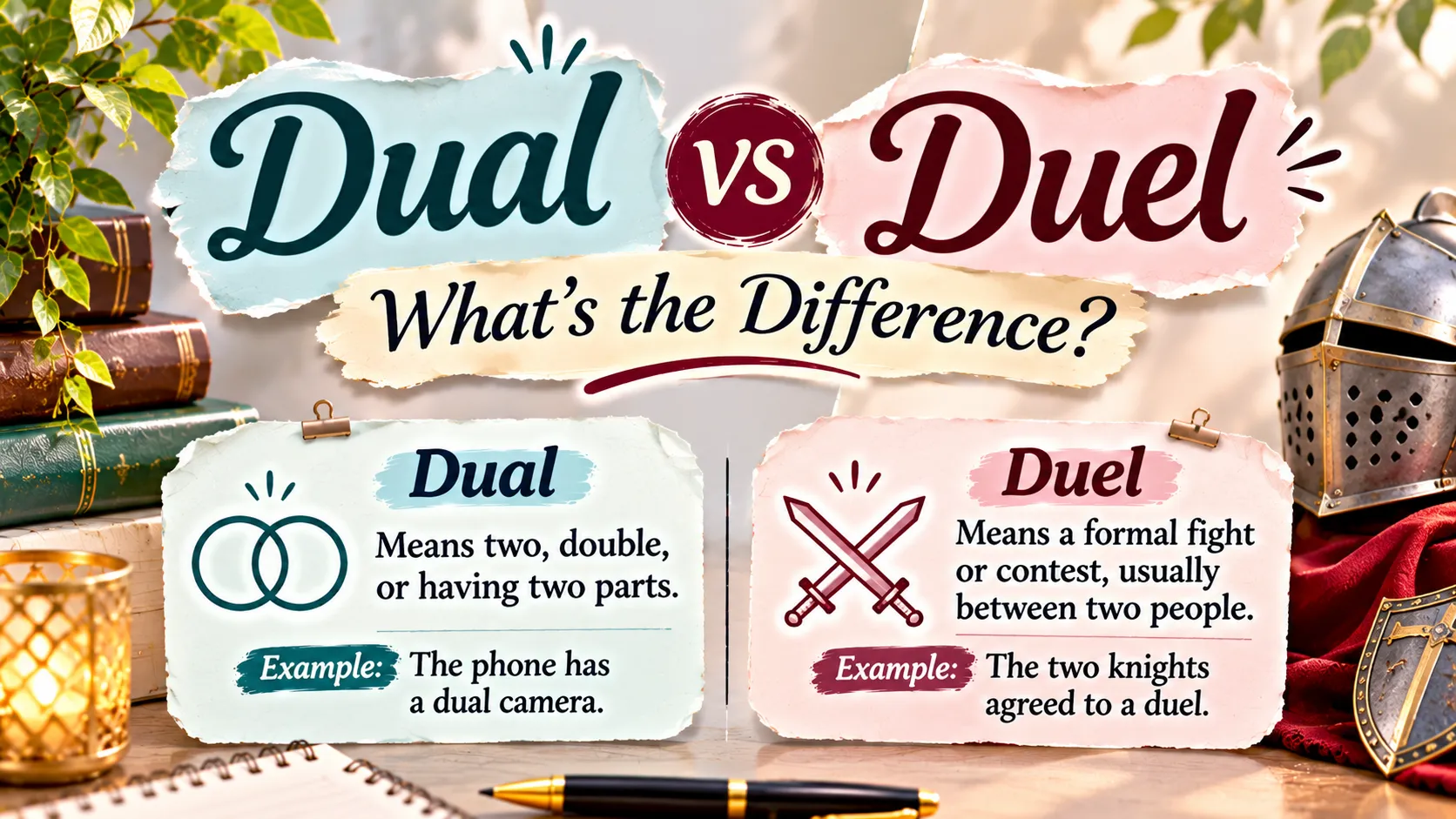
The words “dual” and “duel” sound identical, differ by just one letter, and appear in completely different contexts. The dual vs duel confusion ranks among the most common homophone errors in English writing, appearing in everything from product descriptions to historical accounts and legal documents.
“Dual” is an adjective meaning consisting of two parts, having a double nature, or shared by two. “Duel” is a noun or verb referring to a formal fight between two people, typically with weapons, or a contest between two opponents. These words share identical pronunciation but no shared meaning. This comprehensive guide explains the difference, explores their origins, provides practical examples, and helps you choose the correct word every time you write.
Quick Answer
“Dual” is an adjective meaning having two parts or a double nature, as in “dual citizenship” or “dual-purpose tool.” “Duel” is a noun or verb referring to a formal fight between two people, as in “a duel at dawn” or “they dueled for the championship.” Remember: dual has “u” like “two” (two parts); duel has “e” like “enemy” (a fight). They sound the same but mean completely different things.
Meaning Overview Table
| Aspect | Meaning |
|---|---|
| Definition | Dual: consisting of two parts or having a double nature. Duel: a formal fight or contest between two opponents |
| Pronunciation | Both: /ˈduːəl/ |
| Part of Speech | Dual: adjective. Duel: noun and verb |
| Usage | “Dual monitors” vs. “a duel between rivals” |
| Context | Dual: technology, law, grammar, everyday descriptions. Duel: history, sports, conflict, entertainment |
Main Meaning
Definition
Dual is an adjective meaning consisting of two parts, elements, or aspects; having a double character or purpose; or shared by or involving two people or things. Duel is a noun referring to a formal, prearranged fight between two people, typically with deadly weapons, or a verb meaning to fight in such a contest. The word also extends to any contest or confrontation between two opponents.
Origin
“Dual” comes from the Latin adjective dualis, meaning “relating to two,” from duo (“two”). It entered English in the 16th century and has been used consistently to describe things involving two parts or aspects.
“Duel” comes from the Medieval Latin duellum, a variant of bellum (“war”), possibly influenced by duo (“two”). The word entered English through Old French duel in the 15th century. The original sense referred to a judicial combat or a formal fight between two people to settle a dispute. The meaning extended to any one-on-one contest.
Context
The distinction matters across several contexts:
- Technology: “Dual” describes devices with two components or functions, like dual monitors or dual-core processors
- Law and Government: “Dual” appears in phrases like “dual citizenship” and “dual jurisdiction”
- History: “Duel” appears in accounts of honor disputes and historical combat
- Sports: “Duel” describes one-on-one contests between athletes
- Everyday Writing: Confusing the two creates embarrassing errors in emails, essays, and product descriptions
Modern Usage
Today, “dual” appears constantly in technology, law, and everyday descriptions. Dual monitors, dual cameras, and dual-language programs are common. “Duel” appears less frequently but remains present in historical writing, sports commentary, and entertainment. The phrase “duel to the death” appears in fiction and historical accounts. The confusion between the two persists because they sound identical and spell-check often fails to catch the error.
Detailed Explanation
Literal Meaning
Literally, “dual” means of two. “Duel” literally means a fight between two people. These literal meanings remain the primary definitions of both words.
Common Meaning
Commonly, people use “dual” to describe things with two parts, functions, or purposes. A dual-purpose tool serves two functions. Dual citizenship means citizenship in two countries. They use “duel” to describe a formal fight or a one-on-one contest.
Technical Meaning
In technology, “dual” appears constantly. Dual-core processors have two processing units. Dual-band Wi-Fi operates on two frequency bands. Dual SIM phones hold two SIM cards. Dual monitors extend a computer display across two screens.
Historical Meaning
Historically, “duel” refers to a formal, prearranged fight between two people, typically with pistols or swords, to settle a dispute of honor. Duels were common in Europe and America from the 16th to the 19th centuries. Famous duels, like the Burr-Hamilton duel of 1804, shaped history.
Sports Meaning
In sports, “duel” describes a one-on-one contest or confrontation between two athletes or teams. A pitcher’s duel in baseball describes a game dominated by excellent pitching on both sides. A duel in tennis describes a close match between two players.
Grammatical Meaning
In grammar, “dual” describes a grammatical number form used in some languages to indicate exactly two of something. Ancient Greek, Sanskrit, and Arabic have dual forms.
Examples Table
| Example | Meaning |
|---|---|
| She has dual citizenship in the US and Canada. | Citizenship in two countries |
| The two men fought a duel at dawn. | A formal fight between two people |
| The laptop has dual monitors connected. | Two monitors |
| The tennis match was a thrilling duel. | A one-on-one contest |
| The car has a dual-clutch transmission. | A transmission with two clutches |
| The duel ended with both men wounded. | A formal fight |
| The program offers dual enrollment in high school and college. | Enrollment in two programs |
| The pitcher’s duel lasted nine innings. | A close contest between pitchers |
| The dual-language program teaches in English and Spanish. | Instruction in two languages |
| The rivals dueled for the championship. | Competed one-on-one |
Related Meanings Table
| Related Term | Meaning |
|---|---|
| Dual | Consisting of two parts or having a double nature |
| Duel | A formal fight or one-on-one contest |
| Duo | A pair of two people or things |
| Double | Consisting of two parts; twice as much |
| Duality | The state of having two parts or aspects |
| Dualism | The philosophical view that reality consists of two fundamental elements |
| Duelist | A person who fights in a duel |
| Duplicate | An exact copy; to make an exact copy |
| Duet | A performance by two people |
| Dual-purpose | Serving two functions |
| Dual-core | Having two processing units |
| Dual-band | Operating on two frequency bands |
| Dueling | The act of fighting in a duel |
| Dueled | Past tense of duel |
| Duelling | British spelling of dueling |
Common Uses
People use “dual” and “duel” across numerous contexts:
Technology: “Dual” appears constantly in product descriptions. Dual cameras, dual speakers, dual screens, and dual processors are standard features in modern devices.
Law and Government: “Dual” describes legal arrangements involving two jurisdictions. Dual citizenship, dual taxation, and dual jurisdiction are common legal concepts.
History: “Duel” appears in historical accounts of honor disputes. The Hamilton-Burr duel is a famous example taught in American history.
Sports: “Duel” describes one-on-one contests. Sports commentators describe a pitcher’s duel, a duel between tennis rivals, or a duel between two fighters.
Everyday Descriptions: “Dual” describes things with two purposes. A dual-purpose room serves two functions. A dual-language book presents text in two languages.
Common Mistakes
| Mistake | Correction |
|---|---|
| Writing “duel citizenship” | Write “dual citizenship” (two countries) |
| Writing “dual at dawn” | Write “duel at dawn” (a fight) |
| Writing “dual monitors” as “duel monitors” | Write “dual monitors” (two monitors) |
| Writing “a dual between rivals” | Write “a duel between rivals” (a contest) |
| Writing “duel-core processor” | Write “dual-core processor” (two cores) |
| Writing “dual for the championship” | Write “duel for the championship” (compete) |
| Writing “duel-language program” | Write “dual-language program” (two languages) |
| Writing “the men dualed” | Write “the men dueled” (fought) |
| Assuming spell-check will catch the error | Spell-check often misses homophones; proofread manually |
| Writing “dual-purpose” as “duel-purpose” | Write “dual-purpose” (two functions) |
Related Questions
Is it “dual” or “duel”?
It depends on meaning. Use “dual” for something with two parts or a double nature. Use “duel” for a formal fight or one-on-one contest.
What does “dual” mean?
“Dual” is an adjective meaning consisting of two parts, having a double nature, or shared by two people or things.
What does “duel” mean?
“Duel” is a noun or verb referring to a formal fight between two people, or a one-on-one contest between opponents.
What is the difference between “dual” and “duel” in a sentence?
“Dual” relates to two parts or functions. “Duel” relates to a fight or contest.
Can “duel” be a verb?
Yes. “Duel” functions as a verb meaning to fight in a duel or compete one-on-one. “They dueled for the championship.”
What is “dual citizenship”?
Dual citizenship means holding citizenship in two countries simultaneously.
Why do people confuse “dual” and “duel”?
They sound identical and differ by only one letter. Spell-check often misses homophones, so the error persists in written communication.
FAQs
What does “dual” mean?
“Dual” is an adjective meaning consisting of two parts, having a double nature, or shared by two people or things.
What does “duel” mean?
“Duel” is a noun or verb referring to a formal fight between two people, or a one-on-one contest between opponents.
Is it “dual citizenship” or “duel citizenship”?
The correct phrase is “dual citizenship.” Dual means having two parts.
Is it “duel at dawn” or “dual at dawn”?
The correct phrase is “duel at dawn.” Duel means a formal fight.
Can “dual” be a noun?
No. “Dual” is primarily an adjective, though it can function as a noun in grammar referring to the dual number.
Can “duel” be an adjective?
No. “Duel” is a noun and verb. The adjective form is “dueling” or “duelist.”
How can I remember the difference?
Remember: dual has “u” like “two” (two parts). Duel has “e” like “enemy” (a fight).
What is the origin of “duel”?
“Duel” comes from the Medieval Latin duellum, a variant of bellum (“war”), possibly influenced by duo (“two”).
Conclusion
Mastering the dual vs duel distinction protects your writing from embarrassing homophone errors. “Dual” is an adjective meaning having two parts or a double nature. “Duel” is a noun or verb referring to a formal fight or one-on-one contest. Remember the simple rule: dual has “u” like “two” (two parts); duel has “e” like “enemy” (a fight). Whether you’re writing a product description, a historical account, or a sports report, choosing the correct word ensures your meaning is clear. Practice using “dual” for two parts and “duel” for fights and contests, and your readers will understand exactly what you intend. Small distinctions like this separate careful writers from careless ones.

Natalie Brooks is a content researcher and writer with a strong interest in word meanings, dream interpretations, symbolism, and cultural insights. She is passionate about creating clear, informative, and easy-to-understand content that helps readers discover the deeper meanings behind words, names, dreams, and symbols. Through her work at Meanzly, Natalie aims to make knowledge accessible and valuable for readers around the world.