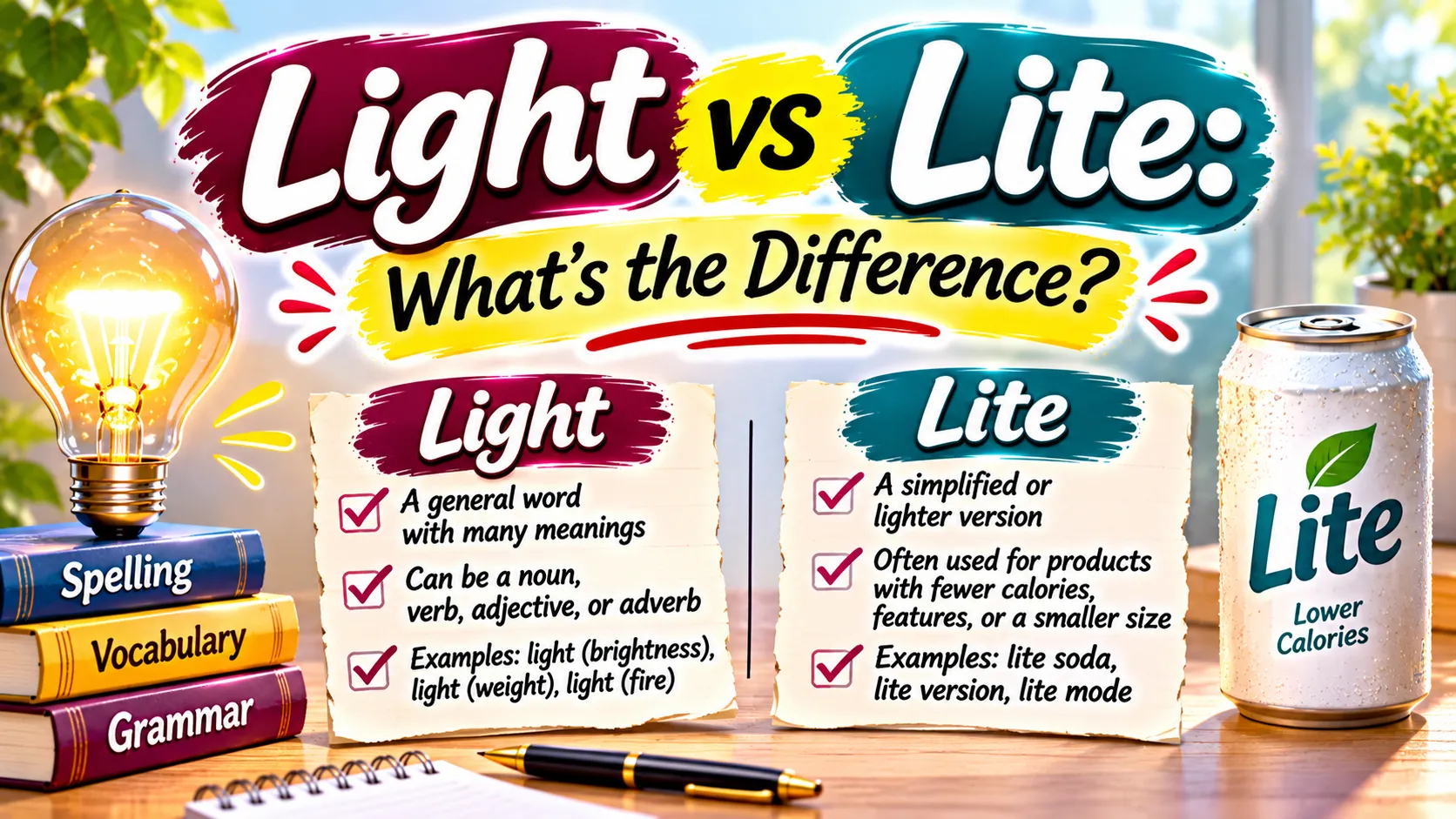
The words “light” and “lite” sound identical and look similar, yet they serve different purposes in English. The light vs lite distinction confuses many writers because both words appear in everyday contexts—from grocery store shelves to beer labels to software descriptions.
“Light” is the standard spelling with a broad range of meanings: illumination, not heavy, pale in color, or a source of fire. “Lite” is an informal, simplified spelling used mainly in marketing to suggest something is lower in calories, fat, or intensity. This comprehensive guide explains the difference, explores their origins, provides practical examples, and helps you choose the correct word every time you write.
Quick Answer
“Light” is the standard spelling for all formal and everyday meanings: illumination, not heavy, pale color, or a flame source. “Lite” is an informal marketing spelling used to suggest something is lighter, lower in calories, or less serious, as in “lite beer” or “lite version.” Remember: light is the standard word; lite is a commercial variant used mainly for products.
Meaning Overview Table
| Aspect | Meaning |
|---|---|
| Definition | Light: standard spelling for illumination, weight, color, and fire. Lite: informal spelling meaning reduced, simplified, or lower in calories |
| Pronunciation | Both: /laɪt/ |
| Part of Speech | Light: noun, adjective, and verb. Lite: adjective |
| Usage | “Turn on the light” vs. “lite beer” |
| Context | Light: standard English, all contexts. Lite: marketing, food labels, software |
Main Meaning
Definition
Light functions as a noun, adjective, and verb. As a noun, it refers to illumination, a source of illumination, or a device that produces light. And
As an adjective, it means not heavy, pale in color, or not serious. As a verb, it means to ignite or illuminate. Lite is an informal adjective meaning reduced in calories, fat, or substance, or simplified in complexity. It appears mainly in product marketing and informal writing.
Origin
“Light” comes from the Old English lēoht, meaning “brightness” or “not heavy.” It has Germanic roots related to German Licht and Dutch licht. The word has been part of English since before the 12th century.
“Lite” is a deliberate respelling of “light,” created for commercial purposes in the 20th century. Food and beverage companies adopted “lite” to suggest reduced calories or fat without making specific health claims. The spelling later spread to software (“lite version”) and informal writing.
Context
The distinction matters across several contexts:
- Formal Writing: “Light” is always correct; “lite” is considered informal
- Food and Beverage: “Lite” appears on labels for reduced-calorie products
- Software and Technology: “Lite” describes free or simplified versions of apps
- Everyday Writing: Confusing the two creates errors in emails, essays, and reports
Modern Usage
Today, “light” appears constantly in all contexts. “Lite” appears mainly in marketing, product labels, and informal descriptions. Some style guides discourage “lite” in formal writing, while others accept it in specific commercial contexts. The confusion persists because the words sound identical and spell-check often fails to catch the error.
Detailed Explanation
Literal Meaning
Literally, “light” means brightness or illumination. “Lite” literally means the same thing but carries an informal, commercial connotation.
Common Meaning
Commonly, people use “light” for illumination, weight, color, and fire. They use “lite” for products marketed as reduced or simplified.
Illumination Meaning
As a noun, “light” refers to visible energy that makes things visible. “Turn on the light.” “The light is bright.” This is the most common meaning.
Weight Meaning
As an adjective, “light” means not heavy. “A light jacket,” “light luggage,” “light as a feather.” The word describes low weight.
Color Meaning
As an adjective, “light” describes pale colors. “Light blue,” “light green,” “light skin.” The word describes low saturation.
Commercial Meaning
“Lite” appears in marketing to suggest reduced calories, fat, or substance. “Lite beer,” “lite mayonnaise,” “lite version.” The spelling signals a commercial product rather than the standard word.
Examples Table
| Example | Meaning |
|---|---|
| Turn on the light. | Illumination |
| This bag is light. | Not heavy |
| She wore a light blue dress. | Pale color |
| He ordered a lite beer. | Reduced-calorie beer |
| The light from the sun is bright. | Illumination |
| The app has a lite version. | Simplified software |
| Light the candle. | Ignite |
| The lite mayonnaise has fewer calories. | Reduced-fat product |
| The room was filled with light. | Illumination |
| The lite edition lacks advanced features. | Simplified edition |
Related Meanings Table
| Related Term | Meaning |
|---|---|
| Light | Standard spelling for illumination, weight, color, and fire |
| Lite | Informal spelling for reduced or simplified products |
| Lighting | The equipment or arrangement of lights |
| Lightweight | Not heavy |
| Daylight | Natural light from the sun |
| Spotlight | A focused beam of light |
| Lighten | To make lighter or brighter |
| Lightly | In a light manner |
| Lite beer | Beer with reduced calories |
| Lite version | Simplified version of software |
| Delight | Great pleasure (contains “light” etymologically) |
| Highlight | To emphasize or mark |
| Flashlight | A portable light source |
| Headlight | A light on the front of a vehicle |
| Nightlight | A small light for nighttime |
Common Uses
People use “light” and “lite” across numerous contexts:
Everyday Speech: “Light” appears constantly in descriptions of illumination, weight, and color. “Turn on the light.” “This box is light.” “She wore a light dress.”
Food and Beverage: “Lite” appears on product labels for reduced-calorie or reduced-fat products. “Lite beer,” “lite yogurt,” “lite salad dressing.”
Software and Technology: “Lite” describes free or simplified versions of apps. “The lite version has limited features.”
Formal Writing: “Light” is always correct. “Lite” is considered informal and should be avoided in academic and professional writing.
Marketing and Advertising: “Lite” signals a product’s reduced or simplified nature. The spelling is deliberately informal to suggest approachability.
Common Mistakes
| Mistake | Correction |
|---|---|
| Writing “lite” for illumination | Write “light” for illumination |
| Writing “light beer” when referring to a branded product | Write “lite beer” for products marketed as reduced-calorie |
| Writing “lite” in formal writing | Write “light” in formal contexts |
| Writing “turn on the lite” | Write “turn on the light” |
| Writing “the lite is bright” | Write “the light is bright” |
| Writing “light version” when describing software | Write “lite version” for simplified software |
| Writing “lite blue” | Write “light blue” (pale color) |
| Writing “lite jacket” | Write “light jacket” (not heavy) |
| Assuming spell-check will catch the error | Spell-check often misses homophones; proofread manually |
| Using “lite” for non-commercial meanings | Use “light” for standard meanings |
Related Questions
Is it “light” or “lite”?
Use “light” as the standard spelling for all formal and everyday meanings. Use “lite” only for products marketed as reduced or simplified.
What does “light” mean?
“Light” refers to illumination, not heavy, pale color, or a source of fire. It functions as a noun, adjective, and verb.
What does “lite” mean?
“Lite” is an informal spelling meaning reduced in calories, fat, or substance, or simplified in complexity. It appears mainly in marketing.
What is the difference between “light” and “lite” in a sentence?
“Light” is the standard word for illumination, weight, and color. “Lite” is used for commercial products and simplified versions.
Can “lite” be used in formal writing?
No. “Lite” is considered informal and should be avoided in academic and professional writing.
Is “lite” a real word?
“Lite” appears in dictionaries as an informal variant of “light,” used mainly in commercial contexts.
Why do companies use “lite”?
Companies use “lite” to suggest reduced calories or fat without making specific health claims. The informal spelling also signals approachability.
How can I remember the difference?
Remember: “lite” is a marketing spelling—use it only for commercial products. “Light” is the standard spelling for everything else.
FAQs
What does “light” mean?
“Light” refers to illumination, not heavy, pale color, or a source of fire. It functions as a noun, adjective, and verb.
What does “lite” mean?
“Lite” is an informal spelling meaning reduced in calories, fat, or substance, or simplified in complexity. It appears mainly in marketing.
Is it “light beer” or “lite beer”?
Both appear, but “lite beer” is common for products marketed as reduced-calorie. “Light beer” also appears and is standard in formal writing.
Is it “light version” or “lite version”?
“Lite version” is common for software. “Light version” also appears but is less common in commercial contexts.
Can “lite” mean “not heavy”?
“Lite” sometimes appears as an informal spelling for “not heavy,” but “light” is standard in all formal contexts.
Is “lite” acceptable in academic writing?
No. “Lite” is informal and should be avoided in academic and professional writing. Use “light” instead.
Why do people confuse “light” and “lite”?
They sound identical and look similar. Marketing use of “lite” has made the spelling familiar, leading to confusion in other contexts.
What is the origin of “lite”?
“Lite” is a deliberate respelling of “light,” created for commercial purposes in the 20th century to suggest reduced or simplified products.
Conclusion
Mastering the light vs lite distinction protects your writing from informal spelling errors. “Light” is the standard spelling for illumination, weight, color, and fire. “Lite” is an informal marketing spelling used for reduced-calorie products and simplified software. Remember the simple rule: use “light” in all standard contexts; use “lite” only for commercial products. Whether you’re writing an email, an essay, or a product description, choosing the correct word ensures your meaning is clear and your writing looks professional. Practice using “light” for standard meanings and “lite” for marketing contexts, and your readers will understand exactly what you intend. Small distinctions like this separate careful writers from careless ones.

Natalie Brooks is a content researcher and writer with a strong interest in word meanings, dream interpretations, symbolism, and cultural insights. She is passionate about creating clear, informative, and easy-to-understand content that helps readers discover the deeper meanings behind words, names, dreams, and symbols. Through her work at Meanzly, Natalie aims to make knowledge accessible and valuable for readers around the world.









