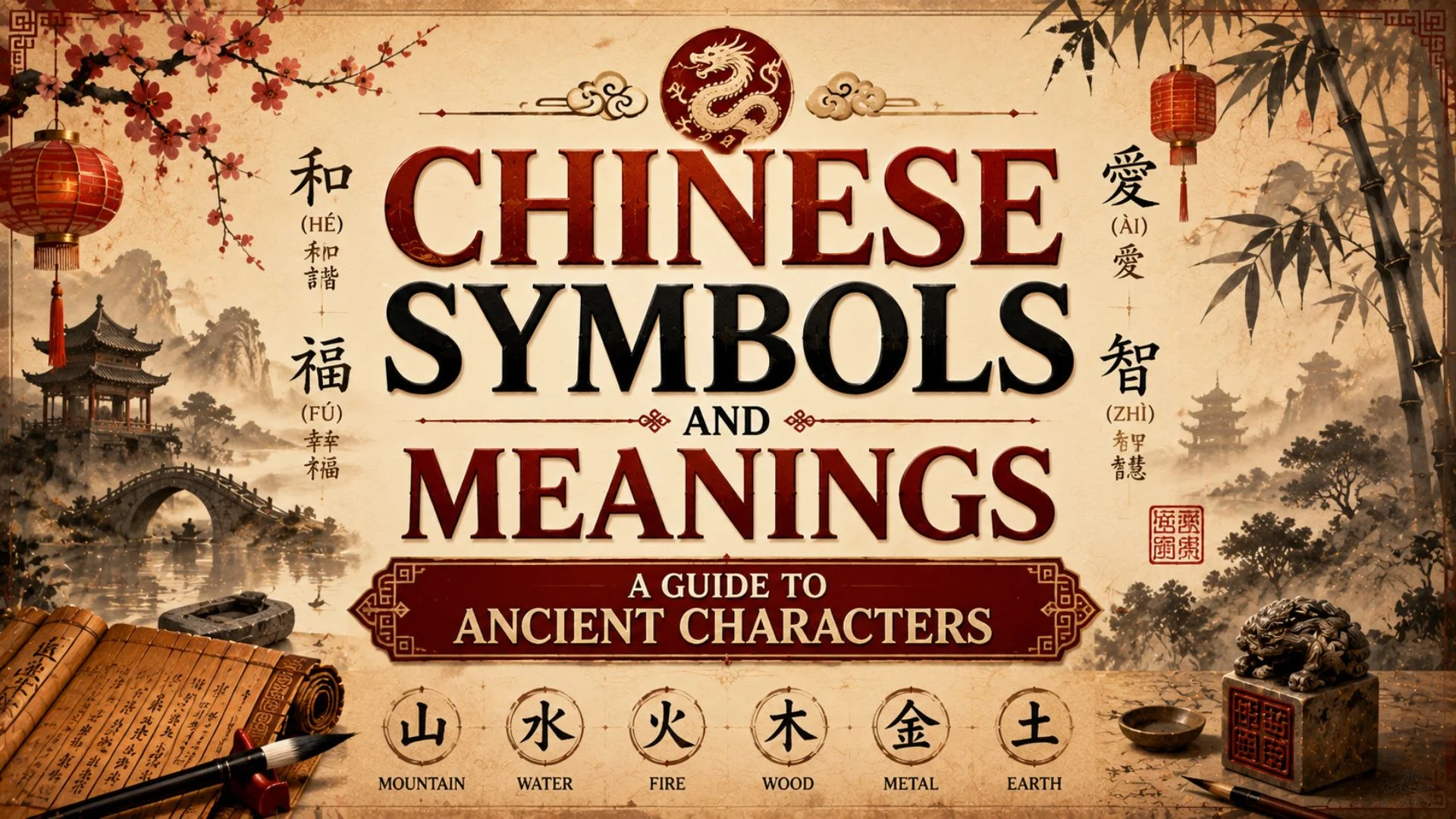
Chinese symbols represent one of the oldest continuously used writing systems in human history, with origins dating back over three thousand years to the Shang dynasty’s oracle bone script. Unlike alphabetic languages, Chinese symbols and meanings are deeply rooted in visual representation, where each character can tell a story, convey a wish, or represent an entire concept through its form and composition. From the powerful dragon symbolizing imperial strength to the humble bat representing good fortune, these characters carry centuries of cultural wisdom. Today, people around the world wear Chinese symbols as tattoos, display them in homes, and incorporate them into art and design. Understanding their true meanings ensures you use them appropriately and avoid cultural misunderstandings. This comprehensive guide explores the rich world of Chinese symbols, their hidden meanings, and how to appreciate them respectfully.
Quick Answer
Chinese symbols and meanings refer to the visual characters and motifs used in Chinese culture to convey ideas, wishes, and beliefs. Popular symbols include the dragon (power), phoenix (renewal), double happiness (marriage), fu (good fortune), and yin-yang (balance). Each symbol carries deep cultural significance rooted in thousands of years of tradition, philosophy, and folklore. Understanding these meanings helps people use Chinese symbols appropriately in tattoos, decor, and daily life.
Meaning Overview Table
| Aspect | Meaning |
|---|---|
| Definition | Visual characters and motifs from Chinese culture that convey ideas, wishes, and beliefs |
| Pronunciation | CHY-neez SIM-buhls and MEEN-ings |
| Part of Speech | Noun phrase |
| Usage | “Before getting a Chinese symbol tattoo, research the Chinese symbols and meanings to avoid cultural missteps.” |
| Context | Tattoo art, home decor, Chinese calligraphy, cultural studies, feng shui, and gift-giving |
Main Meaning
Definition
Chinese symbols and meanings encompass the vast array of characters, motifs, and visual representations used throughout Chinese history to communicate ideas, express wishes, and convey cultural values. These symbols appear in writing, art, architecture, clothing, and ceremonial objects. Each symbol carries layers of meaning that often extend beyond its literal translation to include cultural associations, homophonic puns, and philosophical depth .
Origin
Chinese characters originated from oracle bone script during the Shang dynasty (c. 1600–1046 BCE). Priests carved these symbols onto turtle shells and animal bones for divination purposes . Over millennia, the script evolved through several stages: bronze script, seal script, clerical script, and finally the standard script used today . Many symbols also derive from folk traditions, Taoist and Buddhist iconography, and imperial symbolism .
Context
The meaning of Chinese symbols depends heavily on context. A symbol like the dragon represents imperial power when associated with the emperor but symbolizes good fortune and rain when used in folk contexts. The same character can have different connotations in calligraphy, tattoo art, or everyday writing. Understanding the cultural background and proper usage prevents misinterpretation.
Modern Usage
Today, people use Chinese symbols globally in tattoos, home decor, fashion, and branding. Many choose characters like 爱 (love) or 福 (fortune) for personal expression. Others incorporate symbolic motifs like dragons, phoenixes, and lotus flowers into jewelry and artwork. However, the growing popularity also leads to misuse and misunderstanding, making it essential to research thoroughly before adopting Chinese symbols.
Detailed Explanation
Literal Meaning
Literally, Chinese symbols are logographic characters where each symbol represents a word or morpheme. For example, the character 火 means “fire” and visually resembles flames. The literal meaning forms the foundation upon which symbolic and cultural meanings build.
Common Meaning
Commonly, people use Chinese symbols to express wishes for good fortune, happiness, longevity, and prosperity. The character 福 (fú) appears everywhere during Chinese New Year, often displayed upside down to mean “good fortune has arrived.” The double happiness symbol 喜喜 graces weddings, representing marital joy and unity.
Text Meaning
In written Chinese, symbols function as everyday language. Each character contributes to sentences, poems, and stories. The symbolic meanings often emerge through literary usage, classical texts, and idiomatic expressions that have shaped Chinese culture for centuries.
Slang Meaning
Some Chinese symbols take on slang or informal meanings in modern usage. For instance, the character 囧 (jiǒng), originally meaning “light,” now appears online as an emoji-like symbol representing an embarrassed or awkward expression due to its resemblance to a face.
Internet Meaning
Online, Chinese symbols appear in memes, social media posts, and digital art. Emojis like 🀄 (mahjong tile) represent China in internet culture. The character 666 (liùliùliù), pronounced like “smooth” in Chinese slang, means “awesome” or “well done” in online gaming communities.
Social Media Meaning
On social media platforms, people use Chinese symbols to showcase cultural pride, share aesthetic posts, or convey philosophical messages. Popular hashtags like #中国风 (Chinese style) accompany posts featuring calligraphy, traditional motifs, and cultural symbols. Influencers often incorporate characters into their branding.
Cultural Meaning
Culturally, Chinese symbols carry profound philosophical and spiritual weight. The yin-yang symbol represents cosmic duality and balance. The dragon embodies yang energy, power, and the emperor. The phoenix represents yin energy, rebirth, and the empress. These symbols connect to Taoist, Confucian, and Buddhist thought, reflecting the core values of Chinese civilization.
Examples Table
| Symbol | Meaning |
|---|---|
| 福 (fú) | Good fortune, blessing, happiness; often displayed upside down at New Year |
| 爱 (ài) | Love, affection, compassion; a common choice for tattoos |
| 囍 (shuāng xǐ) | Double happiness; used in weddings to represent marital joy |
| 龙 (lóng) | Dragon; symbol of power, strength, and good luck in Chinese culture |
| 凤 (fèng) | Phoenix; symbol of rebirth, renewal, and feminine energy |
| 寿 (shòu) | Longevity; represents a long and healthy life |
| 和 (hé) | Peace, harmony; central to Confucian philosophy |
| 马 (mǎ) | Horse; represents speed, perseverance, and success |
| 竹 (zhú) | Bamboo; symbolizes resilience, flexibility, and integrity |
| 莲 (lián) | Lotus; represents purity, spiritual awakening, and beauty arising from mud |
| 鹤 (hè) | Crane; symbolizes longevity, wisdom, and immortality |
| 鱼 (yú) | Fish; represents abundance and surplus because it sounds like “extra” |
| 蝙蝠 (biānfú) | Bat; symbolizes good fortune because “bat” sounds like “blessing” in Chinese |
| 桃 (táo) | Peach; represents longevity and immortality in Taoist tradition |
| 松 (sōng) | Pine tree; symbolizes endurance, steadfastness, and longevity |
Related Meanings Table
| Related Term | Meaning |
|---|---|
| Dragon (龙) | Imperial power, yang energy, rain, good fortune |
| Phoenix (凤) | Renewal, rebirth, yin energy, the empress |
| Yin-Yang (阴阳) | Balance, duality, cosmic harmony |
| Fu (福) | Good fortune, blessing, happiness |
| Double Happiness (囍) | Marital joy, unity, celebration |
| Longevity (寿) | Long life, health, vitality |
| Bamboo (竹) | Resilience, flexibility, integrity |
| Lotus (莲) | Purity, spiritual awakening, beauty |
| Crane (鹤) | Longevity, wisdom, immortality |
| Fish (鱼) | Abundance, prosperity, surplus |
| Bat (蝠) | Good fortune, blessings |
| Peach (桃) | Longevity, immortality |
| Pine (松) | Endurance, steadfastness |
| Orchid (兰) | Elegance, refinement, noble character |
| Chrysanthemum (菊) | Autumn, longevity, perseverance |
| Plum Blossom (梅) | Resilience, beauty in adversity |
| Tiger (虎) | Bravery, protection, power |
| Monkey (猴) | Intelligence, cleverness, promotion |
| Gourd (葫芦) | Good health, protection, fertility |
| Coin (钱) | Wealth, prosperity, good fortune |
Common Uses
People use Chinese symbols in various aspects of daily life and special occasions:
Tattoos: Many individuals choose Chinese characters for their aesthetic appeal and profound meanings. Popular choices include 爱 (love), 勇 (courage), 信 (faith), and 和平 (peace). However, getting a Chinese symbol tattoo requires careful research to ensure accuracy.
Home Decor: Chinese symbols appear on wall hangings, scrolls, and decorative items. The character 福 hangs upside down during New Year to invite good fortune. Calligraphy art featuring poems or auspicious phrases adorns many homes.
Weddings: The double happiness symbol 囍 features prominently at Chinese weddings on invitations, decorations, and wedding favors. It represents the union of two families and the joy of marriage.
Festivals: Chinese New Year celebrations feature symbols like 福, 春 (spring), and 年年有余 (abundance year after year). Mid-Autumn Festival incorporates symbols like the moon and rabbits.
Feng Shui: Practitioners place specific symbols in homes and offices to attract positive energy. Dragons, phoenixes, and coins balance energy and bring prosperity.
Gift-Giving: People give gifts featuring auspicious symbols for birthdays, weddings, and other celebrations. Longevity symbols suit recipients, while double happiness fits newlyweds.
Branding and Fashion: Designers incorporate Chinese symbols into logos, clothing, and accessories. Luxury brands often use dragon motifs to convey power and prestige.
Common Mistakes
| Mistake | Correction |
|---|---|
| Getting a Chinese character tattoo without verifying its meaning | Always check with native speakers or professional calligraphers |
| Displaying a symbol upside down unintentionally | Understand the correct orientation; some symbols like 福 are intentionally displayed upside down |
| Confusing simplified and traditional characters | Traditional characters suit cultural contexts; simplified characters are modern |
| Assuming all Chinese symbols are interchangeable | Each symbol has specific meaning and usage |
| Using a symbol meant for mourning in a celebratory context | Research the cultural associations of each symbol |
| Mixing incompatible symbols in the same design | Ensure symbols complement each other thematically |
| Ignoring stroke order when writing characters | Correct stroke order matters for aesthetic and traditional reasons |
| Using a symbol with negative connotations unintentionally | Research potential slang or secondary meanings |
| Assuming a symbol means the same in all dialects | Some symbols have different pronunciations and associations |
| Copying a symbol without understanding its cultural significance | Respect the cultural depth behind each character |
Related Questions
What does the Chinese dragon symbolize?
The Chinese dragon symbolizes power, strength, and good fortune. Unlike Western dragons, Chinese dragons are benevolent creatures associated with rain, water, and imperial authority. They represent yang energy and rank as one of the most revered symbols in Chinese culture.
What does the double happiness symbol mean?
The double happiness symbol 囍 consists of two joined characters meaning happiness. It represents marital joy, unity, and celebration. You will see it predominantly at weddings and on items associated with marriage.
What is the most popular Chinese symbol for a tattoo?
The character 爱 (love) and 福 (fortune) rank among the most popular choices. Others include 勇 (courage), 信 (faith), and 和 (peace). However, people should always verify meanings with native speakers before committing to permanent ink.
What does the yin-yang symbol represent?
The yin-yang symbol represents the duality and balance of opposing forces in the universe. Yin (dark) and yang (light) are complementary, interconnected, and constantly transforming. This concept is central to Taoist philosophy.
What does the lotus flower symbolize in Chinese culture?
The lotus flower symbolizes purity, spiritual awakening, and beauty arising from adverse conditions. It grows from muddy water yet blooms immaculately, making it a powerful symbol of resilience and enlightenment in Chinese culture.
FAQs
What is the Chinese symbol for good luck?
The symbol 福 (fú) is the primary character for good fortune and blessing. People often display it upside down during Chinese New Year, which sounds like “good fortune has arrived” in Chinese.
What does the Chinese phoenix symbolize?
The phoenix 凤 (fèng) symbolizes renewal, rebirth, and feminine energy. Paired with the dragon, it represents marital harmony and imperial authority.
What does the bamboo symbolize in Chinese culture?
Bamboo 竹 (zhú) symbolizes resilience, flexibility, and integrity. Its hollow interior represents humility, and its joints represent strength. It is one of the “Four Gentlemen” in Chinese art.
What color is most auspicious in Chinese symbolism?
Red is the most auspicious color in Chinese culture. It symbolizes happiness, good fortune, and celebration. You see it prominently at weddings, New Year festivities, and other joyful occasions.
What does the fish symbolize in Chinese culture?
The fish 鱼 (yú) represents abundance and prosperity. Its name sounds like “surplus,” so it often appears in sayings and decorations wishing for excess wealth.
What does the crane symbolize?
The crane 鹤 (hè) symbolizes longevity, wisdom, and immortality. It often appears alongside the pine tree and peach to convey wishes for a long and healthy life.
What does the number 8 symbolize in Chinese culture?
The number 8 symbolizes prosperity and good fortune because its pronunciation sounds like “wealth” in Chinese. People often choose phone numbers and license plates containing 8 for this reason.
What are the “Four Gentlemen” in Chinese symbolism?
The Four Gentlemen are plum blossom, orchid, bamboo, and chrysanthemum. Each represents a season and admirable human qualities—resilience, refinement, integrity, and perseverance.
Conclusion
Chinese symbols and meanings offer a fascinating window into one of the world’s oldest continuous civilizations. Each character and motif carries centuries of cultural wisdom, philosophical depth, and artistic beauty. From the powerful dragon to the humble lotus, these symbols connect people to Chinese heritage and universal human values. Understanding their true meanings ensures you use them respectfully and accurately. Whether you are choosing a tattoo, decorating your home, or simply appreciating Chinese culture, take time to research and understand the symbols you use. They are not mere decoration—they are living connections to a rich cultural legacy spanning thousands of years. Treat them with the respect they deserve, and they will enrich your life with their profound beauty and meaning.

Natalie Brooks is a content researcher and writer with a strong interest in word meanings, dream interpretations, symbolism, and cultural insights. She is passionate about creating clear, informative, and easy-to-understand content that helps readers discover the deeper meanings behind words, names, dreams, and symbols. Through her work at Meanzly, Natalie aims to make knowledge accessible and valuable for readers around the world.