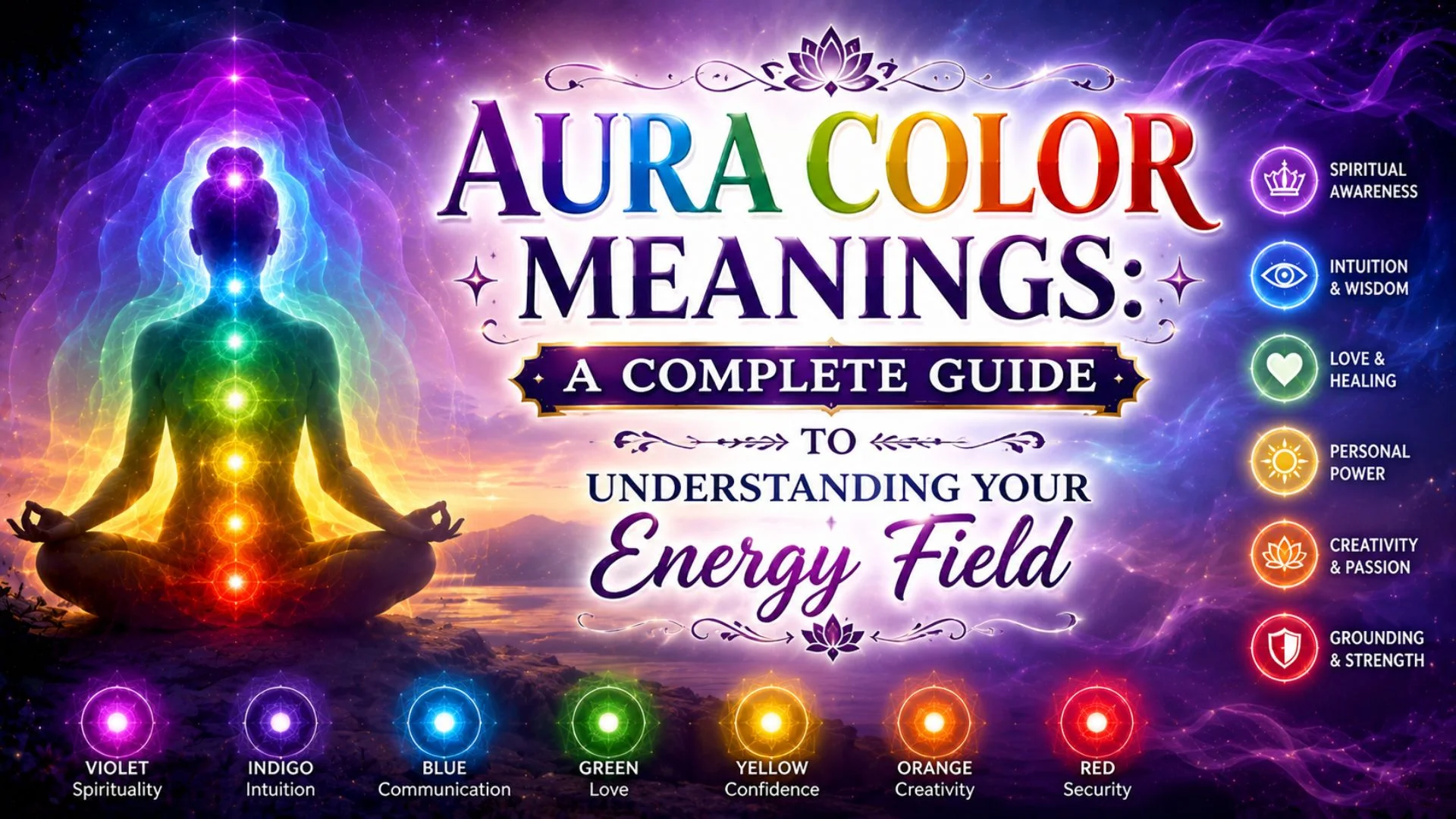
Have you ever walked into a room and instantly felt a “good vibe” from someone, or felt drained after spending time with a particular person? Many believe this is the energy of your aura at work. An aura is the invisible electromagnetic field that surrounds every living being. This energy field, which extends around the body, reflects your physical, emotional, and spiritual state. Understanding aura color meanings can help you better understand yourself, your emotions, and the people around you.
The concept of the human aura has roots in ancient spiritual traditions. However, in the modern world, interest in auras has grown significantly, often linked to chakras, energy healing, and personal development. Each aura color, from a vibrant red to a serene blue, carries a specific meaning about your personality and current state of being. While auras are a mix of colors, one shade is usually more dominant. This guide explores the comprehensive spectrum of aura color meanings, from bright primary colors to rare shades like gold and white.
Quick Answer
Aura color meanings refer to the symbolic interpretation of the colors in a person’s energetic field. Red indicates passion and energy; orange represents creativity and social connection; yellow signals optimism and confidence; green shows a loving, healing nature; blue indicates calmness and intuition; purple signifies a strong spiritual connection; white is a rare color of purity; and black often points to exhaustion or unhealed trauma.
Meaning Overview Table
| Aspect | Meaning |
|---|---|
| Definition | The symbolic significance of the colors seen in a person’s aura or energy field |
| Pronunciation | OR-uh KUHL-er MEEN-ings |
| Part of Speech | Noun phrase |
| Usage | “People often consult aura color meanings to better understand their emotional state and spiritual well-being.” |
| Context | Spiritual development, energy healing, chakras, personal growth |
Main Meaning
Definition
Aura color meanings are the spiritual and psychological interpretations assigned to the colors of a person’s energy field. The aura is the “vibration we are at,” a reflection of our feelings, traumas, and spiritual level. While every aura is unique and changes over time, a dominant color often indicates core personality traits and current emotional states.
Origin
The belief in a human energy field is ancient, appearing in traditions like Hinduism and Buddhism, often linked to chakras. The modern concept of the aura—an electromagnetic field with specific colors carrying meanings—gained traction in the late 19th and 20th centuries through theosophical and New Age movements. The aura is connected to the chakra system; each chakra is associated with a color, which can help when deciphering your aura.
Context
Context is crucial when interpreting aura colors. A bright, clear color generally signifies a positive, balanced state. Meanwhile, a muddy, murky, or dark version of the same color often indicates a blockage, negative emotion, or imbalance. For example, bright, emerald green in an aura suggests a healer’s energy, whereas dark, muddy green can indicate jealousy or insecurity.
Modern Usage
Today, people use aura color meanings widely in spiritual and wellness communities. People explore their auras to understand their strengths, weaknesses, and emotional patterns, and to seek balance in their lives. The concept has also crossed over into pop culture; interpretations of aura colors guide fashion, beauty trends like “aura nails,” and even social media aesthetics.
Detailed Explanation
Literal Meaning
Literally, an aura is an electromagnetic field of energy that surrounds the physical body, extending two to three feet or more. The colors within this field are believed to reflect the vibratory rate of your thoughts, emotions, and spirit. A person’s aura can change rapidly, shifting colors depending on mood. Auras can also be used for healing and protection; for example, flooding your aura with white and violet rays can clear negative thoughts.
Common Meaning
Commonly, people understand aura colors as a reflection of their personality and emotional state. A red aura indicates you’re fiery and energetic, while a blue aura suggests you’re calm and insightful. People often describe the colors using adjectives like “sunny,” “passionate,” or “intuitive.”
Text Meaning
In written and online content, “aura color meanings” refers to the vast library of articles, blog posts, and social media infographics decoding these energetic colors. These resources serve as guides for those wanting to interpret their own energy or understand others better.
Slang Meaning
In slang, “aura points” or “having a good aura” describes someone’s vibe or charisma—drawing on the idea that an attractive or positive personality shines through their energy field. However, this usage often simplifies the concept.
Internet Meaning
Online, the concept of aura color meanings has become a popular trend. People are interested in discovering their aura’s color through guides or apps. Social media platforms showcase “aura photography,” where cameras produce an image that claims to show your aura’s colors.
Social Media Meaning
On social media, people use aura color meanings as a tool for self-expression. Users might create content based on their aura’s color, using it to explain their personality or mood.
Cultural Meaning
Some people view auras through a metaphysical lens, while others interpret them as a psychological metaphor for emotional states. People use the concept in modern wellness to promote self-care, mindfulness, and balance.
Examples Table
| Example | Meaning |
|---|---|
| Seeing a bright, clear red aura | The person is energetic, grounded, and passionate |
| A muddy, dark red aura | The person may be struggling with anger or unresolved trauma |
| An orange aura with a yellow tint | The person is creative, intelligent, and detail-oriented |
| A bright, sunny yellow aura | The person is optimistic, charismatic, and has high self-esteem |
| A bright emerald green aura | The person is a natural healer who is love-centered |
| A dark, muddy green aura | The person may be experiencing jealousy or insecurity |
| A beautiful light blue aura | The person is peaceful, truthful, and intuitive |
| A dark blue or indigo aura | The person is highly intuitive, sensitive, and may be an empath |
| A purple/violet aura | The person is visionary, artistic, and spiritually connected |
| A rare white aura | The person has a very pure, wise, and spiritually connected nature |
Related Meanings Table
| Related Term | Meaning |
|---|---|
| Red | Physical energy, passion, strength, anger, survival, grounded |
| Pink | Kindness, caring, tenderness, love, gentleness, artistic nature |
| Magenta | Non-conformist, creative, free-spirited, eccentric, innovative |
| Orange | Creativity, action, social connection, adventure, good health |
| Yellow | Joy, optimism, charisma, confidence, analytical thinking, fun-loving |
| Green | Love, compassion, healing, balance, growth, nature-loving |
| Blue | Calm, clarity, intuition, truthfulness, loyalty, compassion |
| Indigo | High intuition, sensitivity, empathy, spirituality, enlightened |
| Violet/Purple | Intuition, vision, leadership, charisma, strong spiritual connection |
| Lavender | Imagination, visionary, daydreaming, etheric, enchanting |
| Gold | Enlightenment, divine protection, spiritual energy, wisdom |
| Silver | Abundance, cosmic awakening, intuition, nurturing |
| White | Purity, truth, spiritual transcendence, angelic qualities |
| Black | Exhaustion, protection, unhealed trauma, grief |
| Gray | Fear, sadness, exhaustion, guardedness, low energy |
| Brown | Insecurity, greed, imbalance, stagnation |
| Rainbow | Busy period of change, high energy, spiritual openness |
Common Uses
People most commonly use aura color meanings in spiritual and wellness practices. People often see aura readers or use photography to understand their energy field. In energy healing practices like Reiki, practitioners visualize colors to promote well-being. Aura color meanings also guide personal meditation; visualizing a color can help achieve a desired mental state. In modern wellness, people use aura colors for self-reflection and mindfulness. The concept has also become a popular form of self-expression in fashion and beauty.
Common Mistakes
| Mistake | Correction |
|---|---|
| Believing an aura is only one color | Auras are usually a mix of multiple colors, with one dominant |
| Assuming all red auras mean the same thing | Bright red shows energy; muddy red indicates anger or trauma |
| Misinterpreting a dark green aura as purely negative | It can indicate jealousy or insecurity, but also the need for healing and balance |
| Confusing a white aura with a blank or “no color” aura | White is a rare color indicating a very pure and spiritually connected soul |
| Thinking aura colors are fixed permanently | Auras constantly shift and change with your moods and life experiences |
| Confusing black aura with evil or darkness | Black usually indicates exhaustion, depletion of energy, or a need for grounding, but can also mean protection |
| Assuming a blue aura always means you’re calm | While often calm, blue can also indicate a tendency to be moody or overthink |
| Forgetting the importance of shade and clarity | A clear, bright color is positive; a muddy one suggests negativity or blockage |
| Assuming all purple auras have the same meaning | Purple can mean physical attraction (muddy) or high spiritual wisdom (clear) |
| Thinking an aura is purely visible | Many cannot see auras but can sense them as “vibes” or feelings |
Related Questions
What does a red aura mean?
A red aura is connected to the root chakra and indicates a person who is grounded, energetic, and passionate. They are bold, fearless, and experience the world through action and touch. A muddy red can suggest burnout or unresolved anger.
What does a blue aura mean?
People with blue auras are naturally good communicators and are often insightful and philosophical.
What does a purple aura mean?
The crown chakra connects to a purple, or violet, aura, which symbolizes a strong spiritual connection, intuition, and vision. People with purple auras are often charismatic leaders and visionaries.
What does a green aura mean?
A green aura is connected to the heart chakra and represents love, compassion, and healing. People with green auras are nurturing, balanced, and often have a healing nature.
What is the rarest aura color?
White is the rarest aura color. It indicates a person who is very pure, wise, and spiritually connected, someone who may have “transcended the limitations of the physical realm.”
How do I find out my aura color?
Some people see auras naturally, while others learn through meditation and practice. You can also use aura photography to capture an image of your energy field. Many online guides and quizzes offer a fun way to explore your aura color.
FAQs
What is an aura?
An aura is the invisible electromagnetic field of energy that surrounds every living being. It reflects your physical, emotional, and spiritual state.
What does a white aura mean?
A white aura is rare and indicates a person is in a state of “pure and unconditional love,” possessing a very strong spiritual connection. It is a sign of great spiritual attainment.
What does a pink aura mean?
People with pink auras are generally very caring, gentle, and have a healing presence.
What does an orange aura mean?
An orange aura is connected to the sacral chakra and represents creativity, passion, sociability, and a sense of adventure. People with orange auras often hold relationships in high regard.
What does a yellow aura mean?
A yellow aura is associated with the solar plexus chakra and represents happiness, optimism, charisma, and confidence. People with yellow auras are often natural leaders with high self-esteem.
What does a black aura mean?
A black aura isn’t a color of the aura, but a sign of depletion. It typically points to feelings of exhaustion, fatigue, and being burnt out, or it can indicate a lack of forgiveness.
What is the most common aura color?
Blue is one of the most common aura colors, along with green and yellow. These colors reflect a need for peace and personal growth.
Conclusion
Understanding aura color meanings offers a unique and insightful way to connect with your emotional, mental, and spiritual well-being. Far from being a fixed characteristic, your aura is a dynamic and ever-changing reflection of your thoughts, feelings, and state of being. By learning to interpret the colors in your energy field—whether a vibrant red of passion, a calming blue of intuition, or a rare white of spiritual purity—you can gain a deeper understanding of yourself. Auras provide valuable insight into your personality and can help guide you towards greater balance and harmony in your life.

Natalie Brooks is a content researcher and writer with a strong interest in word meanings, dream interpretations, symbolism, and cultural insights. She is passionate about creating clear, informative, and easy-to-understand content that helps readers discover the deeper meanings behind words, names, dreams, and symbols. Through her work at Meanzly, Natalie aims to make knowledge accessible and valuable for readers around the world.