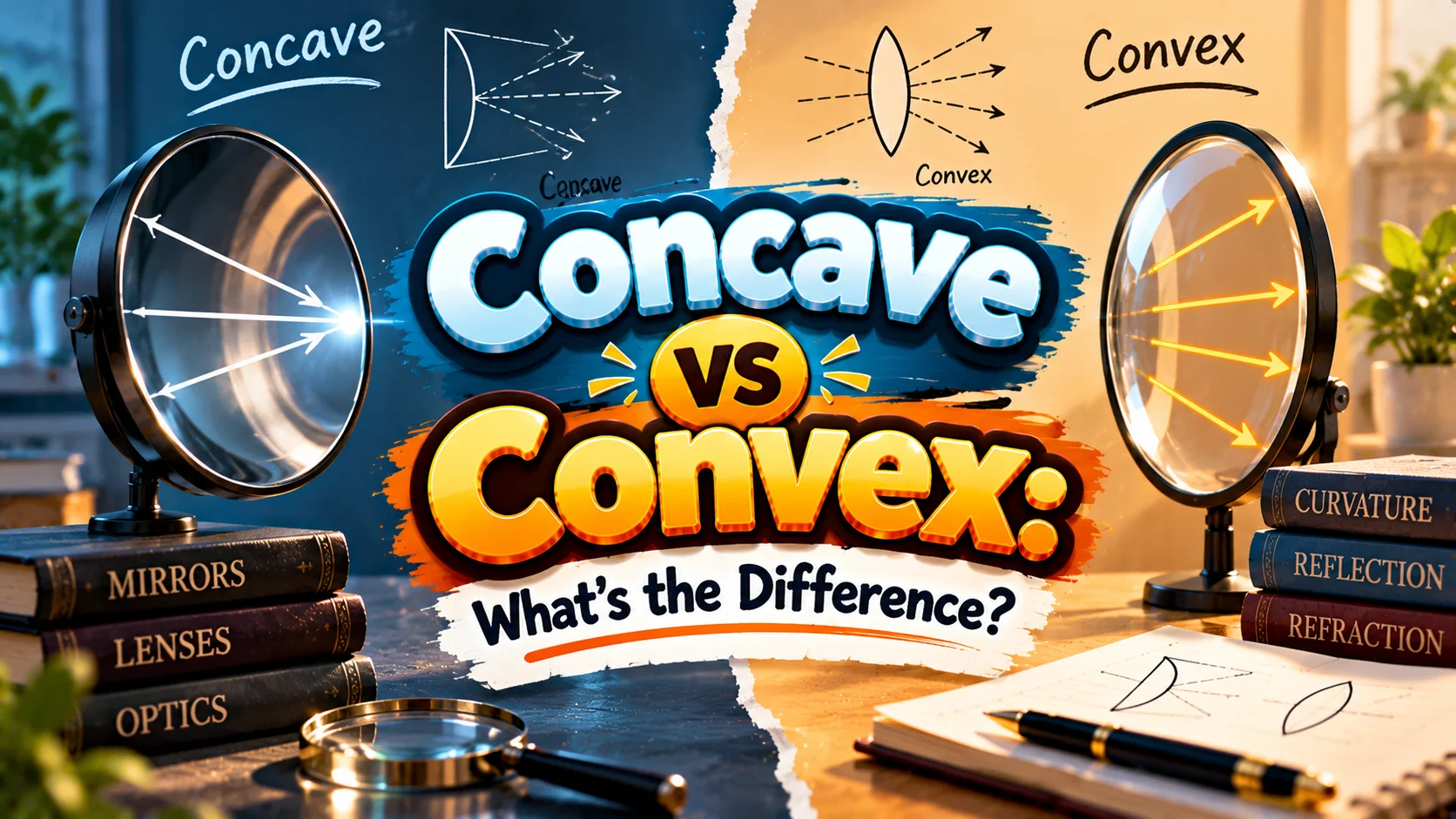
The terms “concave” and “convex” describe curved surfaces, and understanding the concave vs convex distinction is essential in physics, mathematics, and everyday life. These two words look similar and sound somewhat alike, yet they describe opposite shapes with opposite effects on light, sound, and even how we perceive the world through mirrors and lenses.
Concave surfaces curve inward like the inside of a cave, while convex surfaces bulge outward like the outside of a sphere . This simple difference determines how mirrors reflect light, how lenses bend it, and how shapes behave in geometry. From the rearview mirrors in your car to the lenses in your glasses, concave and convex shapes shape the technology and tools we use daily. This comprehensive guide breaks down the difference with clear rules, practical examples, and memory tricks to help you master this fundamental concept.
Quick Answer
The difference between concave and convex comes down to curvature direction. A concave surface curves inward like a cave, bowl, or the inside of a spoon—it “caves in.” A convex surface curves outward like the outside of a ball or the back of a spoon—it bulges out . Remember: concave has “cave” in it, and caves go inward. Convex rhymes with “flex,” and flexing makes muscles bulge outward.
Meaning Overview Table
| Aspect | Meaning |
|---|---|
| Definition | Two terms describing curved surfaces: concave curves inward, convex curves outward |
| Pronunciation | Concave: KON-kayv; Convex: KON-veks |
| Part of Speech | Both are adjectives (can also function as nouns in optics) |
| Usage | “A concave lens diverges light” vs. “A convex lens converges light” |
| Context | Physics, optics, geometry, mathematics, everyday objects |
Main Meaning
Definition
Concave describes a surface that curves inward, creating a hollow or depression. The middle of a concave surface is thinner than its edges . Convex describes a surface that curves outward, creating a bulge. The middle of a convex surface is thicker than its edges .
Origin
Both words come from Latin. “Concave” derives from concavus, meaning “hollow” or “arched inward,” combining com (“together”) and cavus (“hollow”). “Convex” derives from convexus, meaning “arched outward” or “vaulted.” These Latin roots capture the essential difference: one describes hollowness, the other describes a bulge.
Context
The concave vs convex distinction operates across numerous fields:
- Optics: Lenses and mirrors use these shapes to manipulate light
- Geometry: Polygons are classified as concave or convex based on their angles
- Mathematics: Functions and curves are described as concave or convex
- Everyday Objects: Spoons, bowls, and glasses demonstrate both shapes
- Architecture: Domes and arches use convex curves; vaults and alcoves use concave ones
Modern Usage
Today, both terms appear frequently in science education, engineering, and everyday language. Students learn the distinction in physics classes when studying light and optics. Engineers apply the principles in designing lenses, mirrors, and reflective surfaces. Even casual conversations use the terms to describe shapes, from the curve of a skateboard ramp to the contour of a face.
Detailed Explanation
Literal Meaning
Literally, “concave” means “curved inward” or “hollow.” A concave shape has a surface that bends toward its center, creating a depression or cavity. “Convex” means “curved outward” or “bulging.” A convex shape has a surface that bends away from its center, creating a protrusion.
Common Meaning
Commonly, people use these terms to describe everyday objects. The inside of a spoon is concave—it holds food. The outside of a spoon is convex—it bulges outward. A bowl is concave; a ball is convex. These simple examples help people remember the distinction.
Optical Meaning
In optics, the distinction is critical. A concave lens is thinner in the middle and thicker at the edges. It diverges light rays, spreading them apart. Concave lenses correct nearsightedness (myopia) .
A convex lens is thicker in the middle and thinner at the edges. It converges light rays, bringing them together at a focal point. Convex lenses correct farsightedness (hyperopia) and are used in magnifying glasses .
Mirrors follow the same logic. A concave mirror has a reflecting surface that curves inward. It can form real or virtual images depending on the object’s distance. Concave mirrors are used in shaving mirrors, dentist mirrors, and telescope reflectors . A convex mirror has a reflecting surface that bulges outward. It always forms a virtual, diminished, and erect image. Convex mirrors are used as rearview mirrors and safety mirrors at blind corners because they provide a wider field of view .
Geometric Meaning
In geometry, polygons are classified as concave or convex based on their interior angles. A convex polygon has all interior angles less than 180 degrees. No part of the polygon points inward, and any line segment connecting two points inside the polygon stays entirely inside .
A concave polygon has at least one interior angle greater than 180 degrees. It has a “dent” or indentation—a section that points inward. This means at least one diagonal lies outside the polygon .
Mathematical Meaning
In mathematics, functions and curves are described as concave or convex. A convex function curves upward like a cup or a “U” shape. A concave function curves downward like a hill or an upside-down “U” .
Examples Table
| Example | Meaning |
|---|---|
| Inside of a spoon | Concave—curves inward, holds food |
| Outside of a spoon | Convex—bulges outward |
| Concave lens | Thinner in the middle, diverges light, corrects nearsightedness |
| Convex lens | Thicker in the middle, converges light, corrects farsightedness |
| Concave mirror | Curves inward, can magnify, used in shaving mirrors |
| Convex mirror | Bulges outward, provides wide view, used as rearview mirror |
| Concave polygon | Has an inward dent, at least one angle > 180° |
| Convex polygon | No inward dents, all angles < 180° |
| Convex function | Curves upward like a cup |
| Concave function | Curves downward like a hill |
Related Meanings Table
| Related Term | Meaning |
|---|---|
| Concave lens | A lens that curves inward, thinner in the middle, diverges light |
| Convex lens | A lens that curves outward, thicker in the middle, converges light |
| Concave mirror | A mirror with an inward-curving reflecting surface |
| Convex mirror | A mirror with an outward-bulging reflecting surface |
| Converging lens | Another name for a convex lens |
| Diverging lens | Another name for a concave lens |
| Convex polygon | A polygon with all interior angles less than 180° |
| Concave polygon | A polygon with at least one interior angle greater than 180° |
| Convex function | A function that curves upward like a cup |
| Concave function | A function that curves downward like a hill |
| Focal point | The point where converging rays meet |
| Principal focus | The point where parallel rays converge or appear to diverge |
| Center of curvature | The center of the sphere from which a curved surface is formed |
| Biconcave | Having two concave surfaces |
| Biconvex | Having two convex surfaces |
Common Uses
People encounter concave and convex shapes constantly:
Eyeglasses and Contact Lenses: Convex lenses correct farsightedness, while concave lenses correct nearsightedness . Optometrists prescribe lenses based on which shape the eye needs.
Vehicle Mirrors: Convex mirrors serve as side-view and rearview mirrors because they provide a wider field of view . Concave mirrors appear in some headlights to focus light beams.
Safety and Security: Convex mirrors are installed at blind corners, in parking garages, and at ATMs to provide wide-angle views . Stores use them to detect shoplifters .
Dentistry and Medicine: Dentists use concave mirrors to magnify teeth when examining patients . Doctors use concave mirrors in some diagnostic tools.
Solar Energy: Large concave mirrors concentrate sunlight in solar furnaces and cookers to generate heat .
Architecture and Design: Domes are convex, while vaults and alcoves are concave. Designers use both shapes to create visual interest and manipulate light and sound.
Common Mistakes
| Mistake | Correction |
|---|---|
| Confusing concave and convex | Remember: concave has “cave” (goes in), convex rhymes with “flex” (bulges out) |
| Thinking concave lenses converge light | Concave lenses diverge light; convex lenses converge it |
| Thinking convex mirrors magnify | Convex mirrors diminish images; concave mirrors can magnify |
| Mixing up the shapes in diagrams | Trace the curve: inward = concave, outward = convex |
| Assuming all curved mirrors behave the same | Concave and convex mirrors form completely different image types |
| Forgetting the geometry distinction | Concave polygons have inward dents; convex polygons do not |
| Thinking concave functions curve upward | Concave functions curve downward; convex functions curve upward |
| Using the terms interchangeably | They describe opposite shapes and cannot be swapped |
| Confusing “concave” with “convex” in optics | The lens shape determines whether light converges or diverges |
| Missing the real-world applications | Both shapes appear constantly in daily life, from glasses to mirrors |
Related Questions
What is the difference between concave and convex?
Concave curves inward like a cave; convex curves outward like a bulge. Concave lenses diverge light; convex lenses converge it. And Concave mirrors can magnify; convex mirrors provide wide views .
What is a concave lens used for?
Concave lenses correct nearsightedness (myopia) by diverging light before it reaches the eye . They are also used in peepholes, cameras, and some optical instruments.
What is a convex lens used for?
Convex lenses correct farsightedness (hyperopia) by converging light . They are used in magnifying glasses, cameras, microscopes, and telescopes.
Why do convex mirrors provide a wider view?
Convex mirrors curve outward, causing light rays to diverge. This divergence allows the mirror to reflect a larger area, making them ideal for rearview mirrors and safety applications .
What is a concave polygon?
A concave polygon has at least one interior angle greater than 180 degrees, creating an inward dent or indentation .
What is a convex polygon?
A convex polygon has all interior angles less than 180 degrees, with no inward dents .
How do I remember the difference?
Concave has “cave”—caves go inward. Convex rhymes with “flex”—flexing muscles creates outward bulges .
FAQs
What does concave mean?
Concave describes a surface that curves inward, like the inside of a bowl or cave. The middle is thinner than the edges.
What does convex mean?
Convex describes a surface that curves outward, like the outside of a ball. The middle is thicker than the edges .
Is a spoon concave or convex?
A spoon has both: the inside is concave (it holds food), and the outside is convex (it bulges outward).
What type of lens corrects nearsightedness?
Concave lenses correct nearsightedness (myopia) because they diverge light before it reaches the eye .
What type of mirror is used in vehicles?
Convex mirrors are used as rearview and side-view mirrors because they provide a wider field of view .
What is a concave polygon?
A polygon with at least one interior angle greater than 180 degrees, creating an inward dent .
What is the difference between concave and convex functions?
A convex function curves upward like a cup; a concave function curves downward like a hill .
Can something be both concave and convex?
A single object can have both concave and convex surfaces. A spoon is the classic example: concave inside, convex outside.
Conclusion
Mastering the concave vs convex distinction unlocks a clearer understanding of optics, geometry, and the world around you. Concave shapes curve inward like caves, while convex shapes bulge outward like balls. This simple difference determines how lenses correct vision, how mirrors reflect the world, and how polygons behave in geometry. Remember the memory tricks: concave has “cave” (goes in), convex rhymes with “flex” (bulges out). Whether you’re studying for a physics exam, choosing eyeglasses, or simply understanding the mirrors in your car, this knowledge serves you well. Practice identifying concave and convex shapes in everyday objects, and the distinction will become second nature.

Natalie Brooks is a content researcher and writer with a strong interest in word meanings, dream interpretations, symbolism, and cultural insights. She is passionate about creating clear, informative, and easy-to-understand content that helps readers discover the deeper meanings behind words, names, dreams, and symbols. Through her work at Meanzly, Natalie aims to make knowledge accessible and valuable for readers around the world.