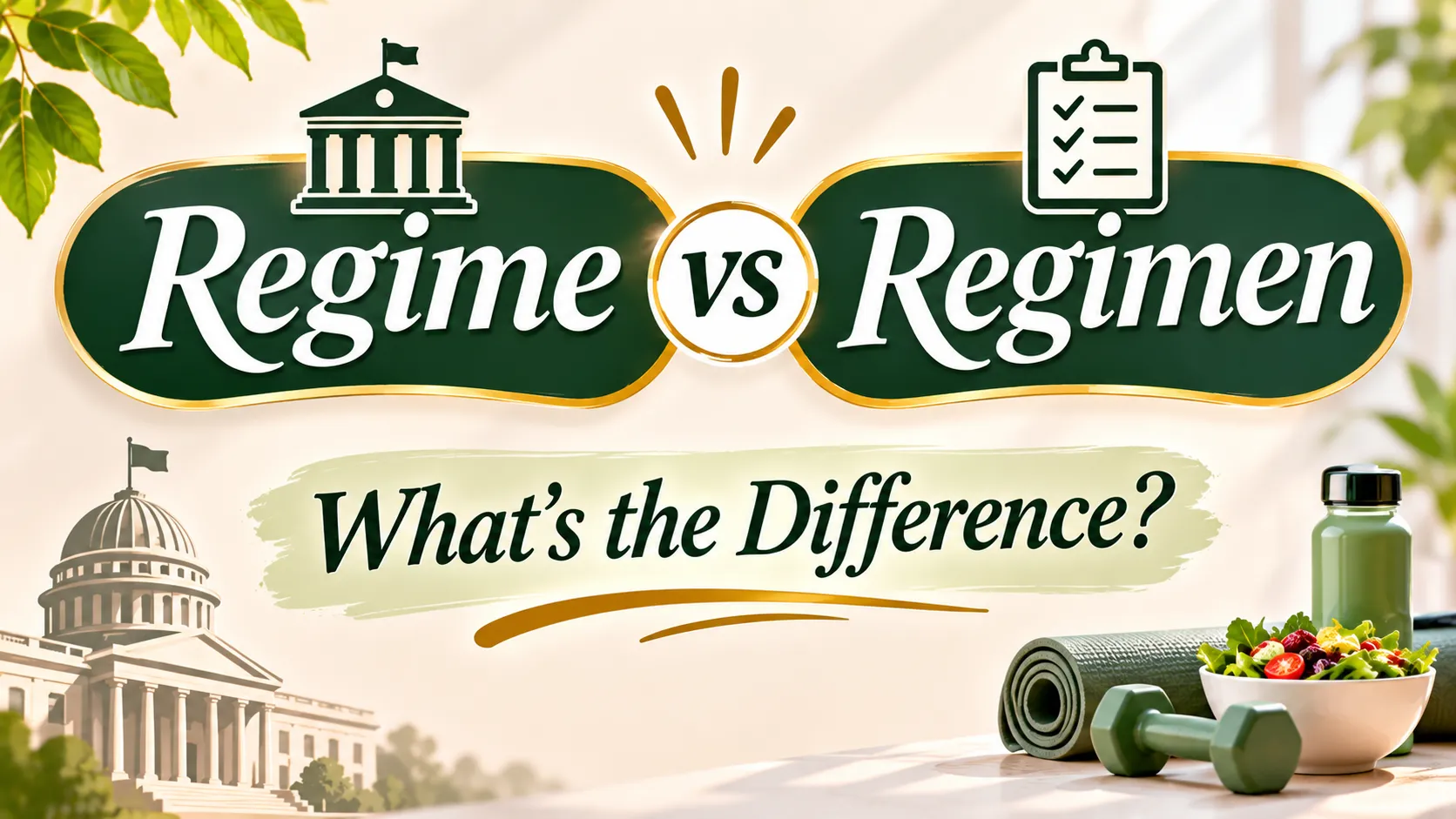
The words “regime” and “regimen” look similar, sound similar, and both refer to systems of organization or control. Yet the regime vs regimen distinction matters in political writing, medical contexts, and everyday conversation. Choosing the wrong word can suggest authoritarian government when you mean a fitness plan.
“Regime” typically refers to a system of government, especially one that is authoritarian or oppressive. “Regimen” refers to a prescribed course of action, especially for health, fitness, or medical treatment. Both come from the same Latin root, but their modern meanings have diverged significantly. This comprehensive guide explains the difference, explores their origins, provides practical examples, and helps you choose the correct word every time you write.
Quick Answer
“Regime” refers to a system or style of government, often with a negative connotation of authoritarian rule, as in “a military regime.” “Regimen” refers to a prescribed plan or routine, especially for health, exercise, or medical treatment, as in “a fitness regimen.” Remember: regime = government; regimen = routine. They sound similar but mean different things.
Meaning Overview Table
| Aspect | Meaning |
|---|---|
| Definition | Regime: a system of government or rule. Regimen: a prescribed plan or routine |
| Pronunciation | Regime: /reɪˈʒiːm/; Regimen: /ˈrɛdʒɪmən/ |
| Part of Speech | Both are nouns |
| Usage | “The military regime” vs. “a daily exercise regimen” |
| Context | Regime: politics, government, international relations. Regimen: healthcare, fitness, lifestyle, medicine |
Main Meaning
Definition
Regime primarily refers to a system or style of government, especially one that is authoritarian, oppressive, or undemocratic. It can also refer more broadly to any system or order of things, such as a “tax regime” or a “regulatory regime.” The word carries a strong negative connotation in political contexts.
Regimen refers to a systematic plan, routine, or course of action designed to achieve a particular goal, especially related to health, fitness, or medical treatment. A regimen implies regularity, discipline, and prescription. It is neutral or positive in connotation.
Origin
Both words derive from the Latin noun regimen, meaning “guidance, direction, or rule,” from the verb regere (“to rule or guide”). “Regimen” entered English in the 14th century with meanings related to government and control, but over time it narrowed to mean a prescribed course of action, especially medical. “Regime” entered English in the 15th century from French, where it referred to a system of government. The negative political connotation developed over centuries, especially in the 20th century.
Context
The distinction matters across several contexts:
- Politics and Government: “Regime” appears in discussions of authoritarian governments, political systems, and international relations
- Healthcare and Medicine: “Regimen” appears in discussions of treatment plans, medication schedules, and recovery protocols
- Fitness and Lifestyle: “Regimen” describes exercise routines, diet plans, and self-care practices
- Business and Regulation: “Regime” appears in phrases like “tax regime” or “regulatory regime,” referring to systems of rules
- Everyday Writing: Confusing the two creates embarrassing errors in news reports, medical documents, and fitness content
Modern Usage
Today, “regime” appears frequently in political news, often with negative connotations. It also appears neutrally in technical contexts like “regulatory regime.” “Regimen” appears in healthcare, fitness, and lifestyle content, where it describes structured routines. The confusion persists because the words look and sound similar and share a common root.
Detailed Explanation
Literal Meaning
Literally, both words relate to rule or guidance. “Regime” means a system of rule. “Regimen” means a system of guidance or prescribed action.
Common Meaning
Commonly, people use “regime” to describe governments, especially those they disapprove of. “The regime cracked down on dissent.” They use “regimen” to describe health or fitness routines. “She follows a strict exercise regimen.”
Political Meaning
In politics, “regime” refers to a system of government or a particular administration. The word often carries a negative connotation, suggesting authoritarianism, oppression, or illegitimacy. “The regime suppressed free speech.” However, it can also appear neutrally in phrases like “the current tax regime.”
Medical Meaning
In medicine, “regimen” refers to a prescribed course of treatment. “The patient followed a regimen of antibiotics and rest.” The word implies a structured, disciplined approach to health.
Fitness Meaning
In fitness, “regimen” refers to a structured exercise routine. “Her daily regimen includes cardio, strength training, and stretching.” The word implies consistency and discipline.
Regulatory Meaning
In business and law, “regime” refers to a system of rules or regulations. “The new regulatory regime affects all financial institutions.” This usage is neutral and technical.
Examples Table
| Example | Meaning |
|---|---|
| The military regime seized power in a coup. | A system of government |
| She follows a strict exercise regimen. | A prescribed routine |
| The regime suppressed political opposition. | An authoritarian government |
| The patient’s treatment regimen includes three medications. | A prescribed medical plan |
| The new tax regime favors small businesses. | A system of rules |
| His morning regimen includes meditation and stretching. | A daily routine |
| The regime collapsed after mass protests. | A government |
| The doctor prescribed a regimen of physical therapy. | A treatment plan |
| The regulatory regime governs food safety. | A system of rules |
| She credits her skincare regimen for her clear skin. | A systematic routine |
Related Meanings Table
| Related Term | Meaning |
|---|---|
| Regime | A system of government or rule |
| Regimen | A prescribed plan or routine |
| Government | The governing body of a country |
| Administration | A presidential term or governing body |
| Dictatorship | An authoritarian regime |
| Routine | A regular course of action |
| Treatment plan | A medical regimen |
| Exercise routine | A fitness regimen |
| Regulatory framework | A system of rules |
| Tax system | A tax regime |
| Regime change | The overthrow of a government |
| Dietary regimen | A prescribed eating plan |
| Medication regimen | A prescribed schedule of medicines |
| Training regimen | A structured exercise plan |
| Regimen compliance | Adherence to a prescribed plan |
Common Uses
People use “regime” and “regimen” across numerous contexts:
Political News: “Regime” appears constantly in coverage of authoritarian governments, coups, and international conflicts. The word signals disapproval or distance.
Healthcare: “Regimen” appears in medical instructions, treatment plans, and recovery protocols. Doctors prescribe regimens; patients follow them.
Fitness and Wellness: “Regimen” appears in fitness magazines, wellness blogs, and personal training plans. The word implies discipline and consistency.
Business and Law: “Regime” appears in technical phrases like “regulatory regime,” “tax regime,” and “legal regime.” This usage is neutral.
Everyday Conversation: People discuss their “morning regimen” or “skincare regimen.” They refer to “the regime” when discussing unpopular governments.
Common Mistakes
| Mistake | Correction |
|---|---|
| Writing “exercise regime” when meaning a routine | Write “exercise regimen” (a prescribed plan) |
| Writing “treatment regime” | Write “treatment regimen” (a medical plan) |
| Writing “the military regimen” | Write “the military regime” (a government) |
| Writing “skincare regime” | Write “skincare regimen” (a routine) |
| Writing “the regimen cracked down on protesters” | Write “the regime cracked down on protesters” (a government) |
| Using “regime” for health routines | Use “regimen” for health and fitness plans |
| Using “regimen” for governments | Use “regime” for systems of government |
| Writing “diet regime” | Write “diet regimen” (a prescribed eating plan) |
| Assuming the words are interchangeable | They have distinct meanings and connotations |
| Writing “regulatory regimen” | Write “regulatory regime” (a system of rules) |
Related Questions
Is it “regime” or “regimen”?
It depends on meaning. Use “regime” for a system of government or rules. Use “regimen” for a prescribed plan or routine, especially for health or fitness.
What does “regime” mean?
“Regime” refers to a system or style of government, often with a negative connotation of authoritarian rule. It also refers to a system of rules in technical contexts.
What does “regimen” mean?
“Regimen” refers to a systematic plan, routine, or course of action designed to achieve a goal, especially related to health, fitness, or medical treatment.
What is the difference between “regime” and “regimen” in a sentence?
“Regime” relates to government and systems of rule. “Regimen” relates to prescribed routines and plans.
Can “regime” be used neutrally?
Yes. “Regime” appears neutrally in technical phrases like “tax regime” or “regulatory regime,” where it means a system of rules.
Can “regimen” be used for governments?
No. “Regimen” refers to prescribed plans and routines, not governments.
Why do people confuse “regime” and “regimen”?
They look and sound similar and share a common Latin root. Spell-check often misses the distinction.
How can I remember the difference?
Remember: regime relates to “rule” (government). Regimen relates to “routine” (health and fitness).
FAQs
What does “regime” mean?
“Regime” refers to a system or style of government, often with a negative connotation of authoritarian rule. It also refers to a system of rules in technical contexts.
What does “regimen” mean?
“Regimen” refers to a systematic plan, routine, or course of action designed to achieve a goal, especially related to health, fitness, or medical treatment.
Is it “exercise regime” or “exercise regimen”?
The correct phrase is “exercise regimen.” A regimen is a prescribed routine.
Is it “treatment regime” or “treatment regimen”?
The correct phrase is “treatment regimen.” A regimen is a prescribed medical plan.
Can “regime” mean a routine?
“Regime” can appear in technical phrases like “tax regime,” but it does not mean a personal routine. Use “regimen” for routines.
Is “regime” always negative?
No. “Regime” carries a negative connotation in political contexts but appears neutrally in technical phrases like “regulatory regime.”
How can I remember the difference?
Remember: regime relates to “rule” (government). Regimen relates to “routine” (health and fitness).
What is a “regime change”?
“Regime change” refers to the overthrow or replacement of a government, often through external intervention or internal uprising.
Conclusion
Mastering the regime vs regimen distinction improves your writing and clarifies your meaning. “Regime” refers to a system of government, often with a negative connotation, or a system of rules in technical contexts. “Regimen” refers to a prescribed plan or routine, especially for health, fitness, or medical treatment. Remember the simple rule: regime = government; regimen = routine. Whether you’re writing a political analysis, a medical report, or a fitness blog, choosing the correct word ensures your meaning is clear. Practice using “regime” for governments and systems of rules and “regimen” for health and fitness routines, and your readers will understand exactly what you intend. Small distinctions like this separate careful writers from careless ones.

Natalie Brooks is a content researcher and writer with a strong interest in word meanings, dream interpretations, symbolism, and cultural insights. She is passionate about creating clear, informative, and easy-to-understand content that helps readers discover the deeper meanings behind words, names, dreams, and symbols. Through her work at Meanzly, Natalie aims to make knowledge accessible and valuable for readers around the world.