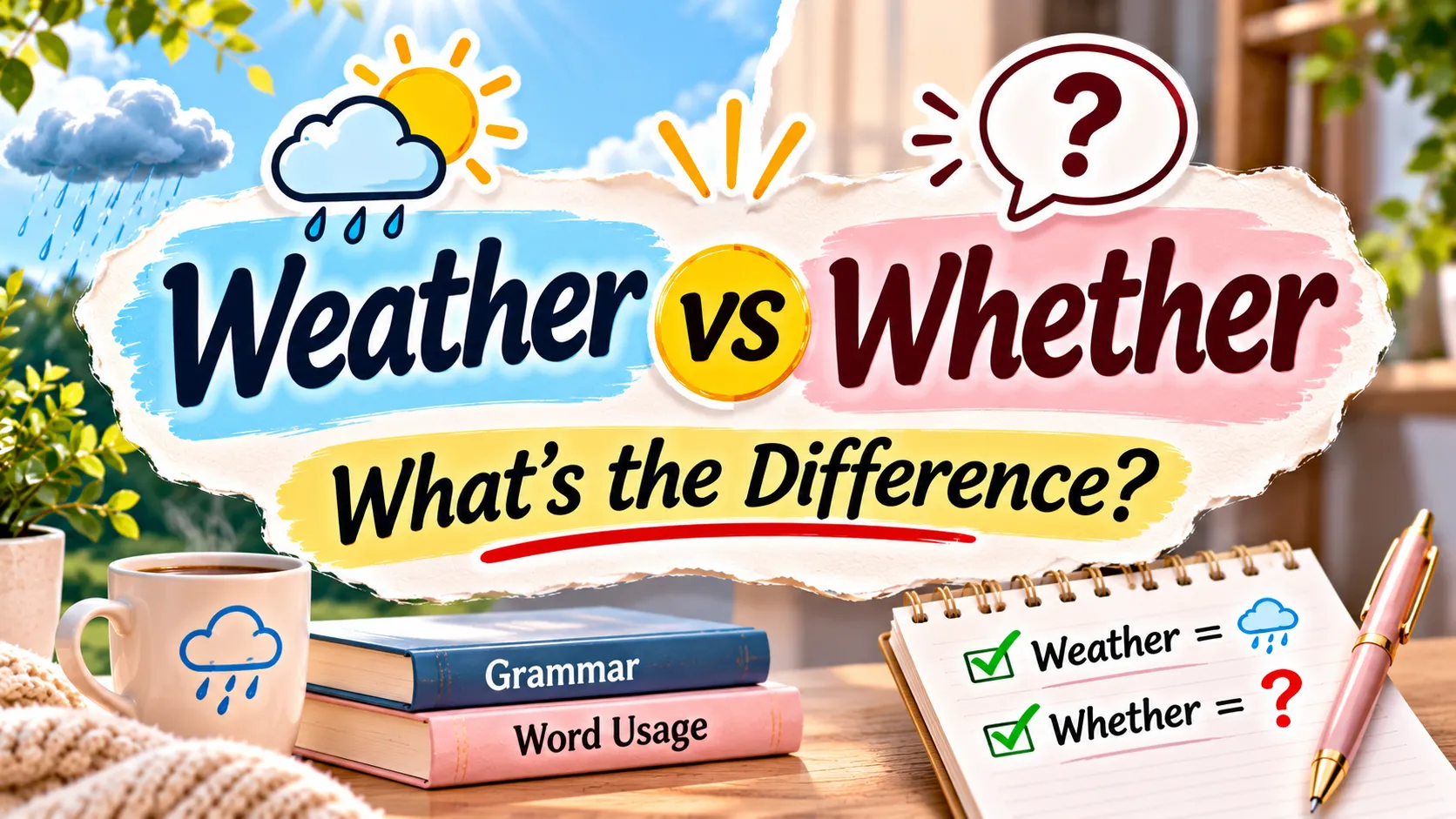
The words “weather” and “whether” sound nearly identical, differ by just two letters, and appear in completely different contexts. The weather vs whether confusion ranks among the most common homophone errors in English writing, appearing in everything from text messages to published articles.
“Weather” refers to atmospheric conditions—rain, sun, wind, and temperature. “Whether” is a conjunction introducing alternatives or indirect questions. These words share similar pronunciation but no shared meaning. This comprehensive guide explains the difference, explores their origins, provides practical examples, and helps you choose the correct word every time you write.
Quick Answer
“Weather” refers to atmospheric conditions like rain, sun, and temperature, as in “the weather is nice today.” “Whether” is a conjunction introducing alternatives or indirect questions, as in “I don’t know whether to go or stay.” Remember: weather has “ea” like “earth” (atmospheric conditions); whether has “he” like “question” (introducing choices). They sound similar but mean completely different things.
Meaning Overview Table
| Aspect | Meaning |
|---|---|
| Definition | Weather: atmospheric conditions. Whether: a conjunction introducing alternatives or indirect questions |
| Pronunciation | Both: /ˈwɛðər/ |
| Part of Speech | Weather: noun and verb. Whether: conjunction |
| Usage | “The weather is cold” vs. “I wonder whether it will rain” |
| Context | Weather: meteorology, small talk, travel. Whether: grammar, formal writing, questions |
Main Meaning
Definition
Weather functions as both a noun and a verb. As a noun, it refers to the state of the atmosphere at a particular place and time—temperature, precipitation, wind, humidity, and cloud cover. As a verb, it means to withstand or endure something difficult, or to erode or discolor through exposure to the elements. Whether is a conjunction used to introduce two or more alternatives, or to introduce an indirect question or doubt.
Origin
“Weather” comes from the Old English weder, meaning “air, sky, or breeze.” It has Germanic roots related to German Wetter and Dutch weer. The word has always referred to atmospheric conditions.
“Whether” comes from the Old English hwæther, meaning “which of two.” It shares roots with “who,” “what,” “where,” and “which.” The word originally meant “which of the two” and evolved into a conjunction introducing alternatives.
Context
The distinction matters across several contexts:
- Everyday Conversation: “Weather” appears constantly in small talk and travel planning. “Whether” appears in questions and conditional statements.
- Meteorology: “Weather” is the technical term for atmospheric conditions. Forecasts, reports, and warnings all use the word.
- Grammar and Writing: “Whether” is essential for introducing alternatives and indirect questions.
- Legal and Formal Writing: “Whether” appears frequently in legal documents and formal arguments.
Modern Usage
Today, “weather” appears frequently in weather forecasts, travel discussions, and casual conversation. “Whether” appears in questions, conditional statements, and formal writing. The confusion persists because the words sound nearly identical and spell-check often fails to catch the error.
Detailed Explanation
Literal Meaning
Literally, “weather” means the state of the atmosphere. “Whether” literally means “which of two” and functions as a conjunction introducing alternatives.
Common Meaning
Commonly, people use “weather” to describe rain, sun, snow, and temperature. They use “whether” to introduce choices or express doubt. “I don’t know whether to bring an umbrella.”
Meteorological Meaning
In meteorology, “weather” refers to the state of the atmosphere at a specific time and place. It includes temperature, humidity, precipitation, wind, and visibility. Weather differs from climate, which describes long-term patterns.
Grammatical Meaning
In grammar, “whether” introduces alternatives, indirect questions, and conditional clauses. “I wonder whether she will come.” “Whether you like it or not, the decision is final.” The word often pairs with “or” to present alternatives.
Verb Meaning
As a verb, “weather” means to endure or survive something difficult. “The company weathered the recession.” It also means to erode or discolor through exposure. “The wood weathered to a gray color.”
Examples Table
| Example | Meaning |
|---|---|
| The weather is beautiful today. | Atmospheric conditions |
| I don’t know whether to go or stay. | Introducing alternatives |
| We weathered the storm together. | Endured a difficult situation |
| Whether it rains or not, we’ll go. | Introducing alternatives |
| The weather forecast calls for snow. | Atmospheric conditions |
| She asked whether I was coming. | Indirect question |
| The rocks weathered over centuries. | Eroded through exposure |
| I wonder whether he received my message. | Expressing doubt |
| Bad weather delayed the flight. | Atmospheric conditions |
| Whether you agree or disagree, the rule stands. | Introducing alternatives |
Related Meanings Table
| Related Term | Meaning |
|---|---|
| Weather | Atmospheric conditions |
| Whether | Conjunction introducing alternatives |
| Weather forecast | A prediction of atmospheric conditions |
| Weather report | A summary of current conditions |
| Weatherproof | Resistant to weather damage |
| Weathering | Erosion through exposure to elements |
| If | A conditional conjunction similar to whether |
| Either | Introducing one of two alternatives |
| Or | Connecting alternatives |
| Climate | Long-term weather patterns |
| Temperature | A measure of heat in the atmosphere |
| Precipitation | Rain, snow, or hail |
| Storm | Severe weather conditions |
| Meteorology | The study of weather |
| Weather vane | A device showing wind direction |
Common Uses
People use “weather” and “whether” across numerous contexts:
Everyday Conversation: “Weather” appears constantly in small talk. “Nice weather we’re having.” “Whether” appears in questions about choices. “I can’t decide whether to wear a jacket.”
Meteorology: “Weather” is the core term in forecasts, reports, and warnings. Meteorologists study weather patterns, predict weather events, and issue weather alerts.
Travel: Travelers check the weather before trips. They decide whether to pack rain gear or sunscreen.
Grammar and Writing: “Whether” appears in questions, conditional statements, and formal arguments. “Whether” often pairs with “or” to present alternatives.
Legal Writing: “Whether” appears frequently in legal documents to introduce issues or questions. “The court must determine whether the law applies.”
Common Mistakes
| Mistake | Correction |
|---|---|
| Writing “whether forecast” | Write “weather forecast” (atmospheric conditions) |
| Writing “I don’t know weather to go” | Write “I don’t know whether to go” (introducing alternatives) |
| Writing “the whether is cold” | Write “the weather is cold” (atmospheric conditions) |
| Writing “weather or not” | Write “whether or not” (introducing alternatives) |
| Writing “whether report” | Write “weather report” (atmospheric conditions) |
| Writing “whether the storm” | Write “weather the storm” (endure a difficult situation) |
| Writing “weather you like it” | Write “whether you like it” (introducing alternatives) |
| Writing “bad whether” | Write “bad weather” (atmospheric conditions) |
| Assuming spell-check will catch the error | Spell-check often misses homophones; proofread manually |
| Writing “whether vane” | Write “weather vane” (a device showing wind direction) |
Related Questions
Is it “weather” or “whether”?
It depends on meaning. Use “weather” for atmospheric conditions. Use “whether” for introducing alternatives or indirect questions.
What does “weather” mean?
“Weather” refers to the state of the atmosphere—temperature, precipitation, wind, and humidity. As a verb, it means to endure or erode.
What does “whether” mean?
“Whether” is a conjunction introducing alternatives or indirect questions. “I don’t know whether to go.”
What is the difference between “weather” and “whether” in a sentence?
“Weather” relates to atmospheric conditions. “Whether” introduces choices or questions.
Can “weather” be a verb?
Yes. “Weather” as a verb means to endure or survive something difficult, or to erode through exposure.
Can “whether” be a noun?
No. “Whether” is only a conjunction.
Why do people confuse “weather” and “whether”?
They sound nearly identical and spell-check often misses the distinction. The words appear in different contexts, but quick typing leads to errors.
How can I remember the difference?
Remember: weather has “ea” like “earth” (atmospheric conditions). Whether has “he” like “question” (introducing alternatives).
FAQs
What does “weather” mean?
“Weather” refers to the state of the atmosphere at a particular place and time, including temperature, precipitation, wind, and humidity.
What does “whether” mean?
“Whether” is a conjunction introducing alternatives or indirect questions. “I don’t know whether to go.”
Is it “weather or not” or “whether or not”?
The correct phrase is “whether or not.” “Whether” introduces alternatives.
Is it “weather forecast” or “whether forecast”?
The correct phrase is “weather forecast.” Weather refers to atmospheric conditions.
Can “weather” be a verb?
Yes. “Weather” as a verb means to endure or survive something difficult, or to erode through exposure.
Can “whether” be a verb?
No. “Whether” is only a conjunction.
How can I remember the difference?
Remember: weather has “ea” like “earth” (atmospheric conditions). Whether has “he” like “question” (introducing alternatives).
What is the origin of “whether”?
“Whether” comes from the Old English hwæther, meaning “which of two.” It shares roots with “who,” “what,” “where,” and “which.”
Conclusion
Mastering the weather vs whether distinction protects your writing from embarrassing homophone errors. “Weather” refers to atmospheric conditions—rain, sun, wind, and temperature. “Whether” is a conjunction introducing alternatives or indirect questions. Remember the simple rule: weather has “ea” like “earth” (atmospheric conditions); whether has “he” like “question” (introducing choices). Whether you’re writing a weather report, a travel plan, or a grammar essay, choosing the correct word ensures your meaning is clear. Practice using “weather” for atmospheric conditions and “whether” for alternatives, and your readers will understand exactly what you intend. Small distinctions like this separate careful writers from careless ones.

Natalie Brooks is a content researcher and writer with a strong interest in word meanings, dream interpretations, symbolism, and cultural insights. She is passionate about creating clear, informative, and easy-to-understand content that helps readers discover the deeper meanings behind words, names, dreams, and symbols. Through her work at Meanzly, Natalie aims to make knowledge accessible and valuable for readers around the world.









