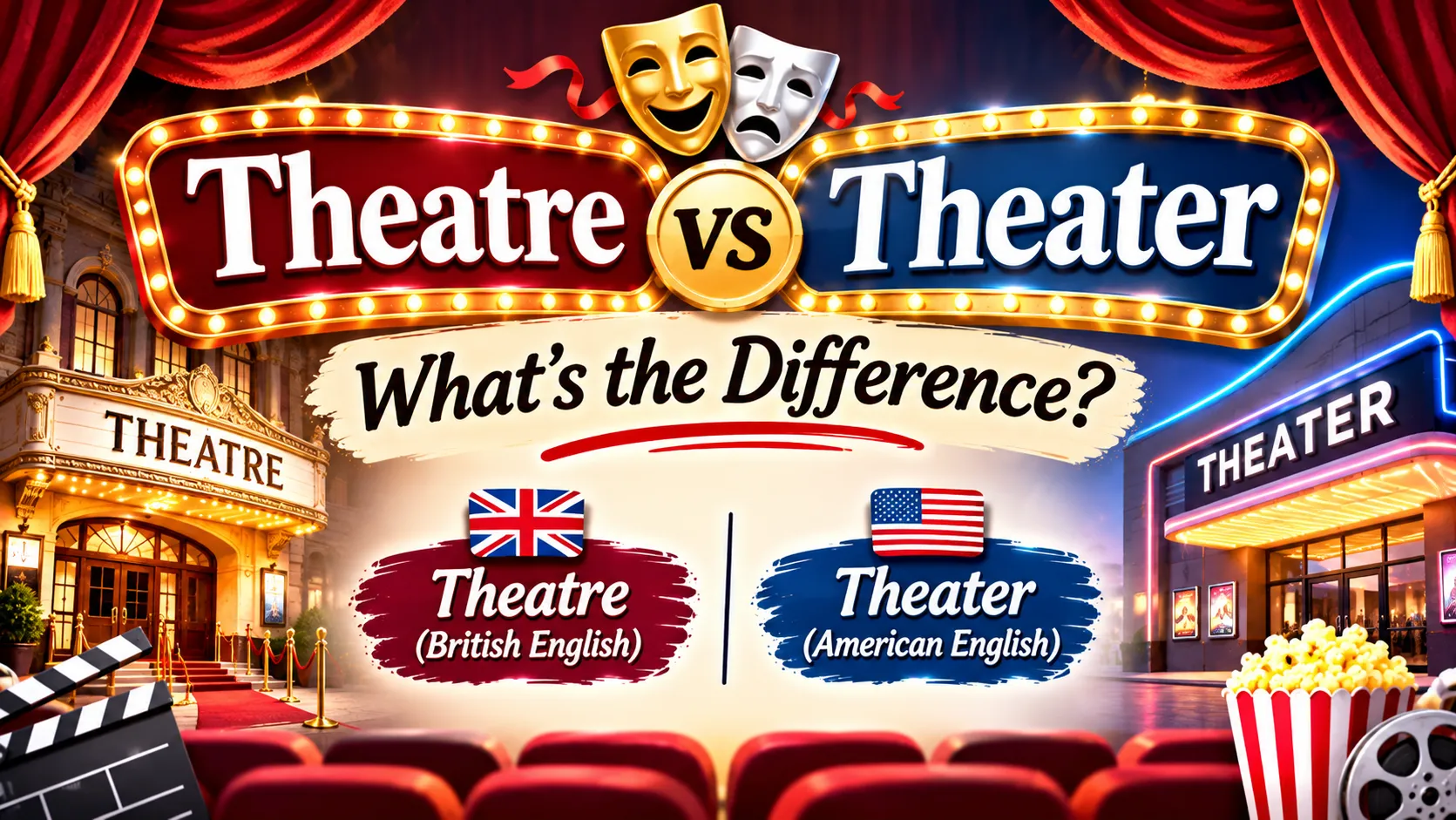
The words “theatre” and “theater” refer to the same thing—a place for performing arts or the art form itself—yet they differ in spelling based on regional conventions. The theatre vs theater question ranks among the most common spelling dilemmas in English, appearing in playbills, academic papers, real estate listings, and everyday conversation.
“Theatre” is the preferred spelling in British English and in academic or artistic contexts. “Theater” is the preferred spelling in American English and in everyday usage. Both spellings are correct, and neither carries a different meaning. This comprehensive guide explains the regional differences, explores the origins of both forms, provides practical examples, and helps you choose the right spelling for your audience and context.
Quick Answer
Both “theatre” and “theater” are correct spellings of the same word. “Theater” is standard in American English. “Theatre” is standard in British English and often preferred in academic, artistic, and formal contexts worldwide. The choice depends on your audience and context, not on grammar rules. Neither spelling is wrong.
Meaning Overview Table
| Aspect | Meaning |
|---|---|
| Definition | A building for performing arts, or the art form of drama and performance |
| Pronunciation | Both: /ˈθiːətər/ |
| Part of Speech | Nouns |
| Usage | “We went to the theater” (US) vs. “We went to the theatre” (UK) |
| Context | Performing arts, entertainment, academia, real estate, everyday speech |
Main Meaning
Definition
Theatre and theater are spelling variants of the same noun, referring to a building or space where plays, films, or other performances take place, or to the art form of drama and performance itself. The word also extends to fields like “operating theatre” (British) and “movie theater” (American).
Origin
Both spellings trace to the Greek word theatron, meaning “a place for viewing,” derived from theasthai (“to behold”). The word entered English through the Latin theatrum and Old French theatre in the 14th century. British English retained the French-influenced “-re” ending, while American English adopted the “-er” ending as part of Noah Webster’s spelling reforms in the early 19th century.
Context
The choice between spellings depends on your audience:
- American English: Always use “theater” in everyday writing, including movie theaters and theater districts
- British English: Use “theatre” for both the building and the art form
- Academic and Artistic Contexts: “Theatre” often appears worldwide in drama departments and professional arts organizations
- Real Estate: “Theatre” appears in the names of many historic venues regardless of location
Modern Usage
Today, “theater” dominates in the United States across all contexts. “Theatre” remains standard in the UK, Canada, Australia, and other Commonwealth countries. Interestingly, many American arts organizations and academic departments use “theatre” to signal artistic seriousness. The spelling distinction persists in formal writing and regional publications.
Detailed Explanation
Literal Meaning
Literally, both words refer to a place for viewing performances or the art of dramatic presentation. The meaning is identical regardless of spelling.
Common Meaning
Commonly, people use “theater” in American English for everything from movie theaters to Broadway theaters. They use “theatre” in British English for the same purposes.
Artistic Meaning
In artistic and academic contexts, “theatre” often signals a connection to the art form rather than just a building. Drama departments at American universities frequently use “theatre” to distinguish their academic programs from commercial movie theaters.
Architectural Meaning
In architecture, both spellings describe buildings designed for performances. Historic venues often retain “theatre” in their names regardless of location, as in “the Apollo Theatre” in New York.
Medical Meaning
In British English, an “operating theatre” is a room where surgeries are performed. American English uses “operating room” instead. This usage follows the British spelling convention.
Examples Table
| Example | Meaning |
|---|---|
| We went to the theater to see a movie. | American spelling for a cinema |
| The Royal Theatre is hosting a new play. | British spelling for a performance venue |
| She studied theater in college. | American spelling for the art form |
| He works in the theatre industry. | British spelling for the profession |
| The operating theatre was prepared for surgery. | British spelling for a surgical room |
| The theater district is bustling tonight. | American spelling for an entertainment area |
| The theatre company tours nationally. | Artistic spelling for a performance group |
| We saw a play at the local theater. | American spelling for a playhouse |
| The theatre was built in 1890. | Historic venue spelling |
| Movie theaters are struggling to compete with streaming. | American spelling for cinemas |
Related Meanings Table
| Related Term | Meaning |
|---|---|
| Theater | American spelling for a performance venue or art form |
| Theatre | British spelling for a performance venue or art form |
| Theatrical | Relating to the theater; dramatic |
| Thespian | An actor; relating to drama |
| Amphitheater | An open-air venue for performances |
| Movie theater | American term for a cinema |
| Cinema | British term for a movie theater |
| Playhouse | A theater for stage productions |
| Auditorium | A room for performances and gatherings |
| Stage | The platform where performances occur |
| Drama | The art form performed in theaters |
| Broadway | The theater district in New York City |
| West End | The theater district in London |
| Opera house | A venue for opera performances |
| Operating theatre | British term for a surgical room |
Common Uses
People use “theatre” and “theater” across numerous contexts:
Entertainment: Americans go to “the theater” to see movies or plays. British audiences go to “the theatre.” Both describe the same experience.
Academia: University drama departments in the US often use “theatre” to signal artistic seriousness and distinguish academic study from commercial cinema.
Real Estate: Historic venues retain their original spellings regardless of location. The “Apollo Theatre” in New York uses the British spelling.
Medicine: British hospitals have “operating theatres.” American hospitals have “operating rooms.”
Publishing: Playbills, reviews, and arts coverage follow regional spelling conventions, though artistic publications often use “theatre” worldwide.
Common Mistakes
| Mistake | Correction |
|---|---|
| Using “theatre” in American everyday writing | Use “theater” for American audiences |
| Using “theater” in British writing | Use “theatre” for British audiences |
| Mixing spellings within one document | Choose one convention and apply it consistently |
| Assuming one spelling is wrong | Both are correct; the difference is regional |
| Using “theatre” for a movie cinema in the US | Use “theater” for American movie venues |
| Using “theater” for an operating room in the UK | Use “theatre” for British surgical rooms |
| Forgetting that historic venues keep their spellings | Respect the original spelling in proper names |
| Changing “theatre” to “theater” in a quoted title | Preserve original spellings in quotations |
| Assuming “theatre” is always more formal | Formality depends on context, not spelling |
| Ignoring the audience’s regional conventions | Match the spelling to your readers |
Related Questions
Is it “theatre” or “theater”?
Both are correct. “Theater” is standard in American English. “Theatre” is standard in British English and often preferred in academic and artistic contexts.
What is the difference between theatre and theater?
There is no difference in meaning. The only difference is regional spelling preference. American English uses “theater”; British English uses “theatre.”
Which spelling is more common?
“Theater” is more common globally due to American influence. However, “theatre” remains standard in British English and in artistic contexts worldwide.
Is “theatre” British or American?
“Theatre” is primarily British, though it appears in American arts organizations and academic departments that want to signal artistic seriousness.
Can I use “theater” in British English?
Yes, though “theatre” is more traditional. Some British publications now accept “theater,” especially in casual contexts.
Why do Americans spell it “theater”?
American English adopted “theater” as part of Noah Webster’s spelling reforms, which simplified many words and differentiated American spelling from British conventions.
FAQs
What does “theatre” mean?
“Theatre” is a British spelling of “theater,” referring to a building for performances or the art form of drama.
What does “theater” mean?
“Theater” is an American spelling of “theatre,” referring to a building for performances or the art form of drama.
Is it “movie theater” or “movie theatre”?
“Movie theater” is standard in American English. British English uses “cinema” instead.
Is it “operating theater” or “operating theatre”?
“Operating theatre” is standard in British English. American English uses “operating room.”
Why do some American theaters use “theatre” in their names?
Many American arts organizations and academic departments use “theatre” to signal artistic seriousness and distinguish themselves from commercial movie theaters.
Which spelling should I use in academic writing?
Use the spelling that matches your institution’s regional conventions. American universities typically use “theater,” while drama departments may use “theatre.”
Can I mix spellings in one document?
No. Choose one convention and apply it consistently throughout the document.
Is “theatre” more formal than “theater”?
Not necessarily. “Theatre” often appears in artistic and academic contexts, but formality depends on context, not spelling.
Conclusion
Mastering the theatre vs theater distinction comes down to understanding regional conventions. American English uses “theater” for everything from movie theaters to Broadway venues. British English uses “theatre” for performance spaces and the art form. Academic and artistic contexts worldwide often favor “theatre” to signal artistic seriousness. Neither spelling is wrong, and the choice depends entirely on your audience and context. Whether you write “theater” or “theatre,” your meaning remains clear. Choose the spelling that matches your region and context, apply it consistently, and write with confidence knowing that both forms are standard English.

Natalie Brooks is a content researcher and writer with a strong interest in word meanings, dream interpretations, symbolism, and cultural insights. She is passionate about creating clear, informative, and easy-to-understand content that helps readers discover the deeper meanings behind words, names, dreams, and symbols. Through her work at Meanzly, Natalie aims to make knowledge accessible and valuable for readers around the world.