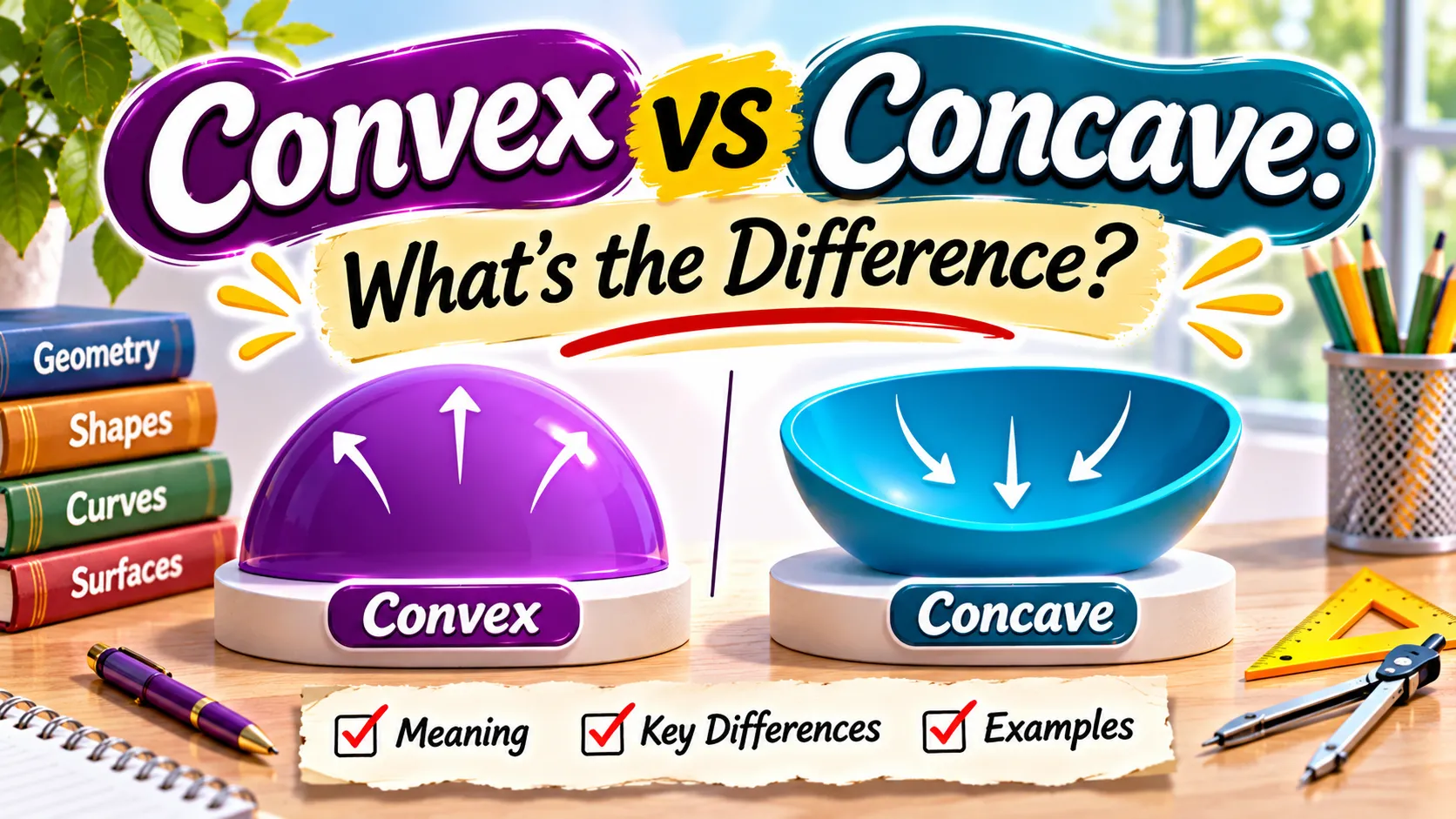
The words “convex” and “concave” describe curved surfaces, yet they point in opposite directions. Understanding the convex vs concave distinction matters in optics, geometry, mirror design, and everyday descriptions of shapes. Confusing the two leads to errors in everything from eyeglass prescriptions to road safety signage.
A convex surface curves outward, like the outside of a sphere. A concave surface curves inward, like the inside of a bowl. The words come from Latin roots that literally describe these shapes: convexus means “arched” or “vaulted,” while concavus means “hollow.” This comprehensive guide explains the difference, explores their origins, provides practical examples, and helps you remember which is which every time.
Quick Answer
“Convex” describes a surface that curves outward, like the outside of a ball or a magnifying glass. “Concave” describes a surface that curves inward, like the inside of a bowl or a spoon. Remember: convex bulges out; concave caves in. The words rhyme with “complex” and “cave,” both helpful memory cues.
Meaning Overview Table
| Aspect | Meaning |
|---|---|
| Definition | Convex: curving outward. Concave: curving inward |
| Pronunciation | Convex: /ˈkɒnvɛks/ or /kənˈvɛks/; Concave: /ˈkɒnkeɪv/ or /kənˈkeɪv/ |
| Part of Speech | Both are adjectives; both can function as nouns in technical contexts |
| Usage | “A convex lens magnifies” vs. “A concave mirror focuses light” |
| Context | Optics, geometry, anatomy, road safety, everyday descriptions |
Main Meaning
Definition
Convex is an adjective describing a surface that curves outward, bulging toward the viewer, like the exterior of a sphere. Concave is an adjective describing a surface that curves inward, hollowing away from the viewer, like the interior of a bowl. In geometry, a convex polygon has all interior angles less than 180 degrees, while a concave polygon has at least one interior angle greater than 180 degrees.
Origin
Both words come from Latin. “Convex” derives from convexus, meaning “arched” or “vaulted,” possibly related to convehere (“to bring together”). “Concave” derives from concavus, meaning “hollow,” combining con- (“together”) and cavus (“hollow”). Both entered English in the 16th century during the rise of scientific and mathematical writing.
Context
The distinction matters across several contexts:
- Optics: Lenses and mirrors are classified as convex or concave based on their curvature
- Geometry: Polygons are classified as convex or concave based on their angles
- Anatomy: Body shapes and organs are described as convex or concave
- Road Safety: Convex mirrors are used at blind corners to widen the field of view
- Everyday Language: People describe bowls, spoons, and hills using these terms
Modern Usage
Today, “convex” and “concave” appear frequently in physics, engineering, mathematics, and medicine. Optometrists prescribe convex lenses for farsightedness and concave lenses for nearsightedness. Engineers design convex and concave surfaces for aerodynamics and acoustics. The words also appear in everyday descriptions of shapes and objects.
Detailed Explanation
Literal Meaning
Literally, “convex” means curving outward like a hill, and “concave” means curving inward like a valley. The literal meanings describe the direction of curvature relative to the viewer.
Common Meaning
Commonly, people use “convex” to describe anything that bulges outward, like a convex mirror or a convex hill. They use “concave” to describe anything that hollows inward, like a concave lens or a concave bowl.
Optical Meaning
In optics, convex lenses are thicker in the middle and thinner at the edges. They converge light rays to a focal point and are used to correct farsightedness. Concave lenses are thinner in the middle and thicker at the edges. They diverge light rays and are used to correct nearsightedness. Convex mirrors bulge outward and provide a wider field of view. Concave mirrors curve inward and can focus light or magnify images.
Geometric Meaning
In geometry, a convex polygon has all interior angles less than 180 degrees, and any line segment connecting two points inside the polygon stays inside. A concave polygon has at least one interior angle greater than 180 degrees, creating a “dent” or indentation.
Anatomical Meaning
In anatomy, convex describes body parts that bulge outward, like the convex surface of the liver or the convex curve of the spine in certain conditions. Concave describes hollowed areas, like the concave surface of the palm or the concave curve of the lower back.
Road Safety Meaning
Convex mirrors appear at blind corners, driveways, and parking garages. They bulge outward and reflect a wider field of view than flat mirrors, helping drivers see around obstacles. Concave mirrors are less common in road safety, though they appear in some specialized applications.
Examples Table
| Example | Meaning |
|---|---|
| A convex lens magnifies objects. | Curves outward, converging light |
| A concave lens corrects nearsightedness. | Curves inward, diverging light |
| The convex mirror at the corner helps drivers see. | Bulges outward, wide field of view |
| The concave bowl held the soup. | Hollows inward |
| A convex polygon has no indentations. | All angles less than 180 degrees |
| A concave polygon has at least one dent. | At least one angle greater than 180 degrees |
| The convex hill rose above the valley. | Bulges upward |
| The concave spoon held the medicine. | Hollows inward |
| Convex eyeglasses correct farsightedness. | Thicker in the middle |
| Concave eyeglasses correct nearsightedness. | Thinner in the middle |
Related Meanings Table
| Related Term | Meaning |
|---|---|
| Convex | Curving outward |
| Concave | Curving inward |
| Convex lens | A lens thicker in the middle that converges light |
| Concave lens | A lens thinner in the middle that diverges light |
| Convex mirror | A mirror that bulges outward and widens the field of view |
| Concave mirror | A mirror that curves inward and can focus light |
| Convex polygon | A polygon with all interior angles less than 180 degrees |
| Concave polygon | A polygon with at least one interior angle greater than 180 degrees |
| Plano-convex | Flat on one side, convex on the other |
| Plano-concave | Flat on one side, concave on the other |
| Biconvex | Convex on both sides |
| Biconcave | Concave on both sides |
| Focal point | The point where light rays converge |
| Diverging lens | Another name for a concave lens |
| Converging lens | Another name for a convex lens |
Common Uses
People use “convex” and “concave” across numerous contexts:
Optometry and Vision: Eye doctors prescribe convex lenses for farsightedness and concave lenses for nearsightedness. The terms appear on prescriptions and in optical discussions.
Physics and Engineering: Physicists describe light behavior using convex and concave lenses and mirrors. Engineers design surfaces for acoustics, aerodynamics, and optics.
Geometry and Mathematics: Mathematicians classify polygons and functions as convex or concave. These terms appear in calculus, optimization, and computational geometry.
Anatomy and Medicine: Doctors describe body parts as convex or concave. The terms appear in descriptions of organs, bones, and spinal curvatures.
Road Safety: Convex mirrors appear at blind corners and driveways. The terms appear in traffic safety discussions.
Everyday Language: People describe bowls, spoons, hills, and valleys using these terms, often without realizing their technical precision.
Common Mistakes
| Mistake | Correction |
|---|---|
| Confusing convex and concave lenses | Convex lenses converge light (magnify); concave lenses diverge light (shrink) |
| Calling a bowl convex | A bowl is concave (curves inward) |
| Calling a ball concave | A ball is convex (curves outward) |
| Confusing convex and concave mirrors | Convex mirrors bulge outward; concave mirrors curve inward |
| Mixing up the geometric definitions | Convex polygons have no indentations; concave polygons have at least one |
| Using “convex” for something that caves in | Use “concave” for inward curves |
| Using “concave” for something that bulges out | Use “convex” for outward curves |
| Forgetting the memory trick | Convex bulges out; concave caves in |
| Confusing the words in optical prescriptions | Convex corrects farsightedness; concave corrects nearsightedness |
| Assuming the words are interchangeable | They describe opposite curvatures and cannot be swapped |
Related Questions
What is the difference between convex and concave?
Convex describes a surface that curves outward, like the outside of a ball. Concave describes a surface that curves inward, like the inside of a bowl.
Which lens is convex?
A convex lens is thicker in the middle and thinner at the edges. It converges light rays and is used to correct farsightedness.
Which lens is concave?
A concave lens is thinner in the middle and thicker at the edges. It diverges light rays and is used to correct nearsightedness.
How can I remember convex vs concave?
Remember: convex bulges out (like a hill), concave caves in (like a cave). The words “convex” and “complex” both contain “con,” while “concave” contains “cave,” which is hollow.
What is a convex mirror used for?
Convex mirrors are used at blind corners, driveways, and parking garages to provide a wider field of view.
What is a concave mirror used for?
Concave mirrors are used in telescopes, headlights, and makeup mirrors to focus light and magnify images.
What is a convex polygon?
A convex polygon has all interior angles less than 180 degrees and no indentations. Any line segment connecting two points inside stays inside.
What is a concave polygon?
A concave polygon has at least one interior angle greater than 180 degrees, creating a dent or indentation.
FAQs
What does convex mean?
Convex describes a surface that curves outward, bulging toward the viewer, like the exterior of a sphere or the surface of a magnifying glass.
What does concave mean?
Concave describes a surface that curves inward, hollowing away from the viewer, like the interior of a bowl or the surface of a spoon.
Is a spoon convex or concave?
The inside of a spoon is concave (it holds food). The back of a spoon is convex (it bulges outward). The same object can have both surfaces.
Is a magnifying glass convex or concave?
A magnifying glass uses a convex lens. It is thicker in the middle and converges light to magnify objects.
What is the difference between a convex and concave lens?
A convex lens converges light and magnifies objects. A concave lens diverges light and shrinks objects.
What is a convex mirror?
A convex mirror bulges outward and provides a wider field of view. It is used at blind corners and driveways.
What is a concave mirror?
A concave mirror curves inward and can focus light. It is used in telescopes and makeup mirrors.
How can I remember the difference?
Remember: convex bulges out (like a hill), concave caves in (like a cave). The word “concave” contains “cave,” which is hollow.
Conclusion
Mastering the convex vs concave distinction improves your writing and clarifies your meaning. “Convex” describes surfaces that curve outward, like the outside of a ball or a magnifying glass. “Concave” describes surfaces that curve inward, like the inside of a bowl or a spoon. Remember the simple rule: convex bulges out; concave caves in. Whether you’re writing about optics, geometry, anatomy, or everyday objects, choosing the correct word ensures your readers understand the direction of curvature. Practice using “convex” for outward curves and “concave” for inward curves, and your writing will gain precision and clarity. Small distinctions like this separate careful writers from careless ones.

Natalie Brooks is a content researcher and writer with a strong interest in word meanings, dream interpretations, symbolism, and cultural insights. She is passionate about creating clear, informative, and easy-to-understand content that helps readers discover the deeper meanings behind words, names, dreams, and symbols. Through her work at Meanzly, Natalie aims to make knowledge accessible and valuable for readers around the world.









