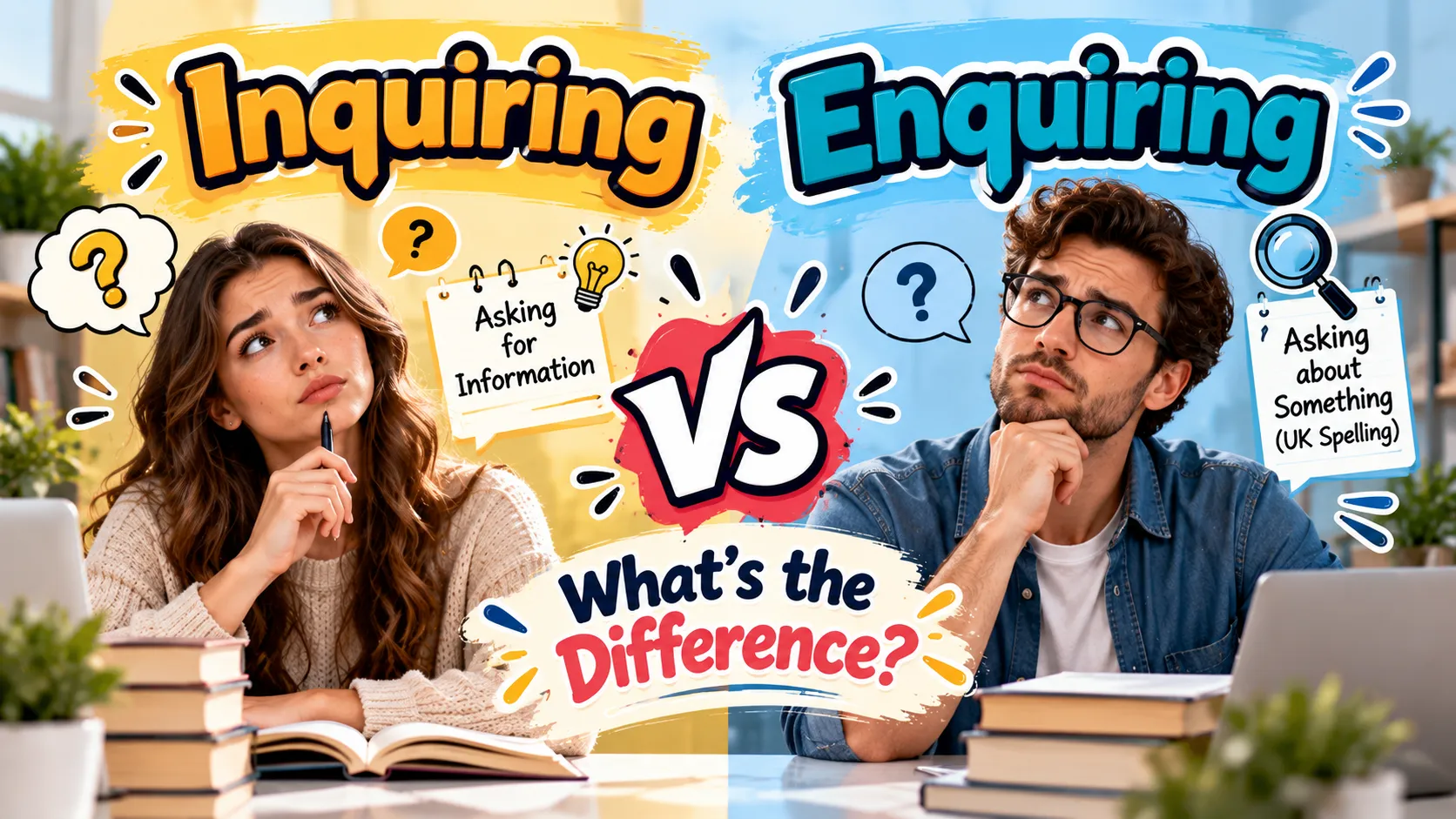
The words “inquiring” and “enquiring” represent one of the most persistent spelling dilemmas in English. Both are present participles of verbs meaning to ask or investigate, both sound nearly identical, and both appear in reputable publications. Yet the inquiring vs enquiring distinction comes down to a simple matter of regional preference rather than grammatical correctness.
“Inquiring” is the preferred spelling in American and Canadian English, while “enquiring” dominates in British English and other Commonwealth countries . Both forms are correct, and neither carries a different meaning. The confusion arises because the two spellings coexist, often appearing side by side in the same document. This comprehensive guide explains the regional differences, explores the origins of both forms, provides practical examples, and helps you choose the right spelling for your audience.
Quick Answer
Both “inquiring” and “enquiring” are correct present participles meaning “asking for information” or “investigating.” Use “inquiring” in American and Canadian English. Use “enquiring” in British English, Australian English, and other Commonwealth varieties. The meaning is identical; only the regional spelling preference differs .
Meaning Overview Table
| Aspect | Meaning |
|---|---|
| Definition | The present participle of inquire/enquire, meaning “asking for information” or “investigating” |
| Pronunciation | Inquiring: /ɪnˈkwaɪərɪŋ/; Enquiring: /ɛnˈkwaɪərɪŋ/ |
| Part of Speech | Present participle (verb form) and adjective |
| Usage | “She was inquiring about the job” (US) vs. “She was enquiring about the job” (UK) |
| Context | Formal writing, business communication, journalism, academic prose |
Main Meaning
Definition
Inquiring and enquiring are the present participle forms of the verbs “inquire” and “enquire,” respectively. Both mean “asking for information,” “seeking knowledge,” or “investigating.” As adjectives, they describe someone who is curious, questioning, or seeking information . The two forms are identical in meaning and function; only the spelling differs based on regional conventions.
Origin
Both words trace back to the Latin verb inquirere, meaning “to seek after” or “to search for,” combining in- (“into”) and quaerere (“to seek”) . The word entered English through Old French enquerre in the Middle Ages. English respelled the word on the Latin model in the 14th century, creating “inquire,” but the half-Latinized “enquire” persisted . This historical dual heritage explains why both spellings survive today.
Context
The choice between the two forms depends on your audience:
- American English: Always use “inquiring”
- Canadian English: Prefer “inquiring,” though “enquiring” appears
- British English: “Enquiring” remains standard, especially for informal requests
- Australian English: Both appear, though “inquiring” is gaining ground
- Legal and Official Writing: “Inquiry” is standard for formal investigations in all varieties
Modern Usage
Today, “inquiring” dominates in North America, while “enquiring” persists in the UK and Commonwealth. The distinction mirrors the broader pattern of American spelling reforms championed by Noah Webster, who simplified many words by removing French-influenced spellings. However, the line blurs in practice. British publications sometimes use “inquiring,” and American publications occasionally use “enquiring” in quoted material or formal contexts .
Detailed Explanation
Literal Meaning
Literally, both words describe the act of seeking information by asking questions. “She was inquiring about the schedule” and “She was enquiring about the schedule” mean exactly the same thing: she was asking for information about the schedule.
Common Meaning
Commonly, people use these words in formal contexts when someone asks for information politely or professionally. “I am inquiring about the position” sounds more formal than “I am asking about the position” . The same applies to “enquiring.”
Adjective Meaning
As adjectives, “inquiring” and “enquiring” describe a curious or questioning nature. “An inquiring mind” refers to someone who seeks knowledge and asks questions . “An enquiring glance” describes a look that asks a question without words. Both forms convey the same meaning.
Formal and Business Meaning
In business communication, both forms signal professionalism and formality. A job applicant might write “I am inquiring about the status of my application.” A customer might say “I am enquiring about your return policy.” The choice depends on the writer’s regional conventions, not on any difference in formality.
Legal and Investigative Meaning
In legal contexts, “inquiry” (with an “i”) is the standard spelling for formal investigations in all varieties of English . A “police inquiry” or “public inquiry” always uses the “i” form, regardless of region. The verb form follows the same pattern in legal writing.
Examples Table
| Example | Meaning |
|---|---|
| She was inquiring about the job opening. | American spelling: asking for information |
| He was enquiring about the train schedule. | British spelling: asking for information |
| The inquiring mind seeks knowledge. | American spelling: curious, questioning |
| The enquiring glance suggested doubt. | British spelling: questioning look |
| I am inquiring as to whether the position is available. | Formal American English |
| We are enquiring about your return policy. | Formal British English |
| The police conducted an inquiry into the incident. | Standard spelling for formal investigation |
| The inquiring reporter asked tough questions. | American spelling: investigative |
| She sent an enquiring email about the sale. | British spelling: requesting information |
| An inquiring mind is a valuable asset. | American spelling: intellectual curiosity |
Related Meanings Table
| Related Term | Meaning |
|---|---|
| Inquire | American/Canadian verb meaning to ask or investigate |
| Enquire | British/Commonwealth verb meaning to ask or investigate |
| Inquiry | Standard spelling for formal investigation in all varieties |
| Enquiry | British spelling for an informal request |
| Asking | The plain-language equivalent of inquiring/enquiring |
| Questioning | Seeking information or expressing doubt |
| Curious | Eager to know or learn something |
| Investigative | Relating to formal examination or research |
| Interrogating | Questioning thoroughly, often formally |
| Probing | Investigating deeply |
| Seeking | Trying to find or obtain |
| Requesting | Asking for something formally |
| Querying | Asking a question or expressing doubt |
| Exploring | Investigating or examining |
| Researching | Systematic investigation |
Common Uses
People use “inquiring” and “enquiring” across numerous contexts:
Business Communication: Professionals use these forms when asking for information politely. “I am inquiring about the status of my order” sounds more formal than “I am asking about my order.”
Journalism: Reporters describe “inquiring minds” and “inquiring reporters.” The spelling follows the publication’s regional style guide.
Customer Service: Representatives use these forms when responding to requests. British companies use “enquiring,” while American companies use “inquiring.”
Academic Writing: Researchers describe “inquiring approaches” and “enquiring methods.” The spelling follows the institution’s regional conventions.
Everyday Conversation: While less common in casual speech, both forms appear in polite requests and formal correspondence.
Common Mistakes
| Mistake | Correction |
|---|---|
| Using “enquiring” in American publications | Use “inquiring” for American audiences |
| Using “inquiring” in British publications without style guide approval | Use “enquiring” for British audiences |
| Spelling “inquiry” as “enquiry” in formal legal contexts | Use “inquiry” for formal investigations in all varieties |
| Spelling “enquiry” as “inquiry” for informal British requests | Use “enquiry” for informal requests in British English |
| Assuming one form is grammatically incorrect | Both are correct; the difference is regional |
| Mixing spellings within one document | Choose one convention and apply it consistently |
| Writing “inquiring” when quoting a British source that used “enquiring” | Preserve the original spelling in quotations |
| Forgetting that “inquiring mind” is the standard phrase in American English | Use “inquiring mind” for American audiences |
| Using “enquiring” in Canadian formal writing | Prefer “inquiring” in Canadian English |
| Believing the two forms have different meanings | Both mean exactly the same thing |
Related Questions
Is it inquiring or enquiring?
Both are correct. “Inquiring” is standard in American and Canadian English. “Enquiring” is standard in British and Commonwealth English. The meaning is identical .
What is the difference between inquiring and enquiring?
There is no difference in meaning. The only difference is regional spelling preference. “Inquiring” uses the Latin-derived “in-” prefix, while “enquiring” uses the French-derived “en-” prefix .
Which spelling is more common?
“Inquiring” is more common globally, largely due to American influence. However, “enquiring” remains standard in British English.
Is “enquiring” British?
Yes. “Enquiring” is the preferred spelling in British English, Australian English, and most Commonwealth varieties. “Inquiring” is preferred in American and Canadian English .
Can I use “inquiring” in British English?
Yes, though “enquiring” is more traditional. Many British publications now accept “inquiring,” and style guides vary.
What is the difference between inquiry and enquiry?
“Inquiry” is standard for formal investigations in all varieties. “Enquiry” is the British spelling for informal requests. American English uses “inquiry” for both meanings .
Why do two spellings exist?
The word entered English through Old French (enquerre) and was later respelled on the Latin model (inquirere). Both forms survived, with regional preferences developing over centuries .
FAQs
What does “inquiring” mean?
“Inquiring” is the present participle of “inquire.” It means asking for information, seeking knowledge, or investigating. As an adjective, it describes someone who is curious or questioning .
What does “enquiring” mean?
“Enquiring” is the present participle of “enquire.” It has the same meaning as “inquiring”: asking for information or investigating. The spelling is preferred in British English.
Is “enquiring” a real word?
Yes. “Enquiring” is a standard spelling in British English and appears in reputable publications, dictionaries, and style guides .
Is “inquiring” a real word?
Yes. “Inquiring” is the standard spelling in American and Canadian English and appears in all major dictionaries.
Which is correct: “inquiring mind” or “enquiring mind”?
Both are correct. “Inquiring mind” is standard in American English. “Enquiring mind” is standard in British English. The phrase means “a curious, seeking intellect” .
How do you pronounce inquiring and enquiring?
When spoken quickly, both sound nearly identical: /ɪnˈkwaɪərɪŋ/ or /ɛnˈkwaɪərɪŋ/. The difference is subtle and often imperceptible in casual speech .
Can I use “inquiring” in a British context?
Yes, though “enquiring” is more traditional. Many British publications and institutions now accept “inquiring,” especially in formal or legal contexts.
Conclusion
The inquiring vs enquiring distinction is simpler than it appears: both words are correct, both mean the same thing, and the choice depends entirely on your audience’s regional conventions. Use “inquiring” for American and Canadian readers. Use “enquiring” for British and Commonwealth readers. In formal legal contexts, “inquiry” remains standard across all varieties. Neither form is more correct or more elegant than the other. Whether you write “an inquiring mind” or “an enquiring mind,” your meaning remains clear and your grammar remains sound. Choose the spelling that matches your audience, apply it consistently, and write with confidence knowing that both forms are standard English.

Natalie Brooks is a content researcher and writer with a strong interest in word meanings, dream interpretations, symbolism, and cultural insights. She is passionate about creating clear, informative, and easy-to-understand content that helps readers discover the deeper meanings behind words, names, dreams, and symbols. Through her work at Meanzly, Natalie aims to make knowledge accessible and valuable for readers around the world.