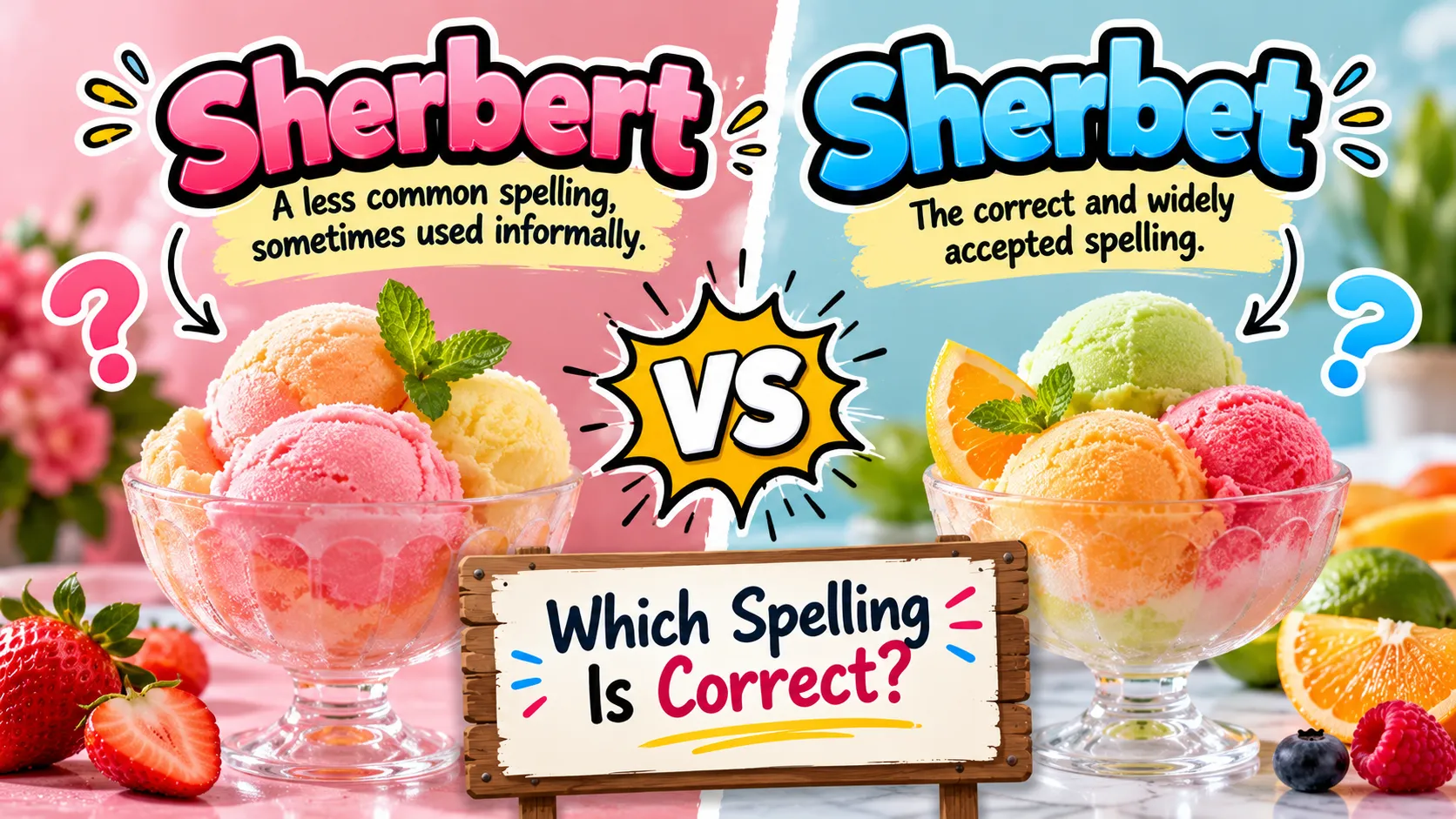
Few dessert debates spark as much confusion as the sherbert vs sherbet question. You see it on menus, in grocery stores, and in recipe books—sometimes spelled one way, sometimes the other. Both words refer to the same fruity frozen treat, yet the extra “r” in “sherbert” has divided spellers for centuries.
Sherbet is the standard spelling, pronounced “SHER-but.” Sherbert, with an added “r,” is a common variant that dictionaries now recognize as acceptable, though far less common in formal writing . The confusion stems from the word’s origins and the natural human tendency to add consonants that feel right. This comprehensive guide explains the difference, explores the word’s fascinating history, and helps you choose the spelling that suits your audience.
Quick Answer
“Sherbet” is the standard spelling for the fruity frozen dessert, pronounced “SHER-but.” “Sherbert” is a common variant spelling with an extra “r,” pronounced “SHER-bert.” Both appear in dictionaries, but “sherbet” is preferred in formal writing and professional contexts. The word comes from Arabic “sharba” (drink) and entered English in the early 1600s .
Meaning Overview Table
| Aspect | Meaning |
|---|---|
| Definition | A frozen dessert made with fruit juice and a small amount of dairy, or a sweet powder in British English |
| Pronunciation | Sherbet: “SHER-but”; Sherbert: “SHER-bert” |
| Part of Speech | Noun |
| Usage | “We ordered raspberry sherbet for dessert” |
| Context | Cooking, food writing, menus, grocery shopping, British vs. American usage |
Main Meaning
Definition
Sherbet is a frozen dessert made from fruit or fruit juice, sugar, and a small amount of dairy—typically milk, cream, or buttermilk. In the United States, federal regulations require sherbet to contain between 1% and 2% butterfat, distinguishing it from dairy-free sorbet and higher-fat ice cream . In British English, “sherbet” often refers to a sweet powder used to make effervescent drinks .
Origin
The word traces back to the Arabic “sharba,” meaning “drink.” It passed through Turkish (“şerbet”) and Persian (“sharbat”) before entering English in the early 17th century . Originally, the word referred to a cold, sweetened fruit drink. Over centuries, the meaning evolved into the frozen dessert Americans know today. Both “sherbet” and “sherbert” appeared in early English usage, but “sherbet” became the established spelling by the late 18th century .
Context
The choice between spellings depends on context:
- Formal Writing: “Sherbet” is the standard choice for cookbooks, menus, and professional food writing
- Casual Communication: “Sherbert” appears frequently in everyday speech and informal writing
- British English: “Sherbet” refers to the powder; the frozen dessert is less commonly called by this name
- American English: Both spellings refer to the frozen dessert, with “sherbet” dominant
Modern Usage
Instacart data from 2024 reveals that 63% of shoppers search for “sherbet,” while 37% use “sherbert” . This split reflects the persistent popularity of the variant. Food publications like Merriam-Webster and Food & Wine acknowledge both spellings as valid, though they note “sherbet” as the primary form . The debate continues on social media and in comment sections, but both spellings will get you the same scoop of dessert in the United States.
Detailed Explanation
Literal Meaning
Literally, “sherbet” refers to a frozen dessert made with fruit and dairy. The word’s Arabic root “sharba” means “drink,” reflecting the original form of the treat—a chilled fruit beverage .
Common Meaning
Commonly, people use “sherbet” and “sherbert” interchangeably to describe the fruity frozen dessert. The distinction rarely matters in casual conversation. In professional food writing, however, “sherbet” is the preferred spelling .
British vs. American Meaning
In the United States, sherbet is a frozen dessert with 1% to 2% butterfat . In the United Kingdom, “sherbet” typically refers to a sweet, fizzy powder used in confections or mixed with water to create a drink . This transatlantic difference can cause confusion when ordering abroad.
Culinary Meaning
Culinary professionals distinguish sherbet from sorbet by its dairy content. Sorbet contains no dairy, while sherbet includes a small amount of milk or cream . This distinction matters for people with lactose intolerance or those following dairy-free diets.
Cultural Meaning
The sherbet vs. sherbert debate reflects broader patterns in English spelling. Words borrowed from other languages often develop multiple spellings as speakers adapt them to familiar phonetic patterns. The added “r” in “sherbert” follows a natural linguistic tendency to insert consonants between vowels, similar to how “athlete” sometimes becomes “athelete” .
Examples Table
| Example | Meaning |
|---|---|
| Raspberry sherbet | A frozen dessert flavored with raspberries |
| Orange sherbert | The variant spelling, same dessert |
| Sherbet powder | British English: a fizzy sweet powder |
| Lemon sherbet | A tart, fruity frozen treat |
| The menu lists strawberry sherbet | Standard professional spelling |
| My grandmother always said sherbert | Common colloquial pronunciation |
| Sherbet contains 1-2% butterfat | US regulatory definition |
| Sorbet has no dairy, unlike sherbet | Distinction between the two desserts |
| The candy shop sells sherbet lemons | British confectionery |
| Instacart users search both spellings | 63% sherbet, 37% sherbert |
Related Meanings Table
| Related Term | Meaning |
|---|---|
| Sorbet | A dairy-free frozen dessert made from fruit and sugar |
| Ice cream | A frozen dessert with at least 10% butterfat |
| Sharbat | The original Persian/Arabic drink from which sherbet derives |
| Sherbet powder | British English: a fizzy sweet powder |
| Sherbet lemon | A British lemon-flavored boiled sweet with fizzy powder |
| Gelato | Italian-style ice cream with lower fat and denser texture |
| Frozen yogurt | A frozen dessert made with yogurt |
| Butterfat | The fat content in dairy products, regulated in sherbet |
| Sorbetto | Italian for sorbet |
| Sharba | Arabic word meaning “drink” |
| Şerbet | Turkish word for sherbet |
| Sherbert | Variant spelling of sherbet |
| Sherbet | Standard spelling for the frozen dessert |
| Effervescent | Describing the fizzy quality of British sherbet powder |
| Palate cleanser | A light dessert served between courses, often sherbet or sorbet |
Common Uses
People use “sherbet” and “sherbert” across numerous contexts:
Cooking and Recipes: Cookbooks and recipe websites typically use “sherbet” as the standard spelling. Recipes for raspberry sherbet, lemon sherbet, and orange sherbet appear in culinary publications .
Restaurant Menus: Professional menus favor “sherbet” for its standard spelling. Some casual establishments may use “sherbert” to reflect local pronunciation.
Grocery Shopping: Instacart data shows 63% of shoppers search for “sherbet” while 37% use “sherbert” . Both searches return the same products.
British Confectionery: In the UK, “sherbet” refers to the fizzy powder found in sweets like sherbet lemons and sherbet fountains .
Dietary Discussions: People discussing lactose intolerance or dairy-free diets distinguish sherbet (contains dairy) from sorbet (dairy-free) .
Common Mistakes
| Mistake | Correction |
|---|---|
| Assuming “sherbert” is always wrong | Both spellings are dictionary-recognized variants |
| Using “sherbet” for British fizzy powder in American contexts | In the US, “sherbet” refers to the frozen dessert |
| Confusing sherbet with sorbet | Sherbet contains dairy; sorbet does not |
| Pronouncing “sherbet” as “sher-bert” in formal settings | The standard pronunciation is “SHER-but” |
| Believing the extra “r” has historical justification | The original Arabic, Turkish, and Persian words lack the second “r” |
| Using “sherbert” in professional food writing | Use “sherbet” for formal and professional contexts |
| Assuming all sherbet contains dairy in the UK | British sherbet powder is typically dairy-free |
| Thinking sherbet and sorbet are the same | Sorbet is dairy-free; sherbet contains 1-2% butterfat |
| Writing “sherbert” in academic or formal writing | “Sherbet” is the standard spelling for formal prose |
| Ignoring regional differences | British and American sherbet mean different things |
Related Questions
Is it “sherbet” or “sherbert”?
Both are correct. “Sherbet” is the standard spelling, pronounced “SHER-but.” “Sherbert” is a common variant with an added “r,” pronounced “SHER-bert.” Dictionaries recognize both .
Why do people say “sherbert” instead of “sherbet”?
The added “r” likely stems from a natural tendency to insert consonants between vowels. The original Arabic, Turkish, and Persian words lack the second “r,” but English speakers have used both spellings since the early 17th century .
Is “sherbert” in the dictionary?
Yes. Merriam-Webster and other dictionaries list “sherbert” as a less common variant of “sherbet” .
What is the difference between sherbet and sorbet?
Sherbet contains a small amount of dairy (1-2% butterfat in the US), while sorbet is dairy-free .
What does “sherbet” mean in British English?
In the UK, “sherbet” often refers to a sweet, fizzy powder used to make drinks or eaten as candy, not the frozen dessert .
Where does the word “sherbet” come from?
It comes from the Arabic “sharba” (drink), passed through Turkish and Persian into English in the early 1600s .
FAQs
What is the correct spelling: sherbet or sherbert?
Both are correct. “Sherbet” is the standard spelling and preferred in formal writing. “Sherbert” is a recognized variant that appears frequently in casual usage .
Is sherbet pronounced “sher-bert”?
The standard pronunciation is “SHER-but.” However, many people say “SHER-bert,” and this pronunciation is widely accepted .
Why does sherbet have an “r” in some spellings?
The extra “r” likely developed from English speakers’ tendency to add consonants between vowels. The original words in Arabic, Turkish, and Persian lack the second “r” .
Is sherbet healthy?
Sherbet is lower in fat than ice cream (1-2% butterfat vs. at least 10%) but contains sugar. It is not a health food, but it can be a lighter dessert option .
Can I use “sherbert” in a cookbook?
“Sherbet” is preferred for professional food writing, though “sherbert” is not technically wrong. Style guides and editors generally choose “sherbet” .
What is the difference between sherbet and ice cream?
Sherbet contains 1-2% butterfat, while ice cream contains at least 10%. Sherbet also typically contains fruit, giving it a tarter flavor .
Does British sherbet contain dairy?
British sherbet powder is typically dairy-free, made from sugar and flavorings. The frozen dessert called sherbet in the US is less common in the UK .
Which spelling is more popular?
Instacart data from 2024 shows 63% of shoppers search for “sherbet” and 37% for “sherbert” .
Conclusion
The sherbert vs sherbet debate has no clear villain. Both spellings are correct, both appear in dictionaries, and both refer to the same fruity frozen treat. “Sherbet” is the standard choice for formal writing, cookbooks, and professional menus. “Sherbert” reflects how many people actually speak and has persisted for centuries despite lacking etymological justification. Whether you prefer the classic “sherbet” or the colloquial “sherbert,” your meaning remains clear. Choose the spelling that fits your audience, apply it consistently, and enjoy your dessert without worrying about the extra letter.

Natalie Brooks is a content researcher and writer with a strong interest in word meanings, dream interpretations, symbolism, and cultural insights. She is passionate about creating clear, informative, and easy-to-understand content that helps readers discover the deeper meanings behind words, names, dreams, and symbols. Through her work at Meanzly, Natalie aims to make knowledge accessible and valuable for readers around the world.