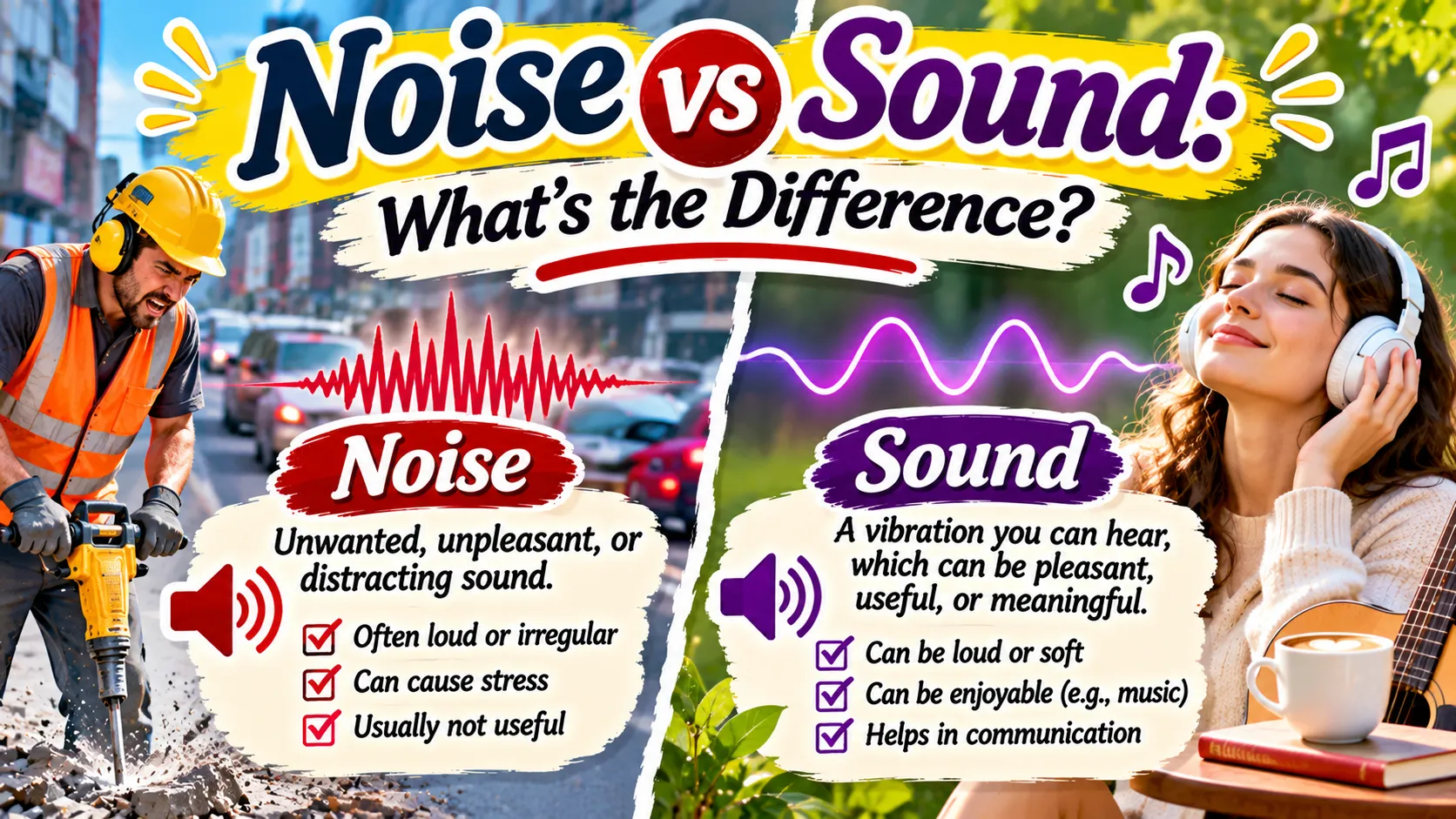
The words “noise” and “sound” appear interchangeable in everyday conversation, yet they carry distinctly different meanings. The noise vs sound distinction matters in physics, environmental science, music, and any context where precision about what we hear matters. Understanding when to use each word helps you communicate with accuracy and emotional nuance.
Sound is any vibration that travels through a medium and can be heard by the ear. Noise is unwanted, unpleasant, or disruptive sound. Every noise is a sound, but not every sound is a noise. A symphony orchestra produces sound; a jackhammer produces noise. The difference lies in perception, context, and purpose. This comprehensive guide explains the distinction, explores the origins of both words, provides practical examples, and helps you choose the right word every time.
Quick Answer
Sound is any vibration that travels through a medium and can be heard—it is neutral and objective. Noise is unwanted, unpleasant, or disruptive sound—it is subjective and often negative. Every noise is a sound, but not every sound is a noise. Use “sound” for neutral descriptions and “noise” for unpleasant or disruptive sounds.
Meaning Overview Table
| Aspect | Meaning |
|---|---|
| Definition | Sound: any audible vibration. Noise: unwanted or unpleasant sound |
| Pronunciation | Sound: /saʊnd/; Noise: /nɔɪz/ |
| Part of Speech | Both are nouns and verbs |
| Usage | “The sound of music” vs. “The noise of traffic” |
| Context | Physics, acoustics, music, environmental science, everyday speech |
Main Meaning
Definition
Sound is a vibration that travels through a medium (such as air, water, or solid material) and can be detected by the ear. It is a neutral, objective term describing any audible phenomenon. Sound has measurable properties: frequency, amplitude, wavelength, and speed.
Noise is unwanted, unpleasant, or disruptive sound. It is a subjective term depending on the listener’s perception and context. What one person considers noise, another might consider music or a pleasant sound.
Origin
“Sound” comes from the Latin sonus, meaning “a noise” or “a sound,” through Old French son. The word has been used in English since the 13th century to describe audible vibrations.
“Noise” comes from the Old French noise, meaning “din,” “quarrel,” or “uproar.” The word may trace to the Latin nausea (“seasickness”) or to a pre-Latin Mediterranean root. It entered English in the 13th century with connotations of unpleasantness and disruption.
Context
The distinction matters across several contexts:
- Physics and Acoustics: “Sound” is the technical term for mechanical waves; “noise” describes unwanted acoustic energy
- Environmental Science: “Noise pollution” describes harmful or annoying sound levels
- Music: “Sound” describes musical tones; “noise” describes discordant or non-musical sounds
- Everyday Speech: People use “sound” neutrally and “noise” negatively
- Engineering: “Noise” describes unwanted signal interference in electronics and communications
Modern Usage
Today, “sound” dominates in technical and neutral contexts. “Noise” appears in discussions of pollution, annoyance, and unwanted interference. The phrase “noise pollution” has become standard in environmental discourse. The distinction matters in legal contexts, where noise ordinances regulate disruptive sounds.
Detailed Explanation
Literal Meaning
Literally, “sound” refers to any audible vibration. “Noise” literally refers to unwanted or unpleasant sound. The literal distinction rests on perception and context rather than physics.
Common Meaning
Commonly, people use “sound” to describe anything they hear, without judgment. “I heard the sound of footsteps.” They use “noise” to describe sounds that annoy or disturb. “The noise from the construction site kept me awake.”
Physics Meaning
In physics, sound is a mechanical wave that propagates through a medium. It has measurable properties: frequency (measured in hertz), amplitude (measured in decibels), and wavelength. Noise, in physics and engineering, refers to unwanted or random fluctuations in a signal. Signal-to-noise ratio measures how much useful information exists compared to unwanted interference.
Environmental Meaning
In environmental science, noise pollution refers to harmful or annoying levels of sound caused by human activity. Traffic, construction, and industrial machinery produce noise pollution. Governments regulate noise levels through ordinances and standards. The term “noise” here emphasizes the negative impact on health and quality of life.
Music Meaning
In music, sound refers to musical tones and notes. Noise refers to discordant, non-musical, or unpleasant sounds. Some avant-garde composers deliberately incorporate noise into their music. The distinction between sound and noise in music is subjective and culturally dependent.
Examples Table
| Example | Meaning |
|---|---|
| The sound of the ocean is calming. | Neutral, pleasant audible vibration |
| The noise from the party kept me awake. | Unwanted, disruptive sound |
| Sound travels faster in water than in air. | Physics: mechanical wave |
| The engine makes a strange noise. | Unpleasant or concerning sound |
| She loves the sound of rain on the roof. | Pleasant, comforting sound |
| Noise pollution affects urban health. | Harmful environmental sound |
| The sound of his voice reassured her. | Neutral or pleasant sound |
| The noise of the crowd was deafening. | Loud, overwhelming sound |
| The sound system at the concert was excellent. | Audio equipment |
| The noise-canceling headphones block unwanted sound. | Technology for reducing noise |
Related Meanings Table
| Related Term | Meaning |
|---|---|
| Sound | Any audible vibration; neutral term |
| Noise | Unwanted or unpleasant sound; subjective term |
| Noise pollution | Harmful or annoying environmental sound |
| Sound wave | A mechanical wave that transmits sound |
| Decibel | Unit for measuring sound intensity |
| Frequency | The pitch of a sound, measured in hertz |
| Signal-to-noise ratio | Measure of useful signal compared to unwanted noise |
| White noise | Random sound containing all frequencies |
| Background noise | Ambient sound in an environment |
| Noise-canceling | Technology that reduces unwanted sound |
| Acoustics | The science of sound |
| Audio | Recorded or transmitted sound |
| Din | Loud, unpleasant noise |
| Racket | Loud, disturbing noise |
| Silence | The absence of sound |
Common Uses
People use “sound” and “noise” across numerous contexts:
Everyday Conversation: People describe pleasant sounds (“the sound of birds”) and unpleasant noise (“the noise of traffic”). The choice reflects emotional response.
Environmental Policy: Governments regulate noise pollution through ordinances. The term “noise” emphasizes health impacts and annoyance.
Music and Audio: Musicians discuss sound quality, sound systems, and sound design. Sound engineers minimize noise in recordings.
Physics and Engineering: Scientists measure sound waves and analyze noise in signals. The distinction matters in telecommunications and electronics.
Healthcare: Doctors assess hearing and sound exposure. Noise-induced hearing loss is a recognized occupational hazard.
Common Mistakes
| Mistake | Correction |
|---|---|
| Using “noise” for pleasant sounds | Use “sound” for neutral or pleasant audible vibrations |
| Using “sound” for unwanted disruption | Use “noise” for unwanted or unpleasant sound |
| Writing “noise of music” when describing a concert | Write “sound of music” for neutral description |
| Writing “sound pollution” | Write “noise pollution” (standard term) |
| Confusing “sound” and “noise” in technical writing | Use “sound” for the physical phenomenon; “noise” for unwanted signal |
| Assuming all sound is noise | Not all sound is unwanted or unpleasant |
| Assuming all noise is loud | Noise can be quiet but still unwanted |
| Writing “noise wave” | Write “sound wave” (the physical phenomenon) |
| Writing “noise system” | Write “sound system” (audio equipment) |
| Forgetting that “noise” is subjective | What one person calls noise, another calls sound |
Related Questions
Is it “noise” or “sound”?
It depends on meaning. Use “sound” for neutral or objective descriptions of audible vibrations. Use “noise” for unwanted, unpleasant, or disruptive sound.
What is the difference between noise and sound?
Sound is any audible vibration. Noise is unwanted or unpleasant sound. Every noise is a sound, but not every sound is a noise.
Is noise always loud?
No. Noise can be quiet but still unwanted. A dripping faucet at night is noise even though it is not loud.
What is noise pollution?
Noise pollution is harmful or annoying environmental sound caused by human activity, such as traffic, construction, or industrial machinery.
What is white noise?
White noise is random sound containing all audible frequencies at equal intensity. People use it to mask unwanted sounds and aid sleep.
What is the difference between sound and noise in physics?
In physics, sound is a mechanical wave. Noise refers to unwanted or random fluctuations in a signal. Signal-to-noise ratio measures the clarity of a signal.
Can music be noise?
Yes. What one person considers music, another may consider noise. The distinction is subjective and culturally dependent.
How can I remember the difference?
Remember: sound is neutral; noise is negative. If you’re describing something pleasant or neutral, use “sound.” If you’re describing something unwanted or disruptive, use “noise.”
FAQs
What does “sound” mean?
“Sound” refers to any vibration that travels through a medium and can be heard. It is a neutral, objective term.
What does “noise” mean?
“Noise” refers to unwanted, unpleasant, or disruptive sound. It is a subjective term depending on the listener’s perception.
Is noise always unpleasant?
Usually yes, but not always. Noise is defined by being unwanted rather than inherently unpleasant. Loud music at a party might be noise to a neighbor but a pleasant sound to the partygoers.
What is “noise pollution”?
Noise pollution is harmful or annoying environmental sound caused by human activity. It is a recognized environmental and public health issue.
What is “white noise”?
White noise is random sound containing all frequencies at equal intensity. It is often used to mask unwanted sounds.
Can “noise” be used positively?
Rarely. “Noise” almost always carries negative connotations. In some contexts, like “making some noise” at a concert, it can mean enthusiastic sound, but the word still implies disruption.
What is the difference between “sound” and “noise” in music?
In music, “sound” refers to musical tones and notes. “Noise” refers to discordant, non-musical, or unpleasant sounds. The distinction is subjective.
Conclusion
Mastering the noise vs sound distinction improves your writing and clarifies your meaning. Sound is any audible vibration—neutral and objective. Noise is unwanted or unpleasant sound—subjective and often negative. Remember the simple rule: sound is neutral; noise is negative. Whether you’re writing an environmental report, a music review, or a casual message, choosing the correct word ensures your readers understand whether you’re describing something pleasant or disruptive. Practice using “sound” for neutral descriptions and “noise” for unwanted disruption, and your writing will gain precision and emotional accuracy. Small distinctions like this separate careful writers from careless ones.

Natalie Brooks is a content researcher and writer with a strong interest in word meanings, dream interpretations, symbolism, and cultural insights. She is passionate about creating clear, informative, and easy-to-understand content that helps readers discover the deeper meanings behind words, names, dreams, and symbols. Through her work at Meanzly, Natalie aims to make knowledge accessible and valuable for readers around the world.