Your cat’s tail is one of the most expressive parts of their body. From a gentle flick to an upright quiver, every movement conveys a specific message about your feline friend’s emotional state. Understanding cat tail language is essential for any pet owner who wants to strengthen their bond with their cat and ensure their well-being. A cat’s tail is a sophisticated communication tool, and learning to read its signals can help you recognize when your cat is happy, anxious, playful, or agitated . This comprehensive guide decodes all the common cat tail meanings, helping you become fluent in feline body language.
Quick Answer
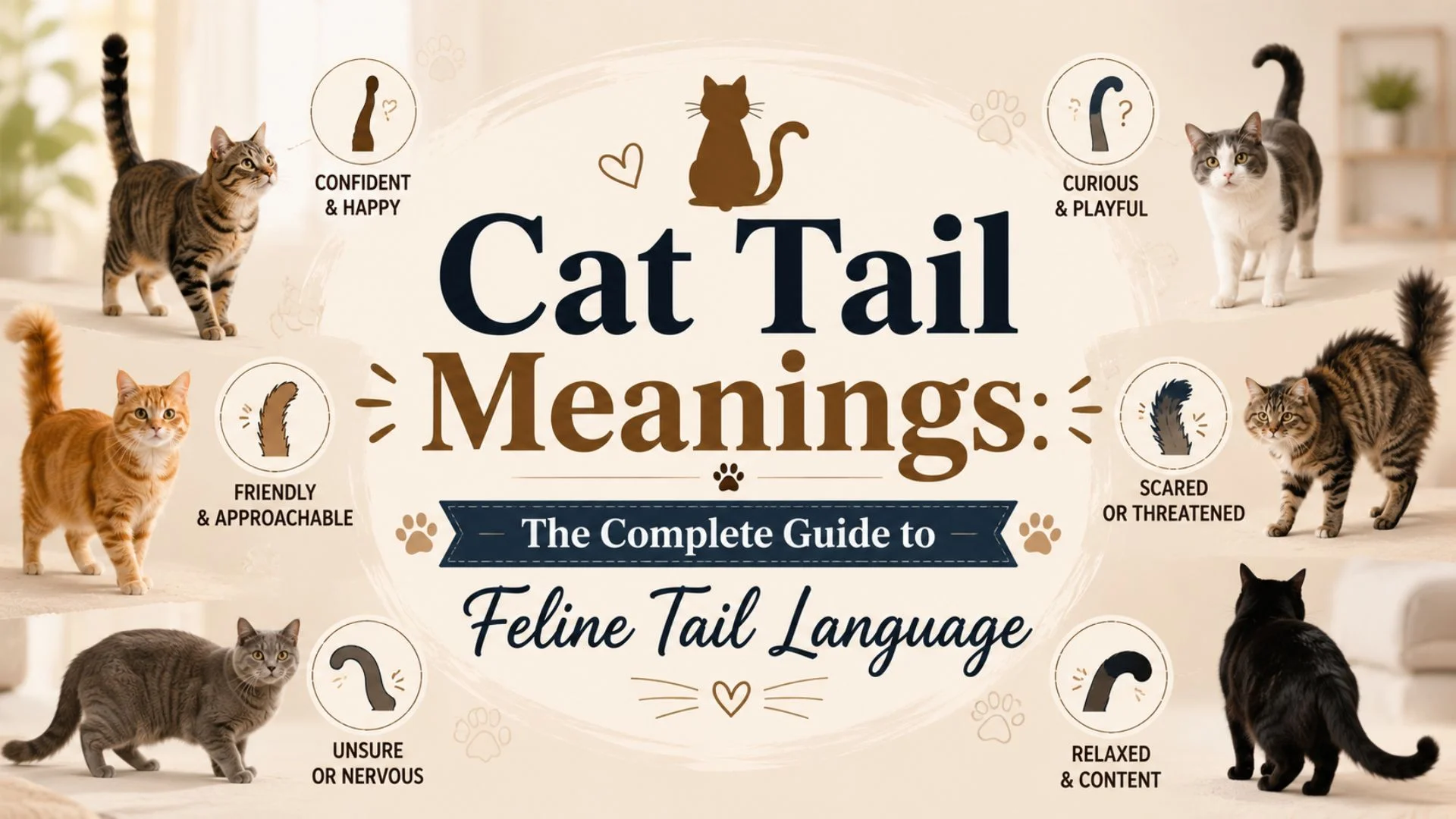
Cat tail meanings range widely. A tail held straight up indicates confidence and happiness, while a puffed-up tail signals fear or aggression. A slow swishing tail shows focused attention, and a thumping tail means irritation . Cats use their tails for balance, environmental sensing, and expressing emotions like excitement, anxiety, and affection .
Meaning Overview Table
| Aspect | Meaning |
|---|---|
| Definition | The various positions and movements of a cat’s tail that communicate their emotional state and intentions |
| Pronunciation | /kæt teɪl ˈmiːnɪŋz/ |
| Part of Speech | Noun phrase |
| Usage | Used when interpreting feline body language for pet care and bonding |
| Context | Pet ownership, veterinary care, animal behavior studies |
Main Meaning
A cat’s tail is a barometer of their feelings. Domestic cats are unique among felines for being able to hold their tails vertically while walking, a trait they share only with lions . A cat’s tail contains 18 to 23 vertebrae, encased in muscles that allow finely graded movements in almost any direction . This gives cats precise control over their tail to send deliberate messages to other cats and humans. The tail serves three primary purposes: sensing the environment behind them, providing balance during movement, and communicating emotional states .
Detailed Explanation
Literal Meaning
Literally, a cat’s tail is an extension of their spine, comprising multiple vertebrae, muscles, nerves, and blood vessels. Cats have full control over their tails, using them for balance, particularly when navigating narrow ledges or making sharp turns . The tail acts as a counterbalance—if a cat moves their head to the left, they instinctively move their tail to the right to stay stable .
Common Meaning
In everyday pet ownership, cat tail meanings refer to the emotional signals cats send through tail positions. The most common interpretations include:
- Upright tail: happiness, confidence, and a friendly greeting
- Question mark curve: playfulness and a desire to interact
- Puffed tail: fear or defensiveness
Text and Internet Meaning
In online discussions and pet care articles, “cat tail meaning” has become a popular search topic. Forums and social media posts frequently share tail language guides, often using phrases like “cat tail speak” or “reading cat tail language.” The domestic cat is the only feline species that can hold its tail vertically while walking, which makes this behavior particularly interesting to cat owners online .
Slang Meaning
Among pet owners, phrases like “happy tail” or “swishy tail” are slang for specific moods. Cat owners might say “the tail doesn’t lie” to emphasize that tail signals are reliable indicators of a cat’s true feelings, unlike human expressions which can be more ambiguous.
Cultural Meaning
In many cultures, cats are seen as mysterious creatures, and their tail movements contribute to this mystique. The “Halloween cat” silhouette—arched back with puffed tail—is one of the most recognizable feline images in Western culture, representing fear or defensive aggression . Some cat breeds, like the Manx, are born without tails and are culturally valued for this unique trait, though it can come with health implications known as Manx syndrome .
Examples Table
| Example | Meaning |
|---|---|
| Tail held straight up when you come home | Confident, happy to see you |
| Tail with a question-mark curl at the tip | Friendly and wants to play |
| Tail thumping loudly on the floor | Irritated—stop what you’re doing |
| Puffed-up tail with arched back | Frightened and defensive |
| Tail tucked between the legs | Anxious, fearful, or submissive |
| Tail swishing slowly side to side | Focused, hunting, or about to pounce |
| Quivering or vibrating upright tail | Excited (could be spraying or pure happiness) |
| Tail wrapped around your leg | Affection—like a feline hug |
| Tail held low and still | Cautious, worried, or in pain |
| Tail twitching at the tip while playing | Concentrating, hunting mode |
Related Meanings Table
| Related Term | Meaning |
|---|---|
| Cat tail language | The system of communication using tail positions |
| Cat tail wagging | Often irritation, unlike dog tail wagging |
| Cat tail straight up | Confidence and happiness |
| Puffed cat tail | Fear or aggression |
| Cat tail thumping | Anger or irritation |
| Cat tail between legs | Fear or submission |
| Cat tail question mark | Playfulness or uncertainty |
| Cat tail wrapped around you | Affection |
| Cat tail flicking | Irritation or concentration |
| Cat tail quivering | Excitement or urine marking |
| Cat tail down | Sadness, insecurity, or illness |
| Cat tail swishing | Focused attention, often while hunting |
| Cat tail brushing | A sign of affection, like a gentle touch |
| Cat tail with ears back | Aggression or fear |
| Cat tail vibrating | Excited greeting or spray marking |
Common Uses
Cat tail language is commonly used by pet owners, veterinarians, and animal behaviorists to assess a cat’s mood and well-being. Recognizing tail signals can help you:
- Know when your cat wants attention versus when they need space
- Prevent bites and scratches by noticing early irritation signs
- Identify stress or illness that may require veterinary attention
- Enhance bonding by responding appropriately to your cat’s emotional state
Common Mistakes
| Mistake | Correction |
|---|---|
| Assuming a wagging cat tail means happiness like a dog | In cats, tail wagging usually means irritation or focused attention, not joy |
| Ignoring tail signals when petting | Always watch for tail flicking to avoid overstimulation |
| Thinking a puffed tail is always playful | A puffed tail indicates fear or defensiveness |
| Believing all tail movements are voluntary | Some tail movements are involuntary emotional responses |
| Missing environmental context | The cat’s overall body language and surroundings matter |
| Confusing hunting swishing with irritation | Slow swishing while crouched = hunting; fast thumping = irritation |
| Thinking a low tail always means fear | Some breeds naturally carry tails low even when happy |
| Ignoring other body language | Eyes, ears, and whiskers also provide important clues |
| Assuming a quivering tail always means spraying | It can also mean pure excitement |
| Forgetting individual cat personalities | Not every cat follows every rule perfectly |
Related Questions
What does it mean when a cat’s tail is straight up?
A straight-up tail means your cat is confident, happy, and approachable. This is often a greeting signal when you come home or when cats meet each other amicably .
Why do cats wag their tails?
Unlike dogs, cats wag their tails to show irritation, focus, or hunting readiness. A thumping tail means “back off,” while slow swishing indicates intense concentration .
What does a puffed cat tail mean?
A puffed tail means your cat is frightened or feels threatened. This is the classic “Halloween cat” posture, often accompanied by an arched back and hissing .
Do cats control their tails?
Yes, cats have full control over their tails. The tail contains muscles, nerves, and vertebrae that allow deliberate movement, though some tail motions may be involuntary emotional responses .
Why do cats wrap their tails around you?
When a cat wraps their tail around your leg or arm, it’s a sign of affection—like a feline hug that encourages interaction and closeness .
FAQs
1. What does a cat’s tail curved like a question mark mean?
This position indicates friendliness and playfulness. The cat is feeling social and may want to interact, though it can sometimes show slight uncertainty .
2. Why does my cat thump their tail on the floor?
Tail thumping is a clear sign of irritation or anger. If your cat is thumping their tail, stop whatever you’re doing and give them space to avoid being scratched .
3. What does it mean when a cat’s tail twitches at the tip?
This often happens when a cat is concentrating, playing, or hunting. It can also indicate mild irritation, so check the context .
4. Can a cat’s tail show they’re in pain?
Yes. A tail held low or still can indicate pain or illness. If your cat’s tail position changes suddenly without an obvious emotional cause, consult a veterinarian .
5. What does it mean when a cat’s tail quivers?
A quivering, upright tail usually means excitement, often when greeting you or anticipating treats. However, it can also accompany urine spraying in unneutered cats .
6. Why does my cat puff up their tail?
A puffed tail is a fear response. Your cat feels threatened and is trying to appear larger to intimidate a perceived enemy .
7. Do all cats use their tails the same way?
Most cats follow similar tail language patterns, but individual personality, breed, and age can influence behavior. Some breeds carry their tails low even when happy .
8. Is a cat’s tail sensitive to touch?
Yes, cats’ tails are sensitive, and many dislike having them held or pulled. Gentle petting is usually fine, but avoid grabbing or pulling .
Conclusion
Understanding cat tail meanings is a valuable skill that helps you better connect with your feline companion. By observing your cat’s tail alongside their ears, eyes, whiskers, and overall body posture, you gain a complete picture of their emotional world . Whether your cat greets you with a straight-up “hello flag,” thumps their tail in irritation, or wraps their tail around you in affection, each movement offers insight into their needs and feelings. Remember that every cat is an individual, and while these general guidelines are reliable, getting to know your own cat’s unique personality is the key to true communication. Start watching your cat’s tail today—you might be surprised how much they’ve been telling you all along.

Natalie Brooks is a content researcher and writer with a strong interest in word meanings, dream interpretations, symbolism, and cultural insights. She is passionate about creating clear, informative, and easy-to-understand content that helps readers discover the deeper meanings behind words, names, dreams, and symbols. Through her work at Meanzly, Natalie aims to make knowledge accessible and valuable for readers around the world.