Have you ever looked at the small tag inside your favorite shirt and felt like you were trying to decipher ancient hieroglyphics? Those tiny symbols—circles, squares, triangles, and iron shapes—are laundry symbols meanings that actually hold the key to keeping your clothes looking great and lasting longer .
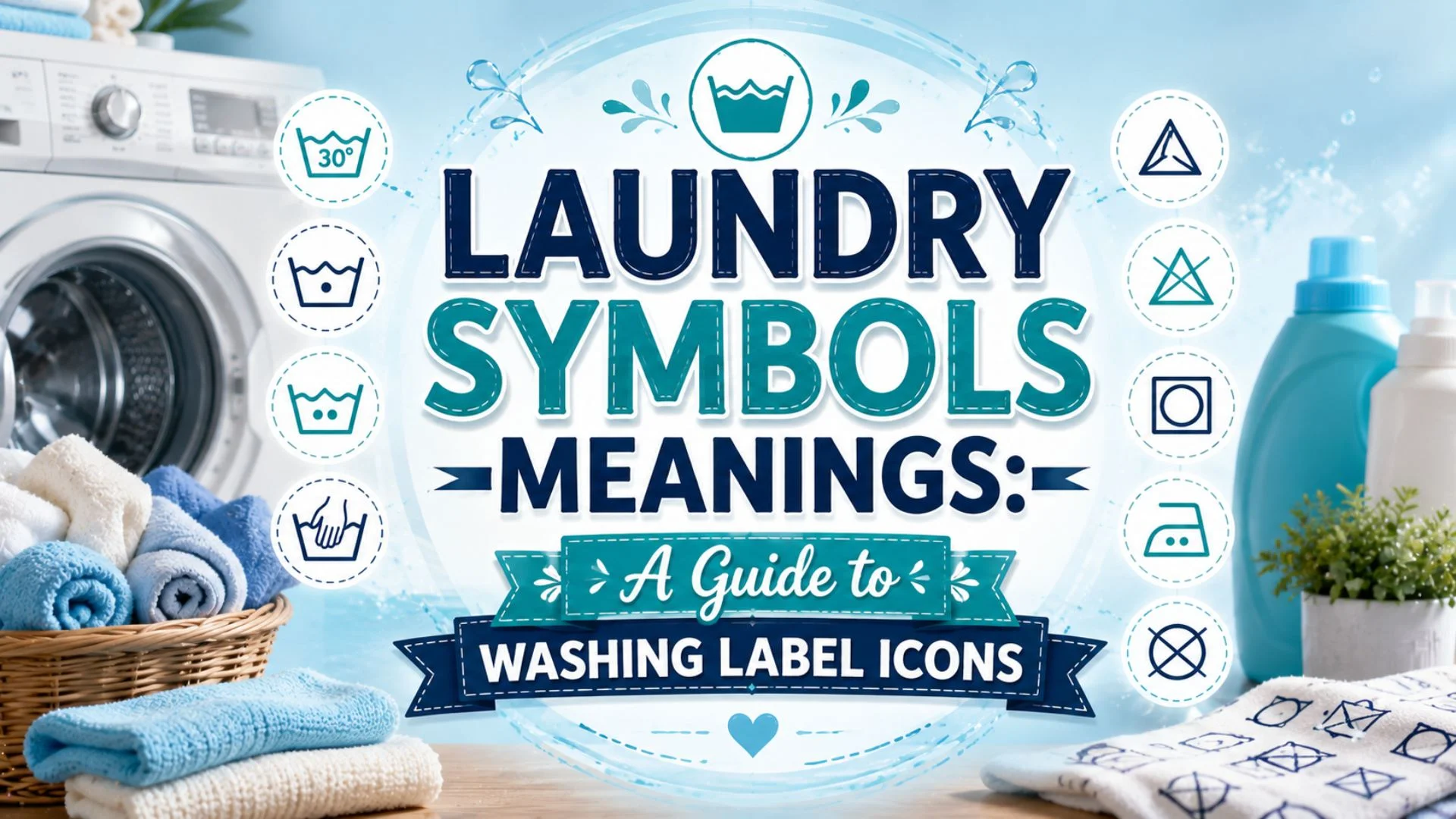
Understanding laundry symbols meanings can save your garments from shrinking, fading, and permanent damage. Clothing manufacturers worldwide use these care labels—also known as wash care symbols—as an international language.They tell you exactly how to wash, dry, bleach, iron, and dry-clean each item. While the symbols may seem confusing at first, they follow a logical system with five basic categories: washing (a tub), drying (a square), ironing (an iron), bleaching (a triangle), and dry cleaning (a circle) . Learning this system helps you protect your wardrobe and avoid costly laundry mistakes.
Quick Answer
Laundry symbols meanings are standardized pictograms on clothing care labels that tell you how to safely wash, dry, bleach, iron, and dry-clean garments. The five basic symbols are a washtub for washing, a square for drying, an iron for ironing, a triangle for bleaching, and a circle for dry cleaning. Dots indicate temperature, lines indicate wash cycles, and crossed-out symbols mean “do not.”
Meaning Overview Table
| Aspect | Meaning |
|---|---|
| Definition | Standardized icons on clothing tags that provide cleaning and care instructions |
| Pronunciation | LAWN-dree SIM-buhls MEEN-ings |
| Part of Speech | Noun phrase |
| Usage | “Always check the laundry symbols meanings before washing a new garment to avoid shrinkage.” |
| Context | Laundry care, clothing maintenance, textile care, household chores |
Main Meaning
Definition
Laundry symbols, also called care symbols or wash care symbols, are pictograms that represent a method of washing, drying, dry-cleaning, and ironing clothing . They appear on labels attached to clothing to indicate how a particular item should best be cleaned. Following these instructions helps prevent shrinkage, discoloration, pilling, and fabric damage .
Origin
GINETEX, the European association for textile care labelling, developed the international system of laundry symbols in 1963 after academic conferences in the late 1950s. The association aimed to create one standard labelling system that people across different languages and countries could understand.Before this standardization, different regions used various systems—Canada once used a color-based system where green meant “go ahead,” yellow meant “be careful,” and red meant “stop” .
Context
You’ll find laundry symbols on care labels stitched into clothing, bedding, towels, and other textiles. These labels typically display the symbols in a specific order: washing, bleaching, drying, ironing, and dry cleaning . While international standards exist, you may notice slight regional variations. European labels often show temperature numbers in Celsius, while North American labels sometimes use dots to indicate temperature .
Modern Usage
Today, laundry symbols are used on nearly every piece of clothing manufactured worldwide. They help people care for their garments properly regardless of language barriers. Many washing machines and dryers now include program symbols that correspond directly to the symbols on care labels . Smartphone apps and online guides also help decode these symbols, making laundry care more accessible than ever .
Detailed Explanation
Literal Meaning
Literally, each laundry symbol is a pictogram representing a specific care action. The washing symbol looks like a washtub with water. The drying symbol is a square (with a circle inside for tumble drying). The ironing symbol resembles an iron. The bleaching symbol is a triangle. The dry cleaning symbol is a circle .
Common Meaning
Commonly, these symbols tell you how to treat your clothes. The washtub indicates whether you can machine wash, hand wash, or not wash at all. Dots inside the symbols indicate temperature levels—more dots mean higher heat. Lines underneath indicate the cycle type—one line for permanent press, two lines for delicate or gentle cycles .
Text Meaning
In text and online content, “laundry symbols meanings” refers to the extensive guides, charts, and resources available to help people decode care labels. This has become a popular topic for household advice articles, with many people searching for quick reference guides before tackling laundry day.
Slang Meaning
Within laundry rooms and households, people often joke about these symbols looking like “hieroglyphics” or “another language” . Some refer to the crossed-out symbols as “the big NO”—meaning don’t do whatever that symbol represents.
Internet Meaning
Online, laundry symbols have become a popular topic for tips, printable charts, and even memes. Content creators share downloadable PDFs and infographics to help users quickly reference symbols . Social media users often share their laundry mishaps—”I ignored the do not tumble dry symbol”—as cautionary tales.
Social Media Meaning
On platforms like Pinterest and Instagram, laundry symbol charts are widely shared as helpful household guides. Users often tag posts with #laundrytips and #clothingcare to help others avoid laundry disasters. Printable guides are especially popular for people learning to do laundry independently.
Cultural Meaning
Different regions have developed slight variations in laundry symbols. European standards typically use numbers inside the washtub to indicate maximum wash temperature in Celsius (e.g., 30°, 40°, 60°), while North American standards more commonly use dots . However, the International Organization for Standardization (ISO) and European Union have agreed on an international standard to reduce confusion .
Examples Table
| Example | Meaning |
|---|---|
| Washtub with wavy line | Machine washable |
| Washtub with hand inside | Hand wash only |
| Washtub with cross through it | Do not wash—must be dry cleaned |
| Washtub with 30°C inside | Maximum wash temperature 30°C (cold water) |
| Washtub with one dot inside | Cold water wash (65-85°F) |
| Washtub with two dots inside | Warm water wash (max 105°F) |
| Washtub with one line underneath | Permanent press cycle |
| Washtub with two lines underneath | Gentle/delicate cycle |
| Triangle with cross through it | Do not bleach |
| Triangle with two diagonal lines inside | Only non-chlorine bleach allowed |
| Square with circle inside | Tumble dry allowed |
| Square with circle crossed out | Do not tumble dry |
| Iron with cross through it | Do not iron |
| Iron with two dots inside | Medium heat ironing (150°C) |
| Circle with cross through it | Do not dry clean |
Related Meanings Table
| Related Term | Meaning |
|---|---|
| Care label | The tag attached to clothing showing care symbols |
| Wash care symbols | Another term for laundry care symbols |
| Machine wash | Washing in a washing machine (tub with wavy line) |
| Hand wash | Washing by hand in a sink or basin (tub with hand) |
| Permanent press | A wash cycle for wrinkle-resistant fabrics (one line under tub) |
| Delicate cycle | A gentle wash cycle for fragile fabrics (two lines under tub) |
| Gentle cycle | Alternative term for delicate cycle |
| Cold wash | Washing at 30°C or one dot |
| Warm wash | Washing at 40°C or two dots |
| Hot wash | Washing at 60°C or three dots |
| Tumble dry | Machine drying (square with circle) |
| Line dry | Drying on a clothesline (square with curved line) |
| Dry flat | Laying item flat to dry (square with horizontal line) |
| Bleach | Using bleaching agents (triangle symbol) |
| Non-chlorine bleach | Oxygen-based bleach safe for colors (triangle with two lines) |
| Dry clean | Professional chemical cleaning (circle symbol) |
| Wet cleaning | Professional water-based cleaning (circle with W) |
Common Uses
Laundry symbols are commonly used in everyday life whenever people do laundry.You’ll encounter these symbols on clothing tags, bedding, towels, and even some upholstery. Understanding them helps you select the correct washing machine cycle, water temperature, and drying method.
People commonly check these symbols when:
- Buying new clothes—to understand care requirements before purchase
- Doing laundry—to prevent shrinking, fading, or damage
- Cleaning delicate items like silk, wool, or cashmere
- Deciding whether to use bleach on white garments
- Determining if an item needs professional dry cleaning
- Choosing between air drying and tumble drying
Many modern washing machines and dryers also display program symbols that correspond directly to laundry symbols. Learning these symbols helps you match your machine’s settings to what the label recommends .
Common Mistakes
| Mistake | Correction |
|---|---|
| Ignoring laundry symbols completely | Always check the label before washing any garment—especially new items |
| Assuming “dry clean only” can be washed at home | Follow the dry clean symbol—hand washing can ruin certain fabrics |
| Using bleach on a “do not bleach” item | Look for the crossed-out triangle—bleach can destroy wool, silk, and spandex |
| Mixing up cold and warm wash symbols | One dot = cold (30°C), two dots = warm (40°C), three dots = hot (60°C) |
| Tumble drying items that should be hung | Check for the crossed-out dryer symbol—heat can shrink or warp fabrics |
| Ironing on the wrong temperature | Match dots to heat levels: one dot = low, two dots = medium, three dots = high |
| Ignoring the hand wash symbol | A hand in the tub means machine washing can damage the item |
| Using steam when the symbol says no steam | Crossed-out lines below the iron mean no steam |
| Wringing out delicate items | Look for the crossed-out twisted fabric symbol—wringing can stretch and damage fibers |
| Not noticing the cycle lines | One line = permanent press, two lines = gentle/delicate cycle |
Related Questions
What does the washing tub symbol mean?
The washing tub symbol indicates whether an item can be machine washed, hand washed, or not washed at all. A tub with a wavy line means machine washable, a tub with a hand means hand wash only, and a crossed-out tub means do not wash .
What do the dots on laundry symbols mean?
Dots indicate temperature. One dot = cold/low heat, two dots = warm/medium heat, three dots = hot/high heat. This applies to washing, drying, and ironing symbols .
What does the triangle symbol mean on clothes?
The triangle symbol relates to bleaching. An empty triangle means bleach is allowed, a triangle with two diagonal lines means use only non-chlorine bleach, and a crossed-out triangle means do not bleach .
What is the symbol for dry clean only?
The dry clean only symbol is an empty circle. A circle with a cross through it means do not dry clean. Sometimes letters like A, P, or F appear inside the circle to guide professional dry cleaners on which solvents to use .
What do the lines under laundry symbols mean?
Lines under symbols indicate the cycle type. No lines = normal cycle, one line = permanent press cycle, and two lines = gentle/delicate cycle. This applies to washing and drying symbols .
What does 30 on a laundry label mean?
The number 30 on a laundry label indicates the maximum water temperature in degrees Celsius (30°C or about 86°F). This is a cold wash setting, typically used for delicate or dark-colored fabrics .
FAQs
What are the five basic laundry symbols?
The five basic laundry symbols are a washtub (washing), a square (drying), an iron (ironing), a triangle (bleaching), and a circle (dry cleaning). Each symbol has variations that indicate specific care instructions like temperature and cycle type .
Can I dry clean a garment with a “do not wash” symbol?
Yes. A crossed-out washtub means the garment cannot be washed with water, so it must be dry cleaned. Look for the circle symbol (dry clean) to confirm professional cleaning is recommended .
What is the difference between chlorine bleach and non-chlorine bleach symbols?
An empty triangle means you can use any bleach (including chlorine). A triangle with two diagonal lines means you should use only non-chlorine bleach (oxygen-based). A crossed-out triangle means no bleach at all .
What does a square with a circle inside mean?
A square with a circle inside means the garment can be tumble dried. Dots inside the circle indicate temperature settings: one dot = low heat, two dots = medium heat, three dots = high heat. A crossed-out symbol means do not tumble dry .
What is the hand wash symbol?
This means you must hand wash the garment only—never use a washing machine. Typically, use water at a maximum temperature of 40°C (104°F).
How do I iron clothes if the label has no dots?
An iron symbol with no dots means you can iron at any temperature. The dots help you choose the right heat: one dot = low (110°C), two dots = medium (150°C), three dots = high (200°C). A crossed-out iron means do not iron at all .
What do the letters A, P, and F mean in dry cleaning symbols?
These letters guide professional dry cleaners on which solvents to use. “A” means any solvent can be used, “P” means petroleum-based solvents only, and “F” means certain solvents should be avoided.Most consumers don’t need to worry about these—they’re instructions for the dry cleaner .
What is the symbol for line drying?
The line drying symbol is a square with a curved line across the top (like a clothesline). A square with a horizontal line inside means dry flat, and a square with three vertical lines means drip dry. A crossed-out twisted fabric symbol means do not wring the item .
Conclusion
Understanding laundry symbols meanings is essential for anyone who wants to keep their clothes looking great and lasting longer. These standardized icons—from the washtub and square to the triangle and circle—provide a universal language that helps you wash, dry, bleach, iron, and dry-clean garments correctly. By learning what each symbol represents, you can avoid common laundry disasters like shrinking, fading, and fabric damage .
The system is simpler than it first appears. Remember the five basic shapes: tub (washing), square (drying), iron (ironing), triangle (bleaching), and circle (dry cleaning). Dots indicate temperature, lines indicate cycle type, and crossed-out symbols mean “do not.” Once you understand these basics, you’ll be able to read any care label with confidence. The next time you do laundry, take a moment to check those symbols—your clothes will thank you.

Natalie Brooks is a content researcher and writer with a strong interest in word meanings, dream interpretations, symbolism, and cultural insights. She is passionate about creating clear, informative, and easy-to-understand content that helps readers discover the deeper meanings behind words, names, dreams, and symbols. Through her work at Meanzly, Natalie aims to make knowledge accessible and valuable for readers around the world.