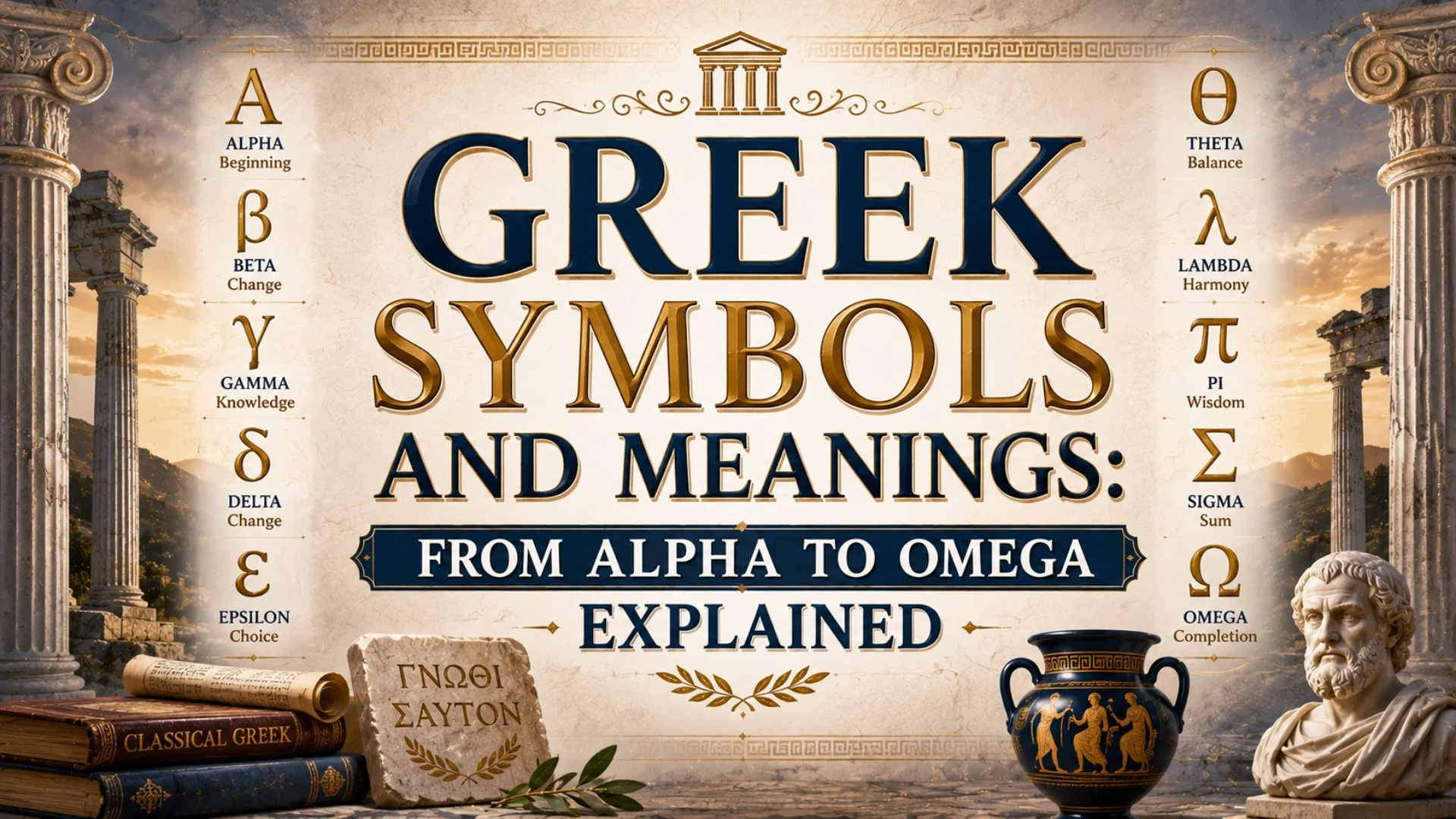
Greek symbols have shaped human knowledge for over 2,800 years, serving as the foundation for modern mathematics, science, engineering, and cultural expression. The Greek alphabet emerged around 800 BCE as the first writing system to include distinct letters for both vowels and consonants, making it a revolutionary leap in human communication . Today, Greek symbols and meanings extend far beyond the language itself—they permeate geometry, physics, statistics, engineering, and even everyday life.
From the mathematical constant π (pi) that calculates circles to the wavelength symbol λ (lambda) used in physics, Greek letters provide a universal shorthand for complex ideas. Their shapes appear in fraternity and sorority emblems, company logos, and global brand identities. Understanding Greek symbols and their meanings unlocks a deeper appreciation for the hidden language of formulas, scientific papers, and cultural artifacts that surround us daily.
Quick Answer
Greek symbols and meanings refer to the 24 letters of the Greek alphabet, each with distinct names, pronunciations, and applications across mathematics, science, engineering, and culture. From α (alpha) representing angles to ω (omega) signifying finality, these symbols convey abstract concepts, constants, and variables. The alphabet originated from Phoenician script and became the foundation for Latin and Cyrillic writing .
Meaning Overview Table
| Aspect | Meaning |
|---|---|
| Definition | The 24-character Greek alphabet used as symbols for mathematical constants, scientific variables, and cultural references |
| Pronunciation | Greek SIM-buhls and MEAN-ings |
| Part of Speech | Noun phrase |
| Usage | “Engineers use Greek symbols like θ and λ to represent variables in formulas.” |
| Context | Mathematics, physics, engineering, statistics, chemistry, astronomy, and culture |
Main Meaning
Definition
Greek symbols and meanings encompass the 24 letters of the Greek alphabet—alpha to omega—along with their associated names, pronunciations, and applications across various disciplines. These symbols represent mathematical constants, scientific variables, statistical parameters, and cultural concepts. The alphabet consists of 24 characters, each with uppercase and lowercase forms .
Origin
The Greek alphabet originated around 800 BCE as an adaptation of the Phoenician writing system . It was revolutionary because it introduced distinct symbols for vowel sounds, a concept absent in previous semitic scripts. The Greeks refined and standardized the alphabet over centuries, eventually creating the classical 24-letter system used today. This alphabet became the ancestor of Latin and Cyrillic scripts, making it one of history’s most influential writing systems .
Context
Greek symbols appear across virtually every technical discipline. In mathematics, they denote constants (π, φ), functions (Γ, ζ), and operators (Σ, Π). In physics, they represent physical quantities like wavelength (λ), density (ρ), and angular velocity (ω). Statistics uses them for population parameters (μ, σ, ρ). Chemistry employs them for reaction extents (ξ) and stoichiometric coefficients (ν) . The context determines each symbol’s precise meaning—the same Greek letter can represent different concepts in different fields.
Modern Usage
Modern usage of Greek symbols spans academia, industry, and popular culture. They appear in scientific publications, engineering textbooks, technical documentation, and software coding. Fraternities and sororities use Greek letters as organizational identifiers. Brands incorporate them into logos for sophistication. The search for meaning behind Greek symbols has grown as more people encounter them in everyday contexts—from π on calculators to ω in technology branding.
Detailed Explanation
Literal Meaning
Literally, Greek symbols are the 24 characters of the Greek writing system. Each letter has a specific name (alpha, beta, gamma, etc.), a corresponding uppercase and lowercase form, and a phonetic value. While the ancient pronunciation differs from modern Greek, standardized English pronunciations have evolved for academic use .
Common Meaning
Commonly, Greek symbols represent mathematical and scientific concepts. Pi (π) universally signifies 3.14159, the ratio of circumference to diameter. Sigma (Σ) indicates summation. Delta (Δ) means change or difference. Theta (θ) typically denotes angles. These conventions make Greek symbols a universal technical shorthand transcending language barriers .
Text Meaning
In written texts and online content, “Greek symbols and meanings” refers to the growing body of educational resources that decode these symbols. Students, researchers, and curious readers consult these guides to understand formulas, technical papers, and scientific notation. The keyword captures search intent from those encountering unfamiliar Greek letters in academic contexts.
Cultural Meaning
Culturally, Greek symbols represent Western civilization’s intellectual heritage. They connect to ancient Greek philosophy, mathematics, and science—the foundations of modern knowledge. Organizations, religious groups, and educational institutions use Greek letters to evoke tradition, scholarship, and authority. The letters carry cultural weight beyond their literal function as writing characters.
Examples Table
| Example | Meaning |
|---|---|
| π (pi) | Mathematical constant 3.14159; ratio of circumference to diameter |
| Σ (sigma) | Summation operator in mathematics |
| Δ (delta) | Change or difference between two values |
| θ (theta) | Variable for angles in geometry and trigonometry |
| λ (lambda) | Wavelength in physics; eigenvalue in linear algebra |
| μ (mu) | Population mean in statistics; coefficient of friction |
| σ (sigma) | Population standard deviation in statistics |
| ρ (rho) | Population correlation coefficient in statistics |
| α (alpha) | Statistical significance level; angular acceleration |
| β (beta) | Type II error probability in hypothesis testing |
Related Meanings Table
| Related Term | Meaning |
|---|---|
| Alpha (α) | First letter; beginning; statistical significance level |
| Beta (β) | Second letter; probability of Type II error |
| Gamma (Γ, γ) | Third letter; gamma function; surface tension |
| Delta (Δ, δ) | Fourth letter; change; discriminant; Dirac delta function |
| Epsilon (ε) | Fifth letter; small quantity; permittivity |
| Zeta (ζ) | Sixth letter; Riemann zeta function |
| Eta (η) | Seventh letter; efficiency; viscosity |
| Theta (θ) | Eighth letter; angle; parameter |
| Iota (ι) | Ninth letter; small quantity; inclusion function |
| Kappa (κ) | Tenth letter; curvature; dielectric constant |
| Lambda (Λ, λ) | Eleventh letter; wavelength; cosmological constant |
| Mu (μ) | Twelfth letter; population mean; micro- prefix |
| Nu (ν) | Thirteenth letter; frequency; neutrino |
| Xi (Ξ, ξ) | Fourteenth letter; Riemann xi function; extent of reaction |
| Omicron (Ο, ο) | Fifteenth letter; rarely used; little-o notation |
Common Uses
Greek symbols appear extensively across numerous fields. Mathematics uses them for constants (π, φ), functions (Γ, ζ), and operations (Σ, Π). Statistics employs α, β, μ, σ, and ρ for hypothesis testing and population parameters . Physics relies on λ for wavelength, ρ for density, ω for angular velocity, and τ for torque .
Engineering uses Greek symbols for material properties, thermal expansion (α), strain (ε), and stress (σ). Chemistry applies ν for stoichiometric coefficients and ξ for reaction extent . Astronomy labels stars with Greek letters (Alpha Centauri). Fraternities and sororities use Greek letters for organizational names. Branding and marketing incorporate Greek symbols for sophistication and timeless appeal.
Common Mistakes
| Mistake | Correction |
|---|---|
| Confusing ν (nu) with English “v” | Nu looks similar but represents frequency; careful to distinguish in formulas |
| Mispronouncing χ (chi) as “chee” | Standard English pronunciation is “kye” (rhymes with eye) |
| Using ξ (xi) incorrectly for “x” | Xi represents specific concepts; don’t substitute randomly for Latin x |
| Thinking π is the only important Greek letter | All 24 letters have distinct mathematical and scientific uses |
| Assuming Greek pronunciation matches English | Greek letters have specific pronunciations—some differ significantly |
| Mistaking μ (mu) for the Latin “u” | Mu has unique mathematical meanings like population mean |
| Confusing uppercase and lowercase forms | Case matters—Σ and σ mean different things (summation vs. standard deviation) |
| Forgetting accents and breathings | Ancient Greek uses diacritics that modern guides often omit |
| Believing all Greek symbols have one universal meaning | Meanings vary by field and context |
| Ignoring alternate forms | Epsilon (ε, ε) and phi (φ, φ) have multiple accepted forms |
Related Questions
What does π (pi) represent?
Pi represents the mathematical constant approximately equal to 3.14159, the ratio of a circle’s circumference to its diameter. It appears in countless formulas across geometry, trigonometry, and physics .
Why do we use Greek letters in science?
Greek letters provide distinct symbols that supplement the Latin alphabet, reducing confusion with regular text. This convention originated when most scholars knew Greek, and it persists today for clarity and tradition .
What does Σ (sigma) mean?
Uppercase sigma represents the summation operator in mathematics, instructing the reader to sum a sequence of terms. Lowercase sigma (σ) typically denotes standard deviation in statistics .
FAQs
What are the 24 Greek letters in order?
Alpha, beta, gamma, delta, epsilon, zeta, eta, theta, iota, kappa, lambda, mu, nu, xi, omicron, pi, rho, sigma, tau, upsilon, phi, chi, psi, omega .
What does omega (ω) represent?
Omega represents angular velocity in physics, the smallest infinite ordinal in mathematics, and can symbolize finality or the end in cultural contexts .
What does delta (Δ) mean in math?
Uppercase delta indicates change or difference (e.g., Δx). Lowercase delta has various uses including the Dirac delta function in physics .
What does lambda (λ) stand for?
Lambda denotes wavelength in physics, eigenvalues in linear algebra, and the cosmological constant in cosmology .
How do you pronounce Greek letters correctly?
Common English pronunciations include: alpha (AL-fuh), beta (BAY-tuh), gamma (GAM-uh), delta (DEL-tuh), pi (PIE), sigma (SIG-muh), omega (oh-MAY-guh), and chi (KYE) .
Why are Greek letters used in fraternities and sororities?
Fraternities use Greek letters to evoke the tradition of ancient Greek academies where scholarship and brotherhood were celebrated. It connects organizations to classical intellectual heritage.
What does mu (μ) mean?
Mu represents population mean in statistics, the coefficient of friction in physics, and the prefix micro- (one-millionth) in the metric system .
Is the Greek alphabet still used today?
Yes—Modern Greek uses it for writing, while global science, mathematics, and engineering rely heavily on Greek symbols for notation .
Conclusion
Greek symbols and meanings represent a bridge between ancient innovation and modern technical language. From alpha to omega, each of the 24 letters carries weight—as mathematical constants, scientific variables, cultural markers, and intellectual heritage. The Greek alphabet’s genius lies in its versatility: it serves as both a functional writing system and a universal symbolic language that transcends spoken tongues. Understanding these symbols opens doors to reading formulas, scientific papers, and the language of equations that describe our universe. Whether calculating with π, summing with Σ, or measuring wavelengths with λ, Greek letters remain essential tools for human knowledge. Their meanings continue to evolve, yet their origin in ancient Greek scholarship connects us to a tradition of inquiry that shaped civilization itself.

Natalie Brooks is a content researcher and writer with a strong interest in word meanings, dream interpretations, symbolism, and cultural insights. She is passionate about creating clear, informative, and easy-to-understand content that helps readers discover the deeper meanings behind words, names, dreams, and symbols. Through her work at Meanzly, Natalie aims to make knowledge accessible and valuable for readers around the world.