Have you ever encountered a word that seems to mean something different in every sentence you read? You are not alone. The English language is filled with words with multiple meanings, making it both fascinating and challenging for native and non-native speakers alike. These linguistic chameleons can shift their meaning entirely based on the context in which they appear. For instance, the word “set” holds the record for having over 400 distinct definitions, making it one of the most versatile words in English .
Studies show that nearly 95% of the most frequently used English words have more than one meaning, with the average word in the top 3,000 having around four different senses . Understanding how these words function is essential for effective communication, reading comprehension, and sounding natural in everyday conversations. This guide explores words with multiple meanings in depth, providing clarity on their usage, offering examples, and addressing common misunderstandings.
Quick Answer
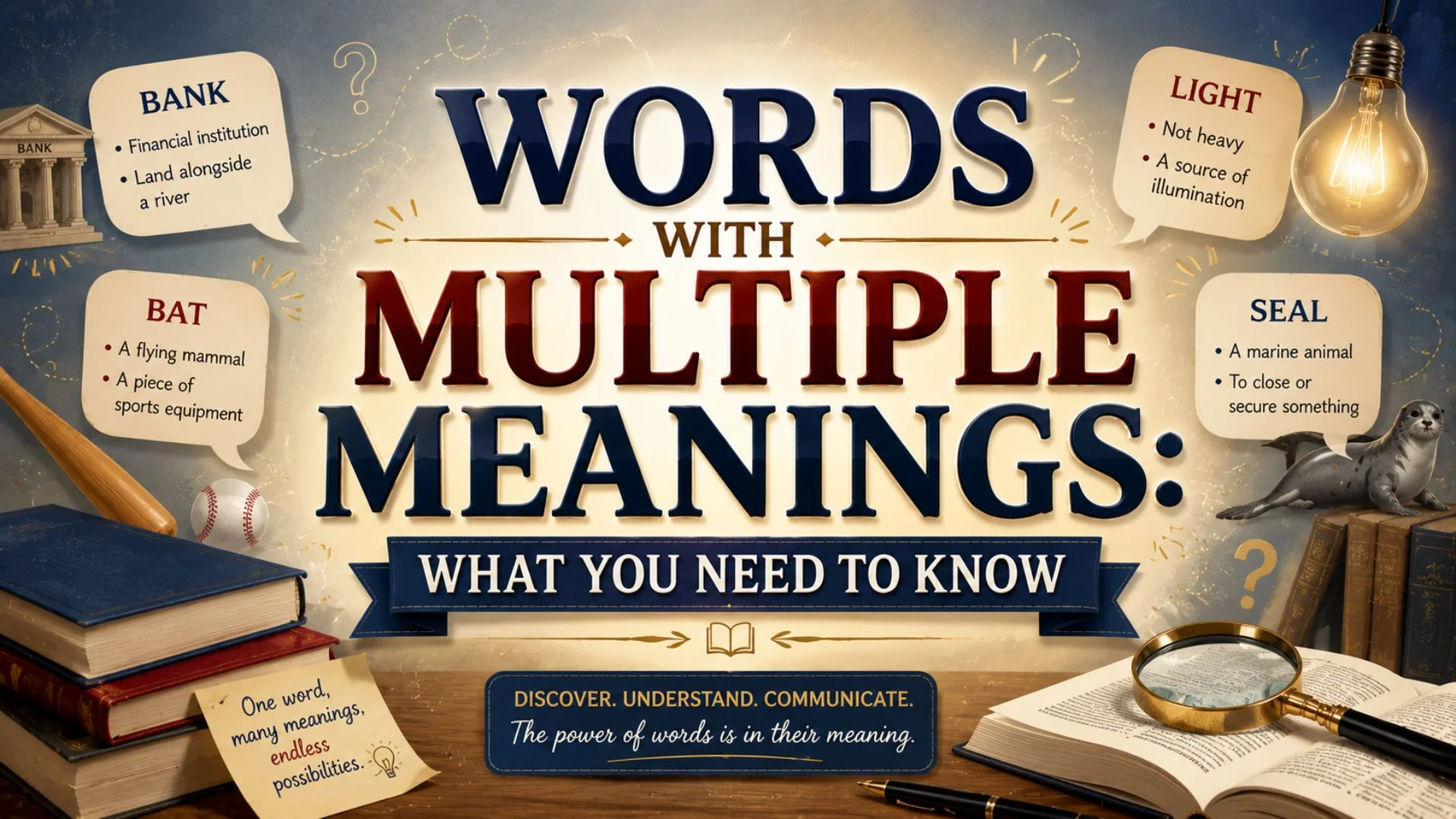
Words with multiple meanings, known as polysemous words and homonyms, are common in English. These can be words with related meanings (like “mouth” referring to both a body part and a river opening), or words with unrelated definitions that coincidentally share spelling or pronunciation (like “bat” for both an animal and sports equipment). Mastering them requires context awareness.
Meaning Overview Table
| Aspect | Meaning |
|---|---|
| Definition | A word that has two or more distinct definitions, either related (polysemy) or unrelated (homonymy) |
| Pronunciation | Varies by word; some homographs have different pronunciations |
| Part of Speech | Can be nouns, verbs, adjectives, or adverbs depending on usage |
| Usage | Determined entirely by the surrounding context of the sentence or conversation |
| Context | The key to meaning; the same word can change meaning across situations |
Main Meaning
The concept of words with multiple meanings arises from the natural evolution of language. As societies change, grow, and encounter new concepts, they often repurpose existing words rather than inventing new ones from scratch. This phenomenon, known as polysemy, occurs when a single word develops related but distinct senses over time. For example, the word “mouth” originally referred to the opening in the human face but later extended to describe the opening of a river, the spout of a bottle, or even the way a wine tastes . Each meaning carries a conceptual link to the original sense.
Polysemy differs from homonymy, where two meanings are unrelated but share the same spelling or sound. A classic example is “bank,” which can mean a financial institution and the side of a river. These two meanings have completely different etymological origins and are not conceptually connected in the minds of speakers . Understanding this distinction helps in accurately interpreting the intended meaning in various contexts.
Modern usage of multiple-meaning words is everywhere, from casual conversations to formal writing. Words like “run,” “get,” and “set” have so many meanings that dictionaries dedicate extensive entries to them. The ability to recognize and correctly interpret these words is a hallmark of language proficiency.
Detailed Explanation
Literal Meaning
The literal meaning of a word refers to its primary, most concrete definition. For instance, the literal meaning of “nail” is the hard, protective covering on the tip of fingers and toes. This is the meaning that first comes to mind when the word is used without additional context.
Common Meaning
The common meaning is the most frequently used definition in everyday language. For words with multiple senses, this is typically the first entry in a dictionary. For example, the most common meaning of “book” is a physical or digital reading material, while reserving something like a hotel room is a secondary sense.
Text Meaning
In written language, the meaning of a polysemous word is usually clarified by surrounding text. Authors often rely on readers to infer the correct sense from context clues. For example, in the phrase, “The bank offered a loan,” the financial institution meaning is clear, while “The river bank was muddy” signals the geographical sense.
Slang Meaning
Some words acquire entirely new meanings in informal language. For instance, “sick” can mean excellent or impressive in slang, as in “That skateboard trick was sick.” This use contrasts sharply with its traditional meaning of being ill.
Internet Meaning
The digital age has created new meanings for many words. “Friend” can now be used as a verb meaning to add someone on social media, and “face” has become a verb as in “to face someone” on video calls. These meanings are often unique to online contexts.
Social Media Meaning
Platforms like Twitter, Instagram, and TikTok have given words specialized meanings. “Tweet” is now both a noun and a verb referring to posts on X (formerly Twitter), and “thread” has become a term for a series of connected posts.
Cultural Meaning
Cultural references can imbue words with meanings understood only within specific communities. For example, “the game” might refer to a specific cultural phenomenon within certain subcultures, requiring insider knowledge to interpret correctly.
Examples Table
| Example | Meaning |
|---|---|
| “Please park the car.” | To leave a vehicle in a designated space |
| “Let’s walk in the park.” | A public green area for recreation |
| “He hit the ball with a bat.” | A wooden sports stick |
| “A bat lives in the cave.” | A flying nocturnal mammal |
| “Can I have the bill?” | A statement of money owed |
| “The duck has a flat bill.” | A bird’s beak |
| “I will book a table.” | To reserve something in advance |
| “I love reading this book.” | A written or printed work |
| “She wore a gold ring.” | A circular piece of jewelry |
| “The phone began to ring.” | A sound made by a bell or phone |
| “We took a plane to New York.” | An aircraft |
| “Draw a plane figure.” | A flat, two-dimensional surface |
| “She painted her nails.” | The hard covering on fingers |
| “Hammer the nail into the wall.” | A metal pin for joining objects |
| “The tree’s bark is rough.” | The outer covering of a tree trunk |
Related Meanings Table
| Related Term | Meaning |
|---|---|
| Polysemy | The coexistence of many possible meanings for a word or phrase |
| Homonym | Words that have the same spelling or pronunciation but different meanings |
| Homophone | Words that sound the same but have different spellings and meanings |
| Homograph | Words that are spelled the same but have different meanings or pronunciations |
| Context | The parts of a text that surround a word and help clarify its meaning |
| Semantics | The branch of linguistics concerned with meaning |
| Etymology | The study of the origin and historical development of words |
| Zeugma | A figure of speech where a word applies to two others in different senses |
| Lexicon | The complete set of words in a language |
| Monosemy | A word with only one meaning |
| Metonymy | A figure of speech where a thing or concept is referred to by the name of something closely associated |
| Metaphor | A figure of speech describing a subject by asserting it is the same as another unrelated object |
| Hyponymy | A relationship where a general word is related to specific words within its category |
| Hypernymy | A general word that encompasses more specific words |
| Ambiguity | The quality of being open to multiple interpretations |
Common Uses
Words with multiple meanings appear in nearly every form of communication. In professional settings, precision is critical. Lawyers and doctors must be careful about ambiguous terms. In casual conversation, context often does the heavy lifting, and listeners instinctively grasp intended meanings. In literature, authors frequently exploit polysemy to add depth and double meanings to their work, creating clever wordplay and enriching the reader’s experience. For example, puns often rely on the multiple meanings of a word to generate humor.
In academic contexts, recognizing polysemy is vital for students reading complex texts. A word like “critical” can mean “expressing disapproval,” “crucial,” or “involving analysis,” and understanding the correct sense depends on the surrounding content. Teaching learners how to navigate these words is a fundamental part of language education. Research emphasizes the importance of vocabulary instruction that addresses context clues, helping students move beyond the primary dictionary definition .
Common Mistakes
| Mistake | Correction | Explanation |
|---|---|---|
| Confusing “affect” and “effect” | Use “affect” as a verb and “effect” as a noun | They have different grammatical functions |
| Misusing “your” and “you’re” | “Your” shows possession; “you’re” means “you are” | They sound identical but are not interchangeable |
| Mixing up “there,” “their,” and “they’re” | “There” is a place; “their” is possessive; “they’re” is “they are” | Each has a distinct meaning and function |
| Saying “I have a right to park here” when meaning “write” | Ensure “right” means correct or direction, not “write” | Homophones can confuse intended spelling |
| Using “to” when “too” is needed | “To” is a preposition; “too” means “also” or “excessively” | Context determines the correct choice |
| Using “your” instead of “you’re” | “You’re” is correct when saying “you are” | For example, “You’re going to love this” |
| Treating “its” and “it’s” the same | “Its” is possessive; “it’s” is “it is” | The apostrophe signals a contraction, not possession |
| Misunderstanding “here” and “hear” | “Here” is a location; “hear” is to perceive sound | They sound similar but have different meanings |
| Confusing “buy,” “by,” and “bye” | “Buy” for purchase; “by” for location; “bye” for farewell | Multiple homophones exist with these spellings |
| Mixing up “complement” and “compliment” | “Complement” means to go well with; “compliment” means praise | One letter changes the entire meaning |
Related Questions
What is the word for words with multiple meanings?
Words with multiple meanings are generally called polysemous words when the meanings are related and homonyms when the meanings are unrelated but the words share spelling or pronunciation .
Why does English have so many words with multiple meanings?
The rich history of the English language, shaped by Germanic, Latin, French, and other influences, alongside natural linguistic evolution, has led to extensive polysemy. Borrowing words and adapting them to new contexts is a primary driver .
How can I determine which meaning is intended?
The most reliable way is to examine the context. Look at the surrounding words, the sentence structure, and the overall topic. Clues like these guide you to the correct interpretation .
What are some common examples of words with multiple meanings?
Some of the most common examples include “set,” “run,” “bank,” “bat,” “ring,” “watch,” “book,” “fly,” “right,” and “spring” . The word “set” holds the record for the most definitions, with over 400.
How many English words have multiple meanings?
Research indicates that a significant majority of high-frequency English words have multiple meanings. Approximately 95% of the most frequent 3,000 words have more than one definition, showcasing how common this feature is .
FAQs
What is the difference between polysemy and homonymy?
Polysemy refers to a word with multiple, related meanings, such as “head” referring to both a body part and a leader. Homonymy refers to words that are identical in spelling or sound but have unrelated meanings, like “right” (correct) and “write” (to inscribe) .
Can a word be both a homonym and a polyseme?
Yes, but usually not simultaneously. Words can shift from one category to another over time. A word might start as polysemous (related meanings) and then drift so far that speakers no longer see the connection, effectively becoming homonyms .
What are some of the most polysemous words in English?
According to the Oxford English Dictionary, the three most polysemous words in English are “run,” “put,” and “set.” The word “set” holds the world record for the most meanings, with over 400 distinct definitions .
How can I teach words with multiple meanings to learners?
The best approach is through contextual practice. Encourage learners to read sentences and paragraphs that highlight different meanings. Use visual aids, discuss clues, and practice creating their own sentences to reinforce each distinct sense .
Are there words with multiple meanings in other languages?
Yes, polysemy and homonymy are universal features of language. Every language has words with multiple meanings, though the specific words and their senses will vary based on cultural and historical developments .
Why do some words have so many meanings?
Words often acquire new meanings through metaphoric or metonymic extension. They are adapted to describe new concepts, and over centuries, the original sense gives rise to many others, as seen with “set” and its hundreds of definitions .
How important is understanding multiple meanings for reading comprehension?
It is crucial. Research shows that words in authentic texts like novels are often used in secondary, less familiar senses. Misinterpreting these can significantly alter or confuse the meaning of a passage. About one-third of the words in a novel like “Harry Potter” are used in a secondary meaning .
Conclusion
Words with multiple meanings are an inescapable and essential part of the English language. They enrich communication, allow for creativity, and reflect the dynamic nature of human expression. From the related senses of polysemous words like “mouth” and “run” to the coincidental overlap of homonyms like “bank” and “bat,” these words add depth and complexity to everything we read and write. The key to mastering them is relying on context, which serves as a guide to which meaning is intended. By paying attention to the surrounding words, the topic, and the sentence structure, you can navigate ambiguity with confidence. Whether you are learning English as a second language or simply looking to improve your communication skills, understanding words with multiple meanings is a fundamental skill.

Natalie Brooks is a content researcher and writer with a strong interest in word meanings, dream interpretations, symbolism, and cultural insights. She is passionate about creating clear, informative, and easy-to-understand content that helps readers discover the deeper meanings behind words, names, dreams, and symbols. Through her work at Meanzly, Natalie aims to make knowledge accessible and valuable for readers around the world.