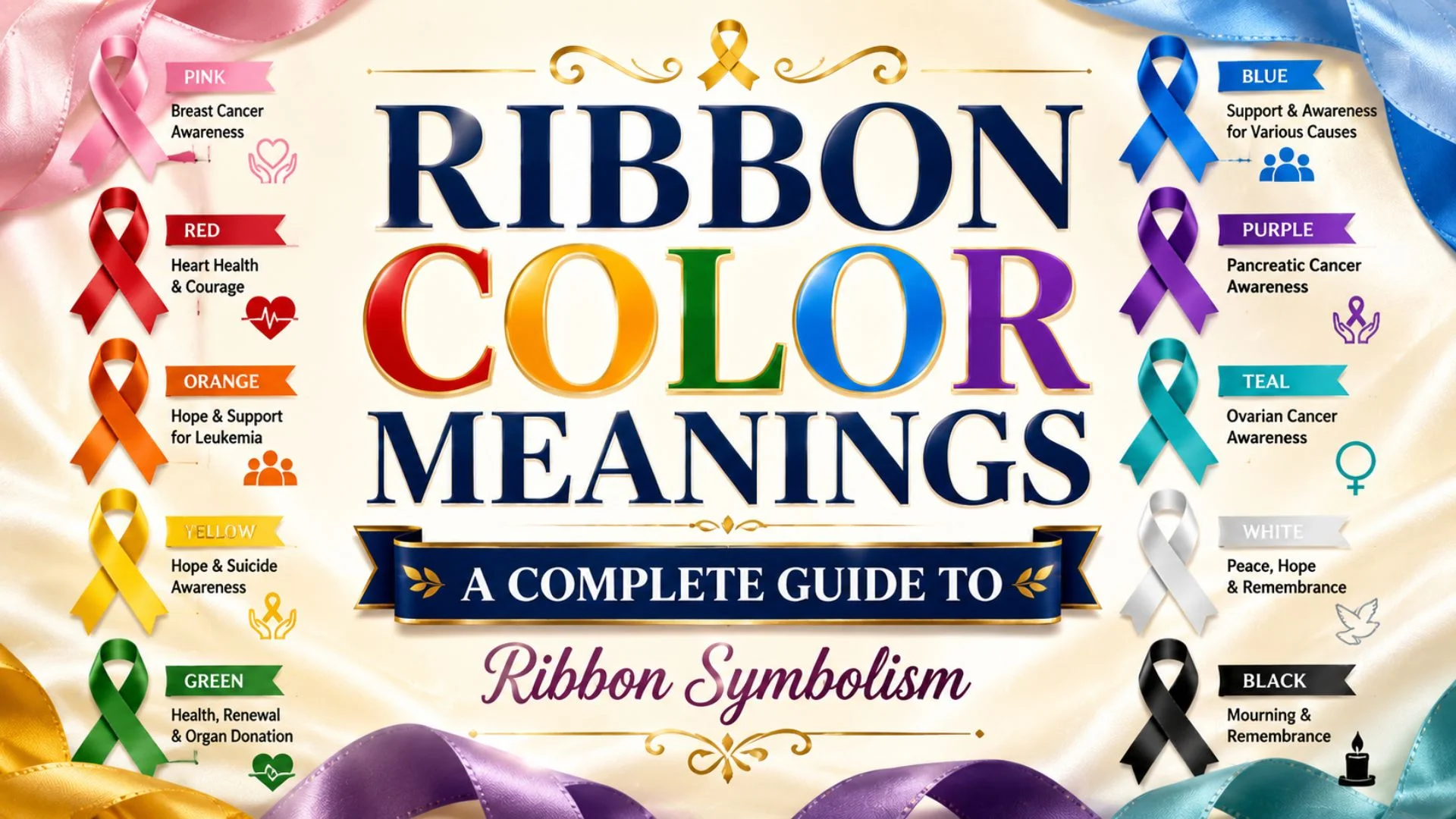
Ribbons have become one of the most recognizable symbols of support, advocacy, and awareness in modern culture. From the iconic pink ribbon for breast cancer to the yellow ribbon for military support, these simple loops of fabric carry profound meaning. Understanding ribbon color meanings helps you show solidarity with causes that matter, honor loved ones, and participate in a global tradition of visual advocacy.
The practice of wearing ribbons to signal support dates back centuries, but the modern awareness ribbon movement gained momentum in the 1970s and exploded in the 1990s with the pink breast cancer ribbon. Today, there are over 50 different ribbon colors and patterns, each representing specific causes, diseases, and social issues. This guide explores the comprehensive spectrum of ribbon color meanings, from the most recognized symbols to the lesser-known shades that represent rare conditions and emerging movements.
Quick Answer
Ribbon color meanings refer to the symbolic language of colored ribbons worn to show support for causes, diseases, and social issues. Pink represents breast cancer, red signifies HIV/AIDS awareness, yellow supports military troops, purple stands for domestic violence and pancreatic cancer, and blue represents child abuse prevention. Each color carries multiple meanings depending on context, and the practice has evolved since the 1990s into a global awareness movement.
Meaning Overview Table
| Aspect | Meaning |
|---|---|
| Definition | The symbolic significance of colored ribbons worn to show support for causes, diseases, and social movements |
| Pronunciation | RIB-uhn KUHL-er MEEN-ings |
| Part of Speech | Noun phrase |
| Usage | “Before wearing an awareness ribbon, check ribbon color meanings to ensure you’re showing support for the right cause.” |
| Context | Advocacy campaigns, disease awareness, social movements, memorial observances |
Main Meaning
Definition
Ribbon color meanings are the associations between specific ribbon colors and the causes, diseases, or social issues they represent. These symbols serve as visual shorthand for advocacy, allowing individuals to show support without speaking. The ribbons are typically folded into a loop and pinned to clothing, tied around objects, or displayed as stickers and magnets on vehicles .
Origin
The tradition of using ribbons as symbols dates back centuries, but the modern awareness ribbon movement began in the 1970s. The red ribbon for HIV/AIDS awareness, launched in 1991 by the Visual AIDS Artists’ Caucus, helped popularize the concept . The pink ribbon for breast cancer followed in 1992, becoming one of the most recognizable awareness symbols in history . Since then, the practice has expanded to include dozens of colors representing hundreds of causes .
Context
Ribbon color meanings vary significantly by context. A pink ribbon universally signals breast cancer awareness, while a yellow ribbon might represent military support, suicide prevention, or bladder cancer depending on the setting. Some colors have multiple meanings—teal can represent ovarian cancer, autism awareness, or post-traumatic stress disorder (PTSD) . Understanding the context helps avoid unintended messages.
Modern Usage
Today, awareness ribbons appear everywhere: on lapels, car magnets, social media profile pictures, and fundraising merchandise. Organizations use them during specific awareness months, such as October for breast cancer (pink) and September for childhood cancer (gold) . The practice has become so widespread that some colors now represent dozens of causes, making it essential to understand the specific ribbon color meanings for any advocacy effort.
Detailed Explanation
Literal Meaning
Literally, an awareness ribbon is a short piece of ribbon folded into a loop, creating a simple visual symbol. The literal form is universal—only the color changes. The physical ribbon itself has no inherent meaning; it gains significance through collective social agreement and organized advocacy campaigns .
Common Meaning
Commonly, wearing a ribbon signals support for a cause or awareness of a disease. It communicates to others that the wearer advocates for a specific issue, honors those affected, or belongs to a community of supporters. Wearing a ribbon often serves as a conversation starter, encouraging dialogue about the cause it represents .
Text Meaning
In written communication and online discussions, “ribbon color meanings” refers to the growing body of reference materials—articles, charts, and guides—that decode the significance of different colors. These resources help people choose the right ribbon for the right cause, especially as new ribbon colors emerge for rare conditions and emerging movements .
Internet Meaning
Online, ribbon color meanings are frequently shared during awareness months, on social media campaigns, and in fundraising efforts. Hashtags like #AwarenessRibbon and #ShowYourSupport help users find information and participate in virtual advocacy. The internet has also expanded ribbon symbolism to include digital ribbons, emojis, and profile picture overlays.
Social Media Meaning
On platforms like Instagram, Facebook, and X, ribbons serve as visual advocacy tools during specific months or in response to current events. Users change their profile pictures, share infographics, and post photos wearing ribbons. Viral campaigns have given rise to new ribbon colors, such as orange for gun control advocacy, which gained visibility through organizations like Everytown for Gun Safety .
Cultural Meaning
Culturally, ribbons represent a shift toward visual, easily shareable advocacy. They allow individuals to participate in social movements with minimal effort while signaling collective solidarity. The practice crosses political, religious, and social boundaries, making it one of the most inclusive forms of advocacy. However, the multiplicity of meanings can sometimes dilute the impact of any single color .
Examples Table
| Example | Meaning |
|---|---|
| Pink ribbon | Breast cancer awareness, hope, and early detection support |
| Red ribbon | HIV/AIDS awareness; also substance abuse and DUI prevention |
| Yellow ribbon | Support for military troops, suicide prevention, and bladder cancer |
| Purple ribbon | Domestic violence, pancreatic cancer, Alzheimer’s disease, and epilepsy |
| Blue ribbon | Child abuse prevention, colon cancer, and crime victim rights |
| Gold ribbon | Childhood cancer awareness—symbolizing children’s preciousness |
| Teal ribbon | Ovarian cancer, sexual assault awareness, and PTSD |
| Orange ribbon | Leukemia, kidney cancer, hunger awareness, and gun control |
| Green ribbon | Mental health awareness, organ donation, and liver cancer |
| White ribbon | Peace, adoption, and lung cancer awareness |
| Silver ribbon | Parkinson’s disease, elder abuse, and mental illness |
| Black ribbon | Mourning, melanoma awareness, and anti-gang initiatives |
| Peach ribbon | Uterine and endometrial cancer awareness |
| Light blue ribbon | Prostate cancer, men’s health, and chronic illness |
| Gray ribbon | Brain cancer, diabetes, asthma, and mental illness |
Related Meanings Table
| Related Term | Meaning |
|---|---|
| Pink ribbon | Breast cancer; women’s health; birth parents |
| Red ribbon | HIV/AIDS; substance abuse; DARE; cardiovascular disease |
| Yellow ribbon | Troop support; suicide prevention; bladder cancer; endometriosis |
| Purple ribbon | Domestic violence; pancreatic cancer; Alzheimer’s; epilepsy; lupus; fibromyalgia |
| Blue ribbon | Child abuse; colon cancer; education; free speech; crime victims |
| Light blue ribbon | Prostate cancer; men’s health; chronic fatigue; thyroid disease |
| Navy blue ribbon | Arthritis; child abuse; colon cancer; drowning prevention; police officers |
| Teal ribbon | Ovarian cancer; sexual assault; PTSD; anxiety; food allergies |
| Green ribbon | Mental health; organ donation; liver cancer; environmental concerns |
| Lime green ribbon | Lymphoma; Lyme disease; muscular dystrophy |
| Gold ribbon | Childhood cancer; breast feeding; COPD |
| Orange ribbon | Leukemia; kidney cancer; hunger; MS; motorcycle safety; gun control |
| White ribbon | Lung cancer; peace; adoption; anti-pornography; blindness |
| Black ribbon | Mourning; melanoma; sleep disorders; gun control |
| Silver/Gray ribbon | Parkinson’s; brain cancer; diabetes; asthma; mental illness |
| Burgundy ribbon | Multiple myeloma; sickle cell; brain aneurysm; hospice care |
| Peach ribbon | Uterine cancer; endometrial cancer; vaginal cancer |
| Periwinkle ribbon | Eating disorders; pulmonary hypertension; esophageal cancer |
| Lavender ribbon | All cancers; epilepsy; Rett syndrome; testicular cancer |
| Zebra print ribbon | Rare diseases; carcinoid cancer; Ehlers-Danlos syndrome |
| Pink and blue ribbon | Pregnancy loss; SIDS; male breast cancer; infertility |
| Black and pink ribbon | Loss of a sister or female child |
| Black and blue ribbon | Loss of a brother or male child |
| Burgundy and ivory ribbon | Oral cancer; head and neck cancer |
| Blue and yellow ribbon | Down syndrome; Cushing syndrome; designated drivers |
Common Uses
Ribbon color meanings are most commonly used during awareness months dedicated to specific causes. For example, October is Breast Cancer Awareness Month, marked by pink ribbons, and September is Childhood Cancer Awareness Month, represented by gold ribbons . Organizations distribute ribbons at fundraising events, walks, and galas to unite supporters visually.
In healthcare settings, patients and families often wear ribbons during treatment or in memory of loved ones. The ribbons provide comfort and signal to medical staff and other patients that they are part of a community facing similar challenges.
Advocacy groups use ribbons in their logos, merchandise, and social media campaigns to build instant recognition. Some causes, like the yellow ribbon for military support, have become so ingrained in public consciousness that the symbol alone communicates the message without explanation .
In recent years, ribbon colors have also been used in response to current events. During the COVID-19 pandemic, some communities used white ribbons to honor healthcare workers, and orange ribbons became associated with gun violence prevention following mass shootings .
Common Mistakes
| Mistake | Correction |
|---|---|
| Assuming the pink ribbon only represents breast cancer | Pink ribbons also represent women’s health, nursing mothers, and birth parents |
| Confusing teal for ovarian cancer with teal for PTSD or food allergies | Teal has multiple meanings—context matters |
| Believing the yellow ribbon only supports troops | Yellow also represents suicide prevention, bladder cancer, and endometriosis |
| Using the wrong shade of blue for a specific cause | Light blue represents prostate cancer; navy blue represents colon cancer and child abuse |
| Ignoring the awareness month associated with a ribbon | Pink is most prominent in October; gold in September; teal in September for ovarian cancer |
| Assuming all purple ribbons mean the same thing | Purple represents domestic violence, pancreatic cancer, Alzheimer’s, epilepsy, and multiple other causes |
| Wearing a ribbon without understanding its meaning | Research the ribbon color meaning before wearing it to avoid unintended messages |
| Thinking ribbon colors are universal across countries | Meanings can vary by region; for example, orange in the U.S. may represent gun control but also other causes globally |
| Using the wrong pattern for rare diseases | Zebra print specifically represents rare diseases and neuroendocrine tumors |
| Forgetting that black ribbons are for mourning | Black often signals mourning or melanoma—avoid wearing it casually without understanding the context |
Related Questions
What does a pink ribbon represent?
The pink ribbon is the universal symbol for breast cancer awareness, representing hope, strength, and support for those affected by breast cancer. Breast Cancer Awareness Month is October .
What does a teal ribbon mean?
Teal ribbons represent ovarian cancer awareness, sexual assault awareness, and PTSD awareness. They are most prominently seen during September for Ovarian Cancer Awareness Month and April for Sexual Assault Awareness Month .
What is the meaning behind a yellow ribbon?
Yellow ribbons support military troops deployed overseas, represent suicide awareness and prevention, and signify bladder cancer awareness. National Suicide Prevention Month is September .
What does a purple ribbon symbolize?
Purple ribbons symbolize domestic violence awareness, pancreatic cancer, Alzheimer’s disease, epilepsy, and several other causes. Domestic Violence Awareness Month is October .
What color ribbon represents all cancers?
The lavender ribbon represents all cancers collectively, often seen during February for National Cancer Prevention Month and on World Cancer Day, February 4 .
What does an orange ribbon mean?
Orange ribbons represent leukemia and kidney cancer, hunger awareness, multiple sclerosis, and gun control advocacy. They gained prominence through organizations like Everytown for Gun Safety .
How do I choose the right ribbon color for a cause?
Research the specific color associated with the cause you wish to support. Many guides provide comprehensive lists of ribbon colors and their meanings. Check awareness months to time your support appropriately .
FAQs
What is the most recognized awareness ribbon?
The pink ribbon for breast cancer awareness is the most widely recognized, followed by the red ribbon for HIV/AIDS awareness and the yellow ribbon for military support .
Can one ribbon color represent multiple causes?
Yes, most ribbon colors represent multiple causes. For example, teal represents ovarian cancer, sexual assault, and PTSD, while purple represents domestic violence, pancreatic cancer, and Alzheimer’s .
What does a zebra-striped ribbon mean?
Zebra-striped ribbons represent rare diseases, carcinoid cancer, neuroendocrine tumors, and Ehlers-Danlos syndrome .
What do multi-colored ribbons represent?
Multi-colored ribbons often represent complex or combination causes. Examples include pink and blue for pregnancy loss, burgundy and ivory for head and neck cancer, and red, white, and blue for patriotism and 9/11 remembrance .
How did awareness ribbons become so popular?
The modern trend began with the red ribbon for HIV/AIDS in 1991, followed by the pink breast cancer ribbon in 1992. The concept spread rapidly due to celebrity endorsements, media coverage, and social media .
What does a white ribbon mean?
White ribbons represent peace, adoption, lung cancer awareness, and the fight against violence against women .
What color ribbon is for mental health awareness?
Green is the mental health awareness color. Lime green specifically represents lymphoma and Lyme disease, while light green raises awareness for sexually transmitted diseases .
Conclusion
Understanding ribbon color meanings empowers you to participate in visual advocacy and show support for causes that matter. From the iconic pink ribbon for breast cancer to the zebra-striped ribbon for rare diseases, these simple symbols carry profound messages of hope, solidarity, and awareness. The practice has evolved from a handful of colors in the 1990s to dozens today, reflecting the expanding landscape of advocacy and social movements.
When you wear a ribbon, you join a global community of supporters. But with so many colors and meanings, it’s essential to research before you wear. The right ribbon shows that you understand and care about the cause. Whether you’re honoring a loved one, raising awareness, or simply showing solidarity, your ribbon speaks volumes without a single word. So choose your color wisely, and let your ribbon spark conversations that truly make a difference.

Natalie Brooks is a content researcher and writer with a strong interest in word meanings, dream interpretations, symbolism, and cultural insights. She is passionate about creating clear, informative, and easy-to-understand content that helps readers discover the deeper meanings behind words, names, dreams, and symbols. Through her work at Meanzly, Natalie aims to make knowledge accessible and valuable for readers around the world.