Mood rings have fascinated people since the 1970s, offering a playful way to express emotions through color-changing jewelry. The science behind these rings is simple yet clever: the stone contains liquid crystals that react to temperature changes on your skin . While they don’t actually read your mind, understanding mood ring color meanings can make wearing one a fun and insightful experience. Whether you’re nostalgic for the 70s fad or curious about how these rings work, this guide covers everything from the history of mood rings to detailed color interpretations.
Quick Answer
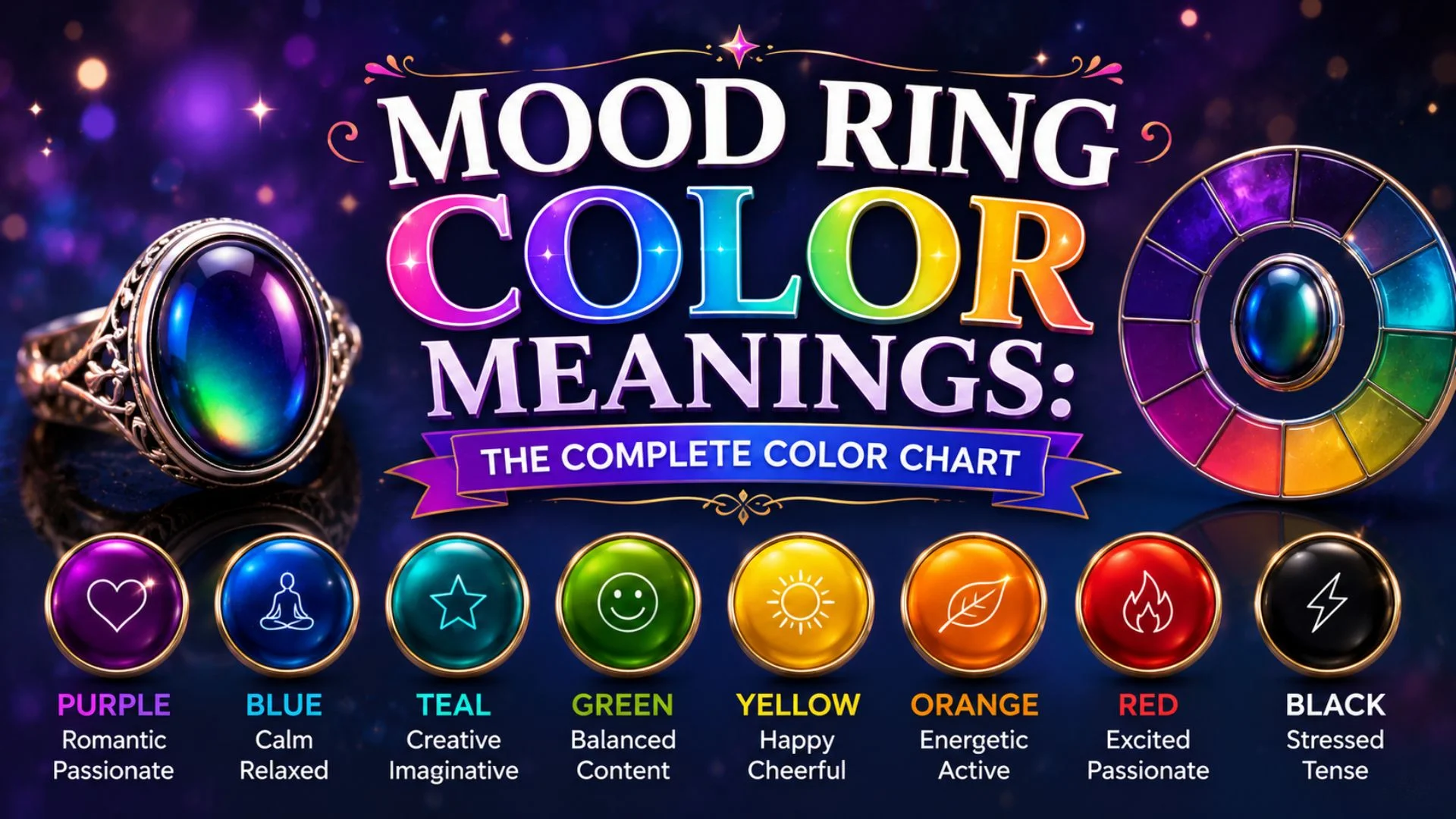
Mood ring color meanings range from violet (passion, love, excitement) to black (stress, feeling overwhelmed). Blue typically indicates calm and relaxation, green suggests a normal or average mood, yellow or amber points to mixed or unsettled feelings, and red signals excitement or anger. These colors reflect changes in finger temperature, not your actual emotions, but the association has made them a classic novelty item .
Meaning Overview Table
| Aspect | Meaning |
|---|---|
| Definition | The emotional states associated with different colors displayed by a mood ring’s heat-sensitive stone |
| Pronunciation | mood ring KUHL-er MEEN-ings |
| Part of Speech | Noun phrase |
| Usage | “Before wearing your mood ring, check the mood ring color meanings to understand what each shade represents.” |
| Context | Fashion accessories, novelty jewelry, self-expression, retro trends |
Main Meaning
Definition
Mood ring color meanings are the emotional interpretations assigned to the various colors displayed by a mood ring’s liquid crystal stone. Each color corresponds to a different state of mind, from relaxation to stress, passion to boredom.
Origin
Mood rings first appeared in 1975, created by New York inventors Maris Ambats and Josh Reynolds . They used thermotropic liquid crystals to create a ring that would change color based on the wearer’s body temperature. The rings quickly became a massive fad, with sales reaching millions of dollars in just a few months . Jewelry designer Marvin Wernick actually pioneered the technology in 1974, but Reynolds and Ambats popularized it with clever marketing .
Context
The context of mood ring color meanings is important: the colors are actually measuring your skin temperature, not your feelings. When you’re excited, your capillaries move closer to the skin’s surface, warming it up. When stressed or anxious, the opposite happens . The ring responds to these temperature changes, but many other factors influence the color, including ambient temperature and your individual body chemistry.
Modern Usage
Today, mood rings remain popular as nostalgic accessories, conversation starters, and gifts. Many jewelry brands continue to sell them, often with updated designs . They appeal to people looking for fun, expressive jewelry, and the color meanings add an element of playfulness.
Detailed Explanation
Literal Meaning
Literally, a mood ring color means your skin at that moment is at a particular temperature. Each color corresponds to a specific temperature range. The stone changes because the liquid crystals twist in response to heat. The warmer your finger, the more the colors shift toward violet and blue. The cooler your finger, the more they shift toward green, brown, and black .
Common Meaning
Commonly, people associate each color with an emotional state. Blue means calm, green means average, amber means a little nervous, and black means stressed or overwhelmed . These associations have become widely accepted through decades of use.
Text Meaning
In text-based communication, mood ring color meanings often appear in gift guides or product descriptions. They add a layer of nostalgia to writing about jewelry or retro trends.
Slang Meaning
In some contexts, mood ring colors may be used humorously. For example, someone might say “my mood ring is black today” to mean they are stressed. This usage treats the ring as a playful metaphor for one’s feelings, often used lightly or ironically.
Internet Meaning
Online, mood ring color charts are widely shared. You can find vibrant guides, quizzes, and even apps that let you choose a “virtual mood ring” color. There is a strong visual emphasis on photos of the rings in different colors.
Social Media Meaning
On platforms like Instagram and Pinterest, mood rings are popular for their aesthetic appeal. They are often featured in “retro” or “vintage” style posts. People enjoy sharing photos of their rings in different colors and comparing the results.
Cultural Meaning
Culturally, mood rings represent a time of playful self-expression and fascination with “new age” ideas. They are also a quintessential example of a fad that captured the public imagination. In the 1970s, they were a symbol of the era’s interest in alternative ways of thinking.
Examples Table
| Example | Meaning |
|---|---|
| Violet or deep purple | Passion, romance, excitement, very happy |
| Deep blue | Happy, content, relaxed, confident |
| Blue | Calm, relaxed, at ease, peaceful |
| Blue-green (teal) | Somewhat relaxed, inner emotions charged |
| Green | Normal, average, neutral, no great stress |
| Amber or yellow | Mixed emotions, unsettled, nervous, cautious |
| Orange | Nervous, confused, aggressive, worried |
| Red | Angry, shocked, intense, fiery, or passionate |
| Gray | Very nervous, anxious, anxious, uneasy |
| Black | Stressed, tense, overworked, depressed |
| Dark brown | Restless, tensions, fear |
| Pink | Loving, affectionate, peaceful, happy |
| White | Bored, frustrated, confused |
| Bright red | Excited, adventurous, or even angry or shocked |
| Dark purple | Sensual, passionate, romantic |
Related Meanings Table
| Related Term | Meaning |
|---|---|
| Violet | Strong feelings, love, passion, happiness |
| Deep Purple | Sensual, passionate, romantic |
| Red Violet | Romantic, loving, infatuated, warm |
| Deep Blue | Calm, happy, contented, confident |
| Blue | Relaxed, friendly, at ease, caring |
| Aqua | Reflective, inner reading, emotions charged |
| Forest Green | Hopeful, expectant, encouraging |
| Green | Normal, average, natural, moderate |
| Pale Green | Peaceful, easygoing, pleased |
| Yellow | Mixed emotions, unsettled, many thoughts |
| Amber | Nervous, anxious, concerned |
| Orange | Aggressive, stressed, upset, confused |
| Red | Fear, alarmed, angered, intense |
| Dark Red | Romantic love or arousal, or fear or anger |
| Pink | Restful, peaceful, loving, happy |
| Gray | Anxious, uneasy, stressed |
| Brown | Restless, tense, aggravated, worried |
| White | Bored, frustrated, confused |
| Black | Stressed, depressed, overworked |
| Taupe | Stress, unpredictability, angst |
Common Uses
Mood rings are commonly used as fashion accessories that also express a playful side. They are popular gifts, especially for teenagers and young adults. They often appear at festivals, gift shops, and jewelry stores as a fun, inexpensive item.
People frequently use them as a novelty to start conversations. Wearing a ring and saying “you can tell my mood by the color” is a classic way to break the ice. Some people use them as a casual “biofeedback tool,” even though they are not scientifically accurate. This use was part of the original marketing for the rings . They are also used to add a pop of color or an element of interest to an outfit.
Common Mistakes
| Mistake | Correction |
|---|---|
| Thinking the ring reads your mind | The ring responds to temperature changes, not thoughts |
| Believing the ring is always accurate | Many factors affect temperature, such as ambient heat, cold hands, or even a fever |
| Using the same color chart for all rings | Meanings can vary slightly between different brands and manufacturers |
| Assuming violet always means romance | It can also indicate happiness, excitement, or intense feelings |
| Ignoring that black is the default color | The ring turns black when it is not being worn or is too cold |
| Believing mood rings are magical | They are a fun piece of technology based on liquid crystals |
| Thinking the ring will last forever | The liquid crystals can degrade over time and the ring may eventually stop changing color |
| Confusing teal with plain blue | Teal (blue-green) is more specific, indicating the wearer is relaxed but alert |
| Believing the ring works in any environment | The ambient temperature strongly affects its appearance |
| Forgetting that the ring only measures a current state | Your mood can change rapidly, and the ring may take a moment to catch up |
Related Questions
What does it mean when a mood ring turns blue?
When a mood ring turns blue, it typically means the wearer is calm, relaxed, or happy. In some cases, a deep blue can indicate feelings of passion or romance . In terms of temperature, it means your finger is at a warm temperature.
What does a black mood ring mean?
A black mood ring usually means the wearer is experiencing stress, anxiety, or feeling overwhelmed. It can also mean the ring is not being worn, is broken, or that the wearer has cold hands . It is the default color when the ring is at a cool temperature.
What does a green mood ring mean?
A green mood ring suggests the wearer is in a normal, average state. They are calm and experiencing no great stress . It is the temperature baseline for the average person .
Do mood rings actually work?
Mood rings work as thermometers. They change color in response to your skin temperature. They do not, however, accurately reflect complex emotions .
What is the science behind mood rings?
The stone in a mood ring contains liquid crystals. These crystals are sensitive to temperature. They twist and change their molecular structure when they are heated or cooled. This twisting causes them to absorb and reflect different wavelengths of light, which our eyes see as different colors .
FAQs
What does a purple mood ring mean?
A purple or violet mood ring typically represents strong emotions, such as excitement, passion, love, or romance . It often indicates that the wearer is in a heated, emotionally charged state.
What does an orange mood ring mean?
An orange mood ring often indicates feelings of nervousness, aggression, or worry . It is not a positive color on the mood ring scale.
What does a pink mood ring mean?
Pink mood ring colors usually mean the wearer is feeling loving, affectionate, or happy. It can also mean they are feeling peaceful and relaxed .
What does a yellow mood ring mean?
Yellow colors on a mood ring typically indicate mixed or unsettled feelings. The wearer may be feeling confused, cautious, or restless .
What does an amber mood ring mean?
Amber on a mood ring means the wearer is feeling nervous, anxious, or is experiencing mixed feelings . It is often in the middle of the temperature scale.
Do mood rings work for everyone?
The liquid crystals in a mood ring react to any temperature change, but how well they work depends on the individual’s skin temperature and the ambient temperature. People with cold hands may find their ring is always dark . They also require that the wearer’s finger temperature changes enough to be noticeable.
Conclusion
Mood ring color meanings add an element of wonder and conversation to a simple piece of jewelry. These rings, a classic 1970s fad, use liquid crystals to react to skin temperature, creating a spectrum of colors with corresponding emotional associations. While they don’t actually read your mind, they offer a fun, nostalgic way to express yourself and connect with a trend that captivated millions . Whether you wear one for style, to spark a conversation, or just out of curiosity, understanding the color guide can make the experience more enjoyable. The next time your ring changes shade, take a moment to consider what it might be telling you—even if the message is just that your hands are a little warm.

Natalie Brooks is a content researcher and writer with a strong interest in word meanings, dream interpretations, symbolism, and cultural insights. She is passionate about creating clear, informative, and easy-to-understand content that helps readers discover the deeper meanings behind words, names, dreams, and symbols. Through her work at Meanzly, Natalie aims to make knowledge accessible and valuable for readers around the world.