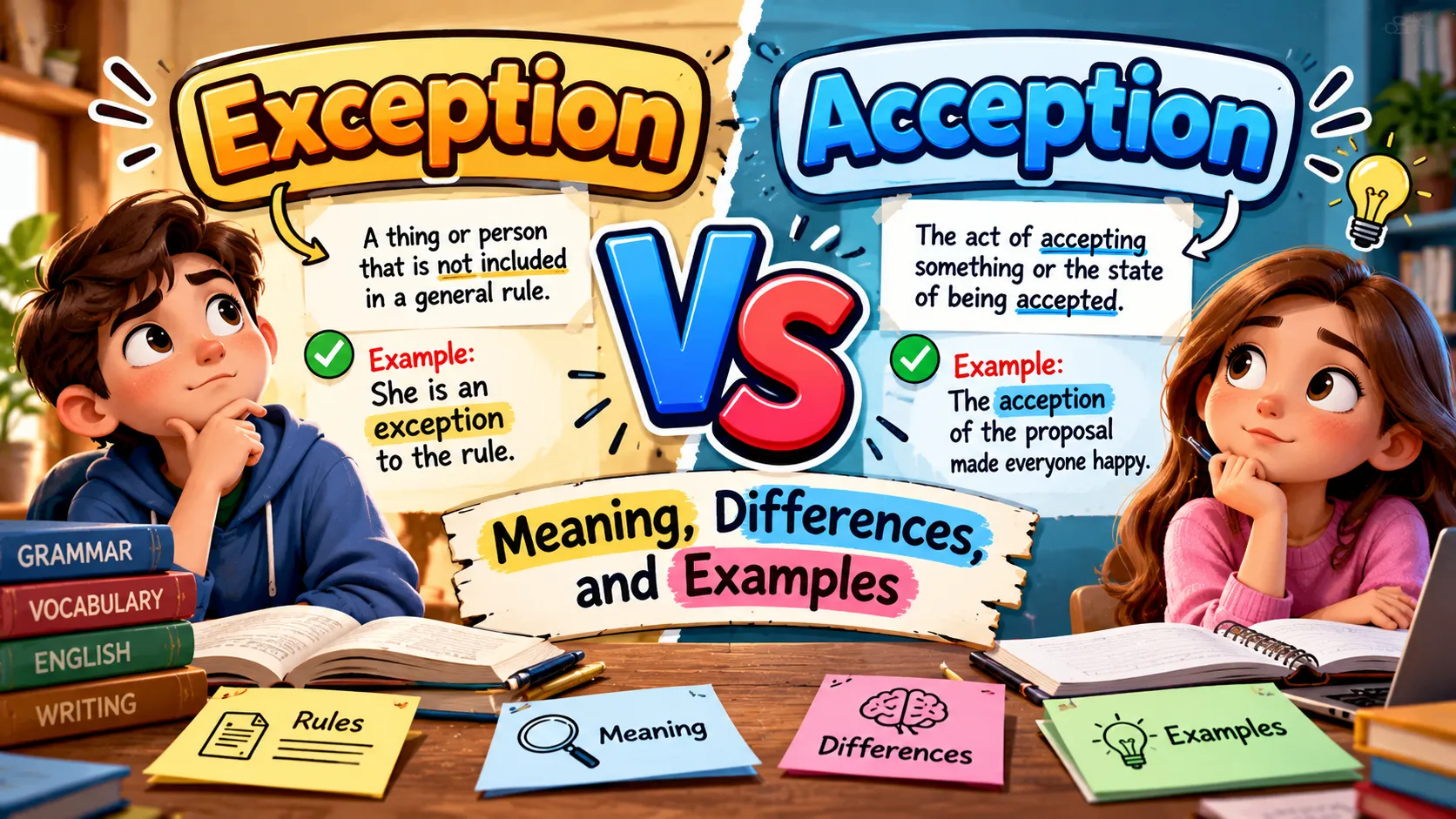
Understanding the difference between exception vs acception is important for anyone who wants to improve their English spelling, vocabulary, and grammar. These words may look similar, but they are not equally common in modern English. Exception is a standard English word, while acception is a rare term that appears mainly in specialized linguistic or historical contexts.
An exception is someone or something that does not follow a general rule. For example, if a school requires every student to wear a uniform but allows one student to wear different clothing for medical reasons, that student has an exception to the rule. The word is also used when describing unusual situations, special permissions, or things that differ from what is normally expected.
Acception, on the other hand, is a rare word historically associated with the taking or receiving of something and with particular senses of interpretation or meaning. In everyday English, people generally use words such as acceptance, approval, or interpretation instead.
In this guide, you will learn what exception and acception mean, how they differ, when to use each word, and how to avoid common spelling mistakes in everyday and professional writing.
What Does Exception Mean? 📘
Exception is a noun that refers to a person, thing, or situation that does not follow a general rule, pattern, or expectation. It is widely used in everyday conversation, academic writing, workplace communication, legal documents, and official policies.
For example, a company might allow employees to work remotely on Fridays, with an exception for employees whose jobs require them to be physically present. Similarly, a teacher might make an exception to a deadline when a student faces an unexpected emergency.
The word can also describe something unusual compared with what normally happens. If someone says, “This winter is an exception,” they mean the season is different from the usual pattern.
Examples of Exception in Sentences
- Everyone must attend the meeting, without exception.
- The manager made an exception to the company policy.
- This restaurant is excellent, and the dessert is no exception.
- Most students passed the examination, with one exception.
- The school granted an exception to the uniform requirement.
- There is an exception to every rule.
- She usually arrives early, but today was an exception.
- The application was approved under a special exception.
- All employees must follow the procedure, with no exceptions.
- The new policy applies to everyone except those who qualify for an exception.
Common Expressions With Exception
Several expressions containing exception are common in English:
- Make an exception: Allow something that differs from the usual rule.
- Without exception: Applying to everyone or everything without any exclusions.
- With the exception of: Excluding a particular person or thing.
- Take exception to: Object to something or consider it offensive.
- No exception: Not different from the general rule or pattern.
For example, “The deadline applies to all applicants without exception” means that no applicant is excluded from the deadline.
What Does Acception Mean? 📖
Acception is a rare English noun that is not commonly used in modern everyday writing. Historical and specialized sources have used it in senses associated with receiving or taking something, as well as particular interpretations or meanings of words.
In contemporary English, however, acception is not the usual word for agreeing to an offer, receiving an invitation, or approving something. The standard word for those situations is acceptance.
For example, you would normally write, “Her acceptance of the job offer surprised everyone,” rather than “Her acception of the job offer surprised everyone.”
Because acception is uncommon and may be unfamiliar to many readers, it is generally best avoided in ordinary emails, essays, business documents, and website content unless you are discussing a historical text or a specialized linguistic usage.
Examples of Modern Alternatives
Instead of using acception in everyday English, choose a word that expresses your intended meaning:
- Acceptance: Her acceptance of the invitation made us happy.
- Approval: The project received approval from the committee.
- Receiving: The receiving of the documents was confirmed.
- Interpretation: The word has a different interpretation in this passage.
- Understanding: His understanding of the instructions was correct.
These alternatives are more natural in modern English because each clearly expresses a specific meaning.
Exception vs Acception: Key Differences 📊
Although the spellings look similar, the words have different meanings and levels of usage.
| Feature | Exception | Acception |
|---|---|---|
| Word status | Standard, commonly used English word | Rare, specialized or historical word |
| Part of speech | Noun | Noun |
| Main meaning | Something excluded from a general rule | Historically associated with receiving or particular senses of meaning |
| Everyday usage | Very common | Uncommon |
| Common context | Rules, policies, unusual situations | Historical or specialized linguistic contexts |
| Modern alternative | Depends on context | Often acceptance, receiving, or interpretation |
| Example | The rule has one exception. | The term appears in a historical text. |
The most important point is that exception and acception are not interchangeable. If you mean a special case that differs from a rule, use exception. If you mean agreeing to something or receiving an offer favorably, use acceptance.
Exception vs Acceptance: An Important Distinction ✍️
One reason people confuse exception and acception is that they may be thinking of the word acceptance. These three spellings look similar, but their meanings differ.
Exception refers to something that does not follow a rule. Acceptance refers to the act of accepting something, agreeing to something, or recognizing something as valid. Acception is a rare term that usually does not replace either word in modern everyday English.
| Word | Meaning | Example |
|---|---|---|
| Exception | Something that differs from a rule | The student received an exception to the policy. |
| Acceptance | The act of accepting something | She confirmed her acceptance of the offer. |
| Acception | A rare historical or specialized term | The word appears in an older linguistic text. |
Consider these examples:
- Exception: The company allows no exceptions to its safety rules.
- Acceptance: His acceptance of the invitation was appreciated.
- Acception: The term may occur in specialized historical discussions.
If you are writing about a job offer, university admission, an invitation, or approval, acceptance is usually the correct word. If you are writing about a rule that does not apply in a particular situation, choose exception.
How to Use Exception in Professional Writing 💼
The word exception is particularly useful in workplace communication because policies, procedures, agreements, and deadlines often contain special conditions.
For example, an employee handbook may explain that all staff members must follow a particular procedure, except in approved circumstances. Those approved circumstances may be described as exceptions.
In academic writing, the word can identify an unusual result or a case that differs from a general observation. In legal and administrative writing, it can describe a permitted exclusion from a rule or requirement.
Professional Examples
- Exceptions to the policy require written approval.
- The contract includes an exception for emergency circumstances.
- All invoices must be submitted by Friday, without exception.
- The committee approved an exception to the eligibility requirement.
- The new procedure applies to all departments, with the exception of the research division.
When using exception professionally, make sure the sentence clearly identifies the rule and the circumstance that differs from it.
Common Mistakes When Using Exception and Acception ❌
The similarity between these spellings can cause confusion, especially when writing quickly. Here are common mistakes and their corrections.
Mistake 1: Using acception instead of exception
Incorrect: There is one acception to the rule.
Correct: There is one exception to the rule.
Use exception when describing a special case.
Mistake 2: Using acception instead of acceptance
Incorrect: She sent her acception of the job offer.
Correct: She sent her acceptance of the job offer.
Use acceptance when someone agrees to an offer or invitation.
Mistake 3: Confusing exception with exclusion
An exception is a special case that does not follow a general rule. An exclusion is the act or condition of leaving someone or something out. These words overlap in some contexts but are not always interchangeable.
Mistake 4: Assuming acception is the standard form of acceptance
Although acception has appeared in historical or specialized usage, it is not the normal modern word for accepting an invitation, proposal, or opportunity. In contemporary writing, acceptance is the appropriate choice.
Easy Ways to Remember Exception vs Acception 🧠
A simple memory trick can help you choose the correct word.
Remember that an exception breaks the usual pattern. If a rule applies to everyone except one person, that person represents an exception.
For acceptance, think of the verb accept. When you accept an invitation, you give your acceptance. This connection makes the spelling easier to remember.
Use these examples for quick revision:
- One exception to the rule.
- An exception to the deadline.
- Acceptance of a job offer.
- Acceptance of an invitation.
- A rare historical use of acception.
Before using acception, ask yourself whether you actually mean exception or acceptance. In most modern writing, one of those two common words will express your intended meaning more clearly.
Frequently Asked Questions About Exception vs Acception ❓
Is exception or acception correct?
Both forms have existed in English, but they are used differently. Exception is the standard word for something that differs from a general rule. Acception is rare and mainly associated with historical or specialized usage.
Is acception a real word?
Yes, acception has appeared in historical and specialized English usage. However, it is uncommon in modern everyday English and should not normally replace acceptance or exception.
What is the difference between exception and acceptance?
An exception is something that does not follow a general rule. Acceptance is the act of agreeing to, receiving, or approving something. For example, a policy may have an exception, while a job applicant may confirm acceptance of an offer.
What is an example of an exception?
An example is: “All students must wear uniforms, with an exception for students participating in the approved sports program.” The exception identifies a situation in which the general rule does not apply.
Can I use acception in a formal email?
It is generally better to avoid acception in a modern formal email because most readers will find it unfamiliar. Use acceptance when referring to agreement or approval, and exception when referring to a special case.
What are synonyms for exception?
Depending on the context, synonyms may include exemption, exclusion, special case, departure, or irregularity. These words have slightly different meanings, so choose the one that best fits your sentence.
Conclusion
The difference between exception vs acception is mainly about meaning and modern usage. Exception is the standard word for a special case that differs from a general rule. Acception is a rare historical or specialized term and is not normally used in everyday English.
If you mean agreeing to an offer or invitation, use acceptance. If you mean a situation in which a rule does not apply, use exception. Understanding this distinction will help you write more clearly and avoid common vocabulary mistakes.
SEO Details
- Focus Keyword: exception vs acception
- SEO Title: Exception vs Acception: Meaning, Differences & Examples
- Slug: exception-vs-acception
- Meta Description: Learn exception vs acception with clear definitions, examples, usage differences, and tips for choosing the correct English word.
- Suggested Image Alt Text: Exception vs acception spelling comparison with meanings and examples










