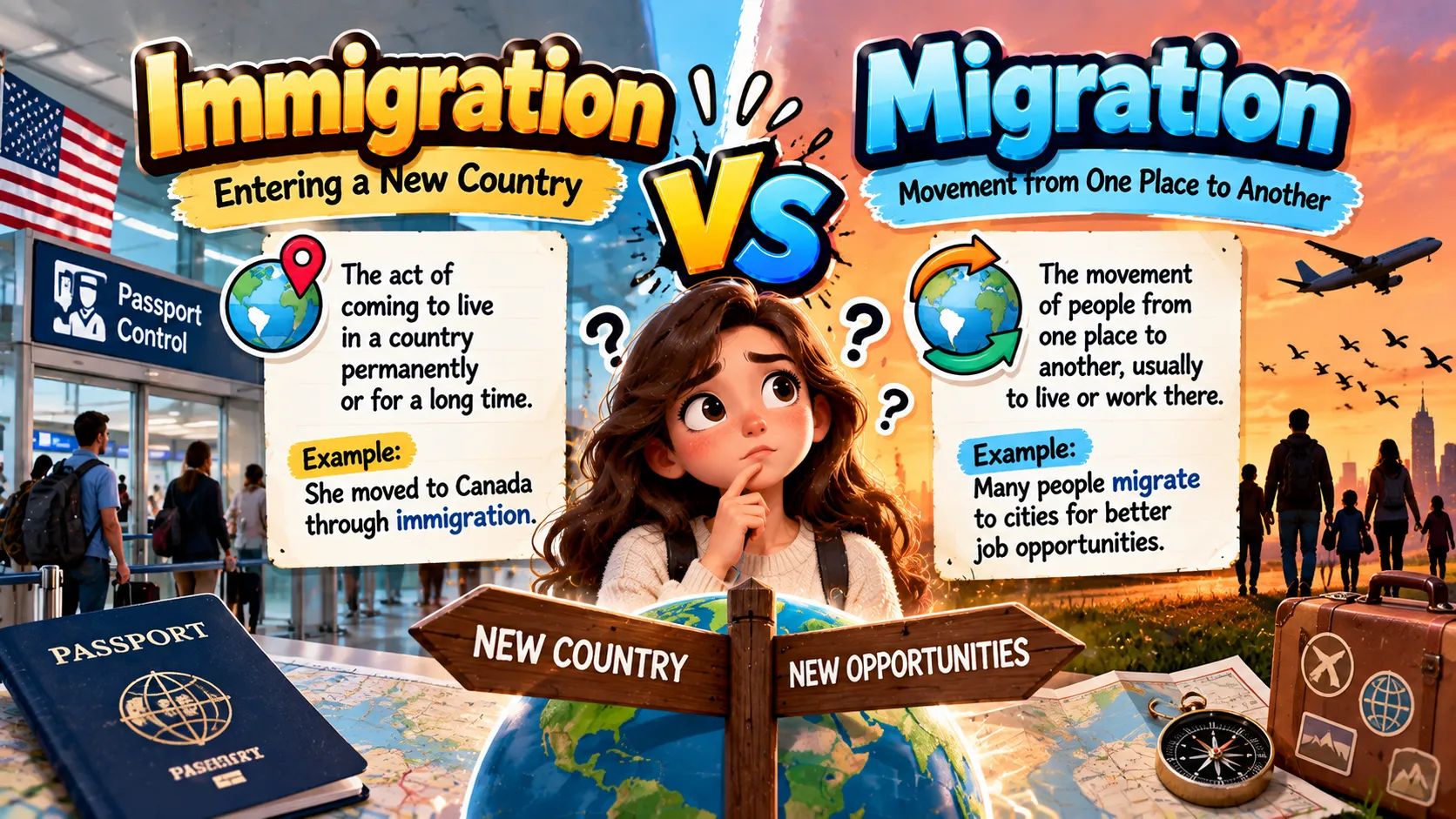
Understanding the difference between immigration vs migration is important when discussing travel, relocation, international borders, population changes, and global communities. Although these terms are closely related, they do not mean exactly the same thing. The main difference lies in how broadly each word describes the movement of people from one place to another.
Migration is the broad term for moving from one location to another, either temporarily or permanently. It can happen within the same country or across international borders. Immigration, on the other hand, refers specifically to entering another country to live there, either permanently or for an extended period, depending on the context and applicable immigration rules.
For example, a family moving from one city to another within the same country is participating in internal migration. If that family moves to another country to establish a new home, the move can also be described as immigration from the perspective of the destination country.
In this guide, you will learn the meanings of immigration and migration, explore their key differences, examine practical examples, and understand how these terms are used in everyday English, news reports, and discussions about international movement.
What Does Immigration Mean? 🌍
Immigration is the process of entering a country other than one’s own to live there, either temporarily or permanently. The term is commonly used when discussing people who move internationally for employment, education, family reunification, safety, or other personal reasons.
The word is closely connected to the destination country. For example, when someone moves from Pakistan to Canada to live, Canada may describe that person as an immigrant. The same person may be described as an emigrant when viewed from Pakistan, the country they leave.
Immigration can involve different legal pathways, including employment-based visas, family sponsorship, study-related arrangements, permanent residence, or humanitarian protection. The available options and requirements depend on the destination country’s laws.
It is important to distinguish the general meaning of immigration from a person’s legal status. Someone may immigrate through an authorized pathway, while another person may enter or remain in a country without the required authorization. The word immigration itself does not automatically indicate whether a person’s status is legal or unlawful.
Examples of Immigration in Sentences
- She plans to immigrate to Australia for work.
- Immigration has shaped the history of many countries.
- The family completed its immigration paperwork.
- He contacted an immigration adviser about his application.
- The country introduced changes to its immigration policy.
- Their immigration process took several months.
- The students explored immigration patterns in their history class.
- She hopes to reunite with her family through an immigration program.
Common Reasons for Immigration
People immigrate for many different reasons, including:
- Employment opportunities and career development.
- Access to educational institutions and specialized training.
- Family reunification and marriage.
- Safety from persecution, conflict, or serious threats.
- Improved living conditions or long-term personal goals.
- Retirement or joining a community in another country.
These reasons differ from person to person. Immigration decisions can involve financial planning, legal requirements, cultural adjustments, and practical challenges such as finding housing or employment.
What Does Migration Mean? 🧳
Migration is the movement of people from one place to another. It is a broader term than immigration because it includes both movement within a country and movement across international borders.
For example, a person who moves from a rural village to a nearby city for a job is participating in internal migration. Someone who moves from one country to another may be participating in international migration.
Migration can be temporary, seasonal, circular, or permanent. Some people move for a few months to find work, while others relocate for many years. Others may move repeatedly between locations because of employment, family responsibilities, environmental conditions, or changing circumstances.
Migration also describes large-scale population movements. Researchers use the term when examining urbanization, labor markets, demographic changes, displacement, and the effects of environmental or economic pressures on communities.
Examples of Migration in Sentences
- Migration from rural areas to cities has increased in the region.
- Seasonal migration allows workers to find temporary employment.
- The researchers studied bird migration patterns.
- Internal migration has changed the population of the city.
- Climate conditions can influence human migration.
- Many families experience migration when they relocate for work.
- International migration connects communities across borders.
- The report examines migration trends over several decades.
Common Types of Migration
Internal migration: Movement within the same country, such as relocating from a village to a city.
International migration: Movement from one country to another.
Seasonal migration: Movement linked to particular seasons, often for agricultural work or other temporary opportunities.
Temporary migration: Moving to another location for a limited period.
Permanent migration: Relocating with the intention of establishing a long-term home.
These categories can overlap. For instance, someone moving to another country for a temporary work assignment is an international migrant and may also be an immigrant under the destination country’s terminology or legal framework.
Immigration vs Migration: Key Differences 📊
The most important difference between immigration and migration is the scope of each term. Migration covers movement between places generally, while immigration specifically emphasizes entering another country.
| Feature | Immigration | Migration |
|---|---|---|
| Main meaning | Entering another country to live there | Moving from one place to another |
| Geographic scope | International movement into a country | Internal or international movement |
| Perspective | Focuses on the destination country | Describes movement more broadly |
| Duration | May be temporary or permanent, depending on context | May be temporary, seasonal, or permanent |
| Common contexts | Visas, residence, immigration policies | Population studies, relocation, labor movement |
| Example | Moving to Canada to establish a home | Moving from a village to a city |
| Related term | Emigration | Internal migration, international migration |
Immigration is therefore one specific context in which migration occurs. Not every migrant is an immigrant in the international sense, because some people move only within their own country.
For example, someone relocating from Lahore to Islamabad participates in internal migration. Someone relocating from Pakistan to the United Kingdom may be described as an immigrant in the UK and an emigrant from Pakistan.
Immigration vs Emigration: Understanding the Difference ✈️
Immigration and emigration are closely related terms that describe the same international move from two different perspectives.
Immigration focuses on entering a country. Emigration focuses on leaving a country to live somewhere else. Migration is the broader term that can include both actions.
Consider someone moving from Pakistan to Germany. From Germany’s perspective, the person is immigrating into the country. From Pakistan’s perspective, the person is emigrating from the country. The overall movement is international migration.
| Term | Focus | Example |
|---|---|---|
| Immigration | Entering a country | She immigrated to Germany. |
| Emigration | Leaving a country | She emigrated from Pakistan. |
| Migration | Movement between locations | She migrated from Pakistan to Germany. |
These distinctions are especially useful when reading immigration statistics, news reports, academic research, and government publications. The same person can be counted as an immigrant by the destination country and an emigrant by the country of origin.
Internal Migration vs International Migration 🗺️
Migration can occur within national borders or across them. Understanding this distinction helps explain why migration is a broader concept than immigration.
Internal migration happens when people relocate within the same country. A family might move from a small village to a large city because of education, employment, housing, or family needs. Since the move does not cross an international border, it is not international immigration.
International migration happens when people move between countries. Depending on the destination and circumstances, this movement may involve immigration and emigration. International migrants may move for work, study, family reasons, safety, or other purposes.
For example, a student who moves from Karachi to Islamabad is an internal migrant. A student who moves from Pakistan to the United States for university is an international migrant and may be considered an immigrant under the relevant destination-country definitions.
Both forms of migration can influence population distribution, local economies, access to services, and community life. However, the legal requirements for crossing an international border differ from those associated with moving within a country.
Why Do People Immigrate or Migrate? 🏡
People move for a wide range of reasons, and the motivations behind migration are often connected. Someone might relocate for a job, while another person may move because of family responsibilities, education, safety, or environmental conditions.
Employment and Economic Opportunities
People may move to find jobs, improve their income, develop professional skills, or access industries that are not available in their current location. Internal migration can connect rural workers with urban employment, while international migration may allow professionals to work in another country’s labor market.
Education and Training
Students frequently relocate to attend universities, colleges, or specialized training programs. Some move within their own country, while others study abroad and later return home or pursue further opportunities elsewhere.
Family and Personal Relationships
Marriage, family reunification, caregiving, and other personal circumstances can lead people to relocate. These movements may occur within a country or across international borders.
Safety and Environmental Conditions
Conflict, persecution, natural disasters, environmental changes, and other threats can force people to leave their homes. The circumstances may involve migration, displacement, or seeking international protection, depending on the situation.
These categories are not mutually exclusive. A person may move for several reasons at the same time, and their reasons may change during the relocation process.
Common Mistakes When Using Immigration and Migration ❌
Because the terms overlap, people sometimes use them interchangeably even when a more precise word is available.
Mistake 1: Calling every move immigration
Incorrect: Moving from one city to another is always immigration.
Correct: Moving between cities in the same country is usually internal migration.
Immigration generally refers to entering another country to live there.
Mistake 2: Assuming migration always means international movement
Migration can happen within a country or across borders. A family moving from a rural area to an urban center is participating in internal migration.
Mistake 3: Confusing immigration with emigration
Immigration means entering a destination country, while emigration means leaving the country of origin. The correct term depends on the perspective.
Mistake 4: Assuming immigration automatically means permanent residence
People may enter another country for temporary or long-term purposes. The specific meaning and legal classification depend on the context and applicable rules.
Mistake 5: Assuming all migrants have the same legal status
Migration describes movement, not a single legal category. Migrants can have different circumstances and statuses, including citizens returning to a country, authorized workers, students, permanent residents, or people seeking protection.
Using these terms accurately helps keep discussions clear and avoids misleading generalizations.
Frequently Asked Questions About Immigration vs Migration ❓
What is the main difference between immigration and migration?
Migration is the general movement of people from one place to another, either within a country or across international borders. Immigration specifically refers to entering another country to live there, temporarily or permanently depending on the context.
Is immigration a type of migration?
Yes. Immigration is one form of international human migration. It describes movement into a destination country rather than every possible kind of relocation.
What is the difference between immigration and emigration?
Immigration describes entering a country, while emigration describes leaving a country to live elsewhere. A person moving from Pakistan to Canada may be an immigrant in Canada and an emigrant from Pakistan.
Can migration happen within one country?
Yes. Internal migration occurs when people move from one location to another within the same country. Examples include moving from a village to a city or relocating from one state or province to another.
Does migration always mean permanent relocation?
No. Migration can be temporary, seasonal, circular, or permanent. Some people move for a short-term job or education, while others relocate for the long term.
Why do people immigrate to another country?
Common reasons include employment, education, family reunification, safety, and personal circumstances. The reasons vary by individual and may involve several factors.
Is an immigrant always a migrant?
In the broad sense of human movement, immigration is a form of migration, so an immigrant is generally considered an international migrant. However, official definitions and categories can vary between governments and statistical organizations.
Conclusion
The difference between immigration vs migration comes down to scope and perspective. Migration is the broad term for movement from one place to another, including moves within a country and across international borders. Immigration specifically describes entering another country to live there, whether temporarily or permanently depending on the circumstances.
Remember this simple distinction: migration is the broader concept, immigration focuses on entering a country, and emigration focuses on leaving one. Understanding these terms will help you interpret news articles, population statistics, policy discussions, and everyday conversations more accurately.

Natalie Brooks is a content researcher and writer with a strong interest in word meanings, dream interpretations, symbolism, and cultural insights. She is passionate about creating clear, informative, and easy-to-understand content that helps readers discover the deeper meanings behind words, names, dreams, and symbols. Through her work at Meanzly, Natalie aims to make knowledge accessible and valuable for readers around the world.