The words “eluded” and “alluded” sound similar, differ by just one letter, and appear in contexts that range from detective stories to literary criticism. The eluded vs alluded confusion ranks among the most common word-choice errors in English writing, appearing in everything from news reports to academic essays.
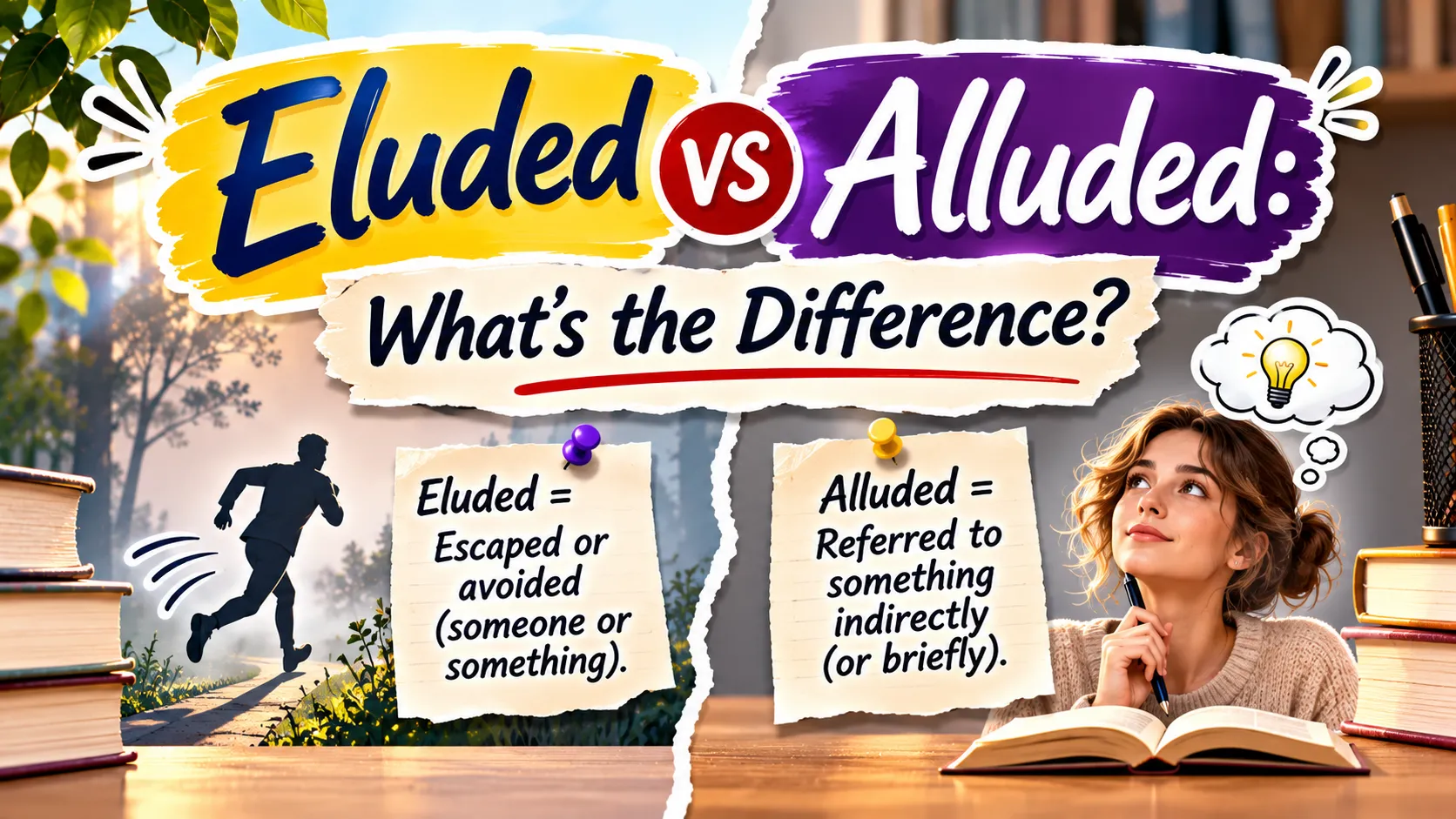
“Eluded” is the past tense of “elude,” meaning escaped or avoided capture. “Alluded” is the past tense of “allude,” meaning indirectly referred to something. These words sound similar but mean completely different things. This comprehensive guide explains the difference, explores their origins, provides practical examples, and helps you choose the correct word every time you write.
Quick Answer
“Eluded” means escaped or avoided capture, as in “the suspect eluded police.” “Alluded” means indirectly referred to something, as in “she alluded to the scandal.” Remember: eluded starts with “e” for “escape”; alluded starts with “a” for “allude” (refer). They sound similar but mean completely different things.
Meaning Overview Table
| Aspect | Meaning |
|---|---|
| Definition | Eluded: escaped or avoided capture. Alluded: indirectly referred to something |
| Pronunciation | Eluded: /ɪˈluːdɪd/; Alluded: /əˈluːdɪd/ |
| Part of Speech | Both are past-tense verbs |
| Usage | “The thief eluded the police” vs. “He alluded to the incident” |
| Context | Eluded: crime, sports, escape. Alluded: literature, conversation, writing |
Main Meaning
Definition
Eluded is the past tense of “elude,” meaning to escape from or avoid capture, to evade or dodge something, or to be difficult to understand or remember. Alluded is the past tense of “allude,” meaning to refer to something indirectly or casually.
Origin
“Eluded” comes from the Latin verb eludere, meaning “to play out” or “to mock,” combining e- (“out”) and ludere (“to play”). The sense of escaping or evading developed from the idea of mocking or outwitting pursuit. “Alluded” comes from the Latin verb alludere, meaning “to play with” or “to jest with,” combining ad- (“to”) and ludere (“to play”). The sense of indirect reference developed from the idea of touching upon something lightly.
Context
The distinction matters across several contexts:
- Crime and Law Enforcement: “Eluded” appears in reports of suspects escaping capture
- Sports: “Eluded” appears in descriptions of players evading defenders
- Literature and Conversation: “Alluded” appears in descriptions of indirect references
- Everyday Writing: Confusing the two creates embarrassing errors in emails, essays, and social media posts
Modern Usage
Today, “eluded” appears frequently in news reports of manhunts, sports commentary, and descriptions of elusive concepts. “Alluded” appears in literary criticism, conversation, and writing about references. The confusion between the two persists because they sound similar and spell-check often fails to catch the error.
Detailed Explanation
Literal Meaning
Literally, “eluded” means escaped from pursuit or avoided capture. “Alluded” literally means referred to something indirectly, touching upon it lightly rather than stating it directly.
Common Meaning
Commonly, people use “eluded” when describing someone who escaped capture. “The suspect eluded police for days.” They use “alluded” when describing an indirect reference. “She alluded to the problem without naming it.”
Crime and Law Meaning
In crime reporting, “eluded” describes suspects who escape or avoid law enforcement. “The fugitive eluded capture for years.” The word carries connotations of pursuit and evasion.
Literary Meaning
In literary contexts, “alluded” describes indirect references to other works, events, or people. “The novel alludes to Shakespeare.” This usage appears in literary criticism and academic writing.
Conversational Meaning
In everyday conversation, “alluded” describes hinting at something without stating it directly. “He alluded to a possible promotion.” The word suggests subtlety and indirectness.
Sports Meaning
In sports, “eluded” describes players evading defenders. “The running back eluded three tacklers.” The word conveys agility and evasion.
Examples Table
| Example | Meaning |
|---|---|
| The suspect eluded police for three days. | Escaped capture |
| She alluded to the incident in her speech. | Referred indirectly |
| The athlete eluded the defender. | Avoided capture or tackle |
| He alluded to his past without details. | Hinted at something |
| Success eluded him for years. | Remained out of reach |
| The writer alluded to Greek mythology. | Referred indirectly |
| The criminal eluded capture. | Avoided being caught |
| She alluded to the problem in the meeting. | Mentioned indirectly |
| The solution eluded the scientists. | Was difficult to achieve or understand |
| The politician alluded to the scandal. | Referred indirectly |
Related Meanings Table
| Related Term | Meaning |
|---|---|
| Elude | To escape or avoid capture |
| Allude | To refer to something indirectly |
| Elusive | Difficult to find, catch, or achieve |
| Allusion | An indirect reference |
| Illusion | A false perception or deceptive appearance |
| Evade | To escape or avoid something |
| Dodge | To avoid by moving quickly |
| Escape | To get free from confinement or danger |
| Refer | To mention or allude to something |
| Hint | To suggest indirectly |
| Suggest | To imply indirectly |
| Imply | To indicate indirectly |
| Cite | To quote or refer to explicitly |
| Mention | To refer to briefly or directly |
| Touch on | To mention briefly, similar to allude |
Common Uses
People use “eluded” and “alluded” across numerous contexts:
Crime Reporting: Journalists use “eluded” when describing suspects who escape capture. “The suspect eluded police.” The word appears constantly in news reports.
Sports Commentary: Announcers use “eluded” when describing players evading defenders. “She eluded three defenders and scored.”
Literary Criticism: Critics use “alluded” when describing references to other works. “The poem alludes to classical mythology.”
Everyday Conversation: People use “alluded” when hinting at something. “He alluded to a surprise but wouldn’t say what.”
Academic Writing: Scholars use “alluded” when referencing other texts indirectly. “The author alluded to earlier research.”
Common Mistakes
| Mistake | Correction |
|---|---|
| Writing “alluded police” | Write “eluded police” (escaped capture) |
| Writing “eluded to the incident” | Write “alluded to the incident” (referred indirectly) |
| Writing “the suspect alluded capture” | Write “the suspect eluded capture” (escaped) |
| Writing “she eluded to the problem” | Write “she alluded to the problem” (referred indirectly) |
| Writing “success alluded him” | Write “success eluded him” (remained out of reach) |
| Writing “the writer eluded to mythology” | Write “the writer alluded to mythology” (referred indirectly) |
| Assuming spell-check will catch the error | Spell-check often misses similar-sounding words; proofread manually |
| Writing “the criminal alluded police” | Write “the criminal eluded police” (escaped) |
| Writing “he eluded to a promotion” | Write “he alluded to a promotion” (hinted at) |
| Writing “the solution alluded the scientists” | Write “the solution eluded the scientists” (remained out of reach) |
Related Questions
Is it “eluded” or “alluded”?
It depends on meaning. Use “eluded” for escaping or avoiding capture. Use “alluded” for indirectly referring to something.
What does “eluded” mean?
“Eluded” is the past tense of “elude,” meaning escaped from, avoided capture, or remained difficult to achieve or understand.
What does “alluded” mean?
“Alluded” is the past tense of “allude,” meaning indirectly referred to something without naming it directly.
What is the difference between “eluded” and “alluded” in a sentence?
“Eluded” relates to escape or evasion. “Alluded” relates to indirect reference.
Why do people confuse “eluded” and “alluded”?
They sound similar and differ by only one letter. Spell-check often misses similar-sounding words, so the error persists in written communication.
How can I remember the difference?
Remember: “eluded” starts with “e” for “escape.” “Alluded” starts with “a” for “allude” (refer).
What is an “allusion”?
An “allusion” is an indirect reference to a person, event, or work of art. It comes from the verb “allude.”
What does “elusive” mean?
“Elusive” is an adjective meaning difficult to find, catch, or achieve. It comes from the verb “elude.”
FAQs
What does “eluded” mean?
“Eluded” is the past tense of “elude.” It means escaped from, avoided capture, or remained difficult to achieve or understand.
What does “alluded” mean?
“Alluded” is the past tense of “allude.” It means indirectly referred to something without naming it directly.
Is it “eluded to” or “alluded to”?
The correct phrase is “alluded to.” “Allude” takes the preposition “to” when referring to something.
Is it “eluded police” or “alluded police”?
The correct phrase is “eluded police.” Elude means to escape or avoid capture.
Can “eluded” be used metaphorically?
Yes. “Success eluded him” means success remained out of reach, using “eluded” metaphorically.
Can “alluded” be used in casual conversation?
Yes. People often say “he alluded to” in everyday speech when describing indirect references or hints.
How can I remember the difference?
Remember: “eluded” starts with “e” for “escape.” “Alluded” starts with “a” for “allude” (refer).
What is the origin of “alluded”?
“Alluded” comes from the Latin alludere, meaning “to play with” or “to jest with,” which developed into the sense of indirect reference.
Conclusion
Mastering the eluded vs alluded distinction protects your writing from embarrassing word-choice errors. “Eluded” means escaped or avoided capture, or remained difficult to achieve. “Alluded” means indirectly referred to something. Remember the simple rule: eluded starts with “e” for “escape”; alluded starts with “a” for “allude” (refer). Whether you’re writing a crime report, a literary analysis, or a social media post, choosing the correct word ensures your meaning is clear. Practice using “eluded” for escape and “alluded” for indirect reference, and your readers will understand exactly what you intend. Small distinctions like this separate careful writers from careless ones.

Natalie Brooks is a content researcher and writer with a strong interest in word meanings, dream interpretations, symbolism, and cultural insights. She is passionate about creating clear, informative, and easy-to-understand content that helps readers discover the deeper meanings behind words, names, dreams, and symbols. Through her work at Meanzly, Natalie aims to make knowledge accessible and valuable for readers around the world.