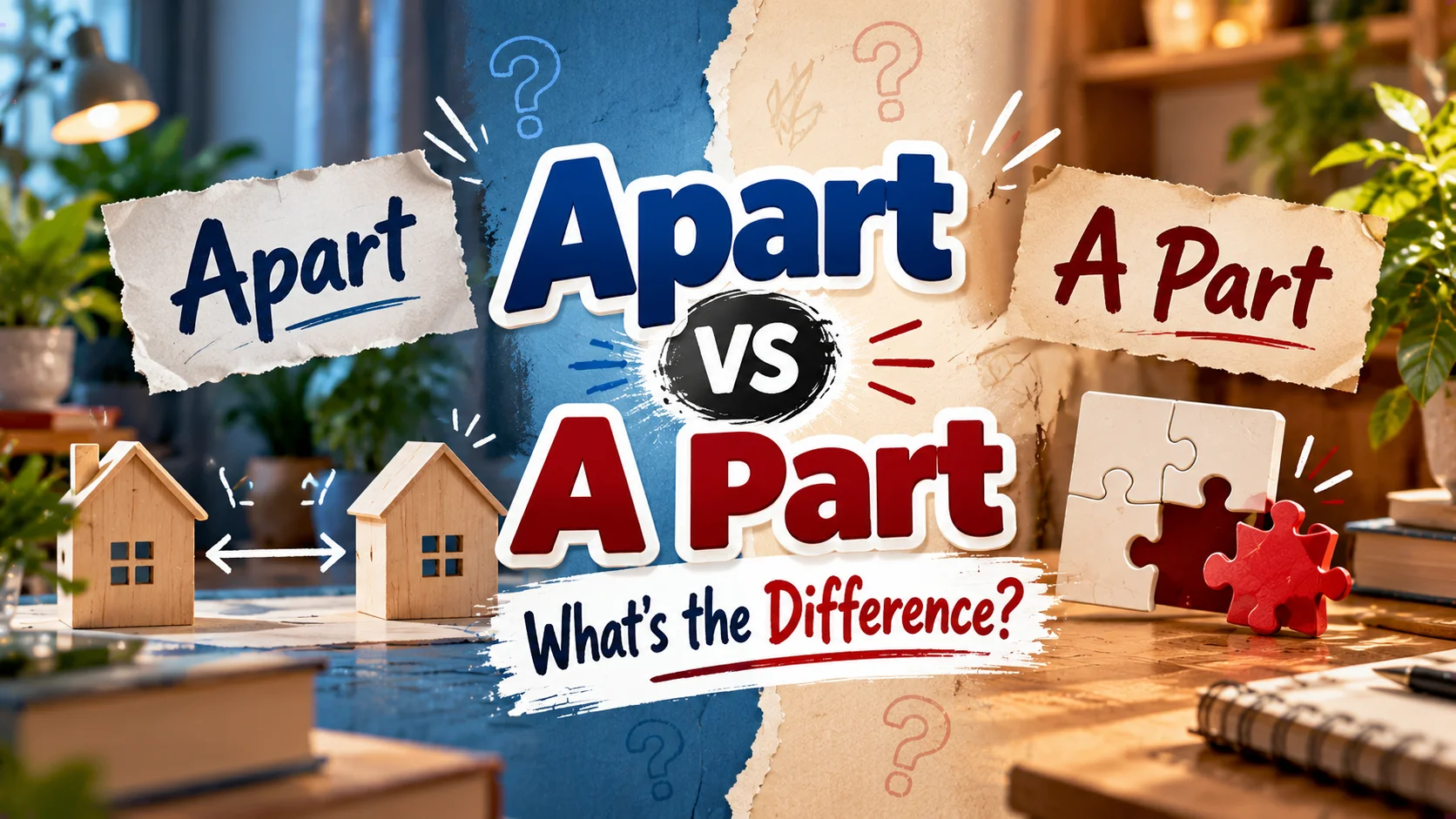
English contains countless word pairs that sound identical but carry opposite meanings, and “apart” versus “a part” ranks among the most confusing. The apart vs a part distinction trips up even native speakers because the only visible difference is a single space. Yet that space changes everything: one word means separation, while two words mean inclusion.
“Apart” (one word) is an adverb meaning separated, distant, or into pieces. “A part” (two words) is a noun phrase meaning a piece, portion, or component of something larger . The confusion makes sense—both sound identical in speech, and the meanings are nearly opposite. “Apart from the team” means excluded from it; “a part of the team” means included in it. This comprehensive guide breaks down the difference with clear rules, practical examples, and memory tricks to help you choose correctly every time.
Quick Answer
“Apart” (one word) means separated, distant, or into pieces. “A part” (two words) means a piece or component of something larger. Use “apart” for separation; use “a part” for inclusion. Remember: “apart” pairs with “from” (separation), and “a part” pairs with “of” (inclusion).
Meaning Overview Table
| Aspect | Meaning |
|---|---|
| Definition | “Apart” means separated; “a part” means a piece of a whole |
| Pronunciation | Both sound identical: /əˈpɑːrt/ |
| Part of Speech | Apart is an adverb or adjective; a part is a noun phrase |
| Usage | “They live apart” vs. “She is a part of the team” |
| Context | Grammar, writing, everyday communication |
Main Meaning
Definition
“Apart” functions as an adverb meaning “separated by distance or time,” “into pieces,” or “excluded from consideration” . It also works as an adjective meaning “separate or isolated” . “A part” is a noun phrase consisting of the article “a” and the noun “part,” meaning “a piece, portion, or component of something larger” .
Origin
Both forms trace back to the Latin word pars, meaning “part” or “portion.” The word “part” entered English through Old French. The adverb “apart” developed from the phrase “on part” or “a part,” meaning “to one side” or “separately.” Over centuries, the two-word phrase “a part” merged into the single word “apart” when used adverbially, while remaining two words when functioning as a noun phrase .
Context
The distinction operates across several contexts:
- Everyday Writing: The most common setting for confusion, especially in emails and social media
- Academic Writing: Precision matters in essays and research papers
- Professional Communication: Errors can undermine credibility
- Literary Analysis: Authors use both forms deliberately for effect
- Grammar Instruction: A standard topic in English classes
Modern Usage
Today, “apart” and “a part” appear constantly in written English. The confusion has become so widespread that even published authors and journalists occasionally misuse them. Social media has amplified the problem, with phrases like “grateful to be apart of this” appearing frequently despite being incorrect . Understanding the distinction remains essential for clear, professional writing.
Detailed Explanation
Literal Meaning
Literally, “apart” means “separated” or “to one side.” “A part” literally means “one piece” or “one segment.” The literal meanings are nearly opposite: apart separates, while a part includes .
Common Meaning
Commonly, people use “apart” to describe physical separation (“the houses are far apart”), emotional distance (“we grew apart”), or disassembly (“take it apart”) . They use “a part” to describe inclusion (“she’s a part of the group”) or components (“a part for the machine”) .
Grammatical Meaning
Grammatically, “apart” is an adverb or adjective. As an adverb, it modifies verbs: “They sat apart.” As an adjective, it describes nouns: “a world apart” . “A part” is a noun phrase where “a” is an article and “part” is the noun. It functions as a subject, object, or complement in sentences .
Idiomatic Meaning
Both forms appear in idioms. “Apart” appears in phrases like “fall apart,” “take apart,” “worlds apart,” and “apart from” (meaning except for) . “A part” appears in phrases like “play a part,” “a part of me,” and “a part of the family” .
Internet and Social Media Meaning
Online, the confusion between “apart” and “a part” is rampant. Phrases like “apart of this journey” appear frequently in captions and comments, despite being grammatically incorrect. The error stems from the identical pronunciation and the visual similarity of the phrases .
Examples Table
| Example | Meaning |
|---|---|
| The two towns are 50 miles apart. | Separated by distance |
| She is a part of our family. | Included as a member |
| He took the clock apart. | Disassembled into pieces |
| A part of me wants to stay. | One portion of my feelings |
| Apart from the rain, it was a great day. | Except for the rain |
| We’re waiting for a part to arrive. | A component for repair |
| They grew apart over the years. | Became emotionally distant |
| She played a part in the school play. | An acting role |
| The old couch is falling apart. | Coming to pieces |
| He felt like a part of the team. | Included and accepted |
| Keep the fighting dogs apart. | Separate from each other |
| This is a part of the process. | A step in the procedure |
Related Meanings Table
| Related Term | Meaning |
|---|---|
| Separate | Apart, divided, not together |
| Together | The opposite of apart |
| Portion | A part or share of something |
| Component | A part of a larger whole |
| Piece | A part or fragment |
| Segment | A section or part |
| Apart from | Except for; other than |
| A part of | Included in; belonging to |
| Fall apart | Break into pieces; disintegrate |
| Take apart | Disassemble |
| Set apart | Make distinct or separate |
| Worlds apart | Completely different |
| Part and parcel | An essential part |
| Play a part | Have a role in something |
| For the most part | Usually; mainly |
| In part | Partially |
| Part with | Give up; relinquish |
| Partake | To participate or share |
Common Uses
People use “apart” and “a part” across numerous contexts:
Everyday Conversation: Speakers use both forms constantly. “I hate being apart from you” expresses separation. “I want to be a part of your life” expresses inclusion .
Formal Writing: Academic and professional writing requires the distinction. “The study is a part of a larger project” versus “The two theories are worlds apart” .
Business Communication: Professionals write “a part of the team” when describing inclusion and “apart from the budget” when making exceptions .
Literary Analysis: Authors use both forms deliberately. “A part of me will always love you” versus “We grew apart.” These choices shape meaning and tone .
Grammar Instruction: Teachers frequently address this pair because errors are common and the distinction is subtle .
Common Mistakes
| Mistake | Correction |
|---|---|
| “I want to be apart of the team” | “I want to be a part of the team” |
| “Apart from the team” when meaning included | Use “a part of the team” for inclusion |
| “A part from the group” when meaning separated | Use “apart from” for separation |
| “They are a part” when meaning separated | “They are apart” for separation |
| “Take a part the machine” | “Take apart the machine” |
| “Falling a part” | “Falling apart” |
| “Worlds a part” | “Worlds apart” |
| “A part from the fact” when meaning except | “Apart from the fact” |
| Removing “a” to test: “I am part of the team” | If “part” works without “a,” it’s “a part” |
| Confusing pronunciation | Both sound identical; rely on meaning, not sound |
Related Questions
What is the difference between apart and a part?
“Apart” means separated or into pieces. “A part” means a piece or component of something larger. They are nearly opposite in meaning .
How can I remember the difference?
“Apart” pairs with “from” (separation); “a part” pairs with “of” (inclusion). Try removing “a” to test: if “part” works alone, it’s “a part” .
Is it “apart of” or “a part of”?
“A part of” is correct for inclusion. “Apart of” is always incorrect. Use “apart from” for separation .
What does “apart from” mean?
“Apart from” means “except for” or “other than.” It introduces an exception: “Apart from the delay, the trip was perfect” .
Can apart be an adjective?
Yes. “Apart” works as an adjective meaning “separate or isolated,” as in “a world apart” or “a breed apart” .
What does “a part” mean in acting?
In theater and film, “a part” refers to an acting role. “She got a part in the play” means she received a role .
FAQs
What is the main difference between apart and a part?
“Apart” (one word) means separated or distant. “A part” (two words) means a piece or component of something larger .
Is it “apart of the team” or “a part of the team”?
“A part of the team” is correct for inclusion. “Apart of” is incorrect and would mean “separated from,” the opposite of the intended meaning .
How do you use apart in a sentence?
“The two houses are far apart.” “She took the toy apart.” “Apart from the weather, the trip was great” .
How do you use a part in a sentence?
“She is a part of the team.” “A part of the machine broke.” “He played a part in the movie” .
What is the easiest trick to remember the difference?
If you can replace “part” with “piece” or “segment,” use “a part.” If you can’t, use “apart.” Also, “apart” goes with “from”; “a part” goes with “of” .
Is “apart” one word or two?
“Apart” is one word. “A part” is two words. The space changes the meaning entirely .
Why do people confuse apart and a part?
They sound identical when spoken. The only difference is the space in writing, making them easy to mix up .
Can I use “apart” to mean “except for”?
Yes. “Apart from” means “except for” or “other than.” “Apart from that, everything is fine” .
Conclusion
Mastering the apart vs a part distinction sharpens your writing and prevents embarrassing errors. “Apart” (one word) means separated, distant, or into pieces. “A part” (two words) means a piece or component of something larger. These forms are nearly opposite in meaning: apart separates, while a part includes. Remember the memory tricks: “apart” pairs with “from,” and “a part” pairs with “of.” Test by removing “a”—if “part” works alone, it’s “a part.” Practice using these forms correctly, and your writing will gain precision and clarity. Whether you’re drafting an email, writing an essay, or composing a social media post, knowing the difference between apart and a part will serve you well.

Natalie Brooks is a content researcher and writer with a strong interest in word meanings, dream interpretations, symbolism, and cultural insights. She is passionate about creating clear, informative, and easy-to-understand content that helps readers discover the deeper meanings behind words, names, dreams, and symbols. Through her work at Meanzly, Natalie aims to make knowledge accessible and valuable for readers around the world.









