The words “may” and “might” represent one of the most confusing pairs of modal verbs in English. Both express possibility, both sound natural in conversation, and both appear constantly in writing. Yet the may vs might distinction carries subtle differences in certainty, formality, and grammatical function that careful speakers and writers should understand.
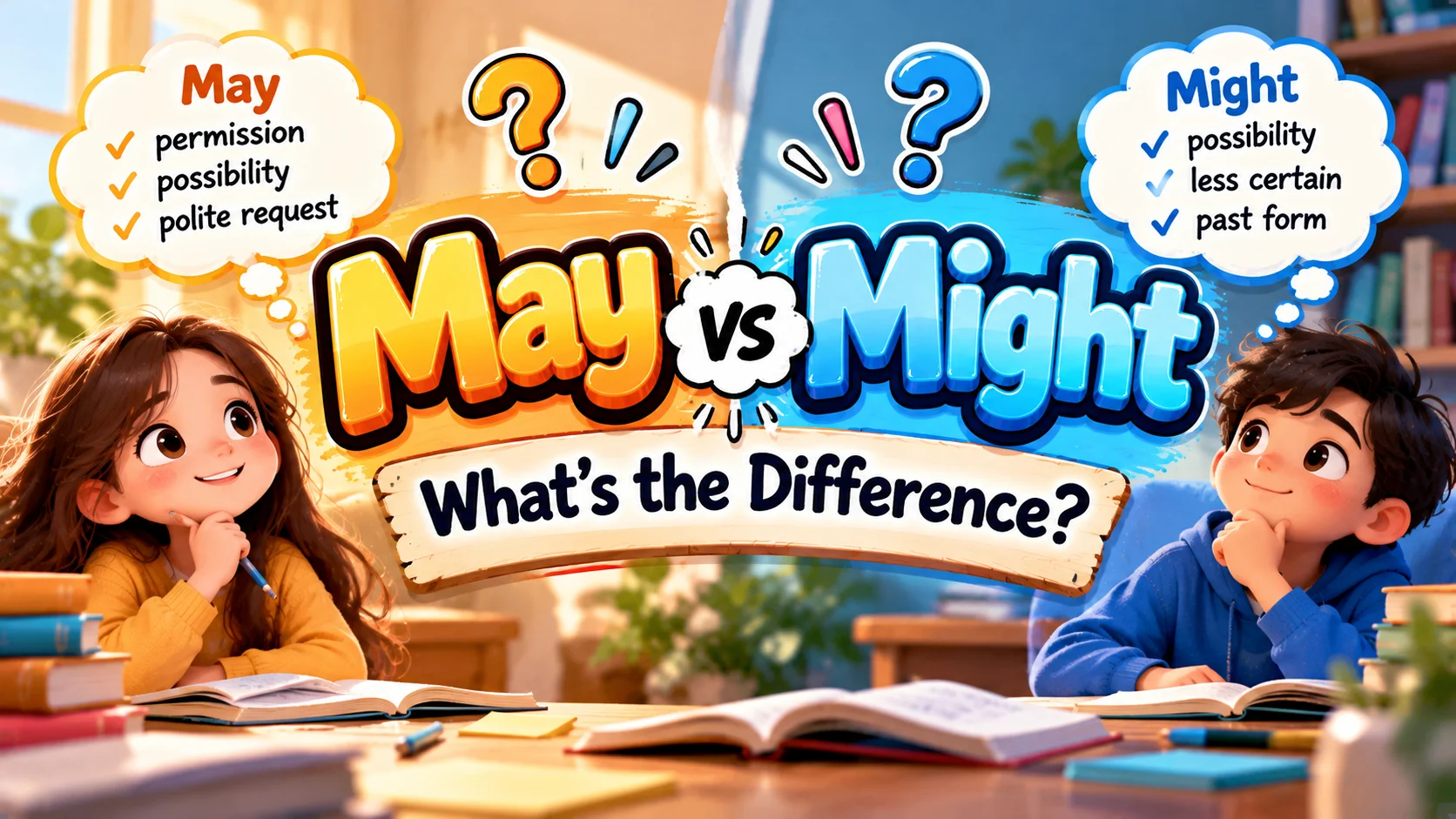
“May” typically suggests a stronger possibility or grants permission. “Might” usually signals a weaker possibility, a hypothetical situation, or greater tentativeness. However, the two words overlap significantly, and many grammar authorities acknowledge that they are often interchangeable . The distinction between them has blurred over centuries of language evolution, leading to confusion even among native speakers. This comprehensive guide breaks down the differences, explores their origins, provides practical examples, and helps you choose the right word with confidence.
Quick Answer
Use “may” for stronger possibilities, formal permission, and wishes. Use “might” for weaker possibilities, hypothetical or counterfactual situations, and polite requests. “May” suggests a higher likelihood; “might” suggests a lower one . In reported speech after a past-tense verb, always use “might” .
Meaning Overview Table
| Aspect | Meaning |
|---|---|
| Definition | Two modal verbs expressing possibility, permission, and hypothetical situations with subtle differences in certainty |
| Pronunciation | May: /meɪ/; Might: /maɪt/ |
| Part of Speech | Modal auxiliary verbs |
| Usage | “I may go to the party” (likely) vs. “I might go to the party” (less certain) |
| Context | Grammar, formal writing, everyday conversation, legal language |
Main Meaning
Definition
“May” and “might” are modal auxiliary verbs that express possibility, permission, purpose, wishes, and hypothetical situations. “May” generally conveys a stronger sense of possibility or grants permission in formal contexts. “Might” typically suggests a weaker possibility, a hypothetical scenario, or serves as the past-tense form of “may” in reported speech .
Origin
Both words share Old English roots. “May” derives from the Old English magan, meaning “to be able” or “to have power.” “Might” serves as the past tense of “may” in its original grammatical function. Over centuries, “might” developed its own distinct uses, particularly for expressing weaker possibility and hypothetical situations. The two words have coexisted in English for over a thousand years, gradually developing subtle differences in meaning and usage .
Context
The may vs might distinction operates across several contexts:
- Possibility: Both express uncertainty, but “may” suggests higher likelihood
- Permission: “May” is the standard choice for granting or requesting permission in formal English
- Hypotheticals: “Might” is preferred for situations that are not real or are contrary to fact
- Reported Speech: “Might” is required after past-tense reporting verbs
- Formality: “Might” often sounds more tentative or polite than “may”
Modern Usage
Today, both words appear frequently in English. In casual conversation, speakers often use them interchangeably without noticeable difference. In formal writing, however, the distinction matters. Style guides and grammar references generally agree that “may” suggests a stronger possibility, while “might” suggests a weaker one . In legal and contract drafting, the distinction becomes even more critical, with some experts recommending “may” for discretion and “might” for pure possibility .
Detailed Explanation
Literal Meaning
Literally, “may” means “to have the ability or power” (from Old English magan). “Might” originally served as its past tense. In modern usage, both words express possibility or permission, but the literal sense of ability has largely disappeared, replaced by the sense of uncertainty or authorization.
Common Meaning
Commonly, people use “may” and “might” to express that something is possible. “It may rain tomorrow” suggests a reasonable chance of rain. “It might rain tomorrow” suggests a smaller chance. Many speakers use them interchangeably, but careful writers preserve the distinction. The choice often depends on how confident the speaker feels about the possibility .
Grammatical Meaning
Grammatically, both words function as modal auxiliary verbs. They precede a main verb in its base form (bare infinitive). Neither takes “-s” for third-person singular. The negative forms are “may not” and “might not” (or “mightn’t”). In reported speech, “may” changes to “might” after a past-tense reporting verb .
Hypothetical Meaning
In hypothetical or counterfactual situations, “might” is the correct choice. When describing something that could have happened but did not, use “might have.” For example, “If he had studied harder, he might have passed” describes a situation contrary to fact. “May have” in this context would suggest the outcome is still uncertain, which contradicts the known result .
Permission Meaning
“May” serves as the standard modal for granting or requesting permission in formal English. “You may leave” grants permission. “May I ask a question?” requests permission. “Might” can also request permission but sounds more formal and tentative: “Might I ask a question?” This usage is rare in modern conversation .
Formal and Legal Meaning
In legal writing and contract drafting, the distinction carries weight. Some experts recommend using “may” exclusively for discretion (granting authority) and “might” exclusively for possibility (describing uncertainty). This practice avoids ambiguity about whether a statement grants permission or merely describes a possible outcome .
Examples Table
| Example | Meaning |
|---|---|
| I may go to the conference. | Stronger possibility; likely |
| I might go to the conference. | Weaker possibility; less certain |
| You may leave early today. | Permission granted |
| May I borrow your pen? | Formal request for permission |
| She may be right. | Stronger possibility; probably correct |
| She might be right. | Weaker possibility; possibly correct |
| It may rain later. | Rain is reasonably likely |
| It might rain later. | Rain is less likely |
| He said he might visit. | Reported speech; past-tense reporting verb |
| If I had known, I might have helped. | Counterfactual; contrary to fact |
| May you live long and prosper. | Expressing a wish |
| Might I make a suggestion? | Very polite, formal request |
| The train may leave on time. | Reasonable possibility |
| The train might leave on time. | Tentative possibility |
| We may as well leave now. | Suggestion; no better alternative |
Related Meanings Table
| Related Term | Meaning |
|---|---|
| Can | Expresses ability or, informally, permission |
| Could | Past tense of can; also expresses possibility |
| Would | Expresses conditional or habitual past action |
| Should | Expresses obligation or expectation |
| Must | Expresses necessity or strong probability |
| May have | Expresses past possibility with present uncertainty |
| Might have | Expresses past possibility, often counterfactual |
| May as well | Suggests doing something because nothing better exists |
| Might as well | Same meaning as “may as well,” often preferred |
| Perhaps | Adverb expressing uncertainty; often redundant with may/might |
| Possibly | Adverb expressing uncertainty; often redundant with may/might |
| Permission | Authorization to do something; “may” grants it |
| Possibility | Likelihood that something may happen |
| Hypothetical | Situations that are not real or are imagined |
| Counterfactual | Situations contrary to fact; requires “might” |
| Tentative | Uncertain or hesitant; “might” sounds more tentative |
| Modal verb | A verb expressing possibility, necessity, or ability |
| Auxiliary verb | A helping verb used with main verbs |
Common Uses
People use “may” and “might” across numerous contexts:
Everyday Conversation: Speakers use both words constantly to express uncertainty. “I may go to the gym later” and “I might go to the gym later” both work, though the second sounds slightly less committed.
Formal Writing: Academic and professional writing requires careful distinction. “May” suggests a stronger possibility; “might” suggests a weaker one. Editors often change “might” to “may” when the possibility seems stronger .
Permission Requests: “May I” remains the standard formal request. “Might I” sounds overly formal or old-fashioned in most contexts. “Can I” dominates informal speech.
Hypothetical Discussions: When discussing what could have been different, “might have” is the standard construction. “If she had arrived earlier, she might have met him.”
Legal and Contract Drafting: Attorneys and contract specialists carefully distinguish between “may” (discretion) and “might” (possibility) to avoid ambiguity .
Wishes and Blessings: “May” expresses wishes and blessings: “May the best man win,” “May you have a safe journey.”
Common Mistakes
| Mistake | Correction |
|---|---|
| Using “may” in counterfactual situations | Use “might” for situations contrary to fact: “If he had studied, he might have passed” |
| Using “might” after a past-tense reporting verb | Use “might” correctly in reported speech: “He said he might come” |
| Using “may” to sound more formal when “might” fits better | Precision matters more than formality |
| Assuming they are always interchangeable | They differ in certainty and hypothetical use |
| Using “might” to grant permission | Use “may” for formal permission granting |
| Adding “possibly” or “perhaps” with may/might | Redundant; may/might already express uncertainty |
| Using “may” when the situation is not real | Use “might” for unreal or hypothetical conditions |
| Confusing “may” and “can” for permission | “Can” is informal; “may” is formal |
| Using “might” when certainty is higher | Use “may” for stronger possibilities |
| Forgetting the past-tense function in reported speech | Change “may” to “might” after past-tense verbs |
Related Questions
What is the main difference between may and might?
“May” suggests a stronger possibility or grants permission. “Might” suggests a weaker possibility or describes hypothetical situations .
Can may and might be used interchangeably?
In casual conversation, yes, often. In formal writing, no—the distinction in certainty and hypothetical use matters .
When should I use might instead of may?
Use “might” for weaker possibilities, hypothetical or counterfactual situations, and after past-tense reporting verbs .
Is “might” more polite than “may”?
“Might I” sounds more formal and tentative than “May I,” but this usage is rare in modern conversation .
What does “might have” mean?
“Might have” expresses a past possibility, often one that did not occur. “I might have gone” means there was a chance I would go, but I didn’t .
Why do people confuse may and might?
They overlap in expressing possibility, and the distinction in certainty is subtle. Many speakers do not perceive a meaningful difference .
FAQs
What is the difference between may and might?
“May” expresses a stronger possibility or grants permission. “Might” expresses a weaker possibility, a hypothetical situation, or serves as the past tense of “may” in reported speech .
Can you use may and might interchangeably?
In casual conversation, often yes. In formal writing, the distinction matters. “May” suggests higher likelihood; “might” suggests lower likelihood .
When do you use might instead of may?
Use “might” for counterfactual situations, weaker possibilities, and after past-tense reporting verbs like “said” or “thought” .
What does “might as well” mean?
“Might as well” suggests doing something because there is no better alternative. “We might as well leave now” means leaving now makes as much sense as waiting .
Is “may” more formal than “might”?
“May” is the standard for formal permission. “Might” can sound more tentative or old-fashioned when used for permission .
What is the past tense of may?
“Might” serves as the past tense of “may” in reported speech: “He said he might come” .
Can I use “may” for permission?
Yes. “May” is the standard modal for granting and requesting permission in formal English: “You may leave” or “May I go?” .
Why do grammar books say might is for less likely possibilities?
The distinction reflects usage patterns. “May” suggests a reasonable chance; “might” suggests a smaller chance. This is a flexible guideline, not an absolute rule .
Conclusion
Mastering the may vs might distinction elevates your writing and clarifies your meaning. “May” expresses stronger possibilities and grants permission. “Might” expresses weaker possibilities, hypothetical situations, and serves as the past tense of “may” in reported speech. While casual conversation often blurs the line, careful writers preserve the difference in certainty and grammatical function. Remember the simple rule: “may” for stronger possibilities and formal permission, “might” for weaker possibilities and hypotheticals. This small distinction carries real weight in professional writing, legal language, and everyday credibility. Choose your words deliberately, and your readers will understand exactly how likely something is.

Natalie Brooks is a content researcher and writer with a strong interest in word meanings, dream interpretations, symbolism, and cultural insights. She is passionate about creating clear, informative, and easy-to-understand content that helps readers discover the deeper meanings behind words, names, dreams, and symbols. Through her work at Meanzly, Natalie aims to make knowledge accessible and valuable for readers around the world.