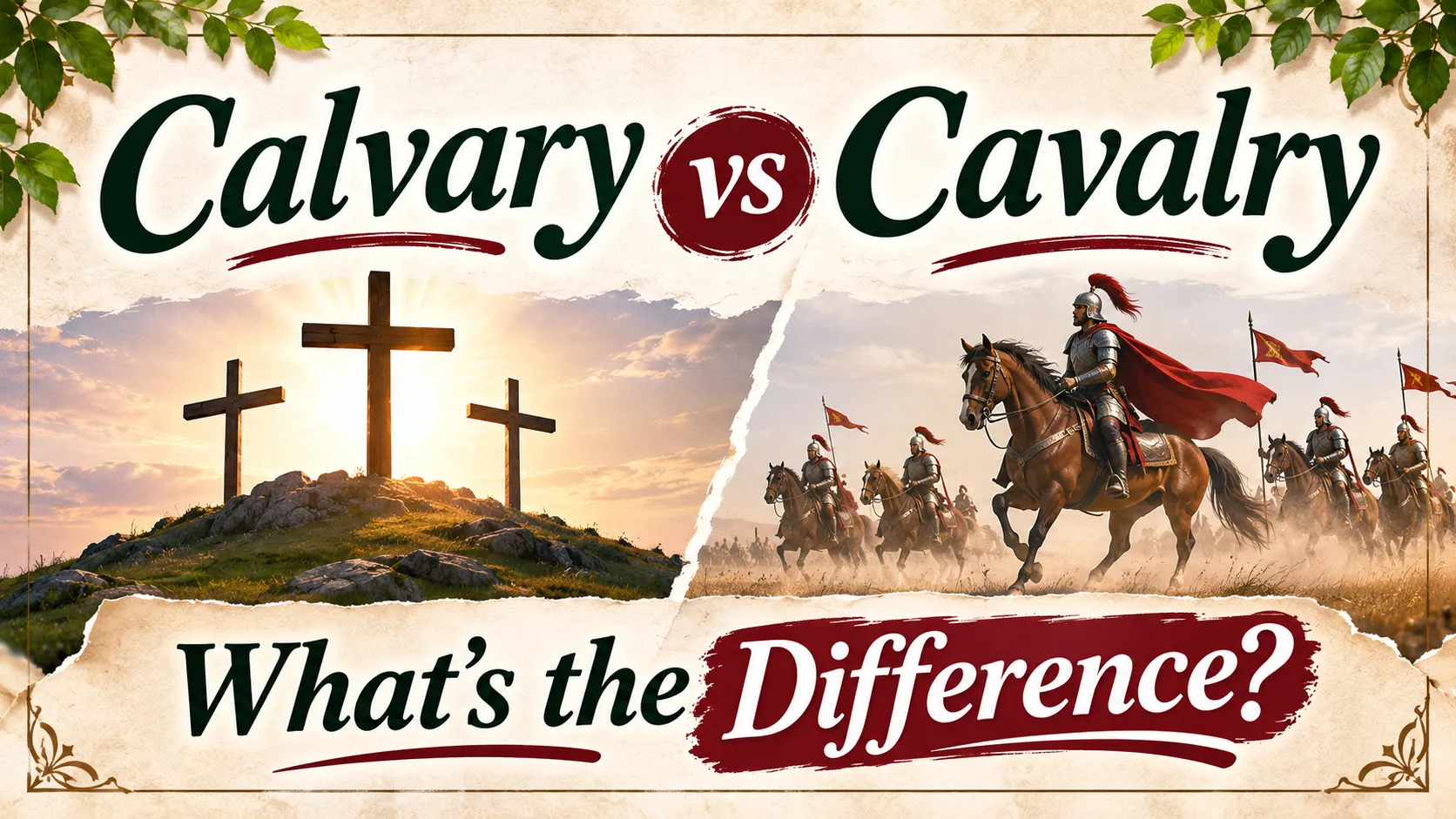
The words “calvary” and “cavalry” look nearly identical, differ by just one letter, and appear in completely different contexts. Yet the calvary vs cavalry confusion ranks among the most common word-swap errors in English, appearing in everything from historical accounts to sermons and news reports.
“Calvary” refers to the hill outside Jerusalem where Jesus was crucified, or more broadly, a place of suffering or a sculpture representing the crucifixion. “Cavalry” refers to soldiers who fight on horseback or, in modern usage, soldiers in armored vehicles. These words sound similar but mean completely different things. This comprehensive guide explains the difference, explores their origins, provides practical examples, and helps you choose the correct word every time you write.
Quick Answer
“Calvary” refers to the biblical hill where Jesus was crucified, or a representation of the crucifixion, as in “Mount Calvary.” “Cavalry” refers to troops who fight on horseback or in armored vehicles, as in “the cavalry arrived.” Remember: Calvary has an “l” for “location” (the hill); cavalry has an “a” after the “v” for “army” (soldiers). They sound similar but mean completely different things.
Meaning Overview Table
| Aspect | Meaning |
|---|---|
| Definition | Calvary: the hill of crucifixion; a place of suffering. Cavalry: mounted soldiers or armored troops |
| Pronunciation | Calvary: /ˈkælvəri/; Cavalry: /ˈkævəlri/ |
| Part of Speech | Both are nouns |
| Usage | “Jesus was crucified at Calvary” vs. “The cavalry charged into battle” |
| Context | Calvary: religion, theology, art, literature. Cavalry: military, history, sports metaphors |
Main Meaning
Definition
Calvary is a proper noun and common noun referring to the hill outside Jerusalem where Jesus was crucified, also known as Golgotha. By extension, it refers to a place of great suffering or a work of art depicting the crucifixion. Cavalry is a noun referring to soldiers who fight on horseback, or in modern military usage, soldiers who operate in armored vehicles or helicopters as part of a mobile strike force.
Origin
“Calvary” comes from the Latin Calvaria, meaning “place of the skull,” which translates the Aramaic Golgotha. The word entered English through Old French Calvaire. “Cavalry” comes from the Italian cavalleria, meaning “horse soldiery,” from cavallo (“horse”), which traces to the Latin caballus (“horse”). The word entered English in the 16th century.
Context
The distinction matters across several contexts:
- Religion and Theology: “Calvary” appears in biblical accounts, sermons, and discussions of the crucifixion
- Art and Literature: “Calvary” appears in descriptions of religious art and literary works
- Military History: “Cavalry” appears in accounts of battles and military strategy
- Modern Military: “Cavalry” refers to armored and airborne units
- Sports and Metaphors: “Cavalry” appears in sports commentary and expressions like “the cavalry is coming”
Modern Usage
Today, “Calvary” appears primarily in religious contexts, church names, and discussions of the crucifixion. “Cavalry” appears in military history, modern military terminology, and metaphorical expressions about rescue or reinforcement. The confusion persists because the words differ by only one letter and sound similar.
Detailed Explanation
Literal Meaning
Literally, “Calvary” means “place of the skull,” the hill where Jesus was crucified. “Cavalry” literally means “horse soldiery,” soldiers who fight on horseback.
Common Meaning
Commonly, people use “Calvary” in religious contexts. “Jesus died at Calvary.” They use “cavalry” in military contexts. “The cavalry charged the enemy line.”
Religious Meaning
In Christianity, Calvary is the site of the crucifixion, located outside Jerusalem. The Gospels describe it as Golgotha, meaning “place of the skull.” Calvary became a central symbol of Christian faith, representing sacrifice and redemption. Many churches are named Calvary, and the word appears in hymns and prayers.
Military Meaning
In military contexts, cavalry refers to troops who fight on horseback. Historically, cavalry played decisive roles in battles from ancient times through World War I. Modern cavalry units operate armored vehicles and helicopters, performing reconnaissance and mobile strike missions.
Metaphorical Meaning
Both words have metaphorical uses. “Calvary” can describe a place or experience of great suffering. “Cavalry” appears in expressions like “the cavalry is coming,” meaning help or rescue is on the way.
Examples Table
| Example | Meaning |
|---|---|
| Jesus was crucified at Calvary. | The biblical hill of crucifixion |
| The cavalry charged into battle. | Mounted soldiers |
| Calvary is also known as Golgotha. | The place of the skull |
| Modern cavalry units use armored vehicles. | Mobile military forces |
| The church is named Calvary Baptist. | A reference to the crucifixion site |
| The cavalry arrived just in time. | Reinforcements or rescue |
| Pilgrims visit Calvary in Jerusalem. | The biblical site |
| The general ordered the cavalry forward. | Mounted troops |
| The painting depicts Calvary. | The crucifixion scene |
| The cavalry is coming to help. | Rescue or assistance is on the way |
Related Meanings Table
| Related Term | Meaning |
|---|---|
| Calvary | The hill of crucifixion; a place of suffering |
| Cavalry | Mounted soldiers or armored troops |
| Golgotha | The Aramaic name for Calvary, meaning “place of the skull” |
| Crucifixion | The execution method used on Calvary |
| Mounted infantry | Soldiers who ride horses but fight on foot |
| Dragoon | A mounted infantry soldier |
| Hussar | A light cavalry soldier |
| Lancers | Cavalry soldiers armed with lances |
| Armored cavalry | Modern cavalry using tanks and vehicles |
| Air cavalry | Helicopter-borne cavalry units |
| The cavalry is coming | An expression meaning help is on the way |
| Calvary Chapel | A Christian denomination named after Calvary |
| Stations of the Cross | A devotional practice commemorating the crucifixion at Calvary |
| Chivalry | The code of conduct associated with medieval knights |
| Chevau-léger | A light cavalry soldier in French military history |
Common Uses
People use “Calvary” and “cavalry” across numerous contexts:
Religion and Church: Calvary appears in church names, hymns, and sermons. “Calvary Baptist Church” and “Calvary Chapel” are common names. The Stations of the Cross commemorate the journey to Calvary.
Military History: Cavalry appears in accounts of historical battles. “The cavalry charged at Gettysburg.” Military historians discuss cavalry tactics and equipment.
Modern Military: Cavalry units exist in modern armies. The U.S. Army has cavalry regiments that operate armored vehicles and helicopters.
Sports and Metaphors: “The cavalry is coming” appears in sports commentary when a team brings in reinforcements or star players. The phrase also appears in everyday speech meaning help is on the way.
Art and Literature: Calvary appears in religious art and literature. Paintings, sculptures, and poems depict the crucifixion scene.
Common Mistakes
| Mistake | Correction |
|---|---|
| Writing “the calvary charged” | Write “the cavalry charged” (mounted soldiers) |
| Writing “Jesus died at cavalry” | Write “Jesus died at Calvary” (the biblical hill) |
| Writing “cavalry Baptist Church” | Write “Calvary Baptist Church” (church name) |
| Writing “the cavalry is coming” as “calvary is coming” | Write “the cavalry is coming” (rescue) |
| Writing “Mount Cavalry” | Write “Mount Calvary” (the biblical site) |
| Writing “Calvary units” | Write “cavalry units” (military) |
| Writing “the cavalry of Christ” | Write “the Calvary of Christ” (crucifixion) |
| Writing “calvary horses” | Write “cavalry horses” (military horses) |
| Assuming spell-check will catch the error | Spell-check often misses these near-homophones; proofread manually |
| Writing “Golgotha, also known as Cavalry” | Write “Golgotha, also known as Calvary” |
Related Questions
Is it “Calvary” or “cavalry”?
It depends on meaning. Use “Calvary” for the biblical hill of crucifixion or a place of suffering. Use “cavalry” for mounted soldiers or armored troops.
What does “Calvary” mean?
“Calvary” refers to the hill outside Jerusalem where Jesus was crucified, also known as Golgotha. It also refers to a place of suffering or a representation of the crucifixion.
What does “cavalry” mean?
“Cavalry” refers to soldiers who fight on horseback, or in modern usage, soldiers in armored vehicles or helicopters.
What is the difference between “Calvary” and “cavalry” in a sentence?
“Calvary” relates to the crucifixion and religion. “Cavalry” relates to military forces.
Why do people confuse “Calvary” and “cavalry”?
They look similar and sound similar. The letters are nearly identical, differing only in the position of the “l” and “a.” Spell-check often misses the error.
What is “Golgotha”?
“Golgotha” is the Aramaic name for Calvary, meaning “place of the skull.” It appears in the Gospels as the site of the crucifixion.
What does “the cavalry is coming” mean?
“The cavalry is coming” is an expression meaning help or rescue is on the way. It comes from the military tradition of cavalry arriving to save the day.
How can I remember the difference?
Remember: Calvary has an “l” for “location” (the hill). Cavalry has an “a” after the “v” for “army” (soldiers).
FAQs
What does “Calvary” mean?
“Calvary” refers to the hill outside Jerusalem where Jesus was crucified, also known as Golgotha. It also refers to a place of suffering or a depiction of the crucifixion.
What does “cavalry” mean?
“Cavalry” refers to soldiers who fight on horseback, or in modern usage, soldiers in armored vehicles or helicopters.
Is it “Calvary Baptist Church” or “Cavalry Baptist Church”?
The correct name is “Calvary Baptist Church.” Calvary refers to the crucifixion site.
Is it “the cavalry arrived” or “the calvary arrived”?
The correct phrase is “the cavalry arrived.” Cavalry refers to mounted soldiers or reinforcements.
What is “Mount Calvary”?
“Mount Calvary” is another name for the hill of crucifixion outside Jerusalem.
Can “cavalry” be used metaphorically?
Yes. “The cavalry is coming” means help or rescue is on the way.
How can I remember the difference?
Remember: Calvary has an “l” for “location” (the hill). Cavalry has an “a” after the “v” for “army” (soldiers).
What is the origin of “cavalry”?
“Cavalry” comes from the Italian cavalleria, meaning “horse soldiery,” from cavallo (“horse”), which traces to the Latin caballus.
Conclusion
Mastering the Calvary vs cavalry distinction protects your writing from an embarrassing word-swap error. “Calvary” refers to the biblical hill of crucifixion, a place of suffering, or a depiction of the crucifixion. “Cavalry” refers to mounted soldiers or modern armored troops. Remember the simple rule: Calvary has an “l” for “location” (the hill); cavalry has an “a” after the “v” for “army” (soldiers). Whether you’re writing a religious reflection, a military history, or a sports metaphor, choosing the correct word ensures your meaning is clear. Practice using “Calvary” for the crucifixion and “cavalry” for soldiers, and your readers will understand exactly what you intend. Small distinctions like this separate careful writers from careless ones.

Natalie Brooks is a content researcher and writer with a strong interest in word meanings, dream interpretations, symbolism, and cultural insights. She is passionate about creating clear, informative, and easy-to-understand content that helps readers discover the deeper meanings behind words, names, dreams, and symbols. Through her work at Meanzly, Natalie aims to make knowledge accessible and valuable for readers around the world.