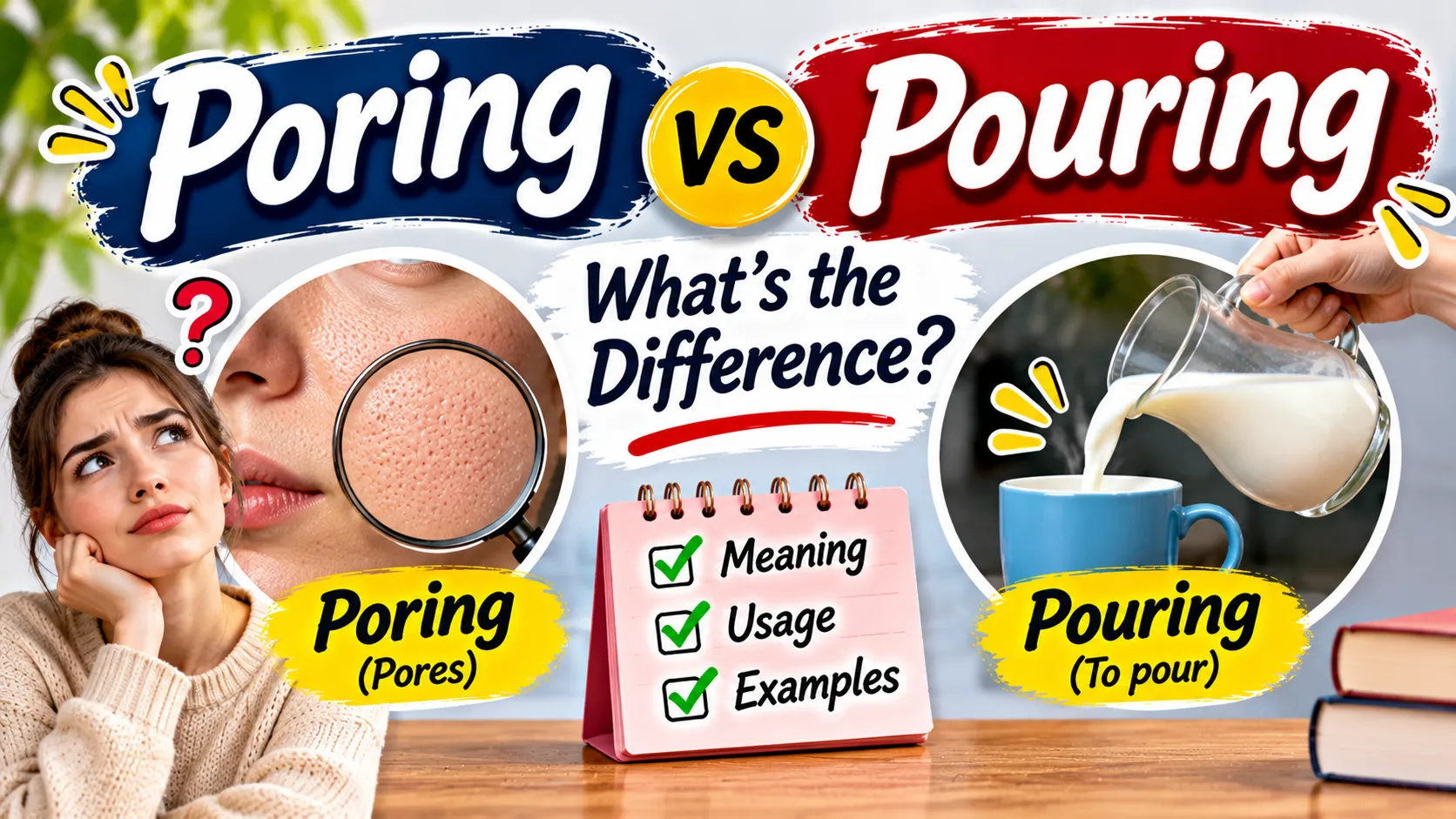
The words “poring” and “pouring” sound identical and look similar on the page, yet they describe completely different actions. The poring vs pouring confusion ranks among the most common homophone errors in English writing, appearing in book reviews, recipes, and everyday correspondence.
“Poring” means studying something intently, usually paired with “over,” as in “poring over a book.” “Pouring” means causing a liquid to flow, or raining heavily, as in “pouring water” or “pouring rain.” These words share identical pronunciation but no shared meaning. This comprehensive guide explains the difference, explores their origins, provides practical examples, and helps you choose the correct word every time you write.
Quick Answer
“Poring” means studying or reading something with intense focus, almost always followed by “over,” as in “poring over documents.” “Pouring” means causing liquid to flow, serving a drink, or raining heavily, as in “pouring coffee” or “pouring rain.” Remember: poring is reading closely; pouring is liquid flowing. They sound the same but mean completely different things.
Meaning Overview Table
| Aspect | Meaning |
|---|---|
| Definition | Poring: studying intently. Pouring: causing liquid to flow or raining heavily |
| Pronunciation | Both: /ˈpɔːrɪŋ/ |
| Part of Speech | Both are present participles |
| Usage | “She was poring over the contract” vs. “He was pouring coffee” |
| Context | Poring: reading, research, study. Pouring: cooking, weather, serving |
Main Meaning
Definition
Poring is the present participle of “pore,” a verb meaning to read or study something with intense and careful attention. It almost always appears with “over,” as in “poring over a map” or “poring over the details.” The word implies deep concentration and close examination.
Pouring is the present participle of “pour,” a verb meaning to cause a liquid or substance to flow from a container, to serve a drink, or to describe heavy rain. It appears in contexts ranging from cooking to weather reporting.
Origin
“Poring” comes from the Middle English verb pouren, meaning to look closely or gaze intently. The word’s origin is uncertain, but it has been used since the 14th century to describe focused reading or examination.
“Pouring” comes from the Old French purer or Latin purare, meaning to purify or strain. It entered English in the Middle Ages and has always related to the flow of liquids.
Context
The distinction matters across several contexts:
- Reading and Research: “Poring” describes careful study of documents, books, or details
- Cooking and Serving: “Pouring” describes transferring liquids and serving drinks
- Weather: “Pouring” describes heavy rain
- Everyday Writing: Confusing the two creates embarrassing errors in emails, essays, and social media posts
Modern Usage
Today, “poring” appears less frequently than “pouring,” primarily in formal and literary contexts describing careful study. “Pouring” appears constantly in everyday language, from cooking instructions to weather reports. The confusion between the two persists because they sound identical and spell-check often fails to catch the error.
Detailed Explanation
Literal Meaning
Literally, “poring” means reading or studying with close attention. “Pouring” literally means causing liquid to flow from a container. These literal meanings remain the primary definitions of both words.
Common Meaning
Commonly, people use “poring” when describing someone reading or studying something carefully. “She was poring over the contract” means she was examining it closely. They use “pouring” when describing liquid flow, serving drinks, or heavy rain.
Reading and Study Meaning
“Poring” almost always appears in the phrase “poring over.” It describes the act of examining documents, books, maps, or details with intense focus. Students pore over textbooks. Lawyers pore over contracts. Detectives pore over evidence.
Cooking and Serving Meaning
“Pouring” appears constantly in cooking instructions. “Pour the batter into the pan.” It also describes serving drinks: “She poured tea for the guests.” The word describes the controlled flow of liquids from one container to another.
Weather Meaning
“Pouring” describes heavy rain. “It’s pouring outside” means rain is falling heavily. The phrase “pouring rain” appears constantly in weather reports and everyday conversation.
Idiomatic Meaning
“Pouring” appears in idioms like “pouring your heart out” (sharing emotions openly) and “pouring oil on troubled waters” (calming a situation). “Poring” appears in few idioms beyond “poring over.”
Examples Table
| Example | Meaning |
|---|---|
| She was poring over the legal documents. | Studying intently |
| He was pouring coffee into two cups. | Causing liquid to flow |
| The detective pored over the evidence. | Examined closely |
| It was pouring rain outside. | Raining heavily |
| Students were poring over their textbooks. | Reading carefully |
| She poured the milk into the batter. | Transferred liquid |
| He spent hours poring over the map. | Studied intently |
| The rain was pouring down. | Falling heavily |
| She was pouring her heart out to a friend. | Sharing emotions openly |
| The intern pored over the financial reports. | Examined carefully |
Related Meanings Table
| Related Term | Meaning |
|---|---|
| Pore | To study closely (verb); a small opening in skin (noun) |
| Pour | To cause liquid to flow |
| Poring over | Studying something intently |
| Pouring rain | Heavy rain |
| Pouring your heart out | Sharing emotions openly |
| Poured | Past tense of pour |
| Pored | Past tense of pore |
| Rain | Water falling from clouds; often “pouring” |
| Study | To examine closely; similar to pore |
| Examine | To inspect carefully; similar to pore |
| Scrutinize | To examine closely; similar to pore |
| Pouring | Causing liquid to flow; present participle |
| Poring | Studying closely; present participle |
| Porous | Full of small holes; related to “pore” as a noun |
| Pouring vessel | A container designed for pouring |
Common Uses
People use “poring” and “pouring” across numerous contexts:
Reading and Research: Students, lawyers, and researchers pore over documents, books, and evidence. The phrase “poring over” appears constantly in academic and professional writing.
Cooking and Baking: Recipes use “pouring” for transferring liquids. “Pour the batter into the pan” appears in countless cookbooks.
Weather Reporting: Meteorologists and everyday speakers describe heavy rain as “pouring.” “It’s pouring outside” is a common phrase.
Serving Drinks: Hosts pour tea, coffee, and wine for guests. The word describes the careful transfer of liquids.
Emotional Expression: People pour their hearts out to friends and therapists. The idiom describes sharing deep emotions.
Common Mistakes
| Mistake | Correction |
|---|---|
| Writing “pouring over a book” | Write “poring over a book” (studying closely) |
| Writing “poring rain” | Write “pouring rain” (heavy rain) |
| Writing “poring water” | Write “pouring water” (liquid flow) |
| Writing “pouring over the documents” | Write “poring over the documents” (studying) |
| Writing “poring coffee” | Write “pouring coffee” (serving) |
| Writing “pouring over the evidence” | Write “poring over the evidence” (examining) |
| Assuming spell-check will catch the error | Spell-check often misses homophones; proofread manually |
| Writing “poring the milk” | Write “pouring the milk” (liquid transfer) |
| Writing “it was poring outside” | Write “it was pouring outside” (heavy rain) |
| Using “poring” without “over” | “Poring” almost always appears with “over” |
Related Questions
Is it “poring” or “pouring”?
It depends on meaning. Use “poring” for studying closely, almost always with “over.” Use “pouring” for liquid flow, serving drinks, or heavy rain.
What does “poring” mean?
“Poring” means studying or reading something with intense focus. It almost always appears in the phrase “poring over.”
What does “pouring” mean?
“Pouring” means causing liquid to flow from a container, serving a drink, or describing heavy rain.
What is the difference between “poring” and “pouring” in a sentence?
“Poring” relates to study and close examination. “Pouring” relates to liquid flow and rain.
Why do people say “pouring over” instead of “poring over”?
This is a common error. “Poring over” is correct because it means studying closely. “Pouring over” would mean spilling liquid on something.
Can “pouring” mean raining heavily?
Yes. “It’s pouring outside” means it is raining heavily.
Why do people confuse “poring” and “pouring”?
They sound identical and spell-check often misses homophones. The phrase “poring over” is less common than “pouring,” so writers sometimes default to the wrong spelling.
How can I remember the difference?
Remember: “poring over” means looking closely — think of “pore” as a tiny opening you look through. “Pouring” means liquid flowing — think of a pitcher pouring water.
FAQs
What does “poring” mean?
“Poring” means studying or reading something with intense focus. It almost always appears with “over,” as in “poring over a book.”
What does “pouring” mean?
“Pouring” means causing liquid to flow from a container, serving a drink, or describing heavy rain.
Is it “poring over” or “pouring over”?
The correct phrase is “poring over.” It means studying something closely.
Is it “pouring rain” or “poring rain”?
The correct phrase is “pouring rain.” It means heavy rain.
Can “poring” be used without “over”?
Rarely. “Poring” almost always appears in the phrase “poring over.” Without “over,” the meaning becomes unclear.
What is the origin of “poring”?
“Poring” comes from the Middle English pouren, meaning to look closely. It has been used since the 14th century.
How can I remember the difference?
Remember: “poring” has “pore” like a tiny opening — you look closely through it. “Pouring” has “pour” like liquid flowing.
Is “pouring your heart out” correct?
Yes. “Pouring your heart out” is an idiom meaning sharing emotions openly. The word “pouring” is correct here because it suggests letting emotions flow out.
Conclusion
Mastering the poring vs pouring distinction protects your writing from embarrassing homophone errors. “Poring” means studying closely, almost always paired with “over.” “Pouring” means causing liquid to flow, serving drinks, or raining heavily. Remember the simple rule: poring is reading closely; pouring is liquid flowing. Whether you’re writing a book review, a recipe, or a weather report, choosing the correct word ensures your meaning is clear. Practice using “poring over” for study and “pouring” for liquids, and your readers will understand exactly what you intend. Small distinctions like this separate careful writers from careless ones.

Natalie Brooks is a content researcher and writer with a strong interest in word meanings, dream interpretations, symbolism, and cultural insights. She is passionate about creating clear, informative, and easy-to-understand content that helps readers discover the deeper meanings behind words, names, dreams, and symbols. Through her work at Meanzly, Natalie aims to make knowledge accessible and valuable for readers around the world.