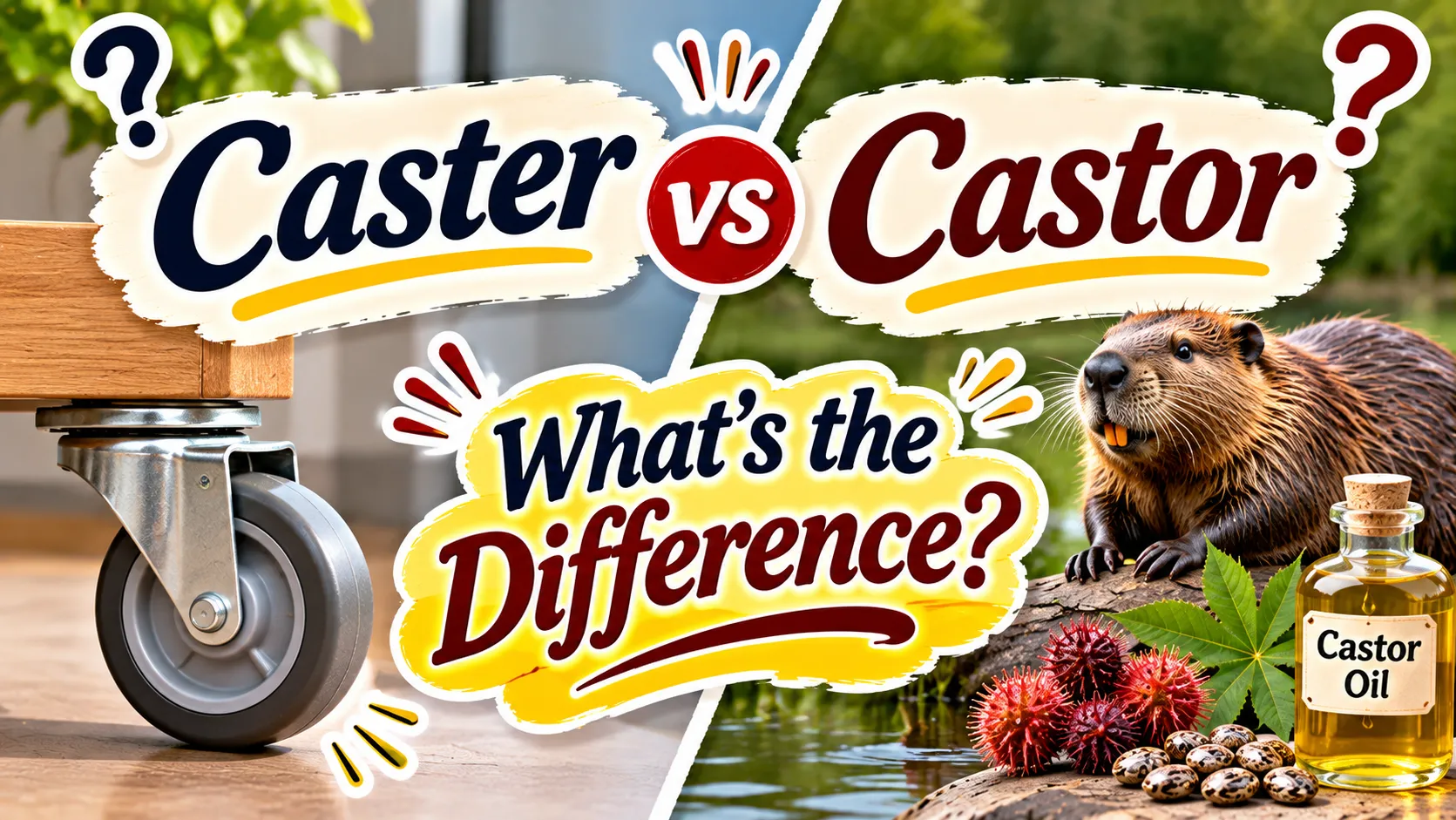
The words “caster” and “castor” look nearly identical, sound the same, and appear in contexts ranging from furniture to baking to medicine. Yet the caster vs castor distinction confuses even careful writers. The two spellings represent overlapping words with different histories and preferred uses.
“Caster” typically refers to a small swiveling wheel attached to furniture, a person or thing that casts, or a container for sprinkling sugar. “Castor” usually refers to the oil derived from castor beans, the beaver (from Latin), or a star in the constellation Gemini. The confusion arises because the words overlap: both spellings appear for the small wheel and for the sugar, though usage guides recommend specific forms for each meaning . This comprehensive guide explains the difference, explores their origins, provides practical examples, and helps you choose the correct spelling every time.
Quick Answer
Use “caster” for the small swiveling wheel on furniture and for the sugar (caster sugar). Use “castor” for the oil (castor oil) and the plant (castor bean). Both spellings appear for the wheel and sugar, but style guides recommend “caster” for the sugar and “castor” for the wheel . For the oil and plant, “castor” is the only correct spelling.
Meaning Overview Table
| Aspect | Meaning |
|---|---|
| Definition | Caster: a swiveling wheel, a sugar shaker, or one that casts. Castor: oil from castor beans, the beaver, or a star |
| Pronunciation | Both: /ˈkæstər/ |
| Part of Speech | Both are nouns; caster can also be a person who casts |
| Usage | “The piano sits on casters” vs. “Castor oil is a natural remedy” |
| Context | Caster: furniture, baking, manufacturing. Castor: medicine, botany, astronomy |
Main Meaning
Definition
Caster functions as a noun with several meanings. It refers to a small wheel mounted on a swivel, attached to the bottom of furniture to make it movable. It also refers to a container with a perforated top for sprinkling sugar or other condiments, and to a person or thing that casts (such as a caster of metal or nets) .
Castor functions as a noun referring to the oil extracted from the seeds of the castor plant (Ricinus communis), the beaver (from Latin castor), or a bright star in the constellation Gemini . The spelling “castor” is the only correct form for the oil and the plant.
Origin
“Caster” derives from the verb “cast,” meaning to throw or form. The sugar shaker sense comes from the container that “casts” or sprinkles sugar .
Context
The distinction matters across several contexts:
- Furniture and Manufacturing: “Caster” is the preferred spelling for the swiveling wheels, especially in American English
- Baking: “Caster sugar” is the standard spelling for the fine sugar used in British baking
- Medicine and Cosmetics: “Castor oil” is the only correct spelling for the oil and its uses
- Botany: “Castor bean” and “castor oil plant” are the standard names for Ricinus communis
- Astronomy and Mythology: “Castor” refers to the star and the mythological figure
Modern Usage
Today, usage varies by region and industry. In the UK, “castor” is the preferred spelling for the wheels, while “caster” dominates in the US . For the sugar, “caster” is recommended in both regions, though “castor” appears . For the oil and plant, “castor” is universal. The overlap creates confusion, but the recommended forms provide guidance.
Detailed Explanation
Literal Meaning
Literally, “caster” means one that casts, whether a person casting metal, a container casting sugar, or a wheel casting movement. “Castor” literally means beaver in Latin, and the plant and oil names derive from this association.
Common Meaning
Commonly, people use “caster” for the small wheels under furniture and for caster sugar. They use “castor” for castor oil, castor beans, and the mythological star.
Furniture Meaning
In furniture and industrial contexts, “caster” (US) or “castor” (UK) refers to a small wheel assembly that allows heavy objects to move. A grand piano on casters can roll across a stage. Office chairs use casters. Hospital beds use medical casters .
Baking Meaning
In baking, “caster sugar” (also spelled “castor sugar”) is a fine granulated sugar used for meringues, custards, and whipped cream. The name comes from the sugar shaker, called a caster, used to sprinkle it .
Medical and Botanical Meaning
“Castor oil” is a vegetable oil pressed from castor beans. It has a long history of medicinal use as a laxative and is used in cosmetics, industrial lubricants, and manufacturing . The castor bean plant is toxic due to the presence of ricin, a potent toxin .
Astronomical Meaning
“Castor” is one of the two brightest stars in the constellation Gemini, named after the mythological twin brother of Pollux. It is a multiple star system about 52 light-years from Earth .
Examples Table
| Example | Meaning |
|---|---|
| The office chair rolls on casters. | Small swiveling wheels |
| The recipe calls for caster sugar. | Fine granulated sugar |
| Castor oil is used as a natural moisturizer. | Oil from castor beans |
| The grand piano sits on castors. | British spelling for wheels |
| She sprinkled sugar from the caster. | Container for sprinkling |
| Castor beans are highly toxic. | Seeds of the castor plant |
| The bed has four casters for easy movement. | Wheels for mobility |
| Golden caster sugar adds flavor to baking. | Fine sugar variant |
| Castor is the brighter twin star in Gemini. | Astronomical object |
| The factory uses heavy-duty casters. | Industrial wheels |
Related Meanings Table
| Related Term | Meaning |
|---|---|
| Caster wheel | A small swiveling wheel for furniture |
| Castor wheel | British spelling for the same wheel |
| Caster sugar | Fine granulated sugar for baking |
| Castor sugar | Alternative spelling of caster sugar |
| Castor oil | Oil from castor beans |
| Castor bean | The seed of the castor plant, toxic |
| Castor plant | Ricinus communis, source of castor oil |
| Castor | A star in Gemini; a mythological figure |
| Swivel caster | A wheel that rotates 360 degrees |
| Rigid caster | A wheel that moves only forward and backward |
| Caster angle | The angle of a vehicle’s steering axis |
| Caster board | A type of skateboard |
| Castoreum | A substance from beaver glands, historically used in perfume |
| Ricin | A toxic protein found in castor beans |
| Castoridae | The biological family of beavers |
Common Uses
People use “caster” and “castor” across numerous contexts:
Furniture and Equipment: Casters (or castors in the UK) appear on office chairs, hospital beds, shopping carts, pianos, and heavy machinery. They enable mobility for heavy objects .
Baking and Cooking: Caster sugar appears in British recipes for meringues, custards, and baked goods. American bakers know it as superfine sugar .
Medicine and Cosmetics: Castor oil appears in laxatives, skin moisturizers, hair products, and industrial lubricants. It has a long history of medicinal use .
Botany and Agriculture: Castor beans and castor plants are cultivated for oil production. The plant grows in tropical and subtropical regions worldwide .
Astronomy and Mythology: Castor appears in discussions of the Gemini constellation and Greek mythology. It is one of the brighter stars visible from Earth .
Common Mistakes
| Mistake | Correction |
|---|---|
| Writing “castor oil” as “caster oil” | Write “castor oil” (the oil from castor beans) |
| Writing “caster bean” | Write “castor bean” (the seed of the castor plant) |
| Writing “caster sugar” as “castor sugar” in formal writing | “Caster sugar” is recommended, though both appear |
| Writing “the piano is on castors” in American English | Use “casters” in American English |
| Writing “the piano is on casters” in British English | Use “castors” in British English |
| Using “castor” for the person who casts metal | Use “caster” for a person or thing that casts |
| Writing “castor wheel” in American technical writing | Use “caster wheel” in American English |
| Writing “caster” for the star in Gemini | Write “Castor” (capitalized) for the star |
| Assuming the spellings are always interchangeable | They overlap for the wheel and sugar but not for oil or plant |
| Writing “castor” for the sugar shaker | The container is typically a “caster” |
Related Questions
Is it caster or castor?
It depends on meaning. Use “caster” for the swiveling wheel (especially in US English), the sugar, and the person who casts. Use “castor” for the oil, the plant, the beaver, and the star .
What is the difference between caster and castor?
“Caster” is the preferred spelling for the wheel (US) and the sugar. “Castor” is the only correct spelling for the oil and the plant. Both spellings appear for the wheel and sugar, with regional preferences .
Is it caster sugar or castor sugar?
Both appear, but “caster sugar” is recommended. The name comes from the sugar shaker (caster) used to sprinkle it .
Is it castor oil or caster oil?
The correct spelling is “castor oil.” The oil comes from the castor bean, and “castor” is the only correct spelling for this meaning .
What is a caster wheel?
A caster wheel is a small wheel mounted on a swivel, attached to the bottom of furniture or equipment to make it movable. The wheel rotates to allow movement in any direction .
What is castor oil used for?
Castor oil has been used as a laxative, a skin moisturizer, a hair treatment, and an industrial lubricant. Modern medical advice cautions against some traditional uses due to side effects .
Is castor bean toxic?
Yes. Castor beans contain ricin, a highly toxic protein. Chewing or crushing the seeds releases the toxin, which can be fatal.
What is the star Castor?
Castor is one of the two brightest stars in the constellation Gemini, named after the mythological twin brother of Pollux. It is a multiple star system about 52 light-years from Earth .
FAQs
What does “caster” mean?
“Caster” refers to a small swiveling wheel on furniture, a container for sprinkling sugar, or a person or thing that casts .
What does “castor” mean?
“Castor” refers to the oil from castor beans, the castor plant, the beaver (from Latin), or a star in Gemini .
Is it “caster wheel” or “castor wheel”?
Both appear. “Caster wheel” is preferred in American English. “Castor wheel” is preferred in British English .
Is it “caster sugar” or “castor sugar”?
Both appear, but “caster sugar” is recommended. The name derives from the sugar shaker called a caster .
Why is castor oil called castor oil?
The name likely comes from its historical use as a substitute for castoreum, a substance from beaver glands used in perfumery. “Castor” is Latin for beaver .
Can I use “caster” for the oil?
No. “Castor oil” is the only correct spelling for the oil. “Caster oil” is a misspelling.
Can I use “castor” for the wheel?
Yes, especially in British English. “Castor” is the preferred spelling for the wheel in the UK, while “caster” dominates in the US .
How can I remember the difference?
Remember: “castor” goes with “oil” and “bean.” “Caster” goes with “sugar” and the furniture wheel (in US English). If it’s from a plant or a beaver, use “castor.” If it’s for sprinkling or rolling, use “caster.”
Conclusion
Mastering the caster vs castor distinction protects your writing from embarrassing errors. “Caster” is the preferred spelling for the swiveling furniture wheel (especially in American English), the fine sugar used in baking, and the person or thing that casts. “Castor” is the only correct spelling for the oil, the plant, the beaver, and the star in Gemini. The overlap between the two forms creates confusion, but the recommended uses provide clear guidance. Whether you’re writing a furniture specification, a recipe, or a medical report, choosing the correct spelling ensures your meaning is clear. Practice using “caster” for wheels and sugar, and “castor” for oil and plants, and your readers will understand exactly what you intend.

Natalie Brooks is a content researcher and writer with a strong interest in word meanings, dream interpretations, symbolism, and cultural insights. She is passionate about creating clear, informative, and easy-to-understand content that helps readers discover the deeper meanings behind words, names, dreams, and symbols. Through her work at Meanzly, Natalie aims to make knowledge accessible and valuable for readers around the world.









