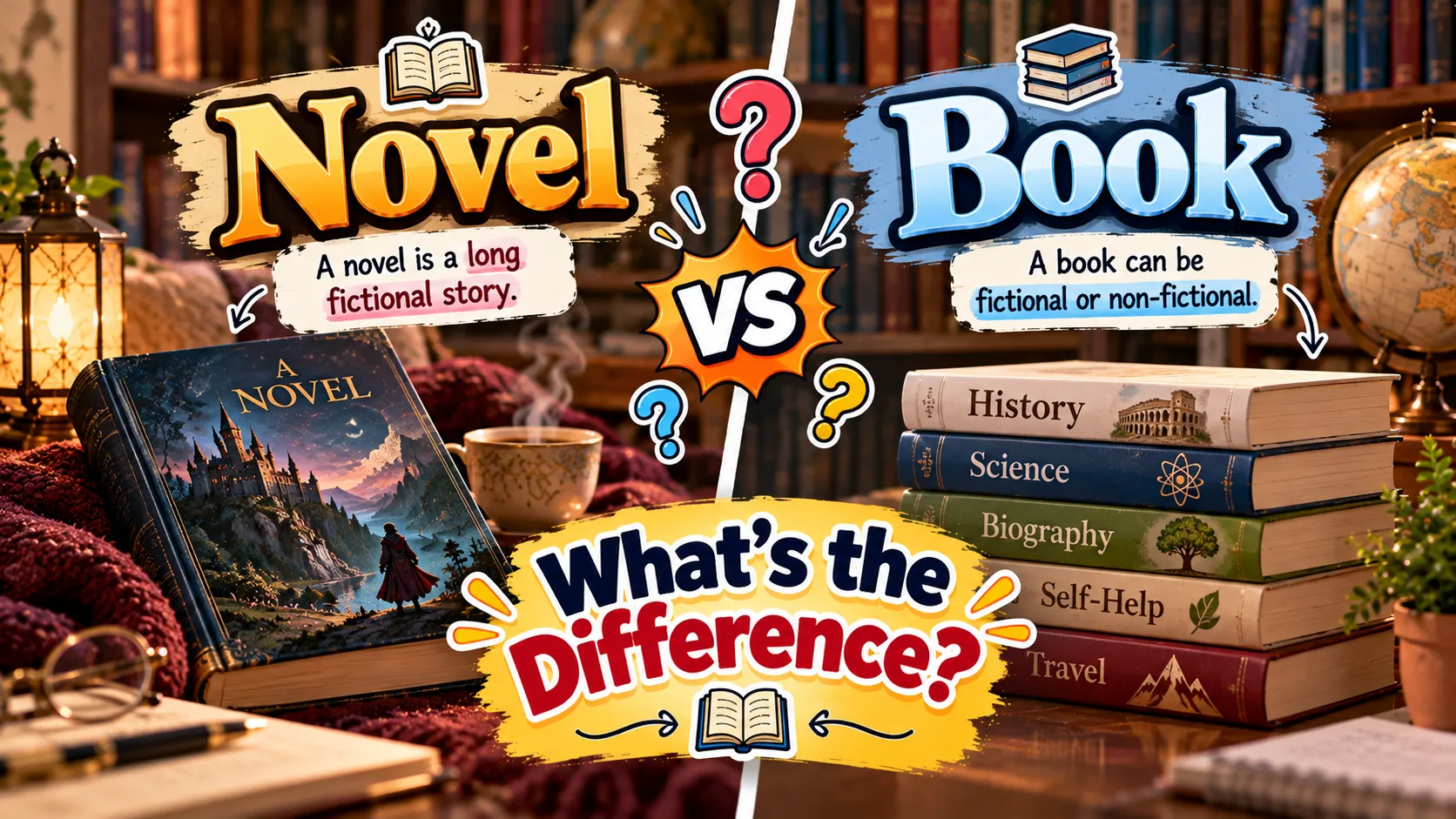
The terms “novel” and “book” often appear interchangeably in everyday conversation, yet they describe different things. Understanding the novel vs book distinction helps readers, writers, and students speak precisely about literature. A book is a broad category covering any bound collection of pages, while a novel is a specific type of book—a long work of fiction that tells a story through prose.
Many people call any book a novel, especially when discussing fiction. That habit creates confusion. A cookbook is a book but not a novel. A poetry collection is a book but not a novel. A graphic memoir is a book but not a novel. This guide breaks down the definitions, origins, and practical differences between the two terms. It also covers common mistakes, related terms, and the questions readers search for most often. By the end, you will know exactly when to use each word.
Quick Answer
A book is any bound or digital collection of written or printed pages, including nonfiction, reference works, and poetry. A novel is a specific type of book: a long work of fiction that tells a story through prose, typically over 40,000 words. Every novel is a book, but not every book is a novel.
Meaning Overview Table
| Aspect | Meaning |
|---|---|
| Definition | Book: any written or printed work bound together. Novel: a long fictional prose narrative |
| Pronunciation | Book: /bʊk/; Novel: /ˈnɒvəl/ |
| Part of Speech | Both are nouns; “novel” also functions as an adjective meaning new or original |
| Usage | “She wrote a book about gardening” vs. “She wrote a novel about lost love” |
| Context | Publishing, literature studies, libraries, bookstores, writing craft |
Main Meaning
Definition
A book is a physical or digital object containing written or printed text, images, or both, bound together for reading. Books include fiction, nonfiction, reference works, textbooks, poetry collections, cookbooks, and memoirs. A novel is a book-length work of fiction written in prose that narrates a story involving characters, plot, setting, and conflict. Novels typically exceed 40,000 words and follow a narrative arc.
Origin
The word “book” comes from the Old English bōc, related to the Germanic root for “beech tree,” since early Germanic peoples carved runes into beech wood. The word “novel” comes from the Italian novella, meaning “a short story” or “a piece of news,” which derives from the Latin novus, meaning “new.” The term entered English in the 16th century to describe long fictional narratives that were new and original in form.
Context
The distinction matters in several settings:
- Publishing: Agents and editors distinguish between novels and other book categories
- Libraries: Cataloging systems separate fiction novels from nonfiction books
- Bookstores: Shelving separates novels from cookbooks, self-help, and reference
- Writing Craft: Authors discuss word counts and genre conventions specific to novels
- Literary Studies: Scholars analyze the novel as a distinct literary form
Modern Usage
Today, people use “book” as an umbrella term for any published work. They use “novel” specifically for long fiction. Digital publishing has expanded both categories. E-books include novels and nonfiction alike. Audiobooks follow the same distinction. The overlap persists in casual speech, where readers often call novels “books” without error, but calling a cookbook a “novel” sounds incorrect.
Detailed Explanation
Literal Meaning
Literally, a book is a set of pages fastened together along one edge and enclosed in a cover. A novel is a fictional prose narrative long enough to fill such a volume. The literal distinction rests on content, not format. A novel can appear as an e-book, audiobook, or serialized web fiction and still remain a novel.
Common Meaning
Commonly, people use “book” for anything they read in bound form. They use “novel” for fiction with a story. A reader might say, “I’m reading a good book,” meaning a novel. That usage is acceptable because every novel is a book. The reverse is not true. Saying “I’m reading a good novel” about a biography would confuse listeners.
Literary Meaning
In literary studies, the novel is a specific form with a history. It emerged in its modern shape in the 18th century with works like Robinson Crusoe and Pamela. Scholars study the novel’s conventions: narrative voice, character development, plot structure, and thematic depth. Books in general include many forms that scholars classify separately, such as epic poetry, essays, and histories.
Publishing Meaning
In publishing, word count defines the categories. Novels typically run from 40,000 to over 150,000 words, depending on genre. Novellas run from 17,500 to 40,000 words. Short stories stay under 17,500 words. Nonfiction books vary widely, from 20,000-word guides to 200,000-word biographies. Publishers label categories precisely because marketing and sales depend on reader expectations.
Digital Meaning
In digital contexts, the distinction holds. An e-book can be a novel or a nonfiction book. A web novel is serialized fiction published online. Interactive fiction and visual novels blend prose with game elements but still fall under fiction. Digital formats change delivery, not definition.
Cultural Meaning
Culturally, the novel carries prestige as a literary art form. Book awards separate fiction from nonfiction categories. Book clubs often focus on novels because they invite discussion of characters and themes. Nonfiction books serve practical, educational, and informational purposes. Both enrich culture, but they serve different reader needs.
Examples Table
| Example | Meaning |
|---|---|
| Pride and Prejudice | A novel and a book |
| A cookbook | A book, not a novel |
| A biography of Lincoln | A book, not a novel |
| A poetry collection | A book, not a novel |
| The Great Gatsby | A novel and a book |
| A textbook on physics | A book, not a novel |
| A graphic novel | A book-length comic narrative; fiction but distinct from prose novels |
| A memoir | A book, not a novel |
| A novella | Shorter fiction; a book, sometimes loosely called a novel |
| A self-help guide | A book, not a novel |
Related Meanings Table
| Related Term | Meaning |
|---|---|
| Novella | A short novel, typically 17,500 to 40,000 words |
| Short story | Fiction under 17,500 words |
| Fiction | Imagined narrative content |
| Nonfiction | Factual writing about real events, people, or ideas |
| Memoir | A nonfiction account of personal experience |
| Anthology | A collection of works by multiple authors |
| E-book | A digital book in any category |
| Audiobook | A recorded reading of a book |
| Graphic novel | A book-length comic narrative |
| Manuscript | An unpublished draft of a book |
| Prose | Ordinary written language, as opposed to verse |
| Genre | A category of fiction or nonfiction |
| Narrative | A story with characters and events |
| Trilogy | A set of three related novels |
| Serial | Fiction published in installments |
Common Uses
People use “book” and “novel” across many situations:
Bookstores and Libraries: Staff separate novels from nonfiction sections. Readers ask for “a good novel” when seeking fiction and “a good book” when open to any category.
Writing Communities: Authors discuss novel word counts, genre conventions, and query letters. They distinguish novels from memoirs and essay collections.
Classrooms: Teachers assign novels for literary analysis and textbooks for instruction. Students learn to identify narrative elements unique to novels.
Publishing Industry: Agents represent novelists and nonfiction authors separately. Editors acquire projects by category.
Everyday Conversation: Readers say “I’m reading a book” for any format. They say “I’m writing a novel” to specify long fiction.
Common Mistakes
| Mistake | Correction |
|---|---|
| Calling a cookbook a novel | Cookbooks are books, not novels |
| Calling every book a novel | Novels are fiction; many books are nonfiction |
| Assuming novels must be printed | Novels can be e-books or audiobooks |
| Thinking length alone defines a novel | Content (fiction, prose narrative) defines a novel; length is a convention |
| Calling a memoir a novel | Memoirs are nonfiction; novels are fiction |
| Using “novel” for short stories | Short stories are fiction but not novels |
| Confusing graphic novels with prose novels | Both are fiction, but graphic novels use sequential art |
| Assuming all fiction is novels | Novellas and short stories are fiction but not novels |
| Saying “novel” when you mean “new” | The adjective “novel” means new or original; context clarifies |
| Ignoring genre distinctions | Novels include romance, mystery, fantasy, and literary fiction |
Related Questions
Is a novel always a book?
Yes. A novel is a type of book. It may appear in print, digital, or audio format, but it belongs to the broader category of books.
Is every book a novel?
No. Books include nonfiction, reference works, poetry, textbooks, cookbooks, and memoirs. Only long fictional prose narratives qualify as novels.
What is the difference between a novel and a novella?
A novella is shorter than a novel, typically 17,500 to 40,000 words. A novel generally exceeds 40,000 words.
Can a novel be nonfiction?
No. By definition, a novel is fiction. Nonfiction narratives are called memoirs, biographies, or creative nonfiction.
What is a graphic novel?
A graphic novel is a book-length narrative told through sequential art. It is fiction or nonfiction but distinct from a prose novel.
How long is a novel?
Word counts vary by genre. Middle grade novels run 30,000 to 50,000 words. Adult literary fiction often runs 80,000 to 100,000 words. Fantasy and science fiction can exceed 120,000 words.
FAQs
What is the main difference between a novel and a book?
A book is any bound collection of written pages. A novel is a specific kind of book: a long fictional prose narrative. Every novel is a book, but not every book is a novel.
Is a novel considered a book?
Yes. A novel is a book. The terms are not opposites. “Novel” describes content; “book” describes the object or format.
What makes a book a novel?
A book qualifies as a novel when it contains a long fictional prose narrative with characters, plot, and setting, usually over 40,000 words.
Can a novel be called a book?
Yes. Calling a novel a book is accurate and common. Calling a book a novel is only accurate if the book is fiction.
Is a memoir a novel?
No. A memoir is nonfiction. A novel is fiction. Memoirs recount real experiences; novels invent stories.
What is a novel vs a short story?
A novel is long fiction, typically over 40,000 words. A short story is fiction under 17,500 words. Novellas fall between them.
Are all novels books?
Yes. Novels appear as print books, e-books, or audiobooks. All are books.
What is the difference between a novel and a textbook?
A novel is fiction meant for narrative reading. A textbook is nonfiction designed for instruction and reference.
Conclusion
The novel vs book distinction is simple once you see it clearly. A book is the broad category: any bound or digital collection of written pages. A novel is a specific type of book: a long fictional prose narrative with characters, plot, and setting. Every novel is a book, but not every book is a novel. Cookbooks, biographies, textbooks, and poetry collections are books without being novels. Novellas and short stories are fiction without being novels. Understanding this difference sharpens your vocabulary and helps you communicate precisely in bookstores, classrooms, libraries, and writing communities. Whether you read for pleasure, study literature, or write your own stories, knowing when to say “book” and when to say “novel” makes your language clearer and more accurate.

Natalie Brooks is a content researcher and writer with a strong interest in word meanings, dream interpretations, symbolism, and cultural insights. She is passionate about creating clear, informative, and easy-to-understand content that helps readers discover the deeper meanings behind words, names, dreams, and symbols. Through her work at Meanzly, Natalie aims to make knowledge accessible and valuable for readers around the world.









