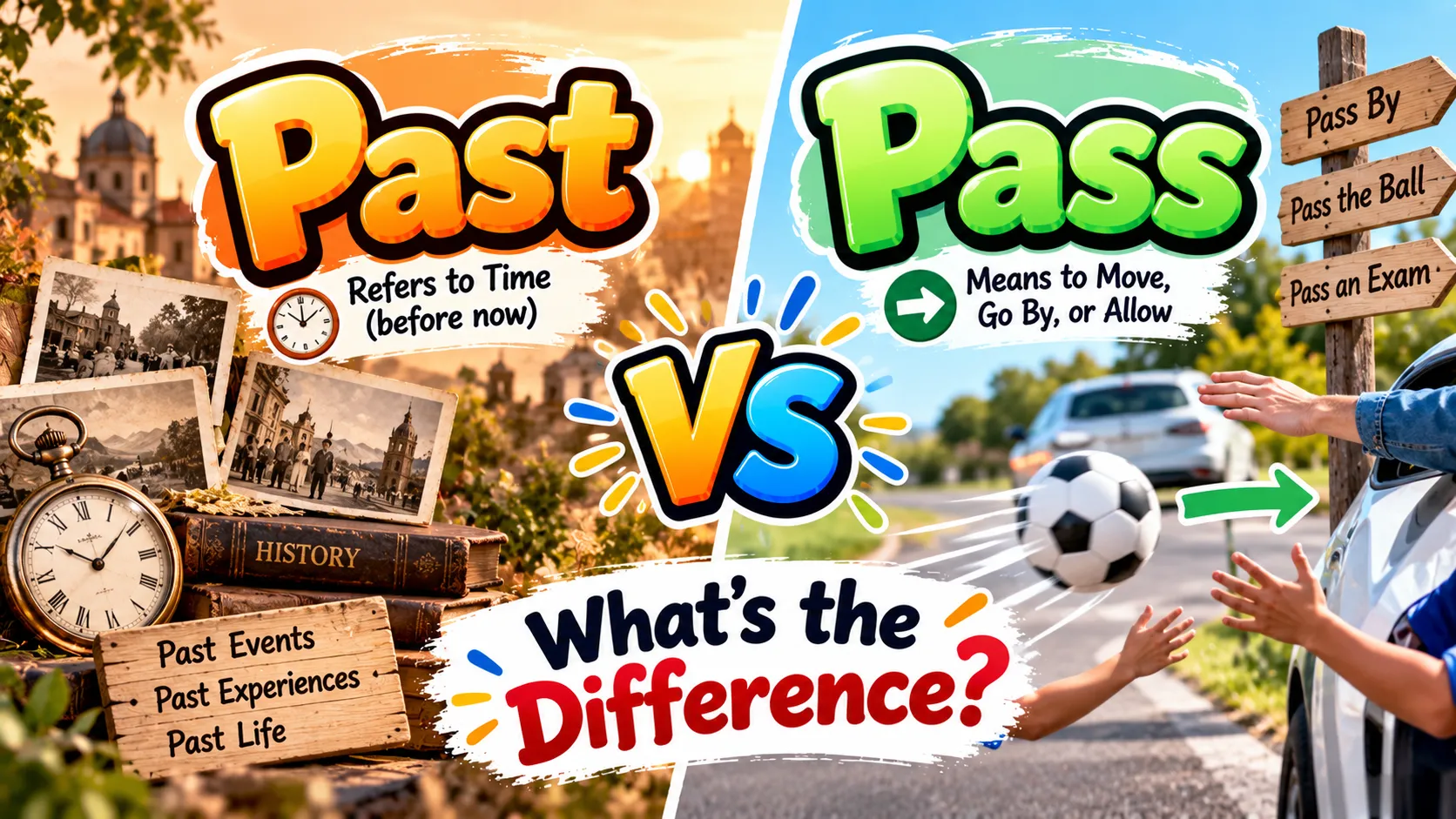
The words “past” and “pass” sound similar and look related, yet they serve completely different grammatical functions. The past vs pass confusion ranks among the most common errors in English writing, appearing in everything from casual texts to professional emails. Understanding this distinction helps you write with clarity and confidence.
“Pass” is a verb meaning to move by, go through, or hand something to someone. “Past” functions as a noun, adjective, preposition, or adverb describing time gone by or movement beyond a point. The two words share a common ancestor—the Latin word passus, meaning “step”—but their modern uses have diverged completely. This comprehensive guide breaks down the difference with clear rules, practical examples, and memory tricks to help you choose the right word every time.
Quick Answer
“Pass” is a verb meaning to go by, move through, or hand over. “Past” describes time before now or movement beyond a point. Use “pass” when you need an action word: “I pass the store.” Use “past” for time or position: “I walked past the store.” Remember: pass = action, past = time or position.
Meaning Overview Table
| Aspect | Meaning |
|---|---|
| Definition | Pass: verb meaning to move by or hand over. Past: noun, adjective, preposition, or adverb meaning time gone by or movement beyond |
| Pronunciation | Both: /pæs/ or /pɑːst/ |
| Part of Speech | Pass: verb. Past: multiple parts of speech |
| Usage | “I pass the ball” vs. “I walked past the house” |
| Context | Grammar, everyday writing, professional communication |
Main Meaning
Definition
Pass is primarily a verb meaning to move past something, go through something, hand something to someone, or successfully complete a test. It also functions as a noun in specific contexts, like a mountain pass or a free pass.
Past functions as a noun (the time before now), an adjective (having happened before), a preposition (beyond a point), and an adverb (moving beyond). It never functions as a verb in standard English.
Origin
Both words trace back to the Latin passus, meaning “step” or “pace,” through the Old French passer (“to pass”). “Pass” entered English as a verb in the 13th century. “Past” emerged as the past participle of “pass” but gradually developed into its own word with distinct grammatical functions. Over centuries, English speakers separated the two into different parts of speech, creating the modern distinction.
Context
The distinction matters across numerous contexts:
- Everyday Writing: “I passed the store” (verb) vs. “I walked past the store” (preposition)
- Time Expressions: “The past year” (adjective) vs. “Pass the year” (verb, rare)
- Sports: “Pass the ball” (verb) vs. “The past season” (adjective)
- Academic Settings: “Pass the exam” (verb) vs. “Past exams” (adjective)
- Professional Communication: “Pass the message” (verb) vs. “In the past” (noun)
Modern Usage
Today, “pass” appears constantly as a verb in everyday language. People pass salt, pass exams, pass time, and pass judgment. “Past” appears as a noun (the past), adjective (past events), preposition (walked past), and adverb (ran past). Confusing the two creates grammatical errors that careful readers notice immediately.
Detailed Explanation
Literal Meaning
Literally, “pass” means to move by or go through. “Past” literally means beyond a point in space or time. When you “pass” something, you move by it. When you go “past” something, you move beyond it. The difference lies in grammatical function: “pass” is the action, “past” describes the position or time.
Common Meaning
Commonly, people use “pass” as a verb for movement, transfer, or success. “Please pass the salt.” “She passed the test.” “Time passes quickly.” People use “past” for time before now or movement beyond. “The past is gone.” “He walked past me.” “It’s half past three.”
Grammatical Meaning
Grammatically, “pass” is a verb. It conjugates: pass, passes, passed, passing. “Past” is never a verb. It functions as a noun (“the past”), adjective (“past mistakes”), preposition (“walked past the house”), or adverb (“ran past”). The past tense of “pass” is “passed,” not “past”—this is the source of most confusion.
Time Meaning
“Past” describes time before the present. “In the past” means in earlier times. “Past events” means events that already happened. “Pass” can also relate to time but as a verb: “Time passes slowly.” The two words describe time differently: “past” identifies a period, while “pass” describes the action of time moving.
Spatial Meaning
“Past” describes movement beyond a point. “He walked past the store” means he walked by and continued beyond it. “Pass” describes the action of moving by. “He passed the store” means the same thing but uses the verb form. Both describe similar physical movement, but the grammar differs.
Examples Table
| Example | Meaning |
|---|---|
| Please pass the salt. | Hand the salt to someone (verb) |
| He walked past the house. | Moved beyond the house (preposition) |
| She passed the exam. | Successfully completed the exam (verb) |
| The past year was difficult. | The previous year (adjective) |
| Time passes quickly. | Time moves forward (verb) |
| It’s half past three. | Thirty minutes after three (preposition) |
| They passed the ball to each other. | Threw the ball (verb) |
| We drove past the exit. | Drove beyond the exit (preposition) |
| The past is behind us. | Earlier times (noun) |
| He passed away last year. | Died (verb, euphemism) |
Related Meanings Table
| Related Term | Meaning |
|---|---|
| Passed | Past tense of “pass” (verb) |
| Passing | Present participle of “pass” |
| Past | Time before now; beyond a point |
| Passerby | Someone who passes by |
| Pastime | Hobby; activity done for enjoyment |
| Password | Secret word for access |
| Passport | Document for international travel |
| Passage | A way through; a section of text |
| Passenger | Someone traveling in a vehicle |
| Past tense | Grammatical tense for completed actions |
| Pass the time | To spend time doing something |
| Pass judgment | To form an opinion |
| Pass out | To faint; to distribute |
| Pass away | To die (euphemism) |
| Past due | Overdue; late for payment |
Common Uses
People use “pass” and “past” across numerous contexts:
Everyday Requests: “Pass the salt,” “pass the message,” “pass the ball.” These use “pass” as a verb meaning to hand over.
Academic Settings: Students “pass exams,” “pass courses,” and “pass grades.” Teachers discuss “past papers” and “past students.”
Time Expressions: People discuss “the past,” “past events,” and “half past the hour.” They also note that “time passes.”
Movement: People “walk past,” “drive past,” and “run past” locations. They also “pass through” towns and “pass by” houses.
Idioms: “Pass away” (die), “pass out” (faint), “pass the buck” (shift responsibility), “pass with flying colors” (succeed brilliantly).
Common Mistakes
| Mistake | Correction |
|---|---|
| Writing “I past the store” | Write “I passed the store” (verb needs -ed) |
| Writing “He walked passed the house” | Write “He walked past the house” (preposition) |
| Saying “Time past quickly” | Say “Time passed quickly” (verb) |
| Writing “In the passed” | Write “In the past” (noun) |
| Confusing “passed” and “past” in exams | “Passed the exam” (verb) vs. “Past exams” (adjective) |
| Writing “half passed three” | Write “half past three” (preposition) |
| Saying “pass the time” as “past the time” | “Pass the time” is correct (verb) |
| Writing “past away” | Write “passed away” (verb) |
| Confusing “past due” with “passed due” | “Past due” is correct (adjective) |
| Using “past” as a verb | “Past” is never a verb; use “passed” |
Related Questions
Is it “passed” or “past”?
Use “passed” as the past tense of the verb “pass.” Use “past” as a noun, adjective, preposition, or adverb. “I passed the test” (verb). “In the past” (noun).
What is the difference between past and pass?
“Pass” is a verb meaning to go by or hand over. “Past” describes time before now or movement beyond a point. Pass is action; past is time or position.
Is it “I walked past” or “I walked passed”?
“I walked past” is correct. “Past” is a preposition here, not a verb. “I walked passed” is incorrect.
Is it “pass time” or “past time”?
“Pass time” means to spend time doing something. “Pastime” (one word) is a noun meaning a hobby. “Past time” means a time before now.
What does “past due” mean?
“Past due” means overdue or late, especially for payments. It uses “past” as an adjective.
What does “passed away” mean?
“Passed away” is a euphemism for died. It uses “passed” as the past tense of “pass.”
How can I remember the difference?
Remember: “pass” is an action you do. “Past” is a time or position. If you can replace the word with “went by” or “handed,” use “pass/passed.” If you can replace it with “beyond” or “previous,” use “past.”
Can “past” ever be a verb?
No. “Past” is never a verb in standard English. The verb form is always “pass” or “passed.”
FAQs
What does pass mean?
Pass is a verb meaning to move by, go through, hand over, or successfully complete something. It also functions as a noun in specific contexts like mountain pass.
What does past mean?
Past refers to time before now or movement beyond a point. It functions as a noun, adjective, preposition, or adverb.
Is it “passed the exam” or “past the exam”?
“Passed the exam” is correct. “Passed” is the verb. “Past the exam” would mean moving beyond the exam location.
Is it “in the past” or “in the passed”?
“In the past” is correct. “Past” is a noun here. “Passed” is a verb and cannot follow “in the.”
What is the past tense of pass?
The past tense of pass is “passed.” For example, “I passed the ball.”
What is the difference between “passed” and “past”?
“Passed” is the past tense of the verb “pass.” “Past” is a noun, adjective, preposition, or adverb describing time or position.
Is “past” an adjective?
Yes. “Past” functions as an adjective in phrases like “past events,” “past years,” and “past due.”
Why do people confuse past and pass?
They sound similar and share a common origin. “Past” was originally the past participle of “pass,” and the two words remain closely related in meaning even though their grammatical functions differ.
Conclusion
Mastering the past vs pass distinction protects your writing from a common and noticeable error. “Pass” is a verb meaning to move by, go through, or hand over. “Past” describes time before now or movement beyond a point. Remember the simple rule: pass is action, past is time or position. If you can replace the word with “went by” or “handed,” use “pass” or “passed.” If you can replace it with “beyond” or “previous,” use “past.” Practice using these words correctly, and your writing will gain clarity and precision. Whether you’re writing an email, an essay, or a simple text message, knowing the difference between past and pass will serve you well.

Natalie Brooks is a content researcher and writer with a strong interest in word meanings, dream interpretations, symbolism, and cultural insights. She is passionate about creating clear, informative, and easy-to-understand content that helps readers discover the deeper meanings behind words, names, dreams, and symbols. Through her work at Meanzly, Natalie aims to make knowledge accessible and valuable for readers around the world.









