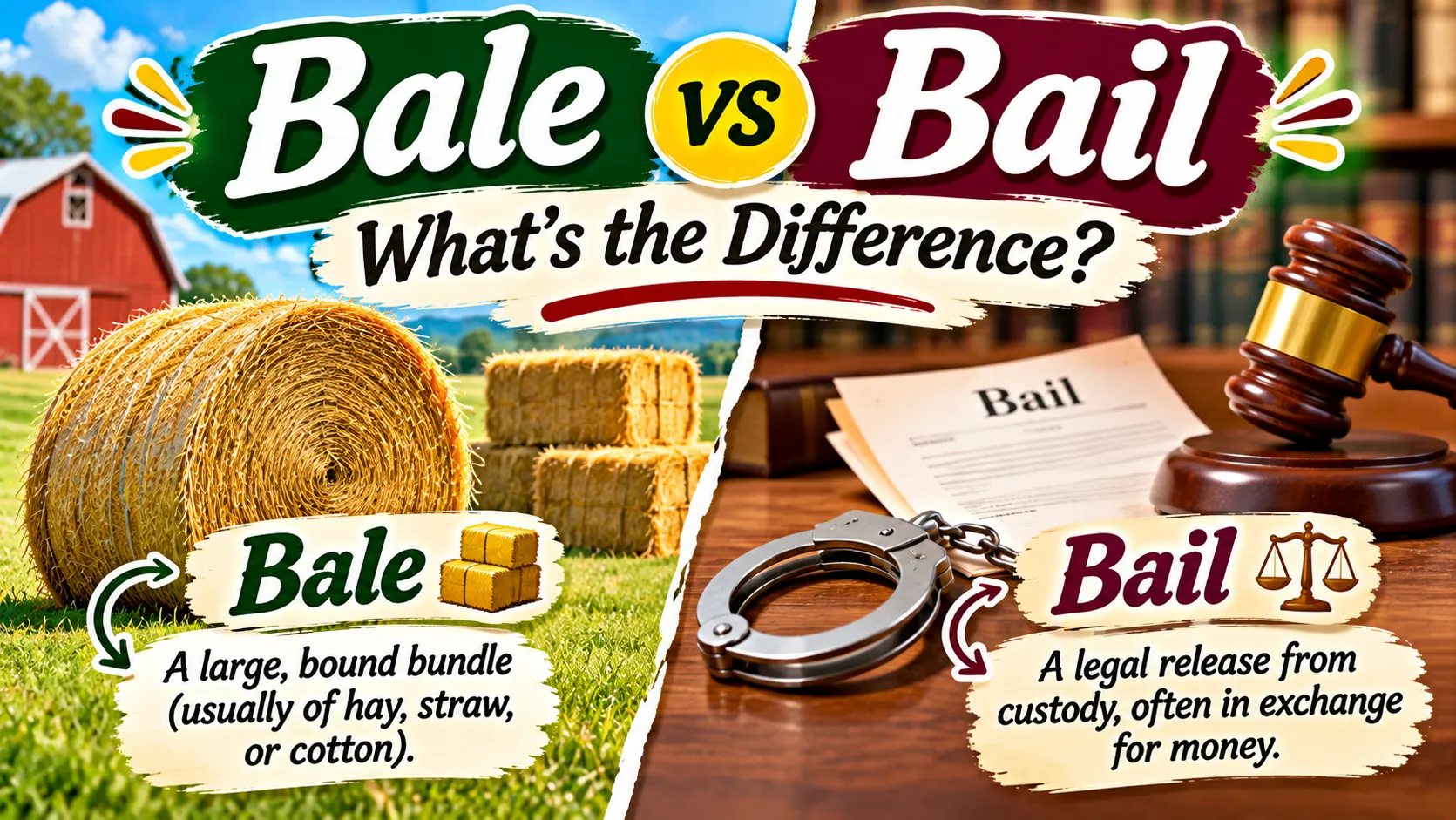
The words “bale” and “bail” sound identical, differ by just one letter, and appear in completely different contexts. The bale vs bail confusion ranks among the most common homophone errors in English writing, appearing in everything from agricultural reports to legal documents and cricket commentary.
“Bale” is a noun referring to a large bundle of hay, straw, or cotton, and as a verb means to make into a bale. “Bail” has multiple meanings: the temporary release of a prisoner, the money paid for that release, or the act of removing water from a boat. This comprehensive guide explains the difference, explores their origins, provides practical examples, and helps you choose the correct word every time you write.
Quick Answer
“Bale” refers to a large bundle of hay, straw, or cotton, as in “a bale of hay.” “Bail” refers to the temporary release of a prisoner, the money paid for that release, or the act of removing water from a boat, as in “released on bail.” Remember: a bale is a bundle; bail is legal release or removing water. They sound the same but mean completely different things.
Meaning Overview Table
| Aspect | Meaning |
|---|---|
| Definition | Bale: a large bundle of material. Bail: temporary release from custody or removing water |
| Pronunciation | Both: /beɪl/ |
| Part of Speech | Bale: noun and verb. Bail: noun and verb |
| Usage | “A bale of hay” vs. “Released on bail” |
| Context | Bale: agriculture, farming, shipping. Bail: law, criminal justice, boating, cricket |
Main Meaning
Definition
Bale functions as both a noun and a verb. As a noun, it refers to a large, tightly bound bundle of material such as hay, straw, cotton, or wool. As a verb, it means to make something into a bale or to bundle material tightly. Bail functions as both a noun and a verb. As a noun, it refers to the temporary release of an accused person awaiting trial, usually secured by a payment or bond. As a verb, it means to release someone on bail, to remove water from a boat, or in cricket, to knock the bails off the stumps.
Origin
“Bale” comes from the Old French bale, meaning a bundle, which traces to Germanic roots. The word has been used in English since the 14th century for bundles of goods and agricultural materials.
“Bail” comes from the Old French baillier, meaning “to take charge of” or “to deliver,” from the Latin baiulare (“to carry a burden”). The legal sense developed from the idea of delivering a person into someone’s custody. The nautical sense of removing water developed separately from the Old French baille, meaning a bucket.
Context
The distinction matters across several contexts:
- Agriculture and Farming: “Bale” appears in discussions of hay, straw, and cotton harvesting
- Law and Criminal Justice: “Bail” appears in discussions of arrests, court proceedings, and release conditions
- Boating and Sailing: “Bail” describes removing water from a boat
- Cricket: “Bail” refers to the small wooden pieces on top of the stumps
- Everyday Writing: Confusing the two creates embarrassing errors in emails, essays, and news reports
Modern Usage
Today, “bale” appears frequently in agricultural and shipping contexts. “Bail” appears constantly in legal news, crime reporting, and boating discussions. The phrase “bail out” has also entered everyday language meaning to rescue someone from financial difficulty. The confusion between the two persists because they sound identical and spell-check often fails to catch the error.
Detailed Explanation
Literal Meaning
Literally, “bale” means a tightly bound bundle. “Bail” literally means to take charge of or deliver, which evolved into the legal sense of releasing a prisoner into someone’s custody.
Common Meaning
Commonly, people use “bale” when discussing hay, straw, or cotton. Farmers bale hay. Shipping companies bale cotton. They use “bail” when discussing criminal justice, boating, or cricket.
Legal Meaning
In law, “bail” refers to the temporary release of an accused person awaiting trial. The court sets bail conditions and often requires payment as security. “Released on bail” means the accused is free until trial. “Bail bond” is the written promise to pay if the accused fails to appear. “Jumping bail” means failing to appear in court after release.
Agricultural Meaning
In agriculture, a “bale” is a large bundle of hay, straw, or silage. Farmers use balers to compress and bind cut hay into bales for storage and transport. Round bales and square bales are common forms.
Nautical Meaning
In boating, “bail” means to remove water from a boat using a bucket or pump. “Bail out” means to remove water to prevent sinking. This sense appears in sailing and maritime contexts.
Cricket Meaning
In cricket, “bails” are the two small wooden pieces that sit on top of the stumps. A bowler “bails” a batsman by knocking the bails off the stumps. This usage appears in cricket commentary and rules.
Examples Table
| Example | Meaning |
|---|---|
| The farmer stacked a bale of hay in the barn. | A large bundle of hay |
| The suspect was released on bail. | Temporary release from custody |
| They baled the cotton before shipping. | Compressed into bundles |
| We had to bail water out of the boat. | Remove water |
| A bale of straw sat in the field. | A large bundle of straw |
| The judge set bail at $50,000. | The amount paid for release |
| He jumped bail and fled the country. | Failed to appear in court |
| The cricket ball knocked the bails off. | The wooden pieces on the stumps |
| The company needed a bailout to survive. | Financial rescue |
| The machine bales cardboard for recycling. | Compresses into bundles |
Related Meanings Table
| Related Term | Meaning |
|---|---|
| Bale | A large bundle of hay, straw, or cotton |
| Bail | Temporary release from custody; remove water |
| Bail bond | A written promise to pay if the accused fails to appear |
| Baleen | Whalebone; unrelated but similar spelling |
| Baler | A machine that makes bales |
| Baling | The act of making bales |
| Bailout | A financial rescue; also removing water from a boat |
| Bailiff | A court officer; unrelated but similar spelling |
| Jump bail | Fail to appear in court after release |
| Post bail | Pay the required amount for release |
| Hay bale | A bundle of hay |
| Straw bale | A bundle of straw |
| Cotton bale | A bundle of cotton |
| Round bale | A cylindrical bundle of hay |
| Square bale | A rectangular bundle of hay |
Common Uses
People use “bale” and “bail” across numerous contexts:
Agriculture: Farmers bale hay and straw. Bales appear in fields, barns, and feed stores. Agricultural machinery includes balers and bale wrappers.
Law and Criminal Justice: Courts set bail. Defendants are released on bail. Bail bondsmen post bail. News reports constantly discuss bail amounts and conditions.
Boating: Sailors bail water from boats. “Bail out” means removing water to prevent sinking.
Cricket: Commentators discuss bails being knocked off. The bails are essential equipment in the game.
Everyday Metaphors: “Bail out” means to rescue someone financially. “Jump bail” means to escape legal obligations.
Common Mistakes
| Mistake | Correction |
|---|---|
| Writing “bail of hay” | Write “bale of hay” (a bundle) |
| Writing “bale of hay” when meaning legal release | Write “bail” for legal release |
| Writing “released on bale” | Write “released on bail” (legal release) |
| Writing “bale water out of the boat” | Write “bail water out of the boat” (remove water) |
| Writing “jump bale” | Write “jump bail” (fail to appear in court) |
| Writing “bale bond” | Write “bail bond” (legal document) |
| Writing “hay bail” | Write “hay bale” (a bundle) |
| Writing “bale out” for financial rescue | Write “bail out” (rescue) |
| Assuming spell-check will catch the error | Spell-check often misses homophones; proofread manually |
| Writing “cotton bail” | Write “cotton bale” (a bundle) |
Related Questions
Is it “bale” or “bail”?
It depends on meaning. Use “bale” for a bundle of hay, straw, or cotton. Use “bail” for legal release, removing water from a boat, or cricket equipment.
What does “bale” mean?
“Bale” refers to a large, tightly bound bundle of material such as hay, straw, or cotton. As a verb, it means to make into a bale.
What does “bail” mean?
“Bail” refers to the temporary release of a prisoner, the money paid for that release, or the act of removing water from a boat. It also refers to cricket equipment.
What is the difference between “bale” and “bail” in a sentence?
“Bale” relates to bundles of material. “Bail” relates to legal release, water removal, or cricket.
What does “jump bail” mean?
“Jump bail” means failing to appear in court after being released on bail.
What is a “bail bond”?
A bail bond is a written promise to pay a specified amount if the accused fails to appear in court.
Why do people confuse “bale” and “bail”?
They sound identical and differ by only one letter. Spell-check often misses homophones, so the error persists in written communication.
FAQs
What does “bale” mean?
“Bale” refers to a large, tightly bound bundle of material such as hay, straw, or cotton. As a verb, it means to make into a bale.
What does “bail” mean?
“Bail” refers to the temporary release of a prisoner, the money paid for that release, or the act of removing water from a boat.
Is it “bale of hay” or “bail of hay”?
The correct phrase is “bale of hay.” A bale is a bundle.
Is it “released on bail” or “released on bale”?
The correct phrase is “released on bail.” Bail refers to legal release.
What is a “hay bale”?
A hay bale is a large bundle of hay, compressed and bound for storage or transport.
Can “bail” be used as a verb?
Yes. “Bail” as a verb means to release someone on bail, to remove water from a boat, or in cricket, to knock the bails off the stumps.
How can I remember the difference?
Remember: “bale” has “a” like “hay” — both relate to bundles. “Bail” has “ai” like “jail” — both relate to legal custody.
What is the origin of “bail”?
“Bail” comes from Old French baillier, meaning “to take charge of,” which developed into the legal sense of releasing a prisoner into someone’s custody.
Conclusion
Mastering the bale vs bail distinction protects your writing from embarrassing homophone errors. “Bale” refers to a large bundle of hay, straw, or cotton. “Bail” refers to legal release, removing water from a boat, or cricket equipment. Remember the simple rule: a bale is a bundle; bail is legal release or water removal. Whether you’re writing an agricultural report, a legal document, or a news article, choosing the correct word ensures your meaning is clear. Practice using “bale” for bundles and “bail” for legal and nautical contexts, and your readers will understand exactly what you intend. Small distinctions like this separate careful writers from careless ones.

Natalie Brooks is a content researcher and writer with a strong interest in word meanings, dream interpretations, symbolism, and cultural insights. She is passionate about creating clear, informative, and easy-to-understand content that helps readers discover the deeper meanings behind words, names, dreams, and symbols. Through her work at Meanzly, Natalie aims to make knowledge accessible and valuable for readers around the world.