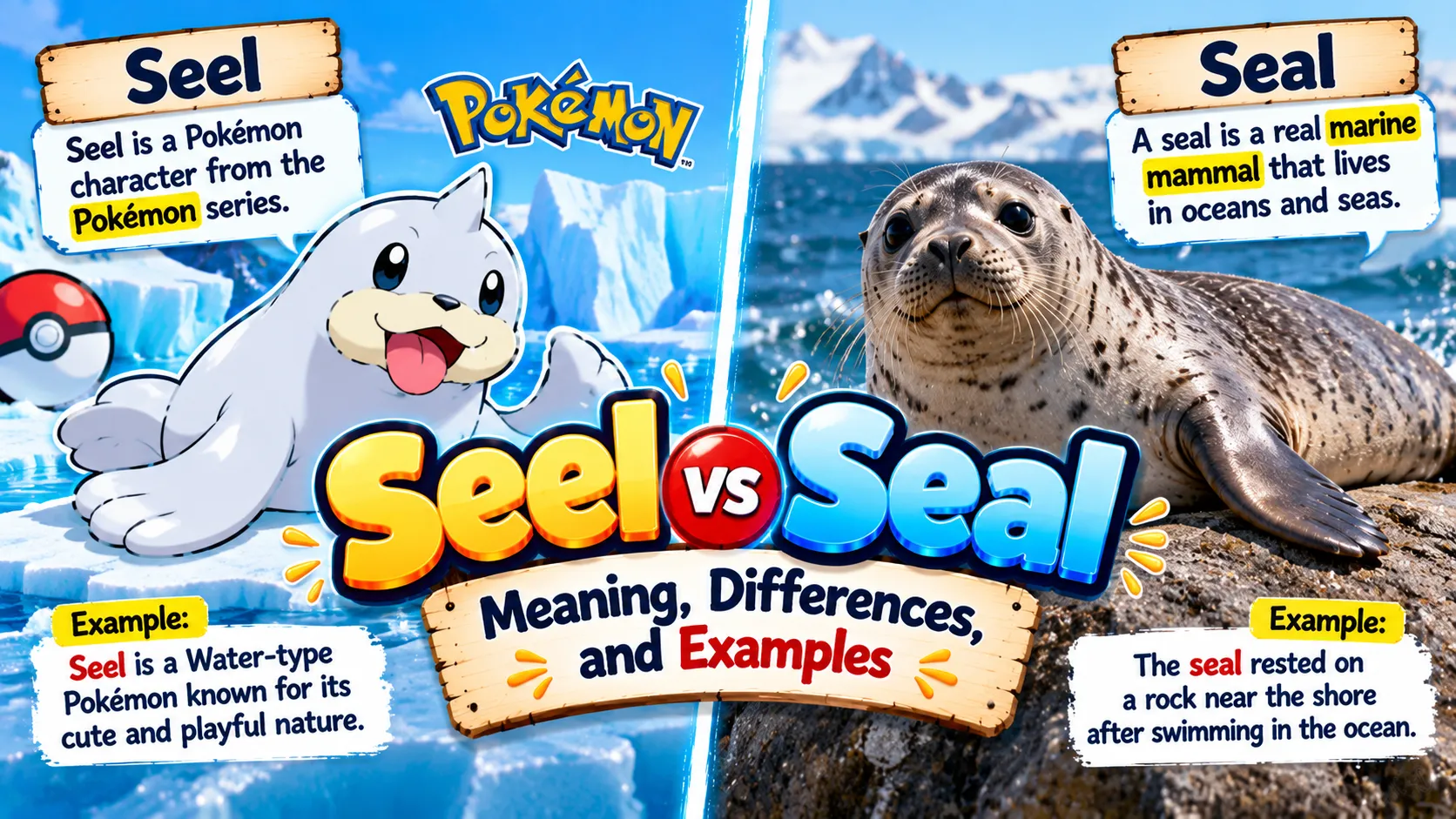
The difference between seel vs seal is mainly a matter of spelling and standard English usage. Although these words look almost identical, seal is the correct spelling for the common English word used to describe an animal, a closure, an official mark, or the act of closing something securely. Seel is a much rarer word that appears in specialized or historical contexts.
People often search for seel vs seal because the two spellings sound alike in ordinary English pronunciation. However, using the wrong spelling can make a sentence confusing, especially in school assignments, professional emails, articles, and other written content.
For example, you might say, “Please seal the envelope before mailing it,” or “We saw a seal swimming near the shore.” In both sentences, seal is the correct spelling. This guide explains the meanings of both words, their grammatical uses, common examples, and simple ways to remember the difference.
What Does Seal Mean? 🦭
Seal is a common English word that can function as both a noun and a verb. As a noun, it can refer to a marine mammal, a device or material that closes an opening, or an official mark used to authenticate a document. As a verb, seal means to close something securely, prevent something from escaping, or formally confirm an agreement.
The meaning depends on the context. For example, a rubber seal prevents water from leaking around a pipe, while an official seal may indicate that a document has been authenticated. The word also appears in expressions such as seal the deal, which means to finalize an agreement.
Examples of Seal in Sentences
- Please seal the envelope before sending it.
- The plumber replaced the damaged rubber seal.
- We watched a seal swimming in the ocean.
- The company used an official seal on the document.
- She sealed the box with strong packing tape.
- The two businesses worked together to seal the deal.
- Make sure the bottle is tightly sealed.
- The court document carried an official seal.
Different Meanings of Seal
Seal as an animal: A seal is a marine mammal that lives in oceans and coastal environments.
Seal as a closure: A seal can be a material or device that prevents air, water, or another substance from passing through an opening.
And Seal as an official mark: An official seal can authenticate a document or indicate approval.
Seal as an action: To seal something means to close it securely or make it difficult to open without breaking the closure.
What Does Seel Mean? 📖
Seel is a rare English word that is not interchangeable with the everyday word seal. It appears mainly in historical or specialized usage, particularly in older falconry terminology.
Historically, seel referred to the practice of sewing or closing the eyelids of a bird, especially a falcon, to keep it calm during handling. The word is associated with older falconry practices and is rarely encountered in modern everyday English.
Because the word is uncommon, most readers do not need to use it in ordinary writing. If you are referring to an ocean animal, closing a package, applying an official mark, or securing an opening, use seal, not seel.
Examples and Usage Notes
- Seel appears in historical discussions of falconry.
- The word may occur in older literary or specialized texts.
- It is not the standard spelling for closing an envelope.
- It is not the correct spelling for the marine mammal.
- It should not replace seal in ordinary business or academic writing.
The important point is that seel has a specialized historical meaning, whereas seal is the familiar word used in most modern contexts.
Seel vs Seal: Key Differences 📊
Although the spellings differ by only one letter, the words have very different levels of everyday use.
| Feature | Seel | Seal |
|---|---|---|
| Standard everyday word | No | Yes |
| Common meaning | Historical falconry term | Animal, closure, official mark, or action |
| Part of speech | Specialized verb | Noun and verb |
| Modern usage | Rare | Very common |
| Example | A historical text may mention seeling a falcon. | Please seal the package. |
| Suitable for ordinary writing | Usually not | Yes, when appropriate |
The main difference is that seal is the standard word for everyday communication, while seel is a rare term associated with a specialized historical practice.
When Should You Use Seal? ✉️
Use seal whenever you mean to close something securely, refer to a marine mammal, describe a closure, or mention an official mark.
For example, if you are preparing a letter for mailing, you should write, “Seal the envelope carefully.” If you are discussing wildlife, you might write, “The seal rested on a rock near the coast.”
The word is also common in business and formal writing. A company might seal an agreement, a document might carry an official seal, and a technician might replace a worn mechanical seal.
Common expressions include:
- Seal an envelope: Close an envelope securely.
- Seal a package: Close a package to protect its contents.
- Official seal: A mark used to authenticate or authorize something.
- Seal the deal: Finalize an agreement.
- Watertight seal: A closure that prevents water from passing through.
- Seal of approval: A sign of acceptance or endorsement.
These expressions are widely understood in modern English and can be used in everyday, academic, and professional contexts.
Common Mistakes When Using Seel and Seal ❌
Since the words sound alike, spelling errors can happen even when the intended meaning is clear. The following examples show how to choose the correct spelling.
Mistake 1: Using seel for a package
Incorrect: Please seel the package before shipping it.
Correct: Please seal the package before shipping it.
Use seal when closing a package securely.
Mistake 2: Using seel for the animal
Incorrect: We saw a seel at the aquarium.
Correct: We saw a seal at the aquarium.
The marine mammal is spelled seal.
Mistake 3: Using seel in a business agreement
Incorrect: The two companies hope to seel the deal.
Correct: The two companies hope to seal the deal.
The expression seal the deal means to finalize an agreement.
Mistake 4: Assuming seel is always meaningless
Although seel is not the correct spelling for common uses of seal, it does have a rare historical meaning. Therefore, whether it is correct depends on the context.
For most modern writing, however, seal is the word you will need.
Easy Ways to Remember Seel vs Seal 🧠
A simple memory trick can help you avoid confusing the two spellings.
Remember the phrase “Seal the deal.” Both seal and deal contain the letters ea. Whenever you mean to close something, finalize an agreement, or describe the marine animal, choose seal.
You can also use these examples as a quick reference:
- Seal the envelope.
- Seal the bottle.
- Watch a seal swim.
- Apply the official seal.
- Seal the deal.
If you encounter seel in an old book or specialized historical text, check its context before deciding whether it is a spelling error. In ordinary English, seal is the correct choice.
Frequently Asked Questions About Seel vs Seal ❓
Is seel or seal correct?
Both spellings exist, but they have different uses. Seal is the standard word for a marine mammal, a closure, an official mark, or the act of closing something securely. Seel is a rare historical term associated with falconry.
Is seel a real English word?
Yes. Seel is a rare word found mainly in historical or specialized contexts. It should not be used as a substitute for seal in everyday writing.
What does seal mean in a sentence?
Seal can mean to close something securely, refer to an official mark, or describe a marine mammal. For example, “She sealed the envelope” uses the word as a verb.
What is the difference between a seal and a seel?
A seal is a common English word with several meanings, including an animal and a secure closure. A seel is a rare historical term associated with closing a bird’s eyelids in falconry.
Is it seal the deal or seel the deal?
The correct expression is seal the deal. It means to finalize an agreement or successfully complete a negotiation.
How do you spell the animal that lives in the ocean?
The correct spelling is seal. For example, “The seal swam through the water.”
Conclusion
The difference between seel vs seal comes down to meaning and usage. Seal is the standard modern English word for a marine mammal, a closure, an official mark, or the act of closing something securely. Seel is a rare historical term used mainly in specialized falconry contexts.
For everyday writing, remember to use seal when closing an envelope, describing an ocean animal, or talking about finalizing an agreement. This simple distinction will help you avoid spelling mistakes and communicate more clearly.

Natalie Brooks is a content researcher and writer with a strong interest in word meanings, dream interpretations, symbolism, and cultural insights. She is passionate about creating clear, informative, and easy-to-understand content that helps readers discover the deeper meanings behind words, names, dreams, and symbols. Through her work at Meanzly, Natalie aims to make knowledge accessible and valuable for readers around the world.