You’re scrolling through TikTok, checking your Instagram DMs, or texting with a friend when suddenly you see it: “WTV.” If you’ve ever wondered what this three-letter abbreviation means, you’re not alone. The WTV meaning has become increasingly common across social media platforms and text messaging, yet its tone can be surprisingly tricky to decipher.
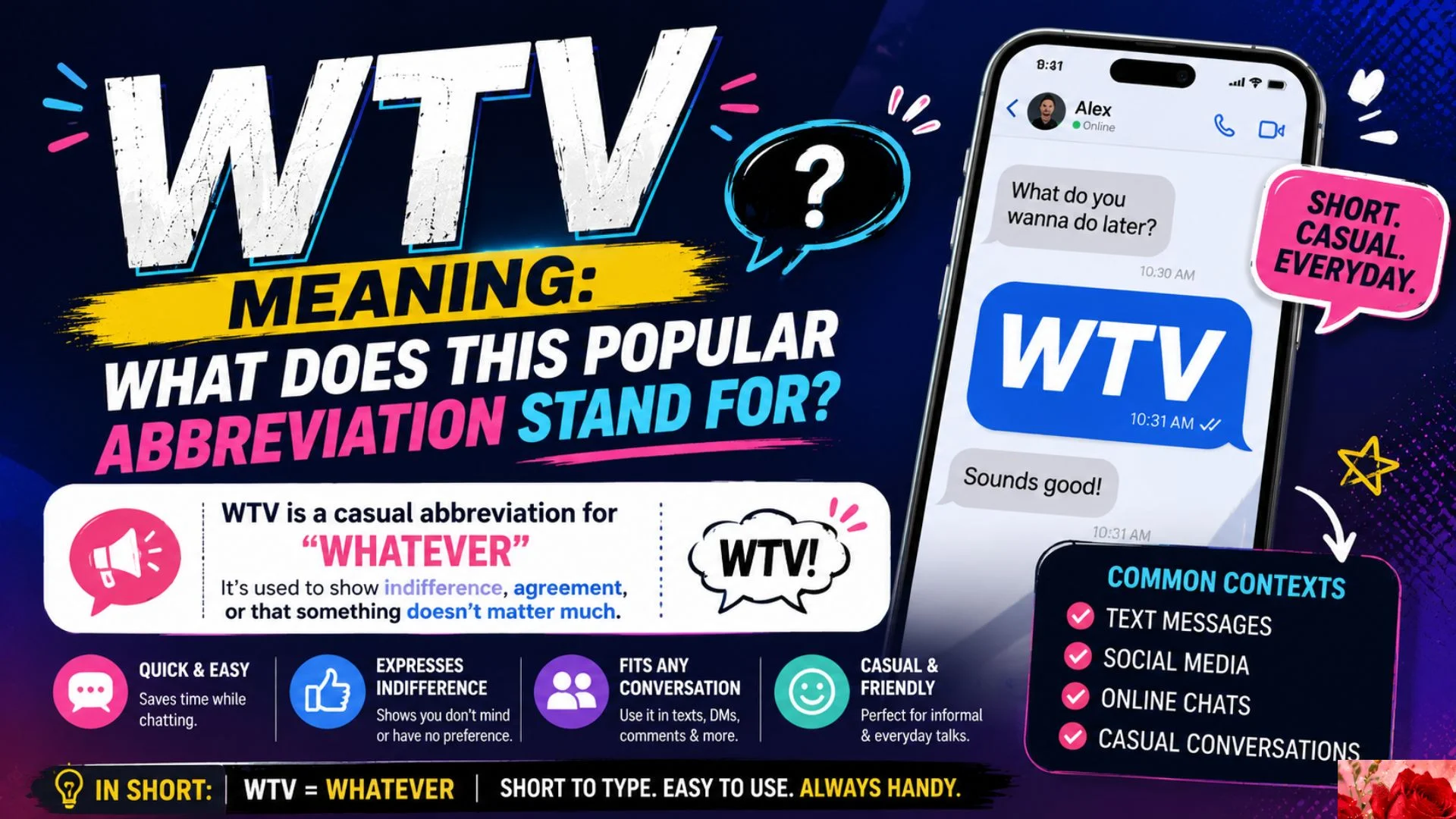
WTV is the shorthand for “whatever,” used primarily in casual digital communication to express indifference, dismissiveness, or a laid-back attitude . Unlike the spoken word “whatever,” which can sometimes sound harsh or passive-aggressive, WTV in text often simply signals that the details don’t really matter . Whether you’re trying to interpret a message you’ve received or considering using WTV yourself, understanding its nuances can help you communicate more effectively and avoid misunderstandings.
Quick Answer
WTV is an abbreviation for “whatever,” commonly used in texting and on social media platforms like TikTok, Instagram, and Snapchat. It expresses indifference, casual agreement, dismissiveness, or annoyance depending on context. Unlike the spoken “whatever,” which can sound rude, WTV often simply means “I don’t have a preference” or “the details don’t matter.” It’s strictly informal slang and should be avoided in professional communication .
Meaning Overview Table
| Aspect | Meaning |
|---|---|
| Definition | An abbreviation for “whatever” used in informal digital communication |
| Pronunciation | Individual letters: “double-you tee vee” (rarely spoken aloud) |
| Part of Speech | Interjection, abbreviation |
| Usage | “We can get pizza or wtv, I don’t really care.” |
| Context | Text messaging, social media (TikTok, Instagram, Snapchat, X), online gaming, casual chats |
Main Meaning
Definition
WTV is an abbreviation of the word “whatever” . It serves as a shorthand way to express indifference, casual agreement, dismissiveness, or mild annoyance in digital communication. Unlike many acronyms that stand for a phrase, WTV is simply a shortened form of a single word .
Origin
The exact origin of WTV remains unclear, but it likely emerged during the early days of text messaging in the late 1990s and early 2000s. At that time, mobile phones had limited keyboards, and carriers often charged per message, prompting users to shorten common words . Abbreviations like WTV also appeared in internet chatrooms and forums from the 1990s . While “whatever” has been a popular dismissive phrase since the 1990s, WTV became the preferred abbreviated form as texting and social media usage grew .
Context
The WTV meaning can shift dramatically based on context. In a friendly chat, it might indicate easygoing indifference: “We can do pizza or wtv” suggests flexibility . In an argument, however, the same abbreviation can signal frustration or emotional withdrawal: “WTV, I’m done talking about this” . Understanding the relationship between the speakers and the conversation’s tone is essential for accurate interpretation .
Modern Usage
Today, WTV appears frequently across platforms like TikTok, Instagram, Snapchat, X, Discord, and WhatsApp . It is especially popular among younger users who value speed and informality in communication . The lowercase version “wtv” is particularly common, aligning with the trend of deliberate lowercase, low-effort-looking caption styles on social media .
Detailed Explanation
Literal Meaning
Literally, WTV stands for “whatever” and is used as a substitute for the full word in any context where “whatever” would appear . It is an abbreviation, not an acronym representing a phrase .
Common Meaning
Commonly, WTV communicates indifference or a lack of preference. It tells the recipient that the speaker doesn’t have strong feelings about the topic at hand . For instance, responding “WTV works for me” to a dinner suggestion indicates you’re open to any option .
Text Meaning
In texting, WTV often serves as a quick way to end a conversation or avoid lengthy explanations. It can express agreement without elaboration, as in “Let’s just get McDonald’s or WTV,” where it implies “or whatever else is convenient” .
Slang Meaning
In slang usage, WTV’s tone can vary from playful to dismissive. Users often add emojis like 😂, 😅, or 😎 to soften the message . For example, “WTV 😅” suggests casual indifference, while “WTV.” with a period can read as colder and more dismissive .
Internet Meaning
On the internet, WTV is commonly used in comments, captions, and DMs. TikTok users frequently pair it with humorous or dramatic captions like “WTV happens, happens 😂” . On Snapchat, it’s especially common in streak replies where speed takes priority over elaboration .
Social Media Meaning
Across social media, WTV maintains its core meaning but can also serve as a “vibe” indicator. On Instagram, it appears in comments like “That trend is foolish, WTV 😂” . On Snapchat, it frequently appears in fast-paced conversations where users prioritize speed .
Cultural Meaning
Culturally, WTV represents the shift toward concise, casual digital communication. Younger generations, in particular, have embraced these abbreviations as a way to maintain conversational flow without committing to lengthy responses . It reflects a broader trend of informal, low-effort communication styles .
Examples Table
| Example | Meaning |
|---|---|
| “I don’t care, WTV” | Expressing indifference or lack of concern |
| “We can do pizza or wtv” | Indicating flexibility and openness to options |
| “WTV works for me” | Showing no strong preference |
| “WTV, I’m done talking about this” | Signaling frustration and ending a conversation |
| “You do it your way, WTV” | Giving in without argument (possibly annoyed) |
| “WTV you want to do” | Giving the other person full decision-making power |
| “People keep complaining, wtv” | Dismissing others’ opinions |
| “WTV happens, happens” | Showing a carefree, go-with-the-flow attitude |
| “WTV 🙄” | Annoyed or dismissive response |
| “Yeah WTV lol” | Casual, relaxed agreement |
Related Meanings Table
| Related Term | Meaning |
|---|---|
| WTVR | “Whatever” with extra emphasis or style |
| WTVTF | “Whatever the f*ck” – expressing stronger frustration |
| IDC | “I don’t care” – similar expression of indifference |
| IDK | “I don’t know” – sometimes used alongside WTV |
| W/E | Older abbreviation for “whatever” from instant messenger era |
| Whatevs | Slang version of “whatever” with similar casual tone |
| WTH | “What the hell” – expressing surprise or frustration |
| WTP | “What’s the plan” or “Want to play” depending on context |
| WTB | “Want to buy” – common in online marketplaces |
| Up to you | Polite alternative expressing flexibility |
| Either works | Friendly alternative showing no preference |
| Doesn’t matter | Neutral way to express indifference |
| Fine by me | Casual agreement without strong opinion |
| What’s the verdict | Alternative meaning of WTV in some contexts |
| What’s the vibe | Alternative meaning asking about the mood or energy |
Common Uses
WTV appears in many everyday scenarios:
Casual Conversations: Friends use WTV when they have no preference: “What movie should we watch?” “WTV you want.”
Family Chats: Among close family members, WTV can simply indicate acceptance: “What should we order?” “WTV works.”
Arguments: WTV often signals that someone wants to stop discussing an issue: “I already explained everything.” “WTV.”
Gaming: Gamers use WTV during multiplayer matches: “WTV strategy works” means any plan is acceptable .
Social Media Comments: People write WTV in captions like “WTV makes you happy” or “WTV happens, happens” .
Group Chats: In busy group conversations, WTV helps someone quickly agree: “Let’s meet at 7.” “WTV” .
Responding to Annoyance: When someone is getting on your nerves, WTV can dismiss them without being confrontational: “I really don’t get why you won’t apologize.” “Fine, WTV.”
Common Mistakes
| Mistake | Correction |
|---|---|
| Assuming WTV is always rude | It often just means “I have no preference.” Context matters |
| Using WTV in professional settings | WTV is strictly informal and unsuitable for work emails or professional communication |
| Believing WTV has only one tone | It can be playful, annoyed, casual, or dismissive depending on context |
| Thinking everyone understands WTV | Older adults or those unfamiliar with internet slang may not recognize it |
| Using WTV in serious emotional conversations | It may come across as uncaring or dismissive |
| Forgetting to add tone indicators | Adding emojis or punctuation helps clarify the intended tone |
| Confusing WTV with “what’s the verdict” | In some cases, WTV can mean this, but “whatever” is the primary meaning |
| Assuming WTV and IDC mean the same thing | IDC means “I don’t care,” while WTV can be more about flexibility than lack of care |
| Using WTV with someone you don’t know well | It might seem overly casual or dismissive |
| Thinking WTV is appropriate for all ages | It is primarily used by younger generations in casual contexts |
Related Questions
What is the difference between WTV and IDC?
While both express indifference, IDC means “I don’t care,” often sounding harsher. WTV can simply mean “I have no preference” or “it doesn’t matter,” and is often more flexible and less confrontational .
Is WTV passive-aggressive?
Usually not. In text, WTV reads as casual indifference rather than the dismissive tone the spoken “whatever” can carry. However, context and punctuation change that—”wtv.” with a period can read colder .
What does WTV mean from a girl vs. a boy?
The meaning doesn’t differ by gender. It generally means the same thing—indifference or dismissal—though tone can vary based on personality and context. On Snapchat and Instagram, it’s typically playful, casual, or dismissive .
What does WTV mean on Snapchat?
On Snapchat, WTV means “whatever” and is often playful, casual, or dismissive in tone. It appears frequently in fast-paced conversations and streak replies .
What does WTVR mean?
WTVR is a variation of WTV meaning “whatever” with extra emphasis or style. It’s mostly used to sound casual or expressive .
FAQs
Is WTV a bad word?
No, WTV is not a bad word. It’s simply slang for “whatever.” However, it can come across as dismissive or rude depending on context and tone .
Can WTV be used in a good way?
Yes! WTV can be friendly and relaxed, especially with emojis like 😅 or 😂. For example, “Yeah WTV lol” sounds casual and easygoing .
What is the history of WTV?
WTV became popular during the rise of text messaging in the late 1990s and early 2000s, when users shortened words to save time and characters. It appeared in internet chatrooms and forums and remains popular on modern platforms like TikTok and Snapchat .
How do you respond to WTV?
If someone sends WTV and you’re unsure of the tone, ask for clarification. If it appears annoyed, you might give them space .
Why do people use WTV instead of “whatever”?
People use WTV to save time and typing effort. It’s especially common in fast-paced conversations, group chats, and on platforms where speed and brevity are prioritized .
Is WTV appropriate for work emails?
No. WTV is strictly informal slang and should be avoided in professional or academic communication .
What does WTV mean in gaming?
In gaming, WTV generally means “whatever” and is used to express that any strategy or option works .
What is the difference between WTV and W/E?
W/E is an older messenger-era abbreviation for “whatever,” while WTV is the form Gen Z uses today on TikTok and in DMs .
Conclusion
The WTV meaning—an abbreviation for “whatever”—has become a staple of digital communication, appearing across text messages and social media platforms. While its core meaning remains consistent, its tone can shift dramatically from casual indifference to playful agreement to outright dismissal depending on context, punctuation, and the relationship between speakers. Understanding these nuances helps you interpret messages accurately and use WTV appropriately .
As with all internet slang, context is everything. What works in a friendly group chat might not suit a professional email, and what sounds playful with an emoji might read as rude without one. Whether you choose to use WTV or simply want to understand what others mean when they send it, recognizing its flexibility will help you navigate the ever-evolving landscape of digital communication .

Natalie Brooks is a content researcher and writer with a strong interest in word meanings, dream interpretations, symbolism, and cultural insights. She is passionate about creating clear, informative, and easy-to-understand content that helps readers discover the deeper meanings behind words, names, dreams, and symbols. Through her work at Meanzly, Natalie aims to make knowledge accessible and valuable for readers around the world.