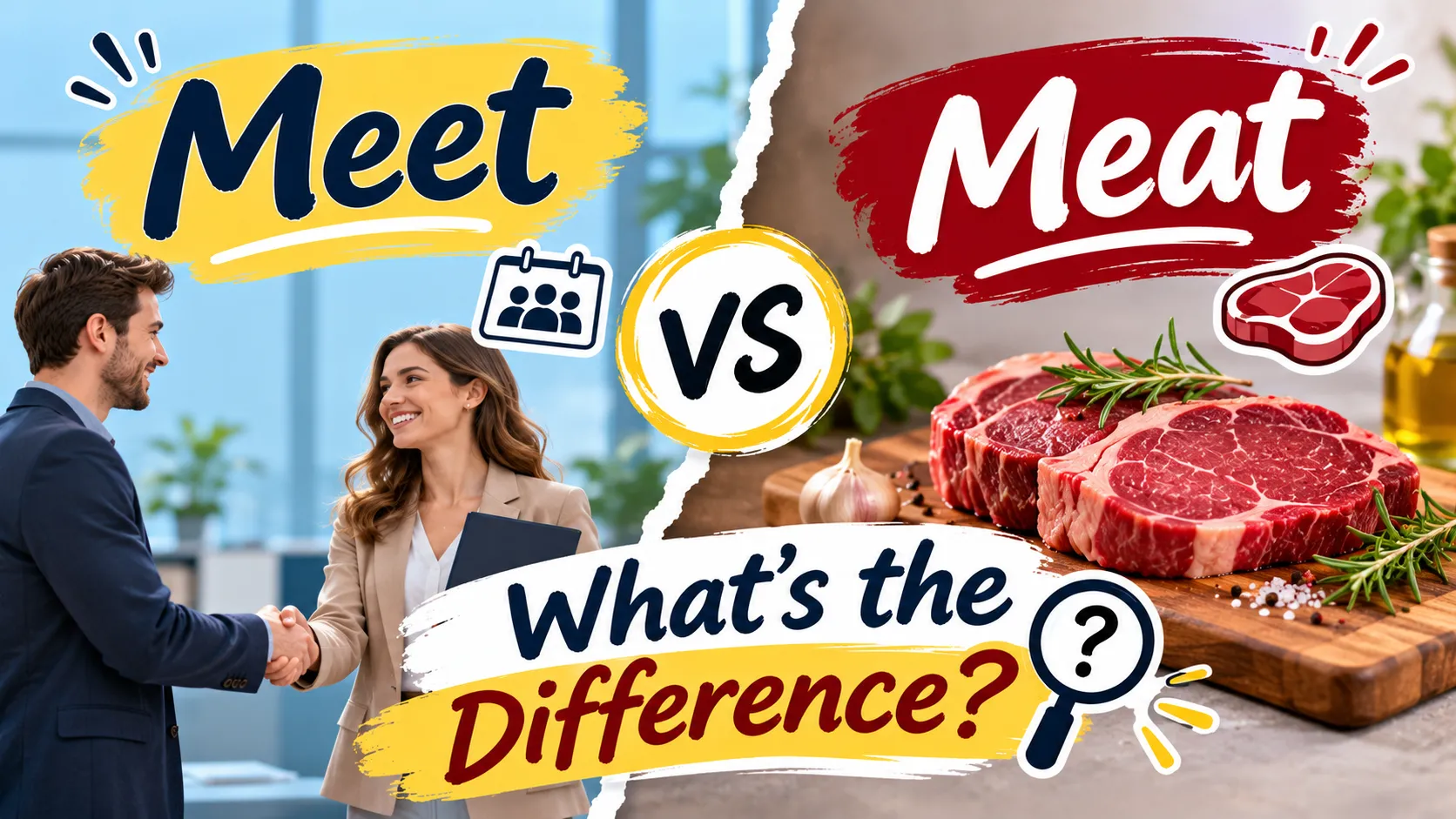
The words “meet” and “meat” sound identical, differ by just one letter, and appear in completely different contexts. The meet vs meat confusion ranks among the most common homophone errors in English writing, appearing in everything from emails to recipes to sports schedules.
“Meet” is a verb meaning to come together, to encounter someone, or to satisfy a requirement. “Meat” is a noun referring to the flesh of an animal used as food. These words share identical pronunciation but no shared meaning. This comprehensive guide explains the difference, explores their origins, provides practical examples, and helps you choose the correct word every time you write.
Quick Answer
“Meet” is a verb meaning to come together, encounter someone, or satisfy a requirement, as in “let’s meet at noon” or “meet the deadline.” “Meat” is a noun referring to animal flesh used as food, as in “grilled meat.” Remember: meet has “ee” like “see” (you see someone when you meet); meat has “ea” like “eat” (you eat meat). They sound the same but mean completely different things.
Meaning Overview Table
| Aspect | Meaning |
|---|---|
| Definition | Meet: to come together or satisfy. Meat: animal flesh used as food |
| Pronunciation | Both: /miːt/ |
| Part of Speech | Meet: verb and noun (a sports event). Meat: noun |
| Usage | “Let’s meet tomorrow” vs. “The meat is fresh” |
| Context | Meet: social, professional, sports, requirements. Meat: food, cooking, nutrition, biology |
Main Meaning
Definition
Meet functions primarily as a verb meaning to come together with someone, to encounter someone by chance, to satisfy a requirement or standard, or to be introduced to someone. It also functions as a noun referring to a sports competition or gathering, such as a track meet. Meat is a noun referring to the flesh of an animal used as food, or the edible part of something.
Origin
“Meet” comes from the Old English mētan, meaning “to encounter” or “to come upon.” It has Germanic roots related to German müssen and Dutch moeten, though the meanings diverged. The word has been used in English since before the 12th century.
“Meat” comes from the Old English mete, meaning “food” in general. Originally, “meat” referred to any solid food, not just animal flesh. Over centuries, the meaning narrowed to refer specifically to animal flesh used as food. The word shares Germanic roots with German Mett and Dutch metworst.
Context
The distinction matters across several contexts:
- Social and Professional: “Meet” appears in discussions of gatherings, appointments, and introductions
- Sports: “Meet” refers to athletic competitions, especially track and field
- Cooking and Nutrition: “Meat” appears in recipes, menus, and dietary discussions
- Business: “Meet” appears in phrases like “meet the deadline” or “meet expectations”
- Everyday Writing: Confusing the two creates embarrassing errors in emails, essays, and social media posts
Modern Usage
Today, “meet” appears constantly in both speech and writing, covering social encounters, professional obligations, and sports events. “Meat” appears frequently in food contexts, cooking shows, and nutrition discussions. The phrase “meat and potatoes” appears in both literal and figurative contexts. The confusion between the two persists because they sound identical and spell-check often fails to catch the error.
Detailed Explanation
Literal Meaning
Literally, “meet” means to come together or encounter. “Meat” literally means animal flesh used as food, though historically it meant any solid food.
Common Meaning
Commonly, people use “meet” when planning gatherings, encountering people, or fulfilling requirements. They use “meat” when discussing food, cooking, or nutrition.
Social Meaning
In social contexts, “meet” describes coming together with others. “Let’s meet for coffee.” “Nice to meet you.” The word covers both planned and accidental encounters.
Professional Meaning
In professional contexts, “meet” describes satisfying requirements or obligations. “Meet the deadline,” “meet expectations,” “meet the criteria.” This usage is standard in business communication.
Culinary Meaning
In cooking, “meat” describes animal flesh used as food. Beef, pork, chicken, and lamb are all meat. The word also extends to the edible part of nuts (“nut meat”) and coconuts.
Sports Meaning
In sports, a “meet” is a competition or gathering. Track meets, swim meets, and gymnastics meets are common. The word refers to the event itself, not the action of meeting.
Examples Table
| Example | Meaning |
|---|---|
| Let’s meet at the coffee shop. | Come together |
| The meat is cooking in the oven. | Animal flesh used as food |
| Nice to meet you. | Encounter or be introduced |
| She doesn’t eat meat. | Animal flesh |
| We need to meet the deadline. | Satisfy a requirement |
| The butcher sold fresh meat. | Animal flesh |
| The track meet starts at noon. | A sports competition |
| The meat was tender and juicy. | Animal flesh |
| Their eyes met across the room. | Encounter or connect |
| Plant-based meat is growing in popularity. | Food product resembling animal flesh |
Related Meanings Table
| Related Term | Meaning |
|---|---|
| Meet | To come together or satisfy |
| Meat | Animal flesh used as food |
| Meeting | A gathering of people |
| Meets | Third-person singular of meet |
| Met | Past tense of meet |
| Meatless | Without meat |
| Meaty | Full of meat; substantial |
| Meathook | A hook for hanging meat |
| Meatball | A ball of ground meat |
| Meetup | An informal gathering |
| Meet-and-greet | A social event for meeting people |
| Deadline | A time by which something must be met |
| Requirement | Something that must be met |
| Track meet | A track and field competition |
| Butcher | A person who sells meat |
Common Uses
People use “meet” and “meat” across numerous contexts:
Social Gatherings: “Meet” appears constantly in invitations and plans. “Let’s meet for lunch.” “Nice to meet you.” These phrases describe coming together with others.
Professional Communication: “Meet” appears in phrases about requirements and deadlines. “Meet the deadline,” “meet expectations,” and “meet the criteria” are standard business phrases.
Sports and Athletics: “Meet” refers to competitions. Track meets, swim meets, and gymnastics meets are common events.
Cooking and Nutrition: “Meat” appears constantly in recipes, menus, and dietary discussions. Vegetarians avoid meat. Butchers sell meat. Chefs cook meat.
Food Industry: “Meat” appears in product labels, restaurant menus, and food safety discussions. Plant-based meat alternatives have expanded the word’s usage.
Common Mistakes
| Mistake | Correction |
|---|---|
| Writing “meat me at the store” | Write “meet me at the store” (come together) |
| Writing “the meet is fresh” | Write “the meat is fresh” (animal flesh) |
| Writing “let’s meat for coffee” | Write “let’s meet for coffee” (come together) |
| Writing “meet the deadline” as “meat the deadline” | Write “meet the deadline” (satisfy) |
| Writing “nice to meat you” | Write “nice to meet you” (encounter) |
| Writing “track meet” as “track meat” | Write “track meet” (sports competition) |
| Writing “meat expectations” | Write “meet expectations” (satisfy) |
| Writing “the meet was tender” | Write “the meat was tender” (animal flesh) |
| Assuming spell-check will catch the error | Spell-check often misses homophones; proofread manually |
| Writing “meat and greet” | Write “meet and greet” (social event) |
Related Questions
Is it “meet” or “meat”?
It depends on meaning. Use “meet” for coming together or satisfying requirements. Use “meat” for animal flesh used as food.
What does “meet” mean?
“Meet” is a verb meaning to come together, encounter someone, or satisfy a requirement. It also functions as a noun referring to a sports competition.
What does “meat” mean?
“Meat” is a noun referring to the flesh of an animal used as food, or the edible part of something.
What is the difference between “meet” and “meat” in a sentence?
“Meet” relates to coming together or satisfying requirements. “Meat” relates to food.
Can “meet” be a noun?
Yes. “Meet” functions as a noun referring to a sports competition, such as a track meet or swim meet.
Can “meat” be a verb?
No. “Meat” is only a noun.
Why do people confuse “meet” and “meat”?
They sound identical and differ by only one letter. Spell-check often misses homophones, so the error persists in written communication.
FAQs
What does “meet” mean?
“Meet” is a verb meaning to come together, encounter someone, or satisfy a requirement. It also functions as a noun referring to a sports competition.
What does “meat” mean?
“Meat” is a noun referring to the flesh of an animal used as food, or the edible part of something.
Is it “nice to meet you” or “nice to meat you”?
The correct phrase is “nice to meet you.” Meet means to encounter or be introduced.
Is it “meet the deadline” or “meat the deadline”?
The correct phrase is “meet the deadline.” Meet means to satisfy a requirement.
Can “meat” refer to plant-based food?
Yes. “Plant-based meat” or “meat alternatives” refer to food products designed to resemble animal flesh.
What is a “track meet”?
A track meet is a track and field competition where athletes compete in running, jumping, and throwing events.
How can I remember the difference?
Remember: meet has “ee” like “see” (you see someone when you meet). Meat has “ea” like “eat” (you eat meat).
What is the origin of “meat”?
“Meat” comes from the Old English mete, meaning “food” in general. Over time, the meaning narrowed to refer specifically to animal flesh.
Conclusion
Mastering the meet vs meat distinction protects your writing from embarrassing homophone errors. “Meet” is a verb meaning to come together, encounter someone, or satisfy a requirement. “Meat” is a noun referring to animal flesh used as food. Remember the simple rule: meet has “ee” like “see” (you see someone when you meet); meat has “ea” like “eat” (you eat meat). Whether you’re writing an email, a recipe, or a sports schedule, choosing the correct word ensures your meaning is clear. Practice using “meet” for gatherings and requirements and “meat” for food, and your readers will understand exactly what you intend. Small distinctions like this separate careful writers from careless ones.

Natalie Brooks is a content researcher and writer with a strong interest in word meanings, dream interpretations, symbolism, and cultural insights. She is passionate about creating clear, informative, and easy-to-understand content that helps readers discover the deeper meanings behind words, names, dreams, and symbols. Through her work at Meanzly, Natalie aims to make knowledge accessible and valuable for readers around the world.