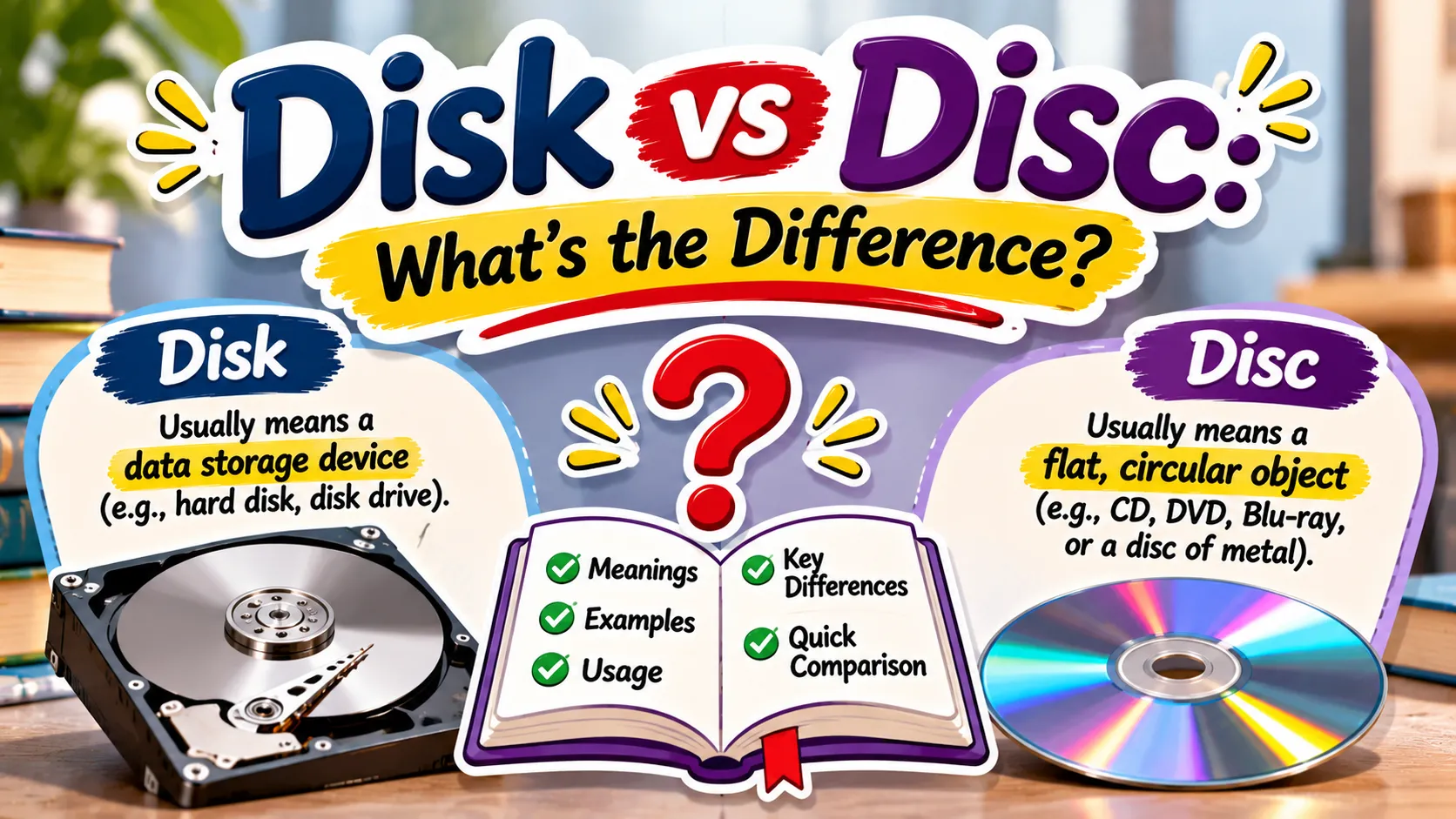
The words “disk” and “disc” look nearly identical and sound exactly the same. Both describe flat, circular objects, and both appear in reputable publications. Yet the disk vs disc distinction follows a set of conventions that vary by region, industry, and specific context. Understanding these rules helps writers choose the right spelling for their audience.
The core difference is simple: “disk” is the preferred spelling in American English and for most computer-related terms, while “disc” is preferred in British English and for audio recordings, optical media, and certain medical and agricultural terms . Both spellings derive from the Latin discus and the Greek diskos, meaning a round, flat object thrown in athletic competition . This comprehensive guide explains the regional and contextual rules, explores the origins of both forms, provides practical examples, and helps you choose the correct spelling every time.
Quick Answer
Use “disk” in American English and for computer storage like hard disks and floppy disks. Use “disc” in British English and for audio recordings, compact discs, disc jockeys, and optical media. For medical terms, American style uses “disk” for spinal disks but “disc” for optic discs. When in doubt, check your audience’s regional convention and the specific industry’s standard.
Meaning Overview Table
| Aspect | Meaning |
|---|---|
| Definition | Two spellings of the same word describing flat, circular objects, with preferences varying by region and context |
| Pronunciation | Both: /dɪsk/ |
| Part of Speech | Nouns and verbs |
| Usage | “Hard disk” (computing, US) vs. “compact disc” (audio, UK) |
| Context | Computing, music, medicine, agriculture, general usage |
Main Meaning
Definition
Disk and disc are variant spellings of the same noun, referring to a thin, flat, circular object. The choice between them depends on regional English conventions and specific industry usage. In computing, “disk” dominates for magnetic storage. In audio and optical media, “disc” dominates. And In general usage, American English favors “disk” while British English favors “disc” .
Origin
Both spellings trace to the Latin noun discus (a quoit or dish) and the Greek diskos, derived from dikein (“to throw”). The word entered English in the mid-17th century as “disk,” modeled on words like “whisk.” The “disc” spelling arose later, based directly on the Latin root . In the 19th century, “disc” became conventional for gramophone records, giving rise to “disc jockey.” By the 20th century, the “k” spelling dominated in American English while the “c” spelling prevailed in British English .
Context
The distinction matters across several contexts:
- Computing: “Disk” is standard for magnetic storage (hard disk, floppy disk, disk drive)
- Audio and Optical Media: “Disc” is standard for compact discs, videodiscs, and disc jockeys
- Medicine: American style uses “disk” for spinal disks but “disc” for optic discs
- Agriculture: “Disc” is preferred for disc harrows and disc plows
- General Usage: American English favors “disk”; British English favors “disc”
Modern Usage
Today, the rules are inconsistent but generally follow industry convention. Computing overwhelmingly uses “disk” for magnetic storage and “disc” for optical media . Music and entertainment use “disc” for recordings and “disc jockey.” Medical style guides specify “disk” for most anatomy but “disc” for ophthalmology . Canadian English uses “disk” for computers and “disc” for everything else .
Detailed Explanation
Literal Meaning
Literally, both words describe a thin, flat, circular object. A disk or disc can be a plate, a coin-like shape, or any round flat surface. The literal meaning is identical; only the spelling convention differs.
Computing Meaning
In computing, “disk” is the standard spelling for magnetic storage devices: hard disks, floppy disks, disk drives, and disk space . IBM pioneered hard disk storage in the 1950s using the “k” spelling, cementing the convention . However, “disc” appears for optical media: compact discs (CDs), videodiscs, and Blu-ray discs. Philips and Sony chose “compact disc” in 1979, possibly because the “c” spelling dominated British English or because the technology succeeded analog disc records .
Audio and Music Meaning
In music and entertainment, “disc” is standard. Compact discs, disc jockeys (DJs), and discographies all use the “c” spelling. The recording industry adopted “disc” throughout the 20th century, and the term “disc jockey” entered the language with that spelling . The word “disco,” derived from discotheque (a record library), also traces to the “c” spelling.
Medical Meaning
Medical writing follows specific rules. The American Medical Association (AMA) style recommends “disk” for most anatomical terms, including spinal disks (intervertebral disks) and herniated disks. However, for ophthalmology, AMA style specifies “disc,” as in optic disc . This exception reflects long-standing usage in eye-related terminology.
Agricultural Meaning
In agriculture, “disc” is preferred for the concave steel tools that make up a disc harrow or disc plow. The verb forms are “disced” and “discing” .
General Meaning
For general usage, American English favors “disk,” and British English favors “disc.” Canadian English occupies a middle ground: “disk” for computers, “disc” for everything else . Style guides vary, and many publications accept both spellings outside their preferred conventions.
Examples Table
| Example | Meaning |
|---|---|
| The hard disk crashed and lost all data. | Computing: magnetic storage (US spelling) |
| She bought the album on compact disc. | Audio: optical media (standard spelling) |
| The doctor treated a herniated disk. | Medicine: spinal disk (AMA style) |
| The optic disc appeared healthy. | Medicine: eye anatomy (AMA style) |
| The farmer used a disc harrow. | Agriculture: soil-working tool |
| The radio disc jockey played requests. | Music: DJ (standard spelling) |
| Check how much disk space is available. | Computing: storage capacity (US spelling) |
| The flying disc sailed across the field. | General: Frisbee-style object |
| The sun appeared as a bright disc. | Astronomy: celestial body (British preference) |
| He slipped a disc in his lower back. | Medicine: spinal injury (US spelling) |
Related Meanings Table
| Related Term | Meaning |
|---|---|
| Disk drive | Computing: device that reads and writes magnetic disks |
| Compact disc | Audio/optical: CD (standard spelling) |
| Disc jockey | Music: DJ (standard spelling) |
| Hard disk | Computing: magnetic storage (standard spelling) |
| Floppy disk | Computing: legacy magnetic storage (standard spelling) |
| Herniated disk | Medicine: spinal injury (AMA style) |
| Optic disc | Medicine: eye anatomy (AMA style) |
| Disc harrow | Agriculture: soil-working implement |
| Disc golf | Sports: game using flying discs |
| Videodisc | Optical media: video storage (standard spelling) |
| Disk space | Computing: storage capacity |
| Disc brake | Automotive: braking mechanism (usually “disc”) |
| Intervertebral disk | Medicine: spinal cushion |
| Diskette | Computing: small floppy disk |
| Flying disc | General: Frisbee-style object |
Common Uses
People use “disk” and “disc” across numerous contexts:
Computing and IT: Professionals write “hard disk,” “disk drive,” and “disk space” for magnetic storage. They write “compact disc” and “optical disc” for laser-read media .
Music and Entertainment: Writers use “disc” for albums, DJs, and discographies. “Disc jockey” is standard, as is “compact disc” .
Healthcare: Medical writers follow AMA style: “disk” for spinal anatomy, “disc” for eye anatomy .
Agriculture: Farmers and equipment dealers write “disc harrow,” “disc plow,” and “discing” .
Everyday Writing: American writers default to “disk” in general contexts; British and Canadian writers often prefer “disc” outside computing .
Common Mistakes
| Mistake | Correction |
|---|---|
| Writing “hard disc” in American computing contexts | Write “hard disk” (standard computing spelling) |
| Writing “compact disk” for audio CDs | Write “compact disc” (standard audio spelling) |
| Writing “disc drive” in American computing | Write “disk drive” (standard computing spelling) |
| Writing “optic disk” in medical writing | Write “optic disc” (AMA style exception) |
| Writing “spinal disc” in American medical writing | Write “spinal disk” (AMA style for anatomy) |
| Using “disk” for disc golf | Write “disc golf” (standard sports spelling) |
| Writing “disc jockey” as “disk jockey” | “Disc jockey” is the standard spelling |
| Assuming one spelling is always correct | Rules vary by region and context |
| Writing “floppy disc” in American English | Write “floppy disk” (computing standard) |
| Using “disc” for computer storage in American publications | Use “disk” for magnetic storage |
Related Questions
Is it “disk” or “disc”?
It depends on context. Use “disk” in American English and for computer storage. Use “disc” in British English and for audio recordings, optical media, and certain medical and agricultural terms .
What is the difference between disk and disc?
There is no difference in meaning. The difference is spelling convention based on region and specific industry usage .
Is “disk” American or British?
“Disk” is the preferred spelling in American English. It is also standard for computer-related terms globally .
Is “disc” British or American?
“Disc” is the preferred spelling in British English. It is also standard for audio recordings, compact discs, and disc jockeys in all varieties of English .
Why is it “compact disc” but “hard disk”?
Philips and Sony chose “compact disc” in 1979 for optical media, while IBM and the computing industry standardized “hard disk” for magnetic storage in the 1950s. The conventions stuck .
Is it “slipped disk” or “slipped disc”?
American medical style uses “slipped disk” (or herniated disk). British usage often uses “slipped disc” .
What does “disc” mean in disc golf?
“Disc golf” uses the “c” spelling for the flying discs thrown in the sport. The standard spelling is “disc golf” .
Can I use either spelling in general writing?
In general writing, both spellings are understood, but American audiences expect “disk” and British audiences expect “disc.” Check your publication’s style guide .
FAQs
What is the difference between disk and disc?
Both words describe the same flat, circular object. “Disk” is preferred in American English and for computing. “Disc” is preferred in British English and for audio, optical media, and certain medical terms .
Is it “hard disk” or “hard disc”?
“Hard disk” is the standard spelling in computing, especially in American English. The “k” spelling dominates for magnetic storage .
Is it “compact disc” or “compact disk”?
“Compact disc” is the standard spelling. Philips and Sony chose the “c” spelling when they developed the technology in 1979 .
Why do we say “disc jockey” and not “disk jockey”?
The recording industry adopted “disc” for phonograph records in the 20th century, and “disc jockey” followed that spelling convention .
Is it “optic disc” or “optic disk”?
American Medical Association style specifies “optic disc” for eye anatomy, despite using “disk” for most other anatomical terms .
Is it “herniated disk” or “herniated disc”?
American medical style uses “herniated disk” or “slipped disk” for spinal injuries. British usage often uses “disc” .
Can I use “disc” for computer storage?
In British English, “disc” sometimes appears for computing, but “disk” remains the dominant spelling for magnetic storage globally. Optical media use “disc” .
What is a “flying disc”?
A “flying disc” is a Frisbee-style object thrown for recreation or sport. The spelling is “disc” in this context .
Conclusion
Mastering the disk vs disc distinction requires attention to region and context rather than a single universal rule. “Disk” dominates in American English and for magnetic computer storage. “Disc” dominates in British English and for audio recordings, compact discs, and optical media. Medical writing follows its own rules: “disk” for spinal anatomy, “disc” for eye anatomy. Agriculture prefers “disc” for soil-working tools. When in doubt, check your audience’s regional convention and your industry’s standard. Both spellings are correct, and both derive from the same ancient root. Choosing the right one demonstrates precision and respect for your readers’ expectations. Whether you write “hard disk” or “compact disc,” your meaning remains clear—but the spelling signals care and professionalism.

Natalie Brooks is a content researcher and writer with a strong interest in word meanings, dream interpretations, symbolism, and cultural insights. She is passionate about creating clear, informative, and easy-to-understand content that helps readers discover the deeper meanings behind words, names, dreams, and symbols. Through her work at Meanzly, Natalie aims to make knowledge accessible and valuable for readers around the world.