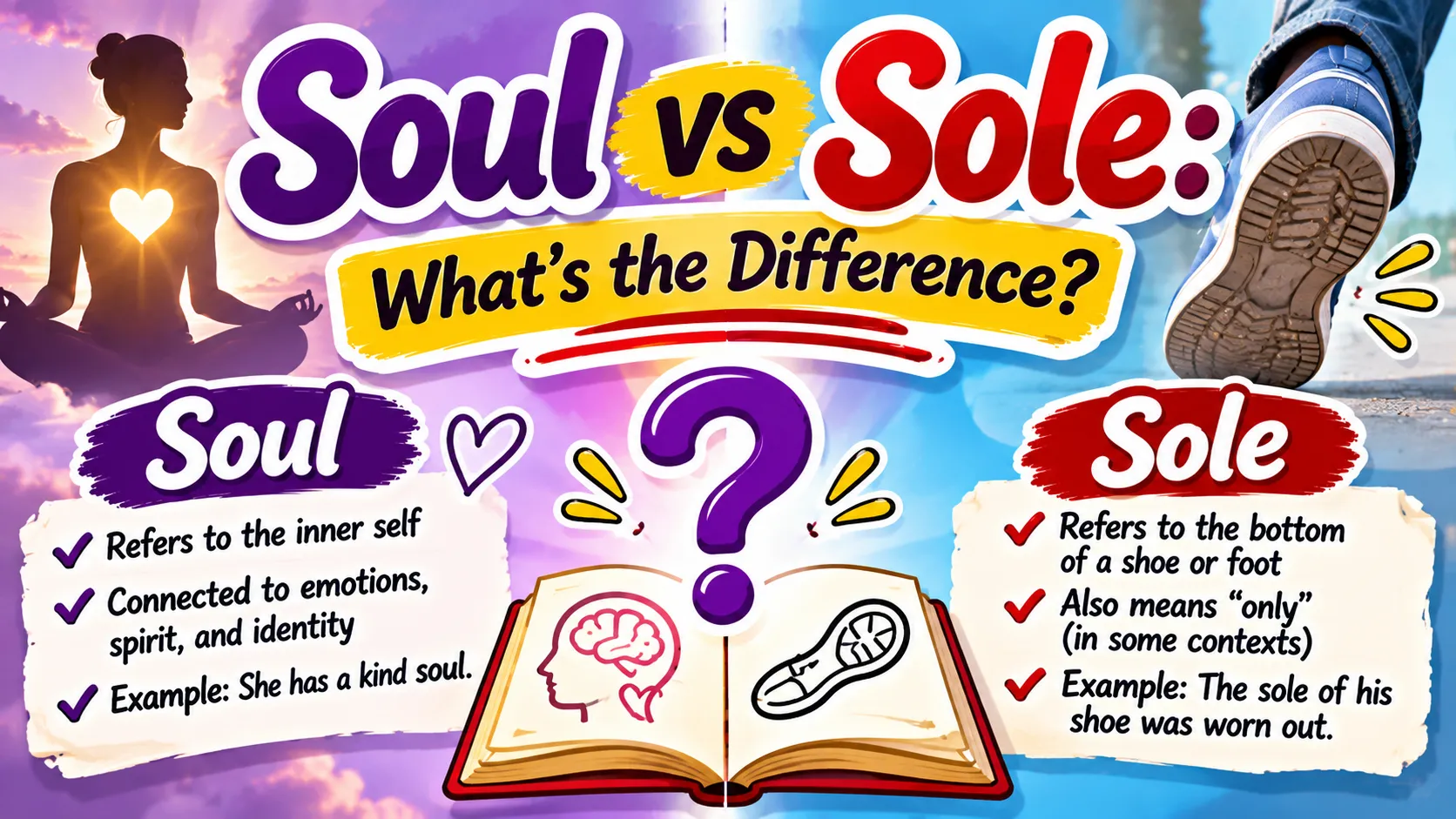
The words “soul” and “sole” sound identical, differ by just one letter, and appear in completely different contexts. The soul vs sole confusion ranks among the most common homophone errors in English writing, appearing in everything from music reviews to shoe advertisements and restaurant menus.
“Soul” refers to the spiritual essence of a person, deep emotion, or a genre of music. “Sole” refers to the bottom of a foot or shoe, being the only one, or a type of fish. These words share identical pronunciation but no shared meaning. This comprehensive guide explains the difference, explores their origins, provides practical examples, and helps you choose the correct word every time you write.
Quick Answer
“Soul” refers to the spiritual part of a person, deep feeling, or soul music, as in “she poured her soul into the song.” “Sole” refers to the bottom of a foot or shoe, being the only one, or a type of flatfish, as in “the sole of my shoe” or “the sole survivor.” Remember: soul has “ou” like “you” (your spirit); sole has “o” like “toe” (part of the foot). They sound the same but mean completely different things.
Meaning Overview Table
| Aspect | Meaning |
|---|---|
| Definition | Soul: spiritual essence, deep emotion, or music genre. Sole: bottom of foot or shoe, only one, or a fish |
| Pronunciation | Both: /soʊl/ |
| Part of Speech | Soul: noun. Sole: noun, adjective, and verb |
| Usage | “She has a beautiful soul” vs. “The sole of my shoe wore out” |
| Context | Soul: spirituality, music, emotion. Sole: footwear, anatomy, law, cuisine |
Main Meaning
Definition
Soul is a noun referring to the spiritual or immaterial part of a human being, regarded as immortal. It also refers to deep feeling or emotion, the essential nature of something, or a genre of African American music combining rhythm and blues with gospel. Sole functions as a noun, adjective, and verb. As a noun, it refers to the bottom surface of the foot or a shoe, or a type of flatfish. As an adjective, it means being the only one. And As a verb, it means to put a sole on a shoe.
Origin
“Soul” comes from the Old English sāwol, meaning the spiritual part of a person. It has Germanic roots related to German Seele and Dutch ziel. The word has always carried spiritual and emotional weight.
“Sole” comes from two different sources. The anatomical sense comes from the Latin solea, meaning a sandal or sole. The fish sense comes from the Latin solea as well, which also named the flatfish. The adjective meaning “only” comes from the Latin solus, meaning “alone.”
Context
The distinction matters across several contexts:
- Spirituality and Religion: “Soul” appears in discussions of the afterlife, consciousness, and spiritual essence
- Music: “Soul” describes a genre of music and the emotional quality of a performance
- Footwear and Anatomy: “Sole” describes the bottom of feet and shoes
- Law and Business: “Sole” describes exclusive ownership or responsibility
- Cuisine: “Sole” refers to a type of flatfish served in restaurants
Modern Usage
Today, “soul” appears frequently in spiritual discussions, music criticism, and expressions of deep emotion. “Sole” appears in footwear descriptions, legal documents, and restaurant menus. The confusion between the two persists because they sound identical and spell-check often fails to catch the error.
Detailed Explanation
Literal Meaning
Literally, “soul” means the spiritual essence of a person. “Sole” literally means the bottom of a foot or shoe.
Common Meaning
Commonly, people use “soul” when discussing spirituality, deep feelings, or soul music. They use “sole” when discussing shoes, feet, exclusive ownership, or the fish.
Spiritual Meaning
In spiritual and religious contexts, “soul” refers to the immaterial, immortal essence of a person. Many traditions believe the soul survives physical death. The word carries profound philosophical and theological weight.
Musical Meaning
In music, “soul” describes a genre that emerged in the 1950s and 1960s, combining rhythm and blues with gospel. Artists like Aretha Franklin and Otis Redding defined the genre. “Soulful” describes emotionally powerful performances.
Footwear Meaning
In footwear, “sole” refers to the bottom layer of a shoe that contacts the ground. Shoe soles come in rubber, leather, and synthetic materials. “Sole” also describes the bottom of the foot.
Legal Meaning
In legal and business contexts, “sole” means exclusive or single. “Sole proprietor” means the only owner. “Sole responsibility” means exclusive responsibility.
Culinary Meaning
In cuisine, “sole” refers to several species of flatfish, including Dover sole and lemon sole. Restaurants serve sole as a delicacy.
Examples Table
| Example | Meaning |
|---|---|
| She poured her soul into the performance. | Spiritual essence or deep emotion |
| The sole of my shoe wore out. | Bottom of the shoe |
| He is the sole survivor of the crash. | Only one |
| Soul music defined the 1960s. | Music genre |
| The soles of my feet hurt after the hike. | Bottom of the feet |
| They ate Dover sole at the restaurant. | A type of fish |
| That song has real soul. | Deep feeling or emotional quality |
| She is the sole owner of the company. | Exclusive ownership |
| He bared his soul to his therapist. | Revealed his deepest feelings |
| The cobbler resoled my boots. | Replaced the sole |
Related Meanings Table
| Related Term | Meaning |
|---|---|
| Soul | Spiritual essence, deep emotion, music genre |
| Sole | Bottom of foot or shoe, only one, or fish |
| Soulful | Expressing deep emotion |
| Soulless | Lacking emotion or spirit |
| Solely | Only; exclusively |
| Sole proprietor | The single owner of a business |
| Sole survivor | The only person who survived |
| Solemn | Serious and dignified (unrelated but similar sound) |
| Soleus | A muscle in the calf (related to “sole”) |
| Soul music | A genre combining R&B and gospel |
| Soulmate | A person ideally suited to another |
| Soled | Having a particular type of sole |
| Resole | To replace the sole of a shoe |
| Solitude | The state of being alone (related to “sole”) |
| Solo | Alone or performed by one person (related to “sole”) |
Common Uses
People use “soul” and “sole” across numerous contexts:
Spirituality and Religion: Discussions of the soul appear in theology, philosophy, and spiritual writing. The soul represents the immortal essence of a person.
Music: Critics and fans discuss soul music and soulful performances. The genre has a rich history and ongoing influence.
Footwear: Shoe manufacturers and cobblers discuss soles. Athletes choose shoes based on sole grip and durability.
Law and Business: Attorneys use “sole” to describe exclusive ownership, responsibility, or liability. Contracts specify sole proprietors and sole agents.
Cuisine: Restaurants serve sole as a seafood delicacy. Menu descriptions highlight Dover sole and lemon sole.
Common Mistakes
| Mistake | Correction |
|---|---|
| Writing “sole music” | Write “soul music” (the genre) |
| Writing “soul of my shoe” | Write “sole of my shoe” (bottom of the shoe) |
| Writing “the soul survivor” | Write “the sole survivor” (only one) |
| Writing “he has a kind sole” | Write “he has a kind soul” (spiritual essence) |
| Writing “Dover soul” | Write “Dover sole” (the fish) |
| Writing “soul proprietor” | Write “sole proprietor” (exclusive owner) |
| Writing “she bared her sole” | Write “she bared her soul” (revealed feelings) |
| Writing “sole food” when meaning soul food | Write “soul food” (Southern cuisine) |
| Assuming spell-check will catch the error | Spell-check often misses homophones; proofread manually |
| Writing “the soul of the foot” | Write “the sole of the foot” (bottom surface) |
Related Questions
Is it “soul” or “sole”?
It depends on meaning. Use “soul” for spiritual essence, deep emotion, or music. Use “sole” for the bottom of a foot or shoe, being the only one, or the fish.
What does “soul” mean?
“Soul” refers to the spiritual or immaterial part of a person, deep feeling, the essential nature of something, or a genre of music.
What does “sole” mean?
“Sole” refers to the bottom of a foot or shoe, being the only one, or a type of flatfish.
What is the difference between “soul” and “sole” in a sentence?
“Soul” relates to spirit and emotion. “Sole” relates to feet, shoes, exclusivity, or the fish.
Why do people confuse “soul” and “sole”?
They sound identical and differ by only one letter. Spell-check often misses homophones, so the error persists in written communication.
How can I remember the difference?
Remember: soul has “ou” like “you” (your spirit). Sole has “o” like “toe” (part of the foot).
What is “soul food”?
“Soul food” is a cuisine originating in the Southern United States, associated with African American culture.
FAQs
What does “soul” mean?
“Soul” refers to the spiritual or immaterial part of a person, deep emotion, the essential nature of something, or a genre of music.
What does “sole” mean?
“Sole” refers to the bottom of a foot or shoe, being the only one, or a type of flatfish.
Is it “soul music” or “sole music”?
The correct phrase is “soul music.” Soul is a genre of music.
Is it “sole survivor” or “soul survivor”?
The correct phrase is “sole survivor.” Sole means only one.
Can “sole” be an adjective?
Yes. “Sole” as an adjective means being the only one, as in “sole owner” or “sole responsibility.”
What is a “sole proprietor”?
A sole proprietor is the single owner of a business. The term uses “sole” meaning exclusive.
How can I remember the difference?
Remember: soul has “ou” like “you” (your spirit). Sole has “o” like “toe” (part of the foot).
What is the origin of “soul”?
“Soul” comes from the Old English sāwol, meaning the spiritual part of a person.
Conclusion
Mastering the soul vs sole distinction protects your writing from embarrassing homophone errors. “Soul” refers to spiritual essence, deep emotion, or soul music. “Sole” refers to the bottom of a foot or shoe, being the only one, or a type of fish. Remember the simple rule: soul has “ou” like “you” (your spirit); sole has “o” like “toe” (part of the foot). Whether you’re writing a music review, a shoe description, or a legal document, choosing the correct word ensures your meaning is clear. Practice using “soul” for spirit and emotion, and “sole” for feet, exclusivity, and fish, and your readers will understand exactly what you intend. Small distinctions like this separate careful writers from careless ones.

Natalie Brooks is a content researcher and writer with a strong interest in word meanings, dream interpretations, symbolism, and cultural insights. She is passionate about creating clear, informative, and easy-to-understand content that helps readers discover the deeper meanings behind words, names, dreams, and symbols. Through her work at Meanzly, Natalie aims to make knowledge accessible and valuable for readers around the world.