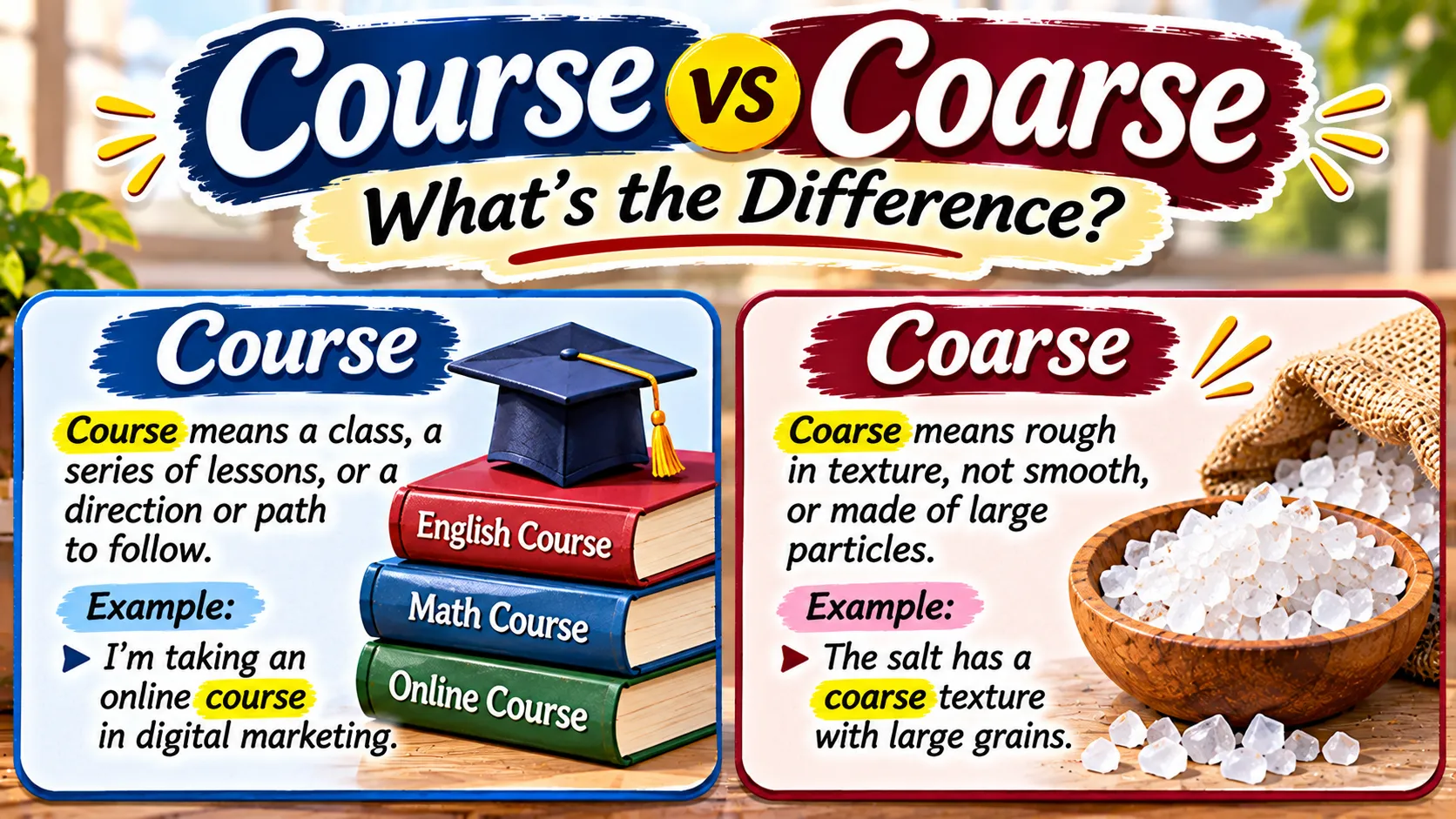
The words “course” and “coarse” sound identical, differ by just one letter, and appear in completely different contexts. The course vs coarse confusion ranks among the most common homophone errors in English writing, appearing in everything from academic catalogs to restaurant menus and golf commentary.
“Course” is a noun referring to a direction, a series of lessons, a part of a meal, or a golf course, and as a verb means to flow or run. “Coarse” is an adjective meaning rough in texture, harsh in manner, or vulgar in language. These words share identical pronunciation but no shared meaning. This comprehensive guide explains the difference, explores their origins, provides practical examples, and helps you choose the correct word every time you write.
Quick Answer
“Course” refers to a direction, a series of lessons, a part of a meal, or a golf course, as in “a college course” or “the main course.” “Coarse” means rough, harsh, or vulgar, as in “coarse sand” or “coarse language.” Remember: course has “our” like “journey”; coarse has “oar” like “rough.” They sound the same but mean completely different things.
Meaning Overview Table
| Aspect | Meaning |
|---|---|
| Definition | Course: a direction, lessons, or part of a meal. Coarse: rough in texture or vulgar in manner |
| Pronunciation | Both: /kɔːrs/ |
| Part of Speech | Course: noun and verb. Coarse: adjective |
| Usage | “She enrolled in a course” vs. “The sand was coarse” |
| Context | Course: education, navigation, dining, sports. Coarse: textures, language, behavior |
Main Meaning
Definition
Course functions as both a noun and a verb. As a noun, it refers to a direction or route, a series of educational lessons, a part of a meal served at one time, a golf course, or the path of a river or ship. As a verb, it means to flow, run, or move swiftly. Coarse is an adjective meaning rough in texture, composed of large particles, harsh or grating to the senses, or lacking refinement in manners or language.
Origin
“Course” comes from the Latin noun cursus, meaning “a running” or “a race,” from the verb currere (“to run”). It entered English through Old French cours in the 13th century. The word has always related to movement, direction, and progression.
“Coarse” comes from the Old French cours, which originally meant “ordinary” or “common.” The word’s meaning shifted toward “rough” or “unrefined” in English. It shares the same root as “course” but developed a completely different meaning over centuries.
Context
The distinction matters across several contexts:
- Education: “Course” appears in discussions of classes, curricula, and academic programs
- Dining: “Course” describes parts of a meal, from appetizer to dessert
- Textiles and Materials: “Coarse” describes rough textures like sand, fabric, or hair
- Language and Behavior: “Coarse” describes vulgar or harsh language and manners
- Navigation and Sports: “Course” describes direction, rivers, and golf courses
Modern Usage
Today, “course” appears constantly in educational, culinary, and navigational contexts. “Coarse” appears in discussions of textures, language, and behavior. The confusion between the two persists because they sound identical and spell-check often fails to catch the error.
Detailed Explanation
Literal Meaning
Literally, “course” means a running or a direction. “Coarse” literally means ordinary or common, which evolved into “rough” or “unrefined.”
Common Meaning
Commonly, people use “course” when discussing education, meals, or direction. “I’m taking a course in Spanish.” “The main course was delicious.” “The ship changed course.” They use “coarse” when describing textures or behavior. “The sand was coarse.” “He used coarse language.”
Educational Meaning
In education, “course” refers to a series of classes or lectures on a particular subject. Students enroll in courses, complete coursework, and earn course credits. This usage is universal across English-speaking countries.
Culinary Meaning
In dining, “course” refers to a part of a meal served at one time. A formal dinner may include an appetizer course, a soup course, a main course, and a dessert course. The phrase “of course” also derives from this sense.
Textural Meaning
“Coarse” describes textures that are rough, granular, or composed of large particles. Coarse sand, coarse fabric, and coarse hair all describe rough or large-grained materials.
Behavioral Meaning
“Coarse” also describes behavior or language that is vulgar, harsh, or lacking refinement. “Coarse language,” “coarse humor,” and “coarse manners” all describe unrefined conduct.
Examples Table
| Example | Meaning |
|---|---|
| She enrolled in a biology course. | A series of lessons |
| The sand on the beach was coarse. | Rough in texture |
| The main course was steak. | A part of a meal |
| He used coarse language. | Vulgar or harsh |
| The ship changed course. | Direction |
| The fabric was coarse and scratchy. | Rough texture |
| Of course you can come. | Certainly (idiom) |
| The golf course was beautiful. | Sports facility |
| Her coarse manners offended everyone. | Lacking refinement |
| The river coursed through the valley. | Flowed swiftly |
Related Meanings Table
| Related Term | Meaning |
|---|---|
| Course | Direction, lessons, part of a meal |
| Coarse | Rough in texture or vulgar |
| Of course | Certainly; an idiom meaning “naturally” |
| Coursework | Assignments completed for a course |
| Coursing | Flowing or running (present participle) |
| Coarsely | In a rough or vulgar manner |
| Coarseness | The quality of being coarse |
| Coarse-grained | Having a rough or large-grained texture |
| Coarse sand | Sand with large particles |
| Main course | The primary dish in a meal |
| Golf course | A facility for playing golf |
| Course correction | A change in direction |
| Coarse language | Vulgar or harsh speech |
| Coarse fabric | Rough-textured cloth |
| Coarse hair | Thick, rough hair |
Common Uses
People use “course” and “coarse” across numerous contexts:
Education: Students enroll in courses. Schools offer courses in various subjects. Course catalogs list available classes. Coursework includes assignments and exams.
Dining: Restaurants serve meals in courses. Formal dinners include multiple courses. Menus list appetizers, main courses, and desserts.
Navigation and Sports: Ships and planes change course. Golfers play on golf courses. Rivers course through landscapes.
Textiles and Construction: Builders use coarse sand for concrete. Tailors distinguish coarse from fine fabrics. Coarse materials require different handling.
Language and Behavior: Critics describe coarse language in films and books. Parents teach children to avoid coarse manners. Coarse humor appeals to some audiences.
Common Mistakes
| Mistake | Correction |
|---|---|
| Writing “coarse” for education | Write “course” for classes and lessons |
| Writing “course” for texture | Write “coarse” for rough textures |
| Writing “of coarse” | Write “of course” (certainly) |
| Writing “main coarse” | Write “main course” (part of a meal) |
| Writing “golf coarse” | Write “golf course” (sports facility) |
| Writing “coarse language” as “course language” | Write “coarse language” (vulgar) |
| Writing “coarse correction” | Write “course correction” (change in direction) |
| Writing “coarse sand” as “course sand” | Write “coarse sand” (rough texture) |
| Assuming spell-check will catch the error | Spell-check often misses homophones; proofread manually |
| Writing “coarse of study” | Write “course of study” (educational program) |
Related Questions
Is it “course” or “coarse”?
It depends on meaning. Use “course” for direction, lessons, or parts of a meal. Use “coarse” for rough textures or vulgar behavior.
What does “course” mean?
“Course” refers to a direction or route, a series of educational lessons, a part of a meal, a golf course, or the act of flowing swiftly.
What does “coarse” mean?
“Coarse” means rough in texture, composed of large particles, harsh to the senses, or lacking refinement in manners or language.
What is the difference between “course” and “coarse” in a sentence?
“Course” relates to direction, education, or meals. “Coarse” relates to texture or behavior.
What does “of course” mean?
“Of course” is an idiom meaning “certainly,” “naturally,” or “as expected.”
Why do people confuse “course” and “coarse”?
They sound identical and differ by only one letter. Spell-check often misses homophones, so the error persists in written communication.
How can I remember the difference?
Remember: “course” has “our” like “journey” — both relate to direction. “Coarse” has “oar” like “rough” — both relate to texture.
FAQs
What does “course” mean?
“Course” refers to a direction or route, a series of educational lessons, a part of a meal, a golf course, or the act of flowing swiftly.
What does “coarse” mean?
“Coarse” means rough in texture, composed of large particles, harsh to the senses, or lacking refinement in manners or language.
Is it “of course” or “of coarse”?
The correct phrase is “of course.” It is an idiom meaning “certainly.”
Is it “main course” or “main coarse”?
The correct phrase is “main course.” It refers to the primary dish in a meal.
Can “course” be a verb?
Yes. “Course” as a verb means to flow or run swiftly, as in “the river coursed through the valley.”
Can “coarse” be a noun?
No. “Coarse” is only an adjective. The noun form is “coarseness.”
How can I remember the difference?
Remember: “course” has “our” like “journey” — both relate to direction. “Coarse” has “oar” like “rough” — both relate to texture.
What is “coarse language”?
“Coarse language” refers to vulgar, harsh, or unrefined speech.
Conclusion
Mastering the course vs coarse distinction protects your writing from embarrassing homophone errors. “Course” refers to a direction, a series of lessons, a part of a meal, or a golf course. “Coarse” means rough in texture, harsh to the senses, or vulgar in behavior. Remember the simple rule: course has “our” like “journey”; coarse has “oar” like “rough.” Whether you’re writing an academic catalog, a restaurant menu, or a news article, choosing the correct word ensures your meaning is clear. Practice using “course” for direction and education, and “coarse” for texture and behavior, and your readers will understand exactly what you intend. Small distinctions like this separate careful writers from careless ones.

Natalie Brooks is a content researcher and writer with a strong interest in word meanings, dream interpretations, symbolism, and cultural insights. She is passionate about creating clear, informative, and easy-to-understand content that helps readers discover the deeper meanings behind words, names, dreams, and symbols. Through her work at Meanzly, Natalie aims to make knowledge accessible and valuable for readers around the world.