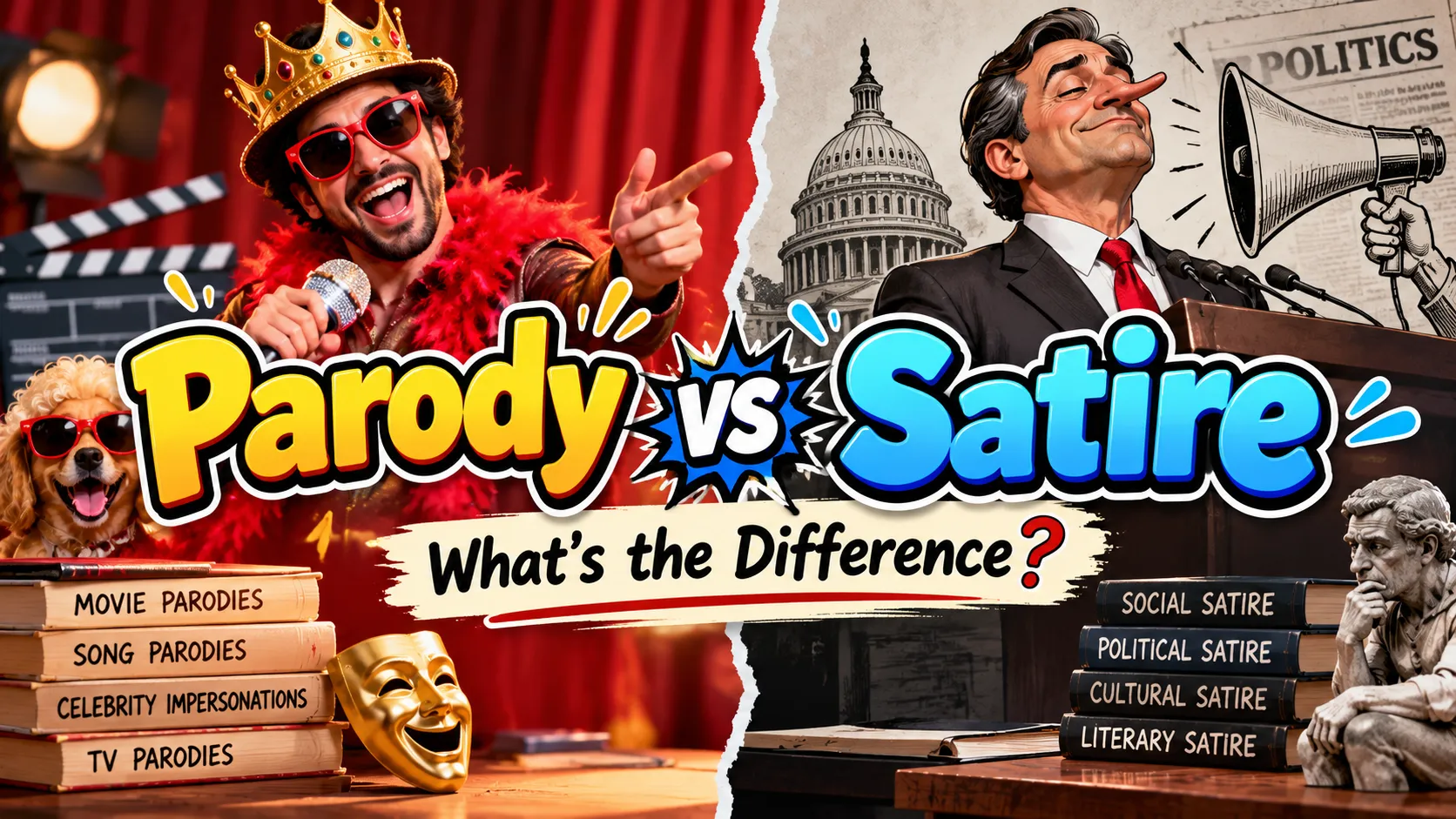
The words “parody” and “satire” appear side by side in literary criticism, film reviews, and cultural commentary. People often use them interchangeably, yet the parody vs satire distinction matters for anyone who wants to understand comedy, art, and social criticism with precision. A parody imitates a style for comic effect. A satire uses humor to criticize or expose folly. The two overlap frequently, but they serve different purposes.
Parody targets the form or style of a work. Satire targets human behavior, institutions, or ideas. A parody of a superhero movie makes fun of superhero movie conventions. A satire of corporate culture uses humor to expose greed and absurdity. Some works combine both, which is why the confusion persists. This comprehensive guide explains the difference, explores their origins, provides practical examples, and helps you distinguish between them with confidence.
Quick Answer
Parody imitates a specific work, style, or genre for comic effect, targeting the form itself. Satire uses humor, irony, or exaggeration to criticize human behavior, institutions, or ideas, targeting the subject rather than the form. Parody asks “Isn’t this style funny?” Satire asks “Isn’t this behavior absurd or wrong?” Many works combine both, but the core purposes differ.
Meaning Overview Table
| Aspect | Meaning |
|---|---|
| Definition | Parody: comic imitation of a style or work. Satire: humor used to criticize folly or vice |
| Pronunciation | Parody: /ˈpærədi/; Satire: /ˈsætaɪər/ |
| Part of Speech | Both are nouns; “parody” and “satirize” are verbs |
| Usage | “The film is a parody of horror movies” vs. “The novel is a satire of politics” |
| Context | Literature, film, comedy, cultural criticism, political commentary |
Main Meaning
Definition
Parody is a literary or artistic work that imitates the style of an author, genre, or specific work for comic effect or ridicule. It targets the form itself, exaggerating recognizable conventions to produce humor.
Satire is a genre that uses humor, irony, exaggeration, or ridicule to expose and criticize human vices, follies, abuses, or shortcomings. It targets behavior, institutions, or ideas rather than artistic form.
Origin
“Parody” comes from the Greek parōidia, meaning “a burlesque song” or “counter-song,” combining para- (“beside” or “counter”) and ōidē (“song”). The word entered English in the 16th century.
“Satire” comes from the Latin satira or satura, meaning “a medley” or “a dish of mixed fruits.” The word originally described a mixed literary form. It entered English in the 16th century and developed its modern meaning of humorous criticism.
Context
The distinction matters across several contexts:
- Literary Criticism: Scholars distinguish between parody (imitating form) and satire (criticizing behavior)
- Film and Television: Critics classify works based on their primary purpose
- Comedy Writing: Comedians choose between parodying a genre or satirizing a subject
- Cultural Commentary: Satire often carries political or social weight; parody often focuses on entertainment
Modern Usage
Today, both terms appear constantly in reviews and cultural analysis. Parody dominates in comedy that imitates genres—superhero spoofs, horror parodies, and musical parodies. Satire dominates in political comedy, social commentary, and works that expose hypocrisy. Many contemporary works blend both, using parody as a vehicle for satire.
Detailed Explanation
Literal Meaning
Literally, “parody” means a song or work that imitates another. “Satire” means a medley or mixture, reflecting its origins as a mixed literary form. In modern usage, parody emphasizes imitation; satire emphasizes criticism.
Common Meaning
Commonly, people use “parody” to describe a funny imitation of a known work or style. They use “satire” to describe humor that makes a point about society, politics, or human behavior. A parody makes you laugh at the imitation. A satire makes you think about the target.
Target Meaning
The key difference lies in the target:
- Parody targets the form: It imitates a style, genre, or specific work. “Spaceballs” parodies “Star Wars.” “Scary Movie” parodies horror films.
- Satire targets the subject: It criticizes behavior, institutions, or ideas. “Animal Farm” satirizes totalitarianism. “The Daily Show” satirizes politics and media.
Overlap Meaning
Parody and satire overlap when a work imitates a form in order to criticize a subject. “Dr. Strangelove” parodies Cold War military films while satirizing nuclear policy. “The Simpsons” parodies countless cultural forms while satirizing American life. In these cases, parody serves as a vehicle for satire.
Tone Meaning
Parody often carries a playful, affectionate tone. It can celebrate the work it imitates even while mocking it. Satire often carries a sharper, more critical tone. It aims to provoke thought, outrage, or reform.
Examples Table
| Example | Meaning |
|---|---|
| “Spaceballs” is a parody of “Star Wars.” | Comic imitation of a specific film’s style |
| “Animal Farm” is a satire of totalitarianism. | Humorous criticism of political systems |
| “Weird Al” Yankovic’s songs are parodies. | Comic imitations of specific songs |
| “The Onion” publishes satire. | Humorous criticism of news and culture |
| “Scary Movie” parodies horror films. | Comic imitation of horror genre conventions |
| “South Park” satirizes American culture. | Humorous criticism of social behavior |
| “The Naked Gun” parodies police procedurals. | Comic imitation of a genre’s style |
| “Brave New World” satirizes technological control. | Humorous criticism of social trends |
| “Austin Powers” parodies spy films. | Comic imitation of spy movie conventions |
| “The Daily Show” satirizes politics. | Humorous criticism of political behavior |
Related Meanings Table
| Related Term | Meaning |
|---|---|
| Spoof | A light parody or send-up |
| Burlesque | A comic imitation, often theatrical |
| Lampoon | A sharp satire or parody |
| Irony | A contrast between expectation and reality; a tool of satire |
| Exaggeration | A tool used in both parody and satire |
| Mockery | Ridicule, often used in satire |
| Caricature | Exaggerated imitation, often satirical |
| Send-up | A parody or mockery |
| Takeoff | A parody or imitation |
| Skit | A short comic performance, often parodic |
| Pastische | An imitation of a style, sometimes parodic |
| Satirical | Adjective describing satire |
| Parodic | Adjective describing parody |
| Satirist | A writer of satire |
| Parodist | A writer of parody |
Common Uses
People use “parody” and “satire” across numerous contexts:
Literary Criticism: Scholars classify works based on their primary purpose. Parody imitates form; satire criticizes behavior. Critics debate works that blend both.
Film and Television Reviews: Reviewers describe comedies as parodies or satires based on their targets. “Spaceballs” is a parody; “Dr. Strangelove” is a satire.
Comedy Writing: Comedians choose between parodying a genre or satirizing a subject. Many blend both, using parody as a vehicle for satire.
Political Commentary: Satire dominates political comedy, from “The Daily Show” to editorial cartoons. Parody appears in political memes that imitate campaign ads or speeches.
Music and Internet Culture: Parody songs, memes, and videos imitate styles for comic effect. Satirical memes criticize behavior and institutions.
Common Mistakes
| Mistake | Correction |
|---|---|
| Using “parody” and “satire” interchangeably | Parody targets form; satire targets behavior or institutions |
| Calling “Animal Farm” a parody | “Animal Farm” is a satire; it criticizes totalitarianism |
| Calling “Spaceballs” a satire | “Spaceballs” is a parody; it imitates “Star Wars” |
| Assuming all satire is funny | Satire can be dark, biting, or unsettling, not always laugh-out-loud funny |
| Assuming all parody is critical | Parody can be affectionate and celebratory, not always critical |
| Confusing the targets | Parody targets style; satire targets subject |
| Calling a political cartoon a parody | Political cartoons are usually satire, not parody |
| Missing the overlap | Many works combine both; don’t force a single label |
| Assuming parody is always inferior | Parody can be sophisticated and artistically valuable |
| Assuming satire is always political | Satire can target social behavior, religion, and culture, not just politics |
Related Questions
What is the main difference between parody and satire?
Parody imitates a style or work for comic effect, targeting the form. Satire uses humor to criticize human behavior or institutions, targeting the subject.
Is parody a type of satire?
Not necessarily. Parody can exist without satire, and satire can exist without parody. Many works combine both, but they are distinct concepts.
What is an example of parody?
“Spaceballs” parodies “Star Wars.” “Weird Al” Yankovic’s songs parody specific songs. “Scary Movie” parodies horror films.
What is an example of satire?
“Animal Farm” satirizes totalitarianism. “The Onion” satirizes news and culture. “The Daily Show” satirizes politics.
Can a work be both parody and satire?
Yes. “Dr. Strangelove” parodies Cold War films while satirizing nuclear policy. “The Simpsons” parodies cultural forms while satirizing American life.
Why do people confuse parody and satire?
Because many works combine both. Parody often serves as a vehicle for satire, making the distinction blurry in practice.
Is parody always funny?
Parody aims for comic effect, but not all parodies succeed in being funny. Some parodies are affectionate rather than mocking.
Is satire always political?
No. Satire can target social behavior, religion, culture, and human folly. Political satire is one type of satire, not the only type.
FAQs
What is the difference between parody and satire?
Parody imitates a style or work for comic effect, targeting the form. Satire uses humor to criticize behavior or institutions, targeting the subject.
Is parody a form of satire?
Parody can be a tool of satire, but it is not inherently satirical. Parody can be affectionate and celebratory, while satire is critical.
What is an example of a parody?
“Spaceballs” is a parody of “Star Wars.” “Weird Al” Yankovic’s songs parody specific songs. “Scary Movie” parodies horror films.
What is an example of satire?
“Animal Farm” satirizes totalitarianism. “The Onion” satirizes news and culture. “The Daily Show” satirizes politics.
Can a parody be serious?
Parody is usually comic, but it can carry serious points. A parody that criticizes its target becomes satirical.
Can satire be funny?
Satire often uses humor, but it can also be dark, biting, or unsettling. Not all satire aims for laughter.
What is the target of parody?
Parody targets the form: a style, genre, specific work, or author’s manner.
What is the target of satire?
Satire targets the subject: human behavior, institutions, ideas, or social norms.
Conclusion
The parody vs satire distinction sharpens your understanding of comedy and criticism. Parody imitates form for comic effect, targeting style, genre, or specific works. Satire uses humor to criticize behavior, institutions, or ideas, targeting the subject itself. Parody asks “Isn’t this style funny?” Satire asks “Isn’t this behavior absurd or wrong?” Many works blend both, using parody as a vehicle for satire, which is why the confusion persists. Remember the simple rule: parody targets the form; satire targets the subject. Whether you’re writing a review, analyzing a film, or creating comedy, understanding this distinction helps you describe works accurately and appreciate their purposes. Small distinctions like this separate careful critics from careless ones.

Natalie Brooks is a content researcher and writer with a strong interest in word meanings, dream interpretations, symbolism, and cultural insights. She is passionate about creating clear, informative, and easy-to-understand content that helps readers discover the deeper meanings behind words, names, dreams, and symbols. Through her work at Meanzly, Natalie aims to make knowledge accessible and valuable for readers around the world.