In literature, film, and art, the terms “symbol” and “motif” often appear side by side. Both involve objects or images that carry deeper meaning, and both help storytellers communicate ideas without stating them directly. Yet the symbol vs motif distinction matters for anyone studying a text, writing an essay, or analyzing a film.
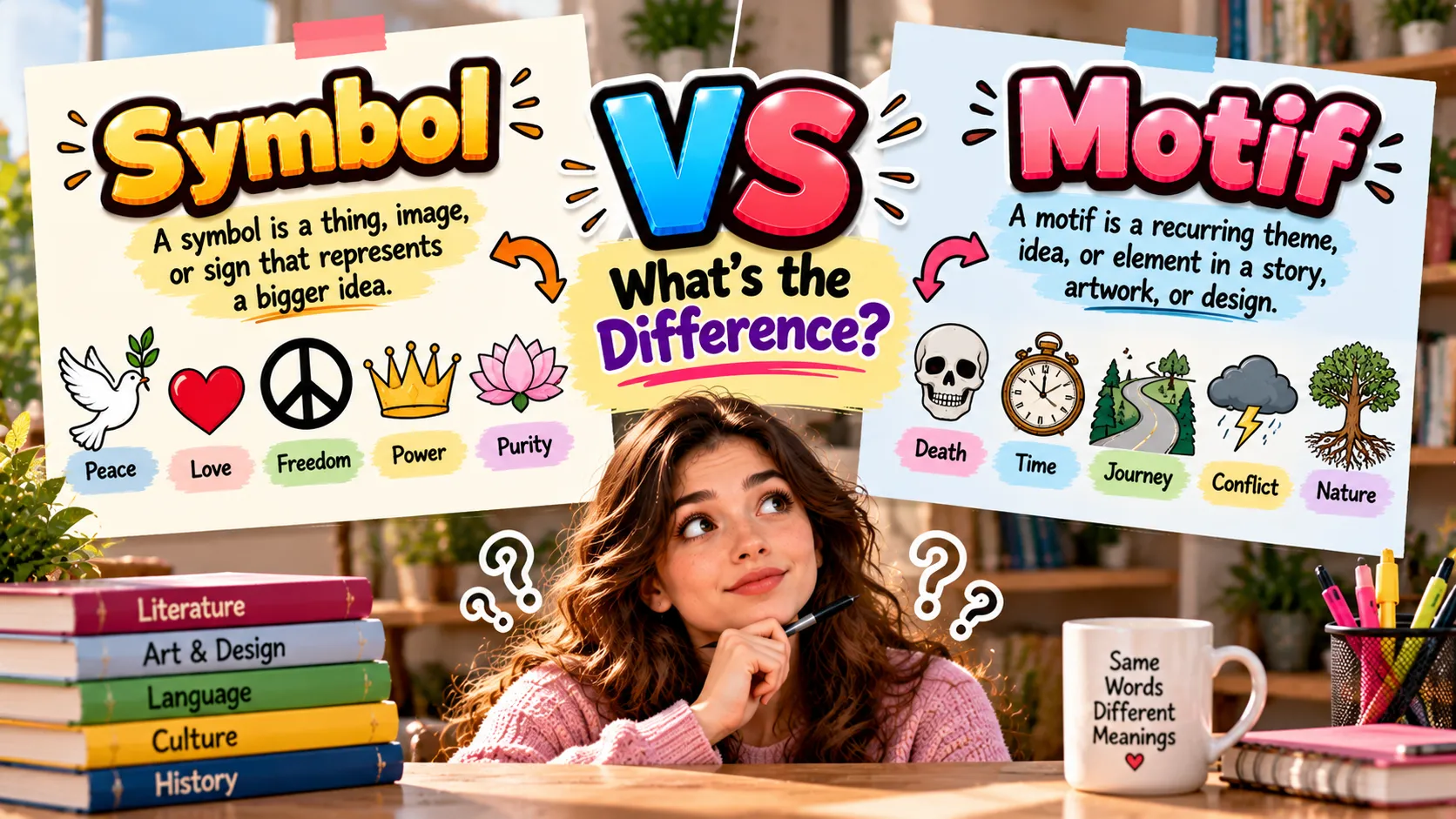
A symbol is a single object or image that represents something beyond its literal meaning. A motif is a recurring element—an image, phrase, or concept—that appears repeatedly to reinforce a theme. The confusion arises because a motif often includes symbols, and both devices operate on multiple levels of meaning. This guide breaks down the difference, explores their origins and uses, and helps you identify each with confidence.
Quick Answer
A symbol is a single object or image that stands for something deeper, appearing once or a few times. A motif is a recurring element—an image, phrase, or concept—that repeats throughout a work to reinforce its central theme. A motif can include symbols, but the key difference is repetition: symbols appear occasionally; motifs appear consistently .
Meaning Overview Table
| Aspect | Meaning |
|---|---|
| Definition | Symbol: a single object representing a deeper meaning. Motif: a recurring element reinforcing a theme |
| Pronunciation | Symbol: /ˈsɪmbəl/; Motif: /moʊˈtiːf/ |
| Part of Speech | Both are nouns |
| Usage | “The green light is a symbol of hope” vs. “Light and darkness form a motif throughout the novel” |
| Context | Literary analysis, film studies, art history, cultural criticism |
Main Meaning
Definition
A symbol is an object, image, or action that represents something beyond its literal meaning. A dove symbolizes peace. A rose symbolizes love. Symbols often appear once or a few times in a work, and their meaning requires interpretation .
A motif is a recurring element—an image, phrase, concept, or action—that appears repeatedly throughout a work to reinforce its theme. The repetition is the defining characteristic. Motifs can be visual (recurring colors), verbal (repeated phrases), or conceptual (recurring ideas) .
Origin
The word “symbol” comes from the Greek symbolon, meaning a token or sign. It entered English in the 15th century and has long described things that represent other things.
“Motif” derives from the French motif, meaning “motive” or “reason,” which itself comes from the Latin motivus (“moving”). The term entered English in the 19th century, originally describing a recurring melodic phrase in music. Literary critics later adopted it to describe recurring elements in texts .
Context
The distinction matters across several fields:
- Literary Analysis: Students identify symbols and motifs to interpret themes and deepen their reading
- Film Studies: Directors use visual and musical motifs to create mood and reinforce ideas
- Art History: Symbols and recurring motifs appear in painting, sculpture, and architecture
- Music: A motif is a short melodic passage that recurs throughout a composition
Modern Usage
Today, both terms appear frequently in academic writing, book reviews, film criticism, and cultural commentary. “Symbol” remains the broader, more familiar term. “Motif” carries a more technical tone, often used by critics and scholars. The distinction helps readers and viewers articulate how meaning is constructed through repetition and association.
Detailed Explanation
Literal Meaning
Literally, a symbol is a mark or object that stands for something else. A stop sign symbolizes “stop.” A motif is a recurring pattern or theme. In music, a motif is a short melodic idea that repeats. In literature, it is a recurring image or phrase.
Common Meaning
Commonly, people use “symbol” to describe anything with deeper meaning. A wedding ring symbolizes commitment. A cross symbolizes faith. People use “motif” less often in everyday speech, usually in discussions of art, literature, or design. A floral motif in wallpaper, for example, is a recurring flower pattern.
Literary Meaning
In literature, symbols and motifs work together. The green light in The Great Gatsby is a symbol of Gatsby’s elusive dream. It appears a few times and carries intense meaning. The recurring image of eyes—on the billboard, in descriptions of characters—forms a motif about observation and judgment. A motif can include symbols, but the repetition is what makes it a motif .
Film Meaning
In film, motifs often appear visually. The recurring image of oranges in The Godfather signals impending death. The color red in The Sixth Sense represents the supernatural. These visual motifs repeat throughout the film to create meaning. A single red object might be a symbol; the pattern of red objects across scenes creates a motif .
Musical Meaning
In music, a motif is a short melodic or rhythmic idea that recurs. Beethoven’s famous four-note motif in his Fifth Symphony repeats throughout the first movement. Film scores use motifs to represent characters or ideas—the “Imperial March” signals Darth Vader’s presence. This musical usage predates the literary adoption of the term .
Examples Table
| Example | Meaning |
|---|---|
| The green light in The Great Gatsby | A symbol of Gatsby’s dream and the American Dream |
| Oranges in The Godfather | A visual motif foreshadowing death |
| The conch shell in Lord of the Flies | A symbol of order and civilization |
| Blood in Macbeth | A motif representing guilt and violence |
| The mockingbird in To Kill a Mockingbird | A symbol of innocence |
| Light and darkness in Macbeth | A motif representing good and evil |
| The red door in The Sixth Sense | A symbol of death and the supernatural |
| Recurring birds | A motif suggesting predator and prey |
| The American flag | A symbol of freedom and patriotism |
| Travel in Pride and Prejudice | A motif supporting the theme of growth and change |
Related Meanings Table
| Related Term | Meaning |
|---|---|
| Theme | The central idea or message of a work |
| Metaphor | A comparison between two unlike things |
| Allegory | A story with a hidden symbolic meaning |
| Imagery | Descriptive language that appeals to the senses |
| Leitmotif | A recurring musical or literary theme associated with a character or idea |
| Symbolism | The use of symbols to express ideas |
| Repetition | The act of repeating elements for emphasis |
| Pattern | A recurring arrangement or sequence |
| Trope | A common or recurring literary device or theme |
| Archetype | A universal symbol or character type |
| Figurative language | Language that is not literal |
| Subtext | Underlying meaning beneath the surface |
| Foreshadowing | Hints about future events |
| Allusion | A reference to another work or event |
| Ambiguity | Openness to multiple interpretations |
Common Uses
People discuss symbols and motifs across numerous contexts:
Literary Analysis: Students and scholars identify symbols and motifs to interpret texts. An essay might analyze the motif of weather in a novel or the symbolic meaning of a character’s name.
Film Criticism: Reviewers discuss visual motifs, recurring colors, and symbolic objects to explain a director’s style and thematic concerns. The recurring motif of water in a film might suggest purification or danger.
Art History: Art historians trace motifs across periods and cultures. The motif of the Madonna and Child appears in religious art for centuries. Symbolism in paintings—a skull for mortality, a lily for purity—requires decoding.
Musicology: Music scholars analyze motifs in compositions. A recurring motif might represent a character in an opera or a concept in a symphony.
Everyday Design: Interior designers use motifs in wallpaper, fabric, and decoration. A floral motif repeats flowers across a surface. This usage extends the literary meaning into visual design.
Common Mistakes
| Mistake | Correction |
|---|---|
| Calling a recurring element a “symbol” | If it repeats throughout a work, it is likely a motif |
| Calling a single object a “motif” | A motif must recur; a single object is a symbol |
| Assuming symbols and motifs are interchangeable | They differ in repetition and function |
| Confusing motif with theme | A theme is an abstract idea; a motif is a concrete recurring element |
| Ignoring the role of repetition | Repetition is the defining feature of a motif |
| Assuming a symbol must be obvious | Symbols can be subtle and require interpretation |
| Forgetting that a motif can contain symbols | A recurring symbol becomes a motif |
| Treating musical motifs as unrelated | The term originates in music and carries similar meaning |
| Overlooking visual motifs in film | Colors, objects, and compositions can all be motifs |
| Using “motif” to sound academic without understanding it | Learn the distinction before using the term |
Related Questions
What is the difference between a symbol and a motif?
A symbol is a single object or image representing something deeper. A motif is a recurring element that reinforces a theme through repetition. A motif can include symbols, but repetition distinguishes it from a symbol .
Can a symbol become a motif?
Yes. If a symbol recurs throughout a work, it becomes a motif. The green light in The Great Gatsby is both a symbol and part of the light/darkness motif .
Is a motif always a symbol?
No. A motif can be a recurring phrase, action, or concept that does not function as a symbol. The recurring phrase “I have a bad feeling about this” in Star Wars is a dialogue motif, not a symbol .
How do I identify a motif in a text?
Look for repeated elements: objects, phrases, colors, actions, or concepts that appear multiple times. Ask what theme the repetition reinforces. If an element recurs and contributes to meaning, it is likely a motif .
What is a leitmotif?
A leitmotif is a specific type of motif, usually a recurring musical phrase associated with a character, place, or idea. The term is common in opera and film music. In literary analysis, it can describe a recurring theme tied to a specific element.
Can a motif be a color?
Yes. Color motifs are common in film and literature. The recurring use of red in a film might represent danger, passion, or death. The repetition of the color creates the motif .
FAQs
What does symbol mean?
A symbol is an object, image, or action that represents something beyond its literal meaning. A dove symbolizes peace; a rose symbolizes love.
What does motif mean?
A motif is a recurring element—an image, phrase, concept, or action—that appears throughout a work to reinforce its theme. Repetition is the key feature .
Is a motif the same as a theme?
No. A theme is the central idea or message of a work. A motif is a concrete element that recurs to support or illuminate that theme .
How many times must a motif appear?
There is no fixed number. A motif must recur enough times for the audience to notice the pattern. Two or three appearances might suffice in a short work; longer works may require more .
Can a symbol appear more than once?
Yes, a symbol can appear multiple times. But when it recurs consistently to reinforce a theme, it becomes a motif as well .
What is a visual motif?
A visual motif is a recurring image, color, object, or composition in a film or artwork. The recurring image of oranges in The Godfather is a visual motif .
Are motifs only found in literature?
No. Motifs appear in film, music, visual art, architecture, and design. The term originated in music and expanded to describe recurring patterns in any creative work .
Why do writers use motifs?
Writers use motifs to reinforce themes, create mood, and add depth to their work. Motifs guide the audience toward the central ideas without stating them directly .
Conclusion
The symbol vs motif distinction comes down to repetition and function. A symbol is a single object or image that carries deeper meaning—a dove for peace, a light for hope. A motif is a recurring element that reinforces a theme through repetition—recurring blood in Macbeth, recurring oranges in The Godfather. A motif can include symbols, but the pattern of recurrence is what defines it. Understanding this difference deepens your reading of literature, film, and art. Whether you are writing an essay, analyzing a film, or simply appreciating a story, recognizing symbols and motifs helps you see how meaning is built. Pay attention to what repeats, and you will find the themes hidden beneath the surface.

Natalie Brooks is a content researcher and writer with a strong interest in word meanings, dream interpretations, symbolism, and cultural insights. She is passionate about creating clear, informative, and easy-to-understand content that helps readers discover the deeper meanings behind words, names, dreams, and symbols. Through her work at Meanzly, Natalie aims to make knowledge accessible and valuable for readers around the world.