The words “peaked” and “piqued” sound identical, differ by just a few letters, and appear in similar contexts. Yet they carry completely different meanings. The peaked vs piqued confusion ranks among the most common homophone errors in English writing, appearing in everything from news reports to social media captions.
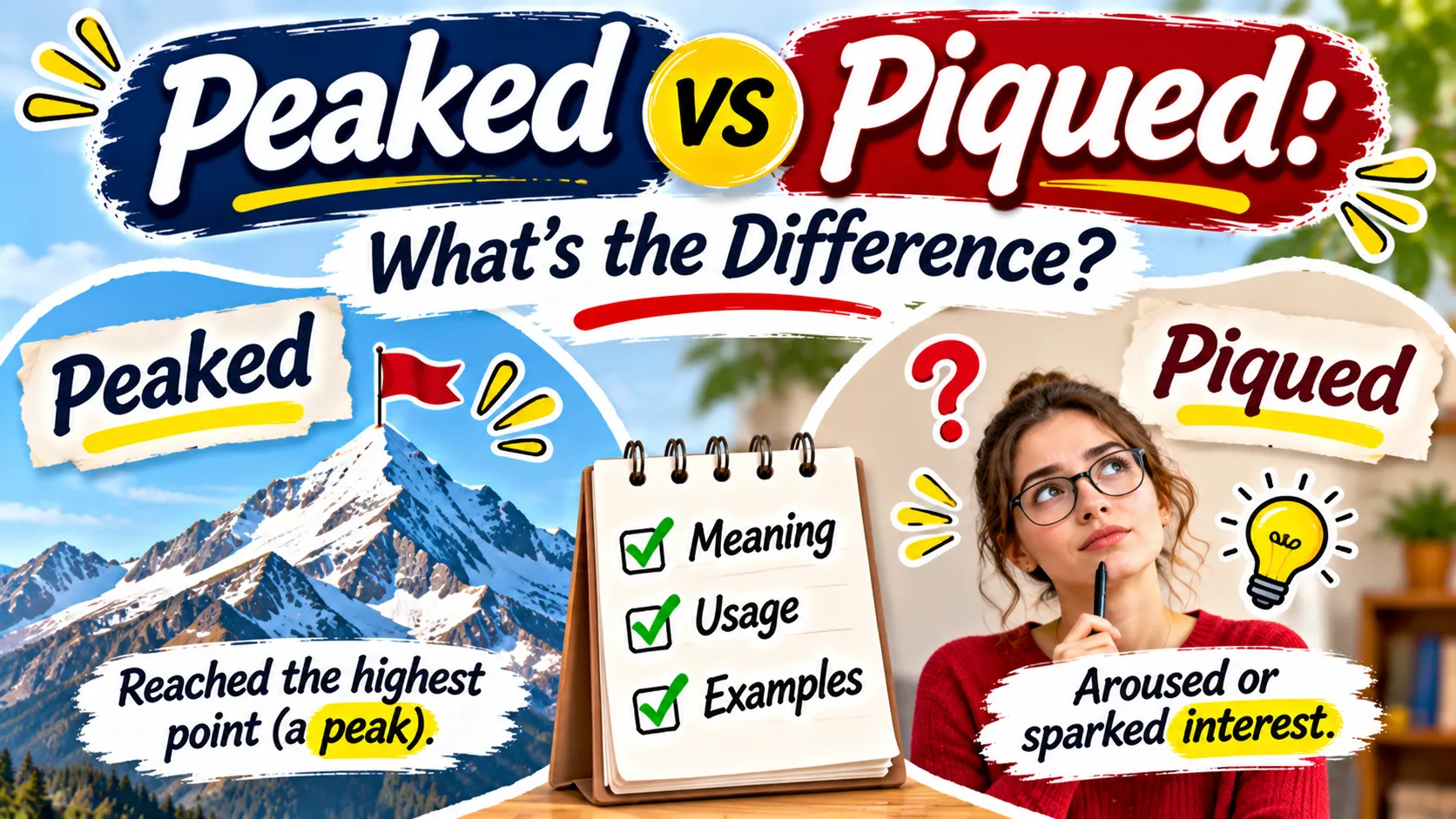
“Peaked” is the past tense of “peak,” meaning to reach the highest point or to look pale and sickly. “Piqued” is the past tense of “pique,” meaning to excite or arouse interest, or to cause irritation. The phrase “piqued my interest” is correct; “peaked my interest” is a common misspelling . This comprehensive guide explains the difference, explores their origins, provides practical examples, and helps you choose the correct word every time you write.
Quick Answer
“Peaked” means reached the highest point, as in “the stock peaked in 2020,” or looked pale and sickly, as in “he looked peaked.” “Piqued” means excited or aroused interest, as in “the movie piqued my curiosity,” or caused irritation. Remember: peak is a mountain top; pique is a prick of curiosity. The correct phrase is “piqued my interest,” never “peaked my interest.”
Meaning Overview Table
| Aspect | Meaning |
|---|---|
| Definition | Peaked: reached the highest point; looked pale. Piqued: excited interest or caused irritation |
| Pronunciation | Both: /piːkt/ |
| Part of Speech | Both are past tense verbs; peaked is also an adjective |
| Usage | “The show peaked in season three” vs. “The trailer piqued my interest” |
| Context | Peaked: graphs, careers, health descriptions. Piqued: curiosity, interest, mild irritation |
Main Meaning
Definition
Peaked is the past tense of “peak,” meaning to reach the highest point of activity, development, or popularity . As an adjective, “peaked” can also describe someone who looks pale, sickly, or exhausted . Piqued is the past tense of “pique,” meaning to excite or arouse interest, curiosity, or attention . It can also mean to cause mild irritation or resentment .
Origin
“Peak” comes from the noun meaning the pointed top of a mountain, likely from the Old English pīc. The verb sense of reaching a maximum developed later. The adjective “peaked” meaning pale comes from a different root, possibly related to “peak” meaning a pointed feature, suggesting a sharp, drawn face .
“Pique” comes from the French verb piquer, meaning “to prick” or “to sting” . The word entered English with the sense of irritation or resentment, and later developed the meaning of exciting curiosity—as if pricking someone’s attention awake.
Context
The distinction matters across several contexts:
- Business and Finance: “Peaked” describes reaching maximum value or performance
- Health Descriptions: “Peaked” describes looking pale or unwell
- Marketing and Media: “Piqued” describes arousing curiosity or interest
- Social Interaction: “Piqued” describes causing mild irritation or offense
- Everyday Writing: Confusing the two creates embarrassing errors in emails, essays, and social media posts
Modern Usage
Today, “peaked” appears frequently in business writing, sports commentary, and health descriptions. “Piqued” appears in discussions of curiosity, interest, and mild annoyance. The confusion between the two persists because they sound identical and spell-check often fails to catch the error.
Detailed Explanation
Literal Meaning
Literally, “peaked” means reached a peak or point. “Piqued” literally means pricked or stung, from the French root. These literal meanings explain the modern definitions.
Common Meaning
Commonly, people use “peaked” to describe something that reached its highest level. “The popularity peaked in the 1990s. The mystery piqued my interest.”
Business Meaning
In business, “peaked” describes sales, stock prices, or performance reaching a maximum before declining. “The company’s revenue peaked in Q3.” The word suggests a high point followed by a downturn.
Health Meaning
As an adjective, “peaked” describes someone who looks pale, tired, or unwell. “You look peaked—are you feeling okay?” This usage appears frequently in medical and everyday contexts .
Curiosity Meaning
“Piqued” most commonly appears in the phrase “piqued my interest” or “piqued my curiosity.” It means something caught your attention and made you want to know more . The word suggests a sharp, sudden arousal of interest.
Irritation Meaning
“Piqued” can also mean mildly irritated or annoyed. This usage is less common but appears in formal and literary contexts .
Examples Table
| Example | Meaning |
|---|---|
| The stock peaked at $150 before falling. | Reached the highest point |
| The movie trailer piqued my curiosity. | Aroused interest |
| He looked peaked after the long flight. | Appeared pale or unwell |
| Her interest was piqued by the strange letter. | Excited or aroused |
| The band’s popularity peaked in the 1980s. | Reached maximum popularity |
| She was piqued by the criticism. | Mildly irritated |
| Sales peaked during the holiday season. | Reached the highest level |
| The mystery piqued his interest. | Caught his attention |
| You look a bit peaked today. | Pale or sickly appearance |
| The headline piqued her attention. | Aroused her interest |
Related Meanings Table
| Related Term | Meaning |
|---|---|
| Peak | The highest point; to reach a maximum |
| Pique | To excite interest or cause irritation |
| Peek | To look quickly (another homophone) |
| Piqued interest | Aroused curiosity or attention |
| Peaked cap | A cap with a pointed front |
| Peak performance | Maximum performance level |
| Fit of pique | A sudden feeling of irritation |
| Peaky | Looking unwell (British English) |
| Peakedness | The state of being pale or pointed |
| Pique oneself | To take pride in something |
| Peak season | The busiest or most popular period |
| Piqued curiosity | Aroused curiosity |
| Peak hours | The busiest hours |
| Pique of interest | A sudden arousal of interest |
| Peaked lapels | Lapels with a pointed shape |
Common Uses
People use “peaked” and “piqued” across numerous contexts:
Business and Finance: Analysts use “peaked” to describe market highs, sales maximums, and performance plateaus. “Housing prices peaked in 2022.”
Health and Medicine: Doctors and friends use “peaked” to describe someone who looks pale or unwell. “The patient looked peaked after surgery.”
Marketing and Media: Marketers use “piqued” to describe content that captures attention. “The teaser campaign piqued consumer interest.”
Social and Personal Writing: People use “piqued” to describe curiosity or mild annoyance. “Her odd behavior piqued my curiosity.”
Everyday Speech: The phrase “piqued my interest” appears constantly in conversation, often misspelled as “peaked my interest.”
Common Mistakes
| Mistake | Correction |
|---|---|
| Writing “peaked my interest” | Write “piqued my interest” (aroused interest) |
| Writing “piqued the mountain” | Write “peaked the mountain” (reached the top) |
| Writing “the stock piqued” | Write “the stock peaked” (reached maximum) |
| Writing “he looked piqued” | Write “he looked peaked” (pale or unwell) |
| Writing “piqued performance” | Write “peak performance” (maximum level) |
| Writing “a fit of peak” | Write “a fit of pique” (irritation) |
| Writing “peeked my interest” | Write “piqued my interest” (peek means look) |
| Writing “the show piqued in season 3” | Write “the show peaked in season 3” (reached maximum) |
| Assuming spell-check will catch the error | Spell-check often misses homophones; proofread manually |
| Writing “sneak peak” | Write “sneak peek” (a quick look) |
Related Questions
Is it “peaked” or “piqued”?
It depends on meaning. Use “peaked” for reaching a maximum or looking pale. Use “piqued” for arousing interest or causing irritation.
What does “piqued my interest” mean?
“Piqued my interest” means aroused my curiosity or attention. Something caught your interest and made you want to know more .
Why do people say “peaked my interest”?
People say “peaked my interest” because “peak” and “pique” sound identical. It is a common misspelling of “piqued my interest” .
What does “peaked” mean?
“Peaked” means reached the highest point, as in a graph or career, or as an adjective, looking pale and unwell .
What does “piqued” mean?
“Piqued” means aroused interest or curiosity, or caused mild irritation .
Is “peaked” related to “peak”?
Yes. “Peaked” is the past tense of “peak,” meaning to reach a maximum or high point.
How can I remember the difference?
Remember: “pique” has a “q” like “curiosity” — pique means to arouse curiosity. “Peak” has an “a” like “maximum” — peak means the highest point .
FAQs
What does “peaked my interest” mean?
“Peaked my interest” is a misspelling. The correct phrase is “piqued my interest,” meaning aroused my curiosity or attention.
Is it “peaked my curiosity” or “piqued my curiosity”?
The correct phrase is “piqued my curiosity.” Pique means to excite or arouse .
What is the difference between “peaked” and “piqued” in a sentence?
“Peaked” relates to reaching a maximum or looking pale. “Piqued” relates to arousing interest or causing irritation.
Can “peaked” mean looking sick?
Yes. As an adjective, “peaked” can mean pale, sickly, or exhausted .
What does “a fit of pique” mean?
“A fit of pique” means a sudden feeling of irritation or resentment, often due to wounded pride .
Why do people confuse “peaked” and “piqued”?
They sound identical and differ by only a few letters. Spell-check often misses homophones, so the error persists.
Is “peaked” ever correct in the phrase “peaked my interest”?
No. “Peaked my interest” is always incorrect. The correct phrase is “piqued my interest.”
What does “peak performance” mean?
“Peak performance” means maximum performance or the highest level of functioning. It uses “peak” meaning the highest point.
Conclusion
Mastering the peaked vs piqued distinction protects your writing from embarrassing homophone errors. “Peaked” means reached the highest point or looked pale and sickly. “Piqued” means aroused interest or caused mild irritation. Remember the simple rule: peak is a mountain top; pique is a prick of curiosity. Whether you’re writing a business report, a health update, or a social media post, choosing the correct word ensures your meaning is clear. Practice using “peaked” for maximums and pale appearances, and “piqued” for curiosity and irritation, and your readers will understand exactly what you intend. Small distinctions like this separate careful writers from careless ones.

Natalie Brooks is a content researcher and writer with a strong interest in word meanings, dream interpretations, symbolism, and cultural insights. She is passionate about creating clear, informative, and easy-to-understand content that helps readers discover the deeper meanings behind words, names, dreams, and symbols. Through her work at Meanzly, Natalie aims to make knowledge accessible and valuable for readers around the world.