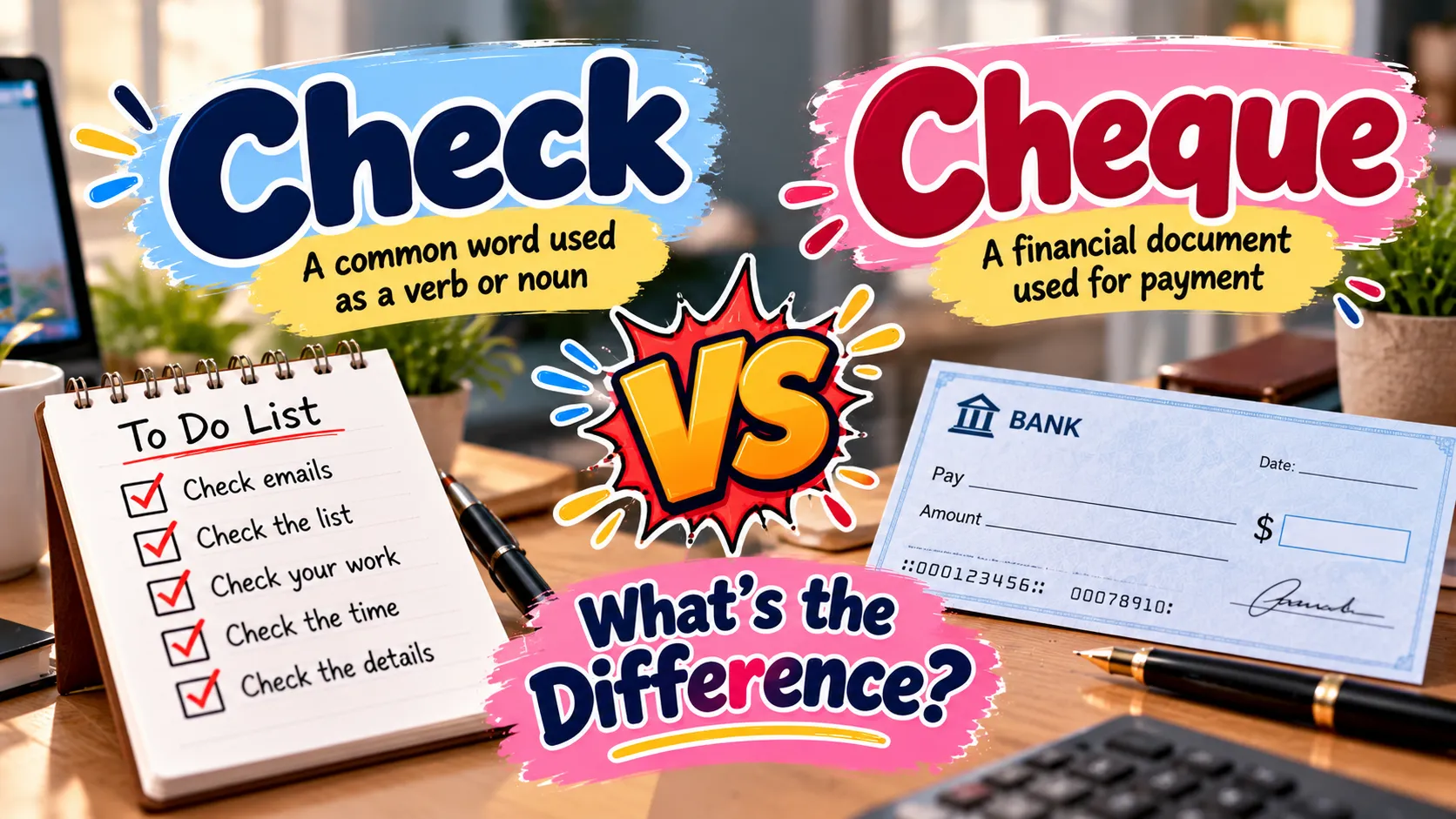
The words “check” and “cheque” sound identical, yet their usage depends entirely on where you live and what you mean. The check vs cheque distinction confuses writers worldwide, especially those who move between American and British English conventions or handle international banking.
“Check” is the standard American spelling for the written payment order, the verb meaning to verify, and dozens of other meanings. “Cheque” is the British and Commonwealth spelling used exclusively for the payment document . Both words are correct, but choosing the wrong one can make your writing look inconsistent or even confusing. This comprehensive guide explains the difference, explores their origins, provides practical examples, and helps you choose the right spelling for every situation.
Quick Answer
Use “check” in American English for all meanings: verifying something, a payment document, a restaurant bill, a pattern, and more. Use “cheque” in British and Commonwealth English only for the payment document. American English never uses “cheque,” while British English uses “check” for every meaning except the bank payment slip.
Meaning Overview Table
| Aspect | Meaning |
|---|---|
| Definition | Check: American spelling for verification, payment orders, and many other meanings. Cheque: British spelling for a written payment order only |
| Pronunciation | Both: /tʃɛk/ |
| Part of Speech | Check: noun and verb. Cheque: noun only |
| Usage | “I’ll write a check” (US) vs. “I’ll write a cheque” (UK) |
| Context | Banking, finance, everyday verification, restaurants, patterns |
Main Meaning
Definition
Check functions as both a noun and a verb with numerous meanings. As a verb, it means to examine, verify, or stop something. As a noun, it refers to an inspection, a payment order, a restaurant bill, a pattern of squares, a mark indicating correctness, and more. In American English, “check” covers every one of these meanings.
Cheque functions only as a noun referring to a written order directing a bank to pay a specified sum from the writer’s account. British and Commonwealth English use “cheque” exclusively for this banking document and “check” for all other meanings .
Origin
Both words share the same origin: the Old French eschec, meaning “check” in chess, which came from Persian shāh (“king”). The chess sense referred to putting the king in a position of danger . Over centuries, the word developed multiple meanings, including “to verify” and “to stop.”
The banking sense emerged in the 18th century when written payment orders began circulating. British English adopted the French-influenced spelling “cheque” to distinguish the financial document from other meanings of “check.” American English retained “check” for all uses .
Context
The spelling choice depends on region and meaning:
- American English: Always “check” for every meaning
- British English: “Cheque” for the payment document; “check” for everything else
- Canadian English: “Cheque” for the payment document; “check” for other meanings
- Australian English: “Cheque” for the payment document
- Banking Documents: Spelling follows the country’s conventions
Modern Usage
Today, “check” dominates in the United States across all contexts. “Cheque” remains standard in the UK, Canada, Australia, and other Commonwealth countries for banking documents. The rise of digital banking has reduced the use of physical cheques, but the spelling distinction persists in legal documents, banking forms, and financial writing. Interestingly, even British banks now sometimes accept “check” in casual contexts, though “cheque” remains the formal standard .
Detailed Explanation
Literal Meaning
Literally, “check” means to examine or verify something, or a written order to pay money. “Cheque” literally means the same payment document, but only in British and Commonwealth spelling.
Common Meaning
Commonly, Americans use “check” for everything: “Check the answers,” “Write a check,” “Check your coat,” “The check please.” British speakers use “check” for verification and “cheque” for the payment document: “Check the answers,” “Write a cheque,” “Check your coat,” “The bill please.”
Banking Meaning
In banking, the distinction matters most. American banks issue “checks.” British banks issue “cheques.” Canadian banks issue “cheques.” Australian banks issue “cheques.” A traveler writing a “check” in London might confuse a British teller, while a British visitor writing a “cheque” in New York might encounter the same confusion .
Verification Meaning
Both varieties use “check” for verification. “Check your email,” “Check the spelling,” and “Double-check the figures” appear in all English varieties. “Cheque” never carries this meaning.
Restaurant Meaning
In American English, the restaurant bill is “the check.” In British English, it is “the bill.” “Cheque” does not appear in restaurant contexts in British English, though the payment document itself would be a “cheque.”
Examples Table
| Example | Meaning |
|---|---|
| I’ll write a check for the rent. | American spelling for a payment document |
| I’ll write a cheque for the rent. | British spelling for a payment document |
| Please check your answers before submitting. | Verification (both varieties) |
| The restaurant check came to $50. | American term for the bill |
| He paid by cheque. | British payment method |
| Check the spelling of that word. | Verification (both varieties) |
| She cashed the check at the bank. | American payment document |
| The cheque cleared within three days. | British payment document |
| Check your coat at the door. | To leave an item for safekeeping (both varieties) |
| The company issued a cheque for the refund. | British/Commonwealth payment document |
Related Meanings Table
| Related Term | Meaning |
|---|---|
| Check | American spelling for all meanings |
| Cheque | British spelling for payment documents only |
| Checkbook | American term for a book of payment slips |
| Chequebook | British term for a book of payment slips |
| Checking account | American term for a bank account |
| Chequing account | Canadian term for a bank account |
| Checkout | The payment counter in a store |
| Check-in | Registration at a hotel or airport |
| Checklist | A list for verification |
| Checkmate | A winning chess move |
| Checkered | A pattern of squares |
| Rain check | A deferred invitation or offer |
| Blank check | A signed payment document with no amount filled in |
| Bounced check | A payment document rejected for insufficient funds |
| Cashier’s check | A payment document issued by a bank |
Common Uses
People use “check” and “cheque” across numerous contexts:
Banking and Finance: Americans write checks and open checking accounts. British and Commonwealth customers write cheques and use chequebooks. Banking forms follow regional spelling conventions.
Everyday Verification: All English varieties use “check” for verifying information. “Check the weather,” “Check your bag,” and “Check the time” appear everywhere.
Restaurants and Retail: Americans ask for “the check.” British speakers ask for “the bill.” The payment document itself is a “cheque” in British English.
Travel and Hospitality: “Check in,” “check out,” and “coat check” appear in all varieties. The banking document remains regional.
Legal and Financial Documents: Contracts and banking regulations follow the country’s spelling conventions. American legal documents say “check,” while British and Commonwealth documents say “cheque.”
Common Mistakes
| Mistake | Correction |
|---|---|
| Writing “cheque” in American English | Use “check” for all meanings in American English |
| Writing “check” for the payment document in British formal writing | Use “cheque” for the payment document in British English |
| Using “cheque” for verification | “Cheque” only means the payment document; use “check” for verification |
| Writing “chequebook” in American English | Use “checkbook” in American English |
| Writing “checkbook” in British formal writing | Use “chequebook” for the payment document book in British English |
| Assuming “cheque” is the only British spelling | British English uses “check” for everything except the payment document |
| Mixing spellings within one document | Choose one convention and apply it consistently |
| Writing “cheque” in a Canadian document for verification | Use “check” for verification in Canadian English |
| Spelling “checking account” as “chequing account” in the US | Use “checking account” in American English |
| Forgetting that “cheque” is a noun only | “Cheque” cannot function as a verb |
Related Questions
Is it check or cheque?
It depends on region and meaning. Use “check” in American English for all meanings. Use “cheque” in British and Commonwealth English only for the payment document .
Is “cheque” British?
Yes. “Cheque” is the standard British, Canadian, Australian, and Commonwealth spelling for a written payment order .
What is the difference between check and cheque?
“Check” has many meanings and is standard in American English. “Cheque” refers only to the payment document and is standard in British and Commonwealth English .
Can I use “check” for a payment document in the UK?
Informally, yes, but formal British writing uses “cheque” for payment documents. British banks and legal documents still use “cheque.”
Is “cheque” a real word?
Yes. “Cheque” is the standard British and Commonwealth spelling for a written payment order.
Why do Americans say “check” and British say “cheque”?
American English retained the original “check” spelling for all meanings. British English adopted the French-influenced “cheque” to distinguish the financial document from other meanings .
FAQs
What does “check” mean?
“Check” has many meanings: to verify, a payment document, a restaurant bill, a pattern, a mark indicating correctness, and more. American English uses “check” for all these meanings .
What does “cheque” mean?
“Cheque” refers only to a written order directing a bank to pay a specified sum. It is the standard spelling in British and Commonwealth English.
Is “cheque” used in America?
No. American English uses “check” for all meanings, including the payment document. “Cheque” is considered a British spelling in the United States .
Is “check” used in Britain?
Yes, but only for meanings other than the payment document. British English uses “check” for verification, patterns, and other meanings, but “cheque” for the banking document.
How do you spell “checkbook” in British English?
The British spelling is “chequebook.” American English uses “checkbook.”
What is a “chequing account”?
A “chequing account” is the Canadian term for a bank account used for daily transactions. American English calls it a “checking account.”
Why does British English use “cheque”?
British English adopted the French-influenced spelling “cheque” in the 18th century to distinguish the financial document from other meanings of “check.”
Can I write “check” on a British cheque?
No. Formal British banking documents use “cheque.” Writing “check” on a formal document may cause confusion.
Conclusion
The check vs cheque distinction is simpler than it appears: both words are correct, but the choice depends on region and meaning. American English uses “check” for everything—payment documents, verification, restaurant bills, and patterns. British and Commonwealth English uses “cheque” only for the payment document and “check” for everything else. Remember the simple rule: “check” for America and all non-banking meanings; “cheque” for British banking documents. Whether you’re writing a business email, filling out a bank form, or drafting a legal document, choosing the correct spelling demonstrates attention to detail and respect for your audience’s conventions. Write with confidence, and your readers will appreciate the precision.

Natalie Brooks is a content researcher and writer with a strong interest in word meanings, dream interpretations, symbolism, and cultural insights. She is passionate about creating clear, informative, and easy-to-understand content that helps readers discover the deeper meanings behind words, names, dreams, and symbols. Through her work at Meanzly, Natalie aims to make knowledge accessible and valuable for readers around the world.