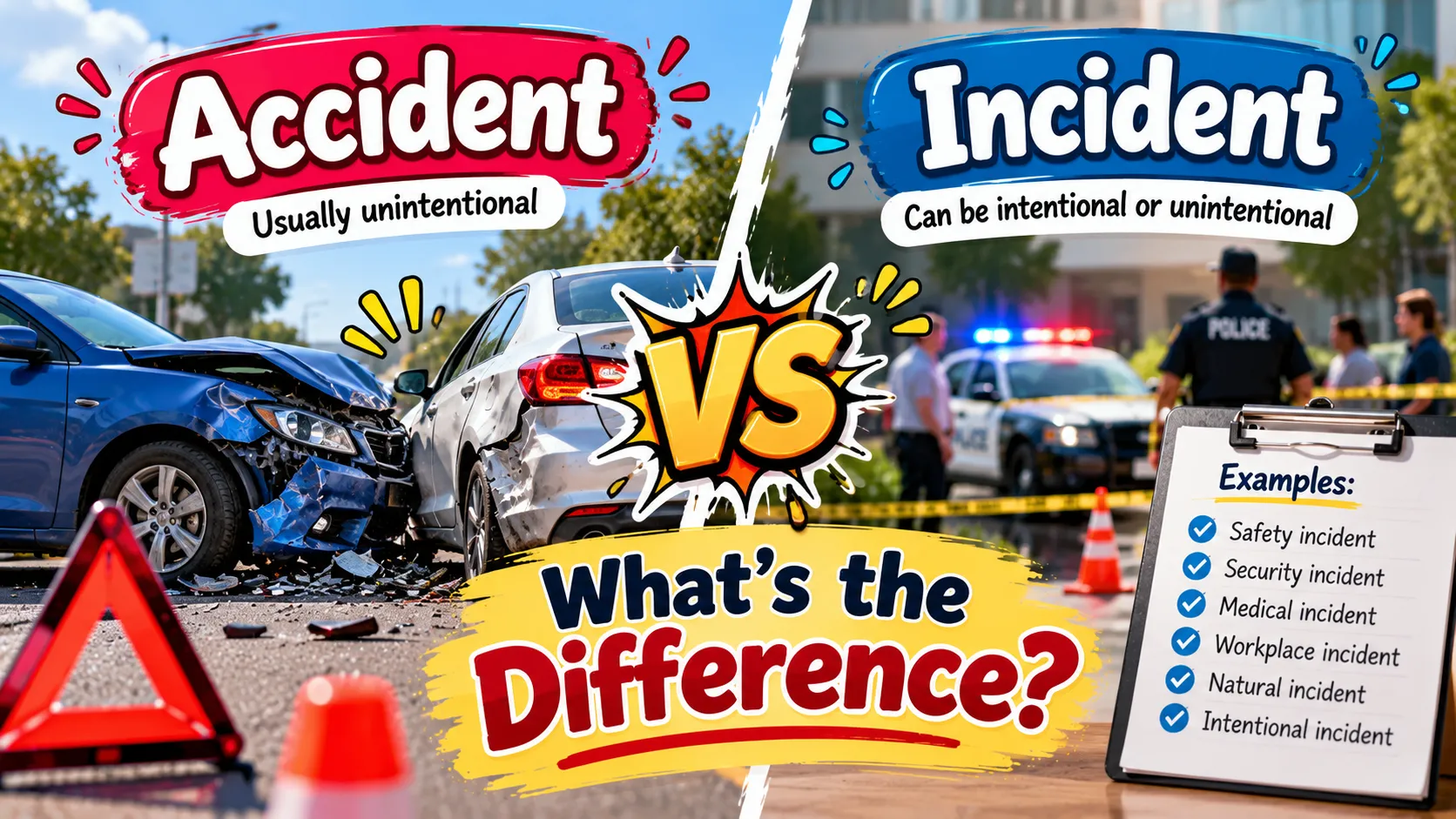
The words “accident” and “incident” appear frequently in news reports, workplace safety manuals, and legal documents, yet many people use them as if they mean the same thing. The accident vs incident distinction matters enormously in insurance claims, safety reporting, and legal proceedings, where precision can determine liability and compensation.
An accident is an unintentional event that causes damage or injury, often resulting from chance or carelessness. An incident is any event or occurrence, whether planned or unplanned, harmful or harmless . Every accident is an incident, but not every incident is an accident. This comprehensive guide explains the difference, explores their origins, provides practical examples, and helps you choose the correct word in any context—from workplace safety reports to everyday conversation.
Quick Answer
An accident is an unplanned event that causes harm, injury, or damage, usually unintentional and often avoidable. An incident is any event or occurrence, planned or unplanned, that may or may not cause harm. Every accident counts as an incident, but not every incident counts as an accident. Use “incident” for neutral, factual reporting and “accident” when harm or damage occurs unintentionally.
Meaning Overview Table
| Aspect | Meaning |
|---|---|
| Definition | Accident: an unplanned event causing harm or damage. Incident: any event or occurrence, harmful or not |
| Pronunciation | Accident: /ˈæksɪdənt/; Incident: /ˈɪnsɪdənt/ |
| Part of Speech | Both are nouns |
| Usage | “The car accident injured two people” vs. “The security incident was resolved without harm” |
| Context | Workplace safety, insurance, law enforcement, healthcare, journalism |
Main Meaning
Definition
Accident refers to an unfortunate event that happens unexpectedly and unintentionally, typically resulting in damage, injury, or loss . The word implies lack of intent and often suggests avoidability—someone could have prevented it.
Incident refers to a single event or occurrence, whether planned or unplanned, significant or trivial . In professional contexts, “incident” serves as a neutral term that covers everything from minor disruptions to serious emergencies. It carries no inherent implication of harm or intent.
Origin
“Accident” comes from the Latin accidere, meaning “to fall upon” or “to happen,” combining ad- (“to”) and cadere (“to fall”). The word entered English in the 14th century, originally meaning “an event that happens by chance.” Over time, it narrowed to mean an unfortunate or harmful event.
“Incident” comes from the Latin incidere, meaning “to fall into” or “to happen,” combining in- (“into”) and cadere (“to fall”). It entered English in the 15th century, meaning “something that happens” or “an occurrence.” The word remained neutral, describing events without judgment about harm or intent.
Context
The distinction matters across several contexts:
- Workplace Safety: Safety professionals distinguish between accidents (harm occurred) and incidents (no harm occurred but could have)
- Insurance: Policies cover accidents, but incidents may not trigger claims without damage
- Law Enforcement: Police report incidents (any event) and accidents (unintentional harm)
- Healthcare: Hospitals track incidents (any unexpected event) and accidents (unintentional injury)
- Journalism: Reporters use “incident” for neutral reporting and “accident” when harm is clear
Modern Usage
Today, “accident” appears in everyday speech for any mishap. “Incident” appears more in professional, official, and journalistic contexts. Workplace safety programs increasingly use “incident” as an umbrella term, reserving “accident” for events that cause actual harm. The distinction reflects a shift toward non-judgmental reporting and prevention-focused analysis.
Detailed Explanation
Literal Meaning
Literally, “accident” means an event that “falls upon” someone unexpectedly—a chance occurrence. “Incident” literally means something that “falls into” a situation—an occurrence or event. Both share the Latin root cadere (“to fall”), but their prefixes create different meanings.
Common Meaning
Commonly, people use “accident” to describe mishaps: car accidents, kitchen accidents, and workplace accidents. They use “incident” for events that may or may not involve harm: security incidents, diplomatic incidents, and critical incidents.
Workplace Safety Meaning
In workplace safety, “incident” serves as the umbrella term for any unplanned event. An “accident” is a specific type of incident that results in injury, illness, or damage. A “near miss” is an incident that could have caused harm but did not. Safety professionals track all three to prevent future accidents.
Legal Meaning
In law, “accident” often implies no fault or intent, though legal responsibility may still apply. “Incident” is a broader term covering any event relevant to an investigation or legal proceeding. Insurance policies frequently define these terms precisely to determine coverage.
Healthcare Meaning
In healthcare, an “incident” refers to any unexpected event that affects patient safety, staff, or operations. An “accident” refers specifically to unintentional harm, such as a fall or medication error. Hospitals track incidents to improve safety and quality.
Journalistic Meaning
Journalists use “incident” as a neutral term before facts are confirmed. “An incident occurred at the stadium” avoids speculation. Once harm is clear, they may switch to “accident.” The choice reflects editorial standards and legal caution.
Examples Table
| Example | Meaning |
|---|---|
| The car accident injured three passengers. | An unintentional event causing harm |
| Police investigated a security incident at the airport. | An event, potentially without harm |
| She had an accident in the kitchen and burned her hand. | An unintentional mishap causing injury |
| The company reported a minor incident involving spilled chemicals. | An event, possibly without harm |
| The accident was caused by a slippery floor. | An unintentional event causing damage |
| A diplomatic incident strained relations between the countries. | An event causing political tension |
| He was injured in a workplace accident. | An unintentional event causing injury |
| The incident report documented the equipment malfunction. | A neutral record of an event |
| The accident destroyed the fence and damaged the car. | An unintentional event causing property damage |
| A critical incident team responded to the emergency. | A significant event requiring response |
Related Meanings Table
| Related Term | Meaning |
|---|---|
| Near miss | An incident that could have caused harm but did not |
| Mishap | A minor accident or unlucky event |
| Crash | A violent collision, usually involving vehicles |
| Collision | An accident involving two or more moving objects |
| Emergency | A serious, unexpected situation requiring immediate action |
| Occurrence | Any event, often used in insurance and safety |
| Event | Anything that happens, planned or unplanned |
| Casualty | A person injured or killed in an accident or incident |
| Malfunction | A failure to function properly, often leading to incidents |
| Hazard | A potential source of harm |
| Risk | The possibility of harm or loss |
| Safety | Freedom from danger or harm |
| Liability | Legal responsibility for harm or damage |
| Negligence | Failure to take proper care, often causing accidents |
| Investigation | A formal examination of an incident or accident |
Common Uses
People use “accident” and “incident” across numerous contexts:
Workplace Safety: Safety managers distinguish between accidents, incidents, and near misses to identify trends and prevent future harm. Incident reports document all events, while accident reports focus on harm.
Insurance: Insurance policies use precise definitions to determine coverage. “Accident” typically triggers coverage, while “incident” may require further investigation to establish harm.
Law Enforcement: Police officers respond to incidents (any event requiring attention) and investigate accidents (unintentional harm). Accident reports document collisions and injuries.
Healthcare: Hospitals track patient safety incidents, including medication errors, falls, and equipment failures. Accident reports focus on unintentional harm to patients or staff.
Journalism: Reporters use “incident” for initial, neutral reporting and “accident” when harm is confirmed. The choice reflects legal caution and editorial standards.
Everyday Conversation: People say “I had an accident” to describe mishaps. They rarely use “incident” in casual speech unless referring to a notable event, like a “diplomatic incident.”
Common Mistakes
| Mistake | Correction |
|---|---|
| Using “accident” for events without harm | Use “incident” for neutral events; “accident” implies harm |
| Using “incident” when harm clearly occurred | Use “accident” for unintentional harm |
| Assuming the words are interchangeable | Every accident is an incident, but not every incident is an accident |
| Using “accident” in workplace safety reports for all events | Use “incident” as the umbrella term |
| Using “incident” in insurance claims for harm events | Use “accident” for unintentional harm |
| Believing “accident” always means no fault | Legal fault may still apply; “accident” describes intent, not liability |
| Using “incident” to downplay serious harm | Choose language that accurately reflects severity |
| Confusing “near miss” with “accident” | A near miss is an incident without harm |
| Using “accident” for planned events | Accidents are unintentional by definition |
| Forgetting that “incident” can refer to trivial events | “Incident” covers everything from minor to major events |
Related Questions
What is the difference between accident and incident?
An accident is an unintentional event causing harm or damage. An incident is any event, harmful or not. Every accident is an incident, but not every incident is an accident.
Is a car crash an accident or an incident?
A car crash is both. It is an incident (an event) and an accident (unintentional harm). The choice depends on context: police reports use “accident report,” while safety analysts may use “incident report.”
Can an incident be an accident?
Yes. An accident is a specific type of incident that causes harm. All accidents are incidents, but incidents without harm are not accidents.
What is a near miss?
A near miss is an incident that could have caused harm but did not. Safety professionals track near misses alongside accidents to prevent future harm.
Why do workplaces use “incident” instead of “accident”?
Workplaces use “incident” as a neutral umbrella term covering all unplanned events, including those without harm. This approach encourages reporting and focuses on prevention rather than blame.
Is “accident” always unintentional?
Yes. By definition, an accident is an unintentional event. If intent exists, the event is not an accident.
FAQs
What does “accident” mean?
“Accident” means an unplanned, unintentional event that causes harm, injury, or damage. It implies chance and often suggests avoidability.
What does “incident” mean?
“Incident” means any event or occurrence, whether planned or unplanned, harmful or harmless. It is a neutral term used in official, professional, and journalistic contexts.
Is a slip and fall an accident or an incident?
It is both. It is an incident (an event) and an accident (unintentional harm). Workplace reports may call it an “incident” and note the injury as an accident.
Are all accidents incidents?
Yes. Every accident is an incident because it is an event. But incidents without harm are not accidents.
What is the difference between an incident and a near miss?
A near miss is an incident that did not cause harm but could have. All near misses are incidents, but not all incidents are near misses.
Why is the distinction important in insurance?
Insurance policies often cover accidents but may not cover incidents without harm. Precise language determines whether a claim is valid.
Conclusion
Mastering the accident vs incident distinction improves your writing and decision-making in professional, legal, and everyday contexts. An accident is an unintentional event causing harm. An incident is any event, harmful or not. Remember the simple rule: every accident is an incident, but not every incident is an accident. Whether you’re writing a workplace safety report, filing an insurance claim, or reporting news, choosing the correct word ensures clarity and accuracy. Practice using “incident” as the neutral umbrella term and “accident” for events with harm, and your readers will understand exactly what you mean. Small distinctions like this separate careful communicators from careless ones.

Natalie Brooks is a content researcher and writer with a strong interest in word meanings, dream interpretations, symbolism, and cultural insights. She is passionate about creating clear, informative, and easy-to-understand content that helps readers discover the deeper meanings behind words, names, dreams, and symbols. Through her work at Meanzly, Natalie aims to make knowledge accessible and valuable for readers around the world.