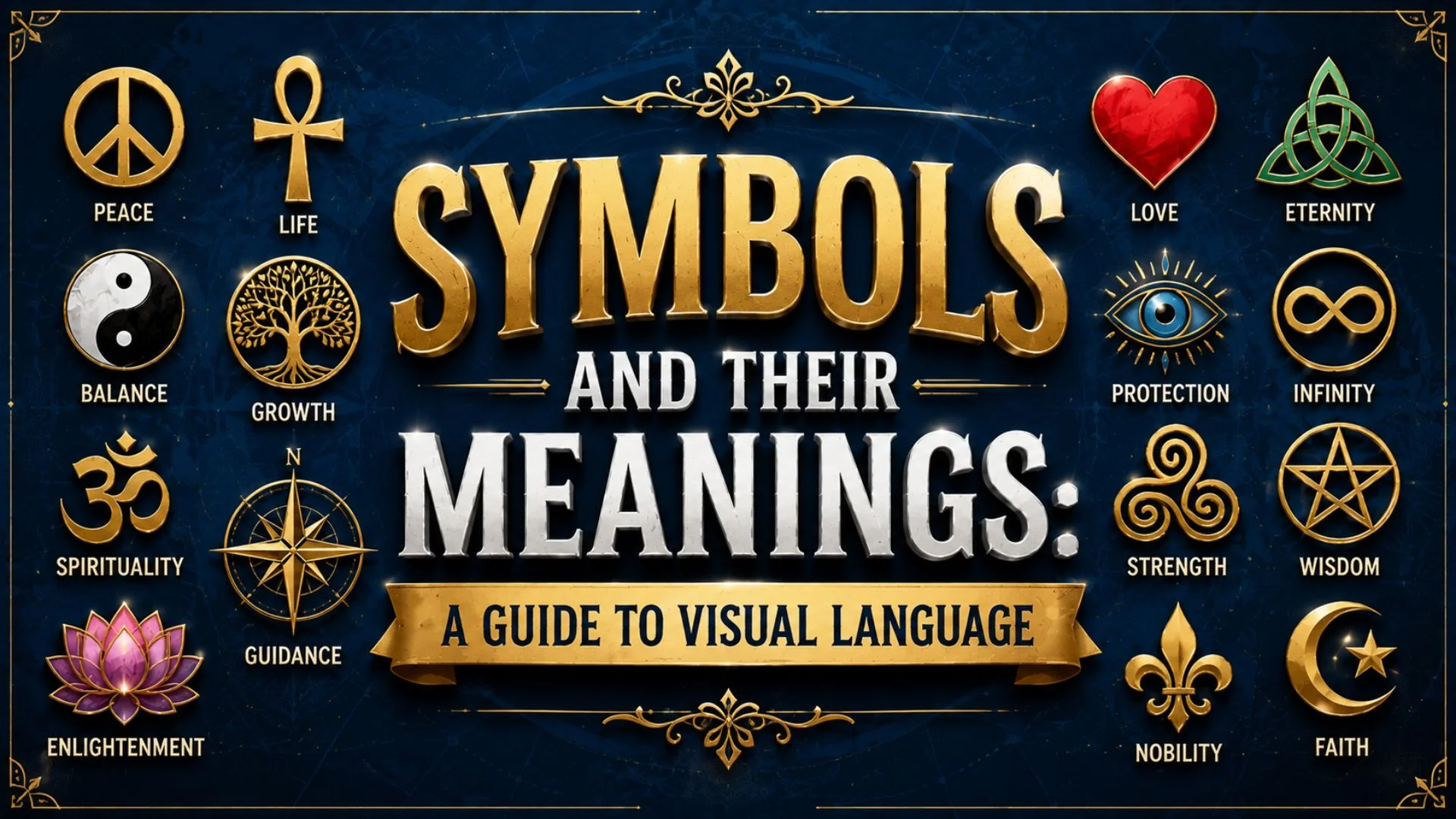
Humans have used symbols to communicate complex ideas long before written language existed. From ancient cave paintings to modern digital icons, symbols and their meanings form a universal visual language that transcends cultural and linguistic boundaries. A symbol is more than just a simple image or sign—it represents something beyond its literal form, carrying layers of meaning that can be personal, cultural, or universal. This guide explores the fascinating world of symbols, from common everyday icons to ancient mystical signs, helping you understand the hidden messages embedded in the visual world around you.
Quick Answer
Symbols and their meanings refer to the visual signs, shapes, and objects that represent ideas, concepts, or qualities beyond their literal definition. Examples include a dove symbolizing peace, a heart representing love, and a skull signifying mortality. Symbols function as a universal language that communicates complex messages instantly, though their interpretations often vary across different cultures and contexts.
Meaning Overview Table
| Aspect | Meaning |
|---|---|
| Definition | A visual sign, shape, or object that represents an idea, concept, or quality beyond its literal meaning |
| Pronunciation | SIM-buhlz and ther MEE-ningz |
| Part of Speech | Noun phrase |
| Usage | “Understanding symbols and their meanings helps you interpret art, literature, and everyday communication more deeply.” |
| Context | Art, literature, religion, mythology, graphic design, everyday communication |
Main Meaning
Definition
A symbol is something that stands for or represents something else by association, resemblance, or convention. Unlike a sign that has a direct, one-to-one meaning (like a stop sign), a symbol carries deeper, often multiple layers of significance. Symbols can be objects, shapes, colors, animals, or even actions that convey abstract ideas. The lamb, for example, represents innocence, while a flag symbolizes a nation and its values.
Origin
Symbols predate written language, with early humans using visual marks to communicate ideas and record events. Ancient cave paintings, petroglyphs, and tribal markings served as some of the earliest symbolic communication. The word “symbol” comes from the Greek symbolon, meaning “token” or “mark.” Ancient Greeks used broken pottery pieces as identification tokens, creating an early form of symbolic communication.
Context
Symbols operate in multiple contexts simultaneously. A single symbol can carry different meanings in religious, cultural, or personal settings. For instance, water symbolizes life and purity in some cultures, but represents chaos and destruction in others. Understanding symbols requires awareness of their context—the same image can convey vastly different messages depending on where and how people use it.
Modern Usage
Today, symbols appear everywhere: in logos, road signs, emojis, religious iconography, and digital interfaces. Designers and communicators use symbols to convey information quickly and efficiently. Modern audiences encounter thousands of symbols daily, from the “play” button on streaming services to the heart symbol in text messages. Their power lies in their ability to communicate instantly across language barriers.
Detailed Explanation
Literal Meaning
Literally, a symbol is a tangible thing—an object, shape, or image—that points to something beyond itself. The physical form of a symbol matters less than what it represents. A circle, for example, has no inherent meaning, but when people use it as a symbol, it can represent eternity, wholeness, or unity.
Common Meaning
Commonly, people use symbols to simplify complex ideas. A red rose represents love, a green light means “go,” and a smiley face communicates happiness. These common symbols have become so embedded in daily life that we interpret them unconsciously.
Religious Meaning
Religions rely heavily on symbolism. The cross represents Christianity and sacrifice, the Star of David symbolizes Judaism, and the crescent moon and star represent Islam. These religious symbols carry deep spiritual significance and often appear in art, architecture, and daily practice.
Mythological Meaning
Ancient myths created powerful symbols that endure today. The phoenix symbolizes rebirth and renewal, the dragon represents power and wisdom in Eastern cultures, and the serpent embodies knowledge and temptation in Western traditions. These mythological symbols continue to appear in literature and popular culture.
Psychological Meaning
Psychologist Carl Jung introduced the concept of archetypes—universal symbols that exist in the collective unconscious. Symbols like the shadow, the hero, and the wise old man appear in myths across cultures, suggesting they tap into fundamental human experiences. Jung believed these symbols help individuals understand themselves and their place in the world.
Cultural Meaning
Cultures develop their own unique symbols based on history, environment, and values. In Western cultures, the color white symbolizes purity and often appears in weddings. In some Eastern cultures, white represents mourning and death. The skull, revered in some cultures as a symbol of life’s continuity, represents mortality in others. Cultural context is essential when interpreting any symbol.
Social Media and Internet Meaning
Digital platforms have created new symbols and shifted the meanings of old ones. The heart emoji, originally representing love, now serves as a reaction to all types of content. The skull emoji often signals humor rather than death. Memes function as modern symbols, carrying shared meaning within online communities.
Examples Table
| Example | Meaning |
|---|---|
| Dove | Peace, innocence, and the Holy Spirit in Christian tradition |
| Heart | Love, affection, and emotional connection |
| Cross | Christianity, sacrifice, and redemption |
| Skull | Mortality, danger, and the impermanence of life |
| Dragon | Power, strength, and wisdom (Eastern); evil and chaos (Western) |
| Phoenix | Rebirth, renewal, and overcoming adversity |
| Ankh | Life, immortality, and ancient Egyptian spirituality |
| Tree of Life | Connection between heaven and earth; growth and family lineage |
| Lotus | Purity, spiritual awakening, and resilience |
| Yin Yang | Balance, harmony, and the duality of existence |
| Swastika | Ancient symbol of good fortune (now associated with hate due to WWII) |
| Infinity Symbol | Eternity, endlessness, and limitless potential |
| Anchor | Stability, hope, and steadfastness |
| Feather | Freedom, spiritual connection, and truth |
| Knotted String | Love, unity, and unbreakable bonds |
Related Meanings Table
| Related Term | Meaning |
|---|---|
| Color | Visual element carrying symbolic meaning (e.g., red = passion, white = purity) |
| Archetype | Universal symbol appearing across cultures (e.g., hero, mother, shadow) |
| Icon | A symbol that resembles what it represents |
| Sign | A symbol with a direct, literal meaning (e.g., traffic signs) |
| Motif | A recurring symbol or theme in art and literature |
| Allegory | A story or image with a hidden symbolic meaning |
| Semiotics | The study of signs and symbols |
| Symbolism | An art movement emphasizing symbolic representation |
| Metaphor | A figure of speech using symbolic comparison |
| Totem | An animal or object serving as a clan symbol |
| Glyph | A specific symbol or character in writing |
| Hieroglyph | A symbol used in ancient Egyptian writing |
| Rune | A symbol from ancient Germanic alphabets with mystical meanings |
| Emoji | Digital symbols conveying emotion or concepts |
| Logo | A symbol representing a brand or organization |
Common Uses
People use symbols and their meanings in countless ways:
Communication: Symbols convey information quickly and universally. Traffic signs, bathroom symbols, and warning labels rely on symbols to communicate without words.
Art and Literature: Artists and writers use symbols to add depth to their work. A raven in a poem might symbolize death or mystery, while a sunrise can represent hope or new beginnings.
Religion and Spirituality: Faith traditions worldwide use symbols to express beliefs, identify followers, and create sacred spaces. The cross, the crescent, the Star of David, and the lotus all carry profound spiritual meaning.
Branding and Marketing: Companies create symbols (logos) to represent their brand identity. The Nike swoosh, McDonald’s golden arches, and Apple’s apple all function as powerful commercial symbols.
Personal Expression: Individuals choose symbols that represent their values, identity, or experiences. Tattoos, jewelry, and personal items often incorporate symbolic imagery.
Digital Communication: Emojis, memes, and reaction icons have become the symbolic language of the internet. These digital symbols allow people to express emotions and ideas quickly and effectively.
Common Mistakes
| Mistake | Correction |
|---|---|
| Assuming all symbols have universal meanings | Cultural context significantly affects interpretation |
| Confusing symbols with signs | Signs have literal meanings; symbols carry deeper significance |
| Using religious symbols without understanding their significance | Always research the meaning and cultural weight of religious symbols |
| Assuming ancient symbols are harmless | Some ancient symbols (like the swastika) have acquired harmful modern associations |
| Believing symbols have only one meaning | Most symbols carry multiple layers of meaning |
| Ignoring the origin of a symbol | Understanding a symbol’s history helps interpret it correctly |
| Overusing symbols without context | Symbols communicate best when people understand their intended meaning |
| Misidentifying a symbol’s cultural origin | Some symbols appear in multiple cultures with different meanings |
| Creating symbols that are too complex | Effective symbols are simple and immediately recognizable |
| Forgetting that symbol meanings evolve | Symbols gain and lose meanings over time |
Related Questions
What is the difference between a sign and a symbol?
A sign has a direct, literal meaning that everyone interprets the same way, like a stop sign or a directional arrow. A symbol carries deeper, more complex meanings that can vary by culture and context, like a heart representing love or an owl representing wisdom.
What is the most universal symbol?
The heart symbol is arguably the most universal, recognized worldwide as representing love and affection. The sun, the circle, and the human figure also enjoy near-universal recognition across cultures.
What is an archetypal symbol?
An archetypal symbol is a universal image or pattern that appears across cultures and throughout history, representing fundamental human experiences. The hero, the mother, and the shadow are examples of archetypes identified by psychologist Carl Jung.
What do colors symbolize?
Colors carry symbolic meaning that varies by culture. In Western culture, red represents passion and danger, white means purity, blue signifies calm and stability, and green represents nature and growth. In Eastern cultures, these meanings often differ.
What does the owl symbolize?
The owl symbolizes wisdom, knowledge, and mystery in many cultures. In ancient Greece, the owl represented Athena, the goddess of wisdom. However, some cultures view the owl as a symbol of death or bad luck.
What does the lotus flower symbolize?
The lotus flower symbolizes purity, spiritual awakening, and resilience. It grows in muddy water but rises to bloom beautifully, representing the ability to overcome difficulties and achieve enlightenment.
FAQs
What is a symbol in simple terms?
A symbol is something that stands for or represents something else. A red heart represents love, and a dove represents peace.
How do symbols get their meanings?
Symbol meanings develop through cultural agreement, religious teachings, literary traditions, and collective human experience. Over time, certain images become associated with specific concepts.
Can a symbol have multiple meanings?
Yes. Most symbols carry multiple meanings that depend on context, culture, and personal interpretation. The color red, for example, can symbolize love, danger, passion, or anger.
What is the importance of symbols in culture?
Symbols help cultures express their values, beliefs, and identities. They create shared understanding and transmit knowledge across generations.
How does one interpret symbols correctly?
Consider the context, the culture that created the symbol, its history, and the specific tradition that uses it. Avoid assumptions based on personal or limited cultural experience.
What are common symbols in literature?
Common literary symbols include darkness (evil or ignorance), light (knowledge or good), water (life or baptism), and birds (freedom or the soul).
What is the origin of the heart symbol?
The heart symbol likely originated from the shape of ivy leaves or the ancient Greek representation of the silphium plant, which they associated with love and contraception. It became widely associated with romance during the Middle Ages.
What is semiotics?
Semiotics is the study of signs and symbols and how people interpret them. It explores how meaning is created and communicated through signs in various cultural and social contexts.
Conclusion
Symbols and their meanings form the foundation of human communication, from ancient cave paintings to modern digital icons. Understanding these visual signs enriches our experience of art, literature, and daily life. Symbols connect us across time and culture, expressing concepts that words sometimes cannot capture. Whether you encounter a religious icon, a corporate logo, or a simple emoji, each symbol carries layers of meaning shaped by history, culture, and context. By studying symbols, you gain insight not just into individual images but into the human need to represent the intangible. The next time you see a symbol, pause and consider what it truly represents—you might discover meanings you have never considered before.

Natalie Brooks is a content researcher and writer with a strong interest in word meanings, dream interpretations, symbolism, and cultural insights. She is passionate about creating clear, informative, and easy-to-understand content that helps readers discover the deeper meanings behind words, names, dreams, and symbols. Through her work at Meanzly, Natalie aims to make knowledge accessible and valuable for readers around the world.