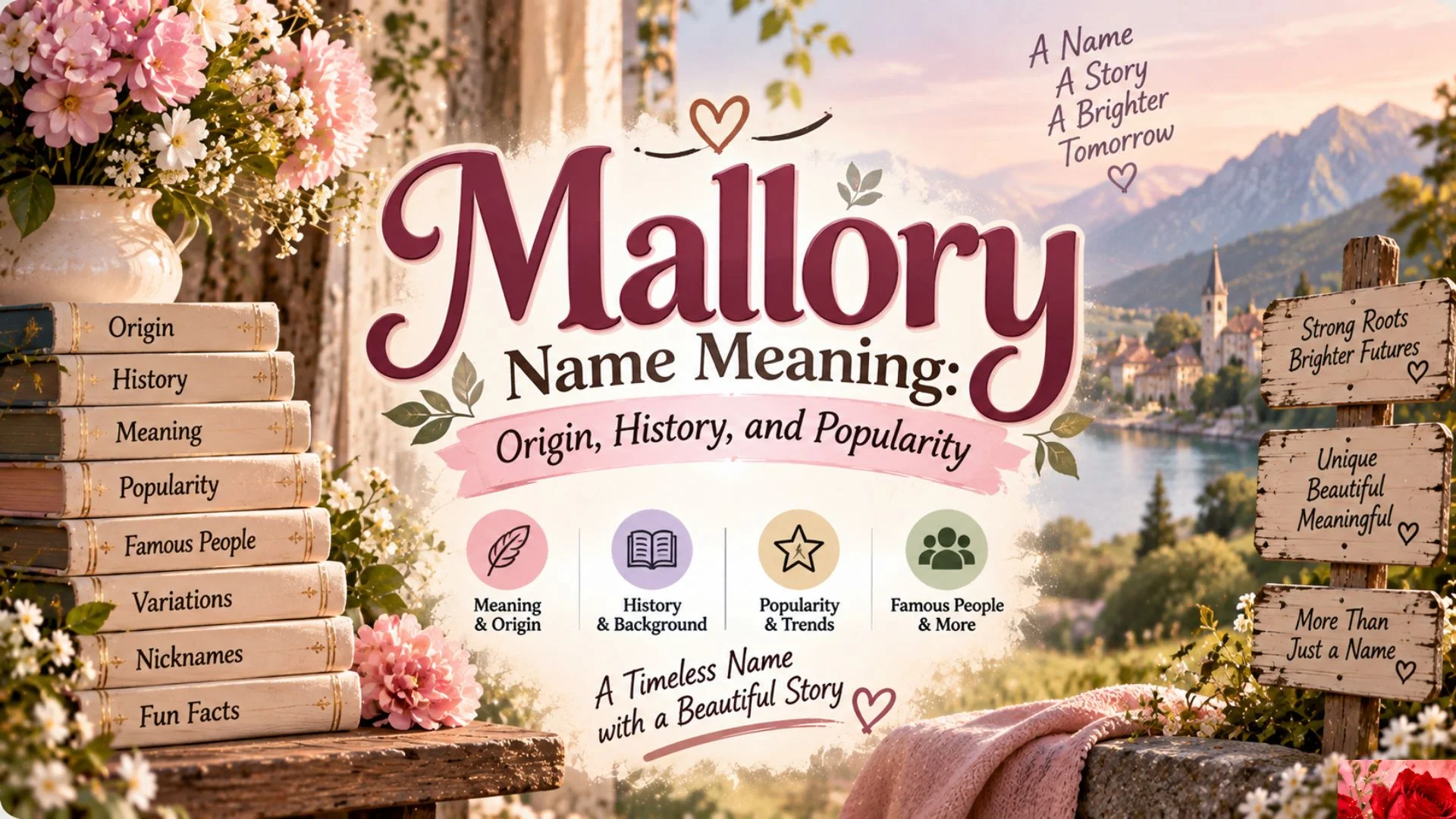
Names often carry surprising histories, and few illustrate this better than Mallory. The Mallory name meaning traces back to Old French and carries a meaning that might raise eyebrows: “unfortunate” or “unlucky.” Despite this somber origin, Mallory has become a beloved name with a bright, upbeat sound and a spirited reputation.
Mallory began as a Norman surname brought to England after the Norman Conquest of 1066. It evolved from a nickname for someone considered unlucky, derived from the Old French words mal (“ill”) and orie (“fortune”). Over centuries, the name transformed from a surname into a given name, gaining particular popularity in the 1980s thanks to the character Mallory Keaton on the sitcom Family Ties. Today, Mallory remains a distinctive choice with a rich history that spans medieval England, Arthurian legend, and modern popular culture. This guide explores the complete story behind the name Mallory.
Quick Answer
Mallory is a gender-neutral name of Old French origin meaning “unfortunate” or “unlucky,” derived from the words mal (“ill”) and orie (“fortune”). Originally a Norman surname brought to England in 1066, it became popular as a given name in the 1980s due to the character Mallory Keaton on Family Ties. Today, Mallory ranks around #372 for girls in the U.S. and remains a distinctive choice with a spirited, slightly tomboyish edge.
Meaning Overview Table
| Aspect | Meaning |
|---|---|
| Definition | A given name and surname of Old French origin meaning “unfortunate” or “unlucky” |
| Pronunciation | MAL-uh-ree |
| Part of Speech | Proper noun (given name, surname) |
| Usage | “Mallory has a beautiful sound, even if its original meaning is a bit dark.” |
| Context | Personal naming, genealogy, cultural history, literature |
Main Meaning
Definition
The name Mallory is an English given name and surname of Norman French origin. It derives from the Old French word malheure, meaning “unhappy” or “unfortunate,” which itself comes from mal (“bad” or “ill”) and eur (“fortune” or “chance”). The name originated as a nickname for someone considered unlucky or who had experienced misfortune.
Origin
The Mallory surname originated in Normandy, a region in northern France, during the medieval period. It first appeared in England after the Norman Conquest of 1066, brought by Norman settlers and knights who accompanied William the Conqueror. One of the earliest recorded instances of the name appears in the Domesday Book of 1086, the survey of landowners commissioned by William the Conqueror.
In the 12th century, the name appears in the records of the Knights Templar, with Sir Robert Mallory participating in the Crusades. The Mallory family established itself in Leicestershire, England, where they held lands and titles for centuries. The name also connects to Sir Thomas Malory, the 15th-century author who wrote Le Morte d’Arthur, the famous compilation of Arthurian legends .
Context
The Mallory name meaning operates in several contexts:
- Personal Identity: For individuals named Mallory, the name connects them to a long history and distinctive heritage
- Genealogy: Families researching their ancestry often encounter Mallory as a surname with deep Norman roots
- Literature: Sir Thomas Malory’s Arthurian works have cemented the name in literary history
- Popular Culture: The name gained widespread recognition through television and film characters
- Naming Trends: Mallory represents the trend of surnames becoming given names, particularly for girls
Modern Usage
Today, Mallory has become primarily a feminine given name in the United States, though it remains gender-neutral. It entered the U.S. Top 1000 baby names in 1975 and climbed steadily through the 1980s. The name peaked in popularity around 1990, ranking #84 for girls . In 2024, Mallory ranked #372 for girls in the United States, showing that the name retains steady, if quieter, popularity. Parents often choose Mallory for its soft yet strong sound, its literary connections, and its distinctive character.
Detailed Explanation
Literal Meaning
Literally, the name Mallory means “unfortunate” or “unlucky.” It derives from the Old French malheure, which combines mal (“bad” or “ill”) and eur (“fortune” or “chance”). This meaning reflects the name’s origin as a nickname for someone who had experienced misfortune or was considered unlucky .
Common Meaning
Commonly, people understand Mallory as a stylish, feminine name with a slightly edgy, tomboyish quality. Most people do not associate the name with its literal meaning. Instead, they recognize it as a modern, appealing choice with literary and pop culture connections. The name’s sound—soft but strong—has made it a favorite among parents seeking something distinctive yet familiar.
Text Meaning
In written communication, “Mallory” appears as a proper noun in countless contexts. It appears in literature, historical records, news articles, and personal communications. In modern usage, the name also appears in baby name guides and naming forums where parents discuss its merits.
Slang Meaning
The name Mallory has no specific slang meaning. However, in some contexts, it has been used as a generic name in jokes or examples, similar to how “John Doe” functions for anonymous males.
Internet Meaning
On the internet, Mallory connects to several references:
- Literature: Discussions of Sir Thomas Malory and Arthurian legends
- Pop Culture: References to characters like Mallory Keaton from Family Ties
- Baby Names: Parents discuss the name on forums and naming websites
- Cultural Commentary: The name’s “unfortunate” meaning often sparks curiosity and discussion
Social Media Meaning
On social media platforms, the name Mallory appears in personal profiles, naming discussions, and cultural references. People named Mallory share their experiences with the name, often noting its distinctive sound and literary connections. Parents considering the name seek opinions and feedback from online communities.
Cultural Meaning
Culturally, Mallory represents several significant themes:
- Norman Heritage: The name connects to the Norman Conquest and medieval English history
- Arthurian Legend: Sir Thomas Malory’s Le Morte d’Arthur cemented the name in literary culture
- Gender Evolution: The name’s shift from masculine surname to feminine given name reflects broader naming trends
- Pop Culture Influence: Television characters have helped popularize the name
- Distinctiveness: Mallory offers a familiar yet uncommon choice for parents
Gender-Neutral Usage
While Mallory has become predominantly feminine in the United States, it remains gender-neutral in its origins and usage. In England, the name still appears as a surname and occasionally as a masculine given name. The name’s versatility makes it appealing to parents seeking a name that transcends traditional gender boundaries.
Examples Table
| Example | Meaning |
|---|---|
| Mallory is a Norman surname | The name originated in Normandy, France, and came to England in 1066 |
| Mallory means “unfortunate” | The literal meaning from Old French malheure |
| Mallory Keaton is a TV character | The Family Ties character who popularized the name in the 1980s |
| Mallory ranks #372 for girls | The name’s current popularity ranking in the U.S. |
| Sir Thomas Malory wrote Le Morte d’Arthur | The 15th-century author who compiled Arthurian legends |
| Mallory has a beautiful sound | The name’s aesthetic appeal despite its dark meaning |
| Mallory is gender-neutral | Used for both children, though more common for girls in the U.S. |
| The Mallory family held lands in Leicestershire | The surname’s historical roots in England |
| Mallory entered the U.S. Top 1000 in 1975 | The name’s modern popularity timeline |
| Mallory peaked in 1990 at #84 | The name’s highest popularity ranking |
Related Meanings Table
| Related Term | Meaning |
|---|---|
| Malheure | The Old French word meaning “unfortunate” from which Mallory derives |
| Mal | Old French for “bad” or “ill” |
| Eur | Old French for “fortune” or “chance” |
| Malorie | A modern variant spelling of Mallory |
| Mallorie | Another variant spelling |
| Malory | A variant spelling, also the surname of Sir Thomas Malory |
| Mallori | A simplified variant spelling |
| Mal | A common nickname for Mallory |
| MalPal | An affectionate nickname for a friend named Mallory |
| Sir Thomas Malory | The 15th-century author of Le Morte d’Arthur |
| Le Morte d’Arthur | The famous Arthurian compilation by Sir Thomas Malory |
| Mallory Keaton | The Family Ties character who popularized the name |
| Family Ties | The 1980s sitcom featuring Mallory Keaton |
| Norman Conquest | The 1066 invasion that brought the Mallory surname to England |
| Domesday Book | The 1086 survey that records early Mallory landholders |
Common Uses
The name Mallory appears in many contexts:
Personal Naming: Parents choose Mallory for its distinctive sound, literary connections, and gender-neutral appeal. The name has been a popular choice for girls since the 1980s, though it remains relatively uncommon compared to other names of similar style.
Genealogical Research: People researching Norman ancestry often encounter Mallory as a surname. The name’s appearance in the Domesday Book and medieval records makes it valuable for tracing family histories.
Literature and Education: Sir Thomas Malory’s Le Morte d’Arthur appears in literature courses worldwide, keeping the name in academic discourse. Students of Arthurian legend encounter the name regularly.
Popular Culture: The name appears in numerous television shows, films, and books. Mallory Keaton from Family Ties remains the most famous fictional bearer, while other characters have appeared in shows like Buffy the Vampire Slayer and American Horror Story.
Everyday Life: Countless individuals named Mallory contribute to the name’s continued presence. They work in all professions and live in all countries, representing diverse backgrounds.
Common Mistakes
| Mistake | Correction |
|---|---|
| Thinking Mallory means “beautiful” | Mallory means “unfortunate” or “unlucky,” not “beautiful” |
| Assuming Mallory is only a girl’s name | Mallory is gender-neutral and was originally a masculine surname |
| Believing Mallory is an Irish name | Mallory is Norman French in origin, not Irish |
| Confusing Mallory with Mallorie | Mallorie is a variant spelling, not a different name |
| Thinking the name is modern | Mallory has medieval origins dating back to 1066 |
| Pronouncing it as “MAL-or-ee” | The correct pronunciation is “MAL-uh-ree” |
| Assuming the name has positive origins | The name originally meant “unfortunate” |
| Confusing it with Malory (the author) | Sir Thomas Malory shares the name but uses a variant spelling |
| Thinking the name is exclusively American | Mallory is used in English-speaking countries worldwide |
| Believing the name has no literary connections | Mallory connects to Arthurian legend through Sir Thomas Malory |
Related Questions
What does the name Mallory mean in the Bible?
Mallory does not appear in the Bible. It is a Norman French name with no biblical origin. However, the name’s meaning (“unfortunate”) has no religious significance.
Is Mallory a boy’s name or a girl’s name?
Mallory is gender-neutral. It originated as a masculine surname, became a masculine given name, and has become predominantly feminine in the United States since the 1980s. In England, it remains more common as a surname.
What is the origin of the name Mallory?
The name Mallory originates from Old French malheure, meaning “unfortunate.” It came to England with the Norman Conquest in 1066 and became a surname before evolving into a given name.
How popular is the name Mallory?
Mallory ranked #372 for girls in the United States in 2024. It peaked in popularity around 1990 at #84. The name remains a distinctive, moderately popular choice.
What are common nicknames for Mallory?
Common nicknames for Mallory include Mal, Mali, Mall, and MalPal (an affectionate nickname used by friends).
Is Mallory a rare name?
Mallory is not rare, but it is not extremely common either. It ranks in the top 400 names for girls in the U.S., making it familiar but distinctive.
FAQs
Is Mallory a good name?
Yes, Mallory is widely considered a good name. It offers a pleasing sound, literary connections, gender-neutral appeal, and a distinctive character. Despite its “unfortunate” meaning, most people choose it for its aesthetic and cultural associations.
What is the personality of a person named Mallory?
While names don’t determine personality, cultural associations with Mallory include confidence, independence, and a spirited, slightly tomboyish quality. The name’s pop culture connections to Mallory Keaton have reinforced these associations.
What does the name Mallory mean in different languages?
In Old French, Mallory means “unfortunate.” The name has no direct translations in other languages, though it is used in English-speaking countries worldwide.
When did Mallory become a popular girl’s name?
Mallory entered the U.S. Top 1000 in 1975 and climbed steadily through the 1980s. The character Mallory Keaton on Family Ties (1982-1989) helped popularize the name for girls. It peaked at #84 in 1990.
Is Mallory a unisex name?
Yes, Mallory is gender-neutral. It originated as a masculine surname and given name, but has become predominantly feminine in the United States since the 1980s.
What famous people have the name Mallory?
Notable bearers include Mallory Keaton (fictional character), Mallory Jansen (actress), Mallory Hagan (Miss America 2013), Mallory Weggemann (Paralympic swimmer), and Mallory Pugh (soccer player).
What middle names go with Mallory?
Common middle names for Mallory include Rose, Grace, Jane, Elizabeth, Anne, Kate, and Claire.
Is Mallory a biblical name?
No, Mallory is not a biblical name. It originates from Norman French and has no connection to the Bible.
Conclusion
The Mallory name meaning reveals a fascinating story of transformation—from a Norman surname meaning “unfortunate” to a beloved gender-neutral given name with a bright, spirited reputation. Despite its somber origins, Mallory has shed its dark connotations and become a name associated with confidence, independence, and literary heritage. Sir Thomas Malory’s Arthurian legends and the character Mallory Keaton on Family Ties have cemented the name in cultural consciousness. Whether you choose Mallory for its distinctive sound, its medieval roots, or its pop culture connections, you are selecting a name with depth, history, and enduring charm. As the name continues to evolve, its core appeal remains constant—a beautiful, distinctive choice for a new generation.

Natalie Brooks is a content researcher and writer with a strong interest in word meanings, dream interpretations, symbolism, and cultural insights. She is passionate about creating clear, informative, and easy-to-understand content that helps readers discover the deeper meanings behind words, names, dreams, and symbols. Through her work at Meanzly, Natalie aims to make knowledge accessible and valuable for readers around the world.