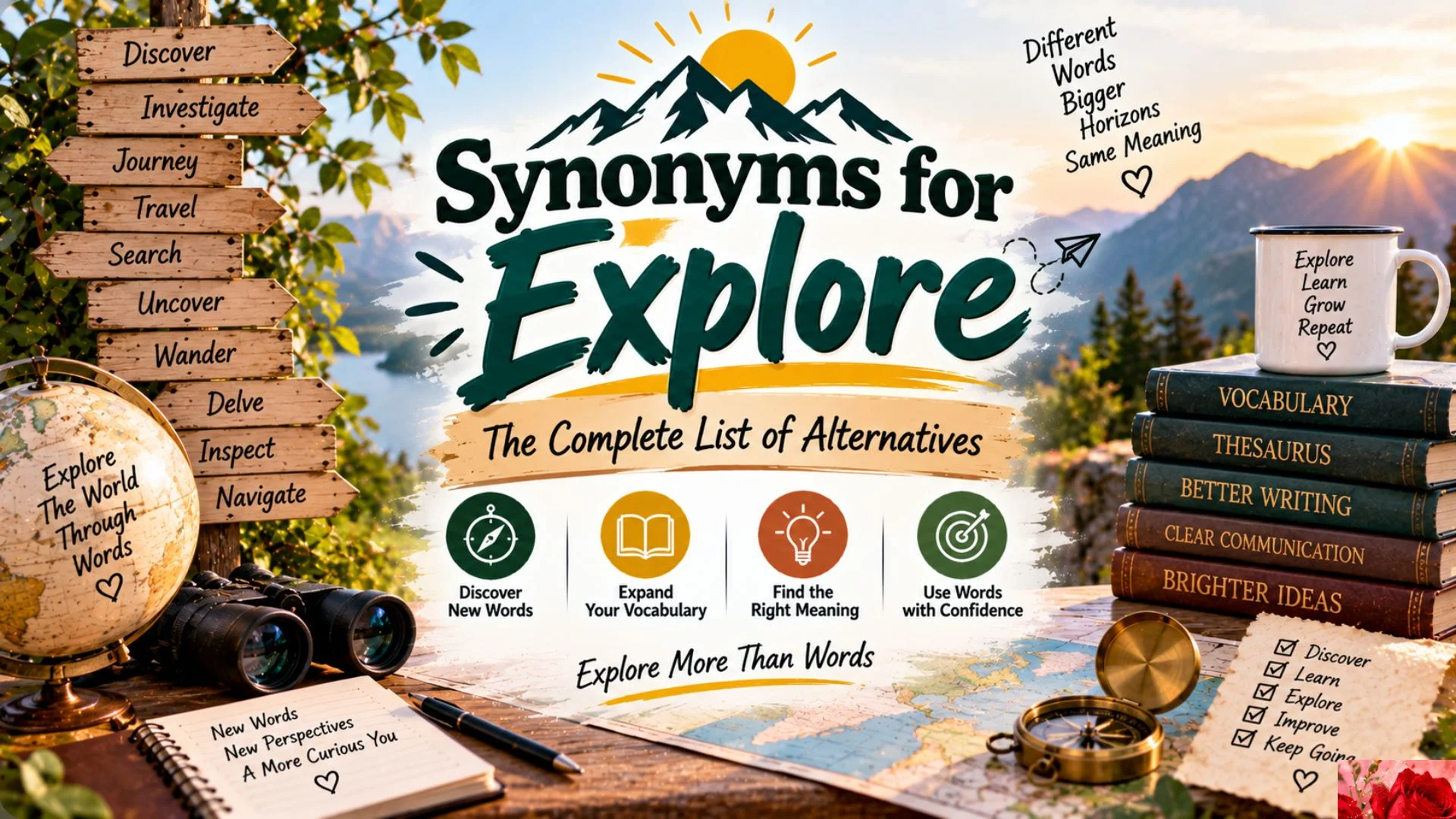
The word “explore” appears constantly in English, whether you’re writing about travel, research, or personal growth. However, repeating the same verb weakens your writing and makes it sound monotonous. Finding the right synonyms for explore helps you convey precise shades of meaning, whether you’re describing a physical journey, a mental investigation, or a creative process.
“Explore” carries a rich history, originating from the Latin explorare, which meant “to search out” or “examine”—likely rooted in the hunting cries of ancient trackers . This dual heritage shapes its modern usage: exploring can mean traveling through unknown territory, examining a subject carefully, or even feeling your way through a physical space . This comprehensive guide provides over 100 alternatives, each suited to different contexts and nuances. Whether you need a formal synonym for academic writing, a casual alternative for conversation, or a vivid verb for creative prose, you’ll find the perfect word here.
Quick Answer
The best synonyms for “explore” depend on context. For physical travel, use “travel,” “tour,” “journey through,” or “traverse.” For casual examination, use “browse,” “look into,” or “check out.”
Meaning Overview Table
| Aspect | Meaning |
|---|---|
| Definition | To travel through or investigate a place, subject, or idea to learn about it |
| Pronunciation | ik-SPLOR |
| Part of Speech | Verb (transitive and intransitive) |
| Usage | “Scientists explore new treatments” or “We explored the old town” |
| Context | Travel writing, academic research, creative writing, everyday conversation |
Main Meaning
Definition
To explore means to travel through or investigate a place, subject, or idea in order to learn about it. The word encompasses both physical journeys through unfamiliar territory and mental investigations into complex topics .
Origin
The word “explore” entered English in the late 16th century from the Latin explorare, meaning “to search out” or “examine.” The Latin root combines ex- (“out”) and plorare (“to cry out”), probably originating from the shouts of hunters who spotted prey . This hunting heritage explains why “explore” carries connotations of active searching and discovery.
Context
“Explore” operates in three main contexts:
- Physical travel: Exploring unfamiliar regions for discovery or scientific purposes
- Intellectual investigation: Examining subjects, ideas, or possibilities systematically
- Sensory examination: Feeling or probing something with hands or body parts
Modern Usage
Today, “explore” appears everywhere from travel blogs to academic papers to casual conversation. The word maintains a neutral register, suitable for both formal and informal contexts . Its versatility makes it one of the most common verbs in English.
Detailed Explanation
Literal Meaning
Literally, “explore” means to travel through an area to learn about it. Explorers venture into unknown territories—jungles, oceans, caves, and mountains—seeking discovery and knowledge .
Common Meaning
Commonly, “explore” extends beyond physical travel to describe examining ideas, possibilities, or options. When someone says “let’s explore that idea,” they mean investigating it thoroughly to understand its implications .
Academic Meaning
In academic writing, “explore” describes systematic investigation. Researchers explore hypotheses, theories, and data sets. The word appears frequently in abstracts and introductions to signal comprehensive examination .
Medical Meaning
In medicine, “explore” has a specialized meaning: examining an organ or body part for diagnostic purposes, often with a probe or surgical instrument .
Creative Meaning
Writers and artists explore themes, emotions, and techniques. A novelist might explore the nature of grief; a painter might explore color relationships. Here, “explore” suggests experimentation and discovery .
Examples Table
| Example | Meaning |
|---|---|
| The city is best explored on foot. | Traveling through an area to learn about it |
| The film explores the relationship between artist and instrument. | Examining a subject in detail |
| Scientists explore new ways to treat disease. | Investigating possibilities systematically |
| Let’s explore the possibilities before deciding. | Examining options carefully |
| She explored the sand with her toes. | Feeling something with hands or body |
| The book explores themes of friendship and loss. | Examining ideas deeply |
| The company is exploring for oil. | Searching for resources |
| We explored the old part of the town. | Traveling through an unfamiliar area |
| The committee will explore the issue further. | Investigating systematically |
| He explored his feelings through journaling. | Examining personal emotions |
Related Meanings Table
| Related Term | Meaning |
|---|---|
| Investigate | Examine systematically to find facts |
| Examine | Look at closely and carefully |
| Research | Investigate systematically for information |
| Probe | Investigate deeply or searchingly |
| Delve into | Research or investigate deeply |
| Scrutinize | Examine very closely |
| Analyze | Examine parts to understand the whole |
| Survey | Examine comprehensively |
| Inspect | Look over carefully |
| Study | Examine and learn about |
| Travel | Go on a journey to different locations |
| Tour | Travel around a place |
| Traverse | Travel across or through |
| Scout | Make a preliminary search of an area |
| Reconnoiter | Make a military observation of a region |
| Pioneer | Be first to explore or develop |
| Prospect | Search an area for resources |
| Chart | Map or describe systematically |
| Navigate | Find a route through |
| Discover | Find something previously unknown |
Common Uses
Travel Writing: Travelers explore cities, countries, and cultures. The word appears in guidebooks, travel blogs, and memoirs to describe journeys of discovery .
Academic Research: Scholars explore topics, theories, and questions. Research papers frequently use “explore” to signal comprehensive investigation .
Business and Strategy: Companies explore markets, opportunities, and options. Strategic discussions often involve exploring possibilities before making decisions.
Creative Writing: Authors explore themes, characters, and narratives. The word suggests depth and experimentation in artistic work .
Personal Growth: Individuals explore interests, emotions, and identities. Self-help and memoir writing often use “explore” to describe inner journeys.
Science and Medicine: Researchers explore new treatments, and doctors explore symptoms for diagnostic purposes .
Common Mistakes
| Mistake | Correction |
|---|---|
| Using “explore” when you mean “exploit” | Explore means to investigate; exploit means to take advantage of |
| Overusing “explore” in formal writing | Vary with “investigate,” “examine,” or “analyze” |
| Using “explore” for quick, casual actions | Use “browse,” “check out,” or “look at” for casual examination |
| Confusing “explore” with “explode” | These are different words with different meanings |
| Using “explore” in medical contexts without precision | Use “diagnose” or “probe” for specific medical examinations |
| Ignoring context when choosing synonyms | Match the synonym to the setting: formal, casual, technical, or creative |
| Using “explore” for completed actions | “Explore” suggests ongoing discovery; use “discovered” for completed findings |
| Forgetting the physical and mental duality | “Explore” works for both travel and ideas; choose synonyms accordingly |
| Using “explore” as a noun | “Explore” is a verb; the noun is “exploration” |
| Repeating “explore” multiple times in one paragraph | Use synonyms like “investigate,” “examine,” or “delve into” for variety |
Related Questions
What is a synonym for “explore” in academic writing?
For academic writing, use “investigate,” “examine,” “analyze,” “research,” “study,” or “scrutinize.” These carry the formal tone appropriate for scholarly work .
What is a synonym for “explore” in travel contexts?
For travel writing, use “travel,” “tour,” “traverse,” “journey through,” “roam,” “wander,” or “navigate” .
What is a synonym for “explore” meaning “to examine deeply”?
For deep examination, use “delve into,” “probe,” “scrutinize,” “dissect,” “fathom,” or “plumb” .
What is a synonym for “explore” in creative writing?
For creative prose, use “discover,” “pioneer,” “chart,” “navigate,” “meander,” or “wander” .
What is a synonym for “explore” meaning “to search for resources”?
For resource exploration, use “prospect,” “search,” “forage,” “hunt,” or “scout” .
What is a synonym for “explore” meaning “to feel with hands”?
For sensory examination, use “feel,” “probe,” “frisk,” or “examine by touch” .
FAQs
What is the best synonym for “explore” in general writing?
“Investigate” is the most versatile synonym, working in academic, professional, and general contexts. “Examine” is another strong choice .
What is a more formal word for “explore”?
For formal writing, use “investigate,” “examine,” “analyze,” “scrutinize,” “research,” or “study” .
What is a casual synonym for “explore”?
For casual contexts, use “check out,” “look into,” “browse,” “poke around,” or “look around” .
What is a synonym for “explore” that means “to discover”?
“Discover” works when exploration leads to finding something new. “Uncover” and “unearth” also fit .
What is a synonym for “explore” meaning “to travel”?
“Travel,” “tour,” “traverse,” “journey through,” and “navigate” all work for physical exploration .
What is the opposite of “explore”?
Antonyms include “ignore,” “overlook,” “disregard,” and “neglect” .
Is “explore” a formal or informal word?
“Explore” is neutral, suitable for both formal and informal contexts .
How many synonyms does “explore” have?
Lists vary, but comprehensive collections include over 100 synonyms across different meaning groups .
Conclusion
Expanding your vocabulary with synonyms for “explore” transforms your writing from repetitive to precise and engaging. Whether you’re describing a physical journey through an unknown city, a deep investigation into a complex subject, or a creative exploration of ideas, the right synonym sharpens your meaning and connects with your reader. From formal terms like “investigate” and “scrutinize” to casual alternatives like “check out” and “browse,” English offers a rich vocabulary for every context. Remember to match your synonym to your setting, avoid overusing any single word, and let precision guide your choices. With these tools at hand, you can explore language itself and discover new ways to express familiar ideas.

Natalie Brooks is a content researcher and writer with a strong interest in word meanings, dream interpretations, symbolism, and cultural insights. She is passionate about creating clear, informative, and easy-to-understand content that helps readers discover the deeper meanings behind words, names, dreams, and symbols. Through her work at Meanzly, Natalie aims to make knowledge accessible and valuable for readers around the world.