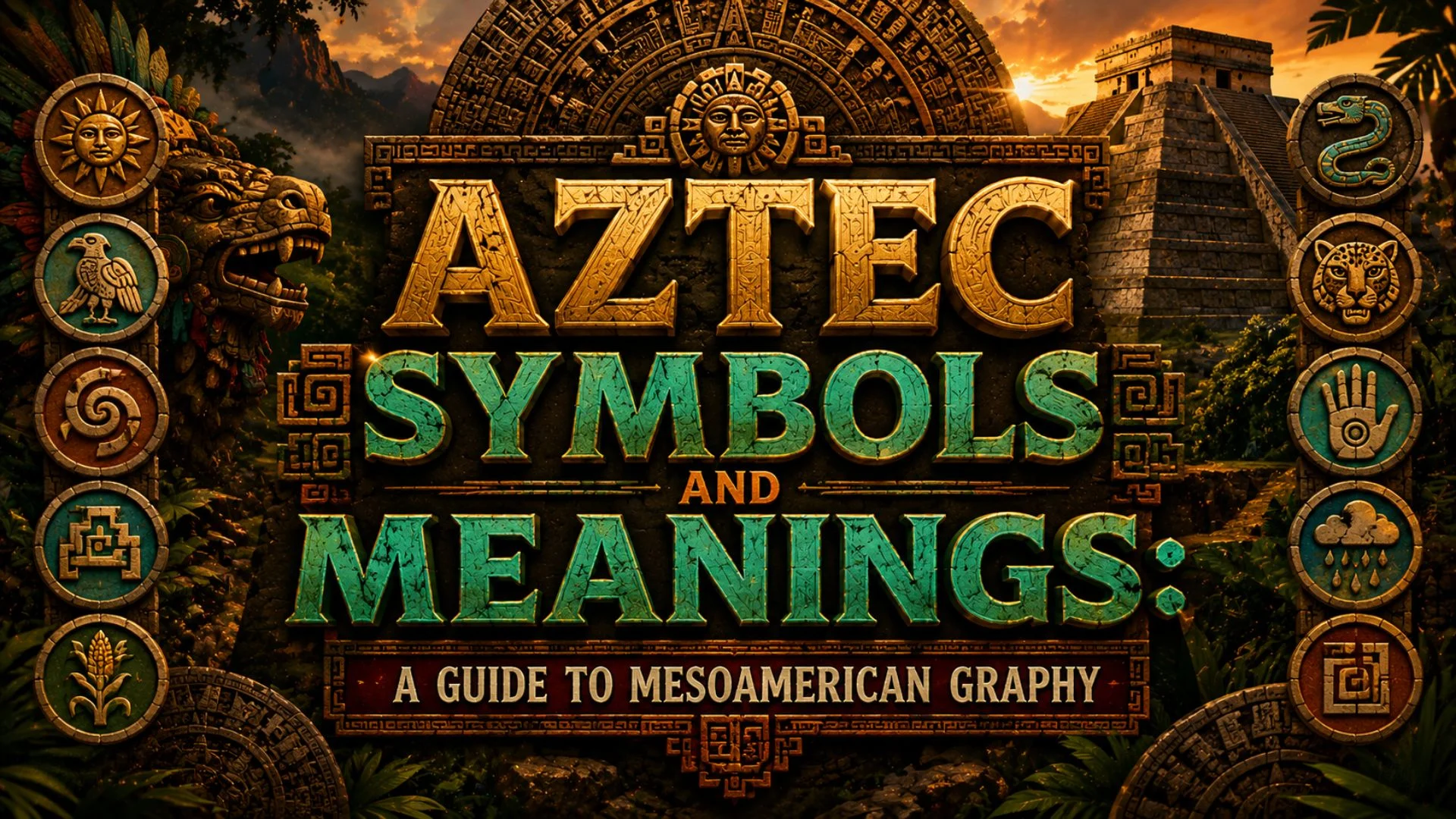
The Aztecs, or Mexica, built one of the most powerful empires in Mesoamerica. Their rich visual language used symbols to record history, express religious beliefs, and communicate power. These Aztec symbols and meanings reveal a civilization that saw the cosmos, nature, and human life as deeply interconnected. Modern viewers can still explore the layers of significance that each image carried, from the eagle on the cactus to the intricate calendar stone.
The Aztec writing system relied heavily on pictograms and logograms. For example, a mat could stand for royal authority, a flower for sacrificial blood, and a burning temple for conquest. Understanding these symbols provides a window into how the Aztecs understood their world, from the movements of the stars to the cycles of agriculture and war.
Quick Answer
Aztec symbols and meanings form a complex visual language that appears in codices, stone carvings, and architecture. Key symbols include the eagle (representing the sun and warriors), the serpent (associated with Quetzalcoatl and fertility), the cactus (symbolizing Tenochtitlan’s founding), and the day signs like Crocodile, Wind, and Movement that structured the sacred calendar. These symbols conveyed religious beliefs, political power, and cosmic order.
Meaning Overview Table
| Aspect | Meaning |
|---|---|
| Definition | The visual symbols, glyphs, and iconographic elements used by the Aztec civilization to convey meaning in writing, art, and architecture |
| Pronunciation | AZ-tek SIM-buhlz and MEE-ningz |
| Part of Speech | Noun phrase |
| Usage | “Researchers study Aztec symbols and meanings to understand how this civilization recorded history and expressed religious beliefs.” |
| Context | Mesoamerican studies, art history, archaeology, cultural anthropology |
Main Meaning
Definition
Aztec symbols and meanings refer to the system of visual signs, glyphs, and iconographic elements that the Aztec civilization used to communicate ideas, record events, and express religious and political concepts. This system combined pictograms (images that look like what they represent), logograms (symbols representing words), and some phonetic elements. These symbols appear in codices (painted books), on stone monuments, and in architectural decorations.
Origin
Over centuries, the Aztec symbolic system evolved, drawing from earlier Mesoamerican civilizations like the Olmec, Maya, and Toltec. When the Mexica people arrived in the Basin of Mexico, they embraced and reshaped these traditions. According to their migration accounts, they founded Tenochtitlan in about 1325 CE after spotting an eagle perched on a cactus, a vision that would define their identity. The Aztec writing and iconographic system kept evolving until the Spanish conquest in 1521.
Even after this, some traditions persisted in colonial-era codices.
Context
Aztec symbols served multiple functions. They recorded tribute payments, such as in the Matrícula de Tributos, which used logograms for quantities of goods. They marked political authority, as seen in the insignia of rulers and elite warriors. And they also expressed cosmological beliefs through symbols like the quincunx, which represented the four cardinal directions and the center of the universe.
Modern Usage
Today, scholars study Aztec symbols and meanings, and a wider audience appreciates them. The Mexican coat of arms still features the eagle, cactus, and serpent—a symbol whose roots lie in the Aztec founding legend.
Tattoo artists, designers, and people exploring their heritage draw inspiration from these symbols. Museums like the National Museum of Anthropology in Mexico City display artifacts like the Sun Stone, helping visitors understand the depth of Aztec symbolic thought.
Detailed Explanation
Literal Meaning
Literally, each Aztec symbol represents something recognizable: an animal, a plant, an object, or a natural phenomenon. The eagle represents the bird itself. The water symbol, atl, depicts flowing water. The day sign cipactli represents a crocodilian creature. However, these literal meanings often opened onto deeper symbolic associations.
Common Meaning
Commonly, Aztec symbols carried widely understood meanings. The eagle symbolized the sun and the warrior class. The serpent, especially the feathered serpent Quetzalcoatl, represented wisdom and fertility. The cactus, with its fruits (tenochtli), represented the island city of Tenochtitlan. The butterfly was associated with the soul, death, and rebirth. The rabbit, in contrast, could represent drunkenness and bad luck.
Religious Meaning
Religiously, symbols were deeply embedded in Aztec cosmology. The Sun Stone, which many misidentify as a calendar, represents the Aztec conception of time and the cosmos. The four cardinal directions each had associated colors and deities: East was red, North was yellow, West was blue, and South was green. The center was associated with the fire deity Xiuhtecuhtli. The 20 day signs of the tonalpohualli (260-day sacred calendar) each had specific associations with gods and forces of nature.
Political Meaning
Politically, symbols marked rank and authority. The mat symbol represented royal authority. The bundle of spears and the eagle-down feathers were symbols of Aztec lordship. Tribute records used symbols to indicate what provinces owed the empire.
Cultural Meaning
Culturally, Aztec symbols expressed identity and history. The founding of Tenochtitlan was commemorated through the eagle and cactus, a symbol that remains central to Mexican national identity today. The altepetl (“water-hill”) symbol, representing the city-state, was fundamental to how the Aztecs understood their political organization.
Examples Table
| Example | Meaning |
|---|---|
| Eagle on cactus | Foundation of Tenochtitlan; the sign from Huitzilopochtli |
| Golden Eagle labret | Elite warrior status; association with the sun and military power |
| Serpent (Coatl) | Fifth day sign; associated with Chalchihuitlicue; fertility |
| Quetzalcoatl | Feathered serpent; wisdom, creation, Venus |
| Water (Atl) | Ninth day sign; associated with Xiuhtecuhtli |
| Crocodile (Cipactli) | First day sign; earth floating in primeval waters |
| Movement (Ollin) | Seventeenth day sign; associated with Xolotl; earthquakes |
| Butterfly | Soul, death, rebirth, warriors, fire |
| Reed (Acatl) | Thirteenth day sign; associated with Tezcatlipoca |
| Rabbit | Symbol of drunkenness; bad luck |
| Mat | Royal authority; power |
| Burning Temple | Conquest |
| Flower | Sacrificial blood |
| Quincunx | Four directions plus center; cosmic order |
| Atl-Tlachinolli | “Burning water”; symbol of war |
Related Meanings Table
| Related Term | Meaning |
|---|---|
| Tenochtitlan | Aztec capital; “place of the cactus fruit” |
| Huitzilopochtli | Patron god; he gave the eagle and cactus sign |
| Tonatiuh | Sun god; central figure on the Sun Stone |
| Mictlantecuhtli | God of death; associated with the North |
| Tlaloc | Rain god; associated with the North |
| Chalchihuitlicue | Goddess of flowing water; associated with the West |
| Tezcatlipoca | God of the night sky; associated with the reed sign |
| Xolotl | God of shifting shapes; associated with movement |
| Xiuhtecuhtli | Fire god; dwells in the center |
| Teocuitlatl | Gold; “excrement of the gods” |
| Templo Mayor | Great Temple of Tenochtitlan |
| Tonalpohualli | 260-day sacred calendar |
| Xiuhpohualli | 365-day solar calendar |
| Pleiades | Tianquiztli; associated with New Fire Ceremony |
| New Fire Ceremony | Ritual every 52 years to ensure cosmic renewal |
Common Uses
Aztec symbols and meanings served a variety of purposes:
Codices: The Aztecs painted books on deerskin or paper, recording history, tribute, and religious rituals.
Stone Monuments: Sculptures like the Sun Stone and the Stone of Tizoc carried symbolic imagery that expressed cosmology and political power.
Architecture: Builders oriented temples and buildings according to astronomical alignments. The Pyramid of the Sun, for example, aligned with the rising and setting of the Pleiades.
Elite Adornment: Rulers and warriors wore symbols of their status, such as eagle-headed labrets and feathered regalia.
Calendrical Systems: The Aztecs used two interlocking calendars: the sacred tonalpohualli (260 days) and the solar xiuhpohualli (365 days). Day signs structured time and religious life.
Common Mistakes
| Mistake | Correction |
|---|---|
| Calling the Sun Stone a calendar | It represents the conception of time, not a calendar that could tell the date |
| Assuming the eagle always holds a snake | The original Aztec symbol did not include the snake; this was a later addition |
| Confusing all Aztec symbols as having one meaning | Many symbols had multiple, layered meanings (e.g., butterfly = soul, warriors, death) |
| Thinking Aztec writing was purely phonetic | It was primarily logographic and pictographic, with some phonetic elements |
| Ignoring color associations | Colors were tied to directions and deities |
| Misunderstanding the rabbit symbol | Rabbits were not always positive; they represented drunkenness in some contexts |
| Confusing the eagle species | The bird on the Mexican flag is a golden eagle, not the common caracara |
| Assuming all serpents are Quetzalcoatl | Coatl, the serpent, was a day sign associated with Chalchihuitlicue |
| Forgetting the 52-year cycle | The Aztec century was 52 years, not 100 |
| Thinking symbols were static | Symbolic meanings could change over time and context |
Related Questions
What does the Aztec eagle symbol mean?
The eagle represented the sun, warriors, and the god Huitzilopochtli. In the founding legend, an eagle on a cactus marked the site for Tenochtitlan.
What is the most famous Aztec symbol?
Perhaps the most famous Aztec symbol is the Sun Stone (Piedra del Sol), though the eagle-on-cactus symbol has also achieved wide recognition, especially in modern Mexico.
What did butterflies symbolize to the Aztecs?
Butterflies symbolized the soul, death, rebirth, warriors, and fire. They appeared on funerary objects and were associated with gods like Itzpapalotl (Obsidian Butterfly).
What is the Aztec symbol for death?
The North was associated with death and the god Mictlantecuhtli. The ancient Maya associated the ilhuitl (day sign) with symbols related to mortality. The obsidian butterfly also symbolized death and duplicity.
What are Aztec day signs?
The 20 day signs formed the tonalpohualli (260-day calendar). Examples include Crocodile, Wind, Water, Serpent, and Movement. Each had associations with deities and forces of nature.
What is the quincunx symbol?
The quincunx is a symbol representing the four cardinal directions and a center point. It often appears in Aztec art and is thought to represent cosmic order.
FAQs
What does the Aztec symbol of a flower mean?
The flower symbol could represent sacrificial blood, pleasure, or abundance, especially when combined with a butterfly or other elements. It was associated with deities like Xochiquetzal, the flower goddess.
What did the Aztecs believe about the Pleiades?
The Aztecs called the Pleiades “Tianquiztli,” meaning “marketplace.” Every 52 years during the New Fire Ceremony, they closely observed the Pleiades. When the stars reached the zenith, they believed the world would continue. If the stars failed to reach the zenith, they feared demons might devour the people.
What is the meaning of the “burning water” symbol?
Atl-Tlachinolli, or “burning water,” was a symbol of war. To an untrained eye, it could look like a snake. Some early colonial sources may have misinterpreted this symbol.
How did the Aztecs view gold?
Gold, or teocuitlatl, was believed to be “the excrement of the gods.” Its radiant qualities tied it to the divine. The ruler and high-ranking warriors reserved gold adornments for the elite.
What is the Aztec word for “city-state”?
The word is altepetl, meaning “water-hill.” The symbol for a city-state often involved a glyph representing a hill and water. The altepetl was the basic unit of political organization in the Aztec Empire.
What is the meaning of the glyph with a mat?
In Aztec pictography, a mat symbolized royal authority or power. It often represented the ruler’s seat of power and governance.
What does the “crocodile” day sign mean?
Cipactli, the first day sign of the Aztec calendar, was symbolized by a crocodilian creature. In Aztec cosmology, this creature was associated with the earth floating in the primeval waters.
Are there “forbidden” Aztec symbols?
The Aztecs associated symbols like the tzitzimimê, the demons of darkness linked to solar eclipses, with dangerous powers. However, they did not forbid these symbols entirely but treated them with great respect and fear.
Conclusion
Aztec symbols and meanings offer a profound glimpse into a civilization that saw the universe as a dynamic, interconnected whole. The eagle represented the sun and the founding of Tenochtitlan, while the butterfly symbolized the soul and rebirth. Each image carried multiple layers of significance. The Aztec symbolic system functioned not just as a means of recording information but also as a way to comprehend the cosmos, demonstrate religious devotion, and assert political power. Today, these symbols continue to resonate, informing Mexican identity and inspiring artists and scholars worldwide.

Natalie Brooks is a content researcher and writer with a strong interest in word meanings, dream interpretations, symbolism, and cultural insights. She is passionate about creating clear, informative, and easy-to-understand content that helps readers discover the deeper meanings behind words, names, dreams, and symbols. Through her work at Meanzly, Natalie aims to make knowledge accessible and valuable for readers around the world.