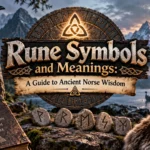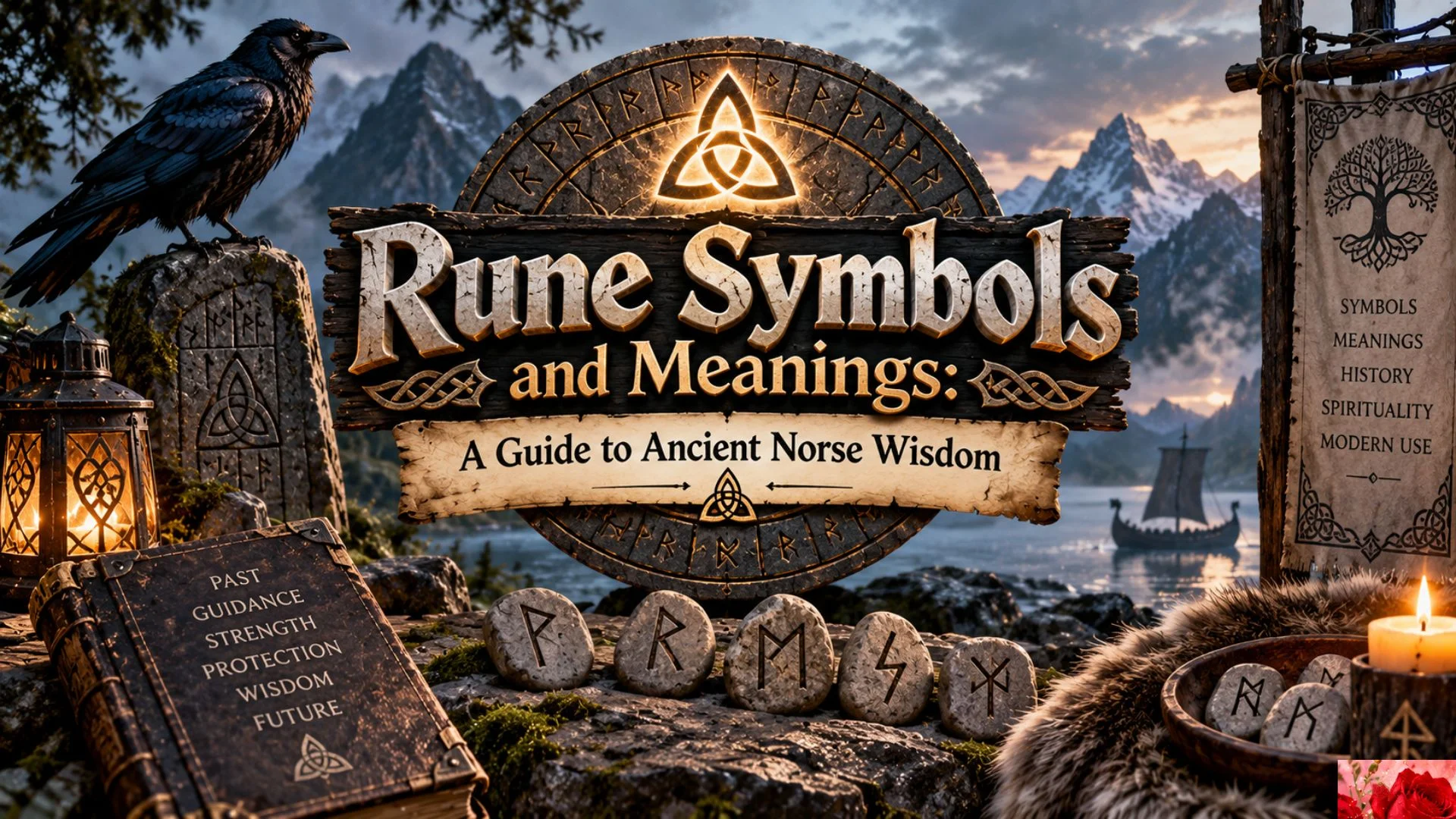
The word “rune” itself comes from a root meaning both “a secret” and “to whisper,” reflecting a time when knowledge passed orally from shaman to pupil. Each rune carries layers of meaning—literal, mythological, and magical. The Elder Futhark, the oldest complete runic system with 24 symbols, remains the most widely used for divination today. This guide explores the origins, structure, and detailed meanings of these powerful symbols, from Fehu’s wealth to Othala’s ancestral heritage.
Quick Answer
Rune symbols and meanings refer to the 24 characters of the Elder Futhark, an ancient Germanic alphabet used for writing, magic, and divination. Each rune represents a concept: Fehu means wealth, Uruz means strength, Thurisaz means protection, Ansuz means divine wisdom, and so on. Runes are divided into three groups of eight (aettir) and carry deep mythological significance tied to Norse gods and natural forces.
Meaning Overview Table
| Aspect | Meaning |
|---|---|
| Definition | Ancient Germanic symbols used for writing, magic, and divination, each carrying specific philosophical and spiritual meanings |
| Pronunciation | ROON SIM-buhlz and MEE-ningz |
| Part of Speech | Noun phrase |
| Usage | “Studying rune symbols and meanings helps modern practitioners connect with Norse spiritual traditions.” |
| Context | Divination, Norse mythology, Germanic history, modern spirituality, tattoo art |
Main Meaning
Definition
Rune symbols and meanings refer to the characters of the runic alphabets used by Germanic peoples, particularly the Elder Futhark. Each symbol represents both a sound and a concept, allowing runes to function as letters, ideograms, and magical sigils simultaneously. Modern practitioners use runes for divination, meditation, and spiritual growth.
Origin
The runic alphabet emerged around the 2nd century CE among Germanic groups. The Elder Futhark, with its 24 characters, represents the oldest complete system. Scholars debate its exact origins, though many trace influences to Latin, Greek, and Etruscan alphabets. Norse mythology attributes the runes’ discovery to Odin, who hung on Yggdrasil for nine days and nights, sacrificing himself to himself to gain their wisdom. The poem Hávamál records this event, describing how Odin seized the runes screaming and subsequently learned their secrets.
Context
Runes function in several contexts:
- Historical Writing: Germanic peoples carved runes on stone, bone, wood, and metal for memorials, ownership marks, and messages
- Divination: Modern practitioners cast runes to gain insight into past, present, and future
- Magic and Ritual: Runes served as talismans, curses, and protective sigils in ancient times
- Modern Spirituality: Contemporary Heathens and pagans use runes for meditation, self-discovery, and connection with Norse heritage
- Art and Fashion: Rune designs appear in tattoos, jewelry, and decorative art
Modern Usage
Today, rune symbols and meanings appear in diverse settings. Diviners cast rune stones and interpret their messages. Heathen practitioners incorporate runes into rituals honoring Norse deities. Artists use runic designs in tattoos and jewelry. Scholars study runic inscriptions to understand Germanic history and language. Each use respects the ancient traditions while adapting them for contemporary needs.
Detailed Explanation
Literal Meaning
Literally, each rune represents a sound in the Germanic languages. The Elder Futhark contains 24 runes, divided into three groups of eight called aettir (singular: aett). The first aett belongs to Freyr and Freyja, the second to Heimdall, and the third to Tyr. This structure organizes the runes and reflects cosmological principles.
Common Meaning
Commonly, people associate runes with divination and magic. Each rune carries a name and meaning rooted in Norse cosmology. For example, Fehu means “cattle” or “wealth,” Uruz means “aurochs” or “strength,” and Ansuz means “god” or “divine breath.” These meanings form the foundation for interpreting runes in readings.
Divination Meaning
In divination, practitioners interpret rune meanings based on their position and relationship to other runes. A single rune drawn from a bag might answer a specific question. Three runes might represent past, present, and future. More complex spreads provide deeper insight. The meanings shift depending on context, orientation (upright or reversed), and the querent’s situation.
Magical Meaning
In magical practice, runes serve as sigils for protection, attraction, and transformation. Ancient Germanic peoples carved runes on weapons, amulets, and boundary markers. The Icelandic grimoire Galdrabók records runic spells for various purposes. Modern practitioners continue these traditions, using runes in talismans and rituals.
Cultural Meaning
Culturally, runes represent Norse and Germanic heritage. They connect modern people to ancient traditions, myths, and spiritual practices. Runes appear in popular culture through films, video games, and books. However, respectful study acknowledges their sacred origins and avoids trivializing their significance.
Examples Table
| Example | Meaning |
|---|---|
| Fehu (ᚠ) | Wealth, cattle, abundance, financial success |
| Uruz (ᚢ) | Strength, vitality, health, wild energy |
| Thurisaz (ᚦ) | Protection, conflict, Thor’s hammer, defensive force |
| Ansuz (ᚨ) | Divine wisdom, communication, Odin’s breath, inspiration |
| Raidho (ᚱ) | Journey, travel, movement, cosmic order |
| Kenaz (ᚲ) | Fire, creativity, illumination, knowledge |
| Gebo (ᚷ) | Gift, exchange, partnership, generosity |
| Wunjo (ᚹ) | Joy, harmony, contentment, belonging |
| Hagalaz (ᚺ) | Disruption, hail, transformation, unavoidable change |
| Nauthiz (ᚾ) | Need, necessity, constraint, resilience |
| Isa (ᛁ) | Ice, stillness, patience, frozen conditions |
| Jera (ᛃ) | Harvest, cycles, reward, seasonal change |
| Eihwaz (ᛇ) | Yew tree, endurance, protection, transformation |
| Perthro (ᛈ) | Mystery, fate, hidden knowledge, destiny |
| Algiz (ᛉ) | Protection, higher self, divine connection |
| Sowilo (ᛊ) | Sun, success, vitality, guidance |
| Tiwaz (ᛏ) | Justice, honor, victory, self-sacrifice |
| Berkano (ᛒ) | Birth, growth, nurturing, fertility |
| Ehwaz (ᛖ) | Horse, partnership, trust, movement |
| Mannaz (ᛗ) | Humanity, self, community, social order |
| Laguz (ᛚ) | Water, intuition, flow, emotional depth |
| Ingwaz (ᛜ) | Fertility, potential, gestation, internal growth |
| Dagaz (ᛞ) | Day, breakthrough, awakening, transformation |
| Othala (ᛟ) | Ancestral property, heritage, inheritance, home |
Related Meanings Table
| Related Term | Meaning |
|---|---|
| Elder Futhark | The oldest runic alphabet with 24 characters |
| Younger Futhark | A reduced runic alphabet with 16 characters used in Viking Age Scandinavia |
| Anglo-Saxon Futhorc | An extended runic alphabet used in England |
| Aett | A group of eight runes within the Elder Futhark |
| Wyrd | Fate or destiny in Norse cosmology |
| Yggdrasil | The World Tree connecting the nine realms |
| Odin | The Norse god who discovered the runes |
| Seiðr | A form of Norse magic involving trance and prophecy |
| Galdr | Runic chanting or singing used in magic |
| Blót | A Norse sacrificial ritual |
| Heathenry | Modern reconstruction of Norse paganism |
| Asatru | A form of modern Heathenry |
| Bindrune | Two or more runes combined into a single symbol |
| Rune stone | A stone with runic inscriptions |
| Rune casting | The practice of throwing runes for divination |
| Runic talisman | An object inscribed with runes for magical purposes |
Common Uses
People use rune symbols and meanings in various contexts:
Divination: Practitioners cast rune stones or tiles to answer questions and gain insight. Common spreads include the single-rune draw, the three-rune spread (past, present, future), and the nine-rune grid.
Meditation: Meditators focus on individual runes to absorb their qualities. Contemplating Fehu might inspire abundance thinking. Meditating on Algiz might strengthen protective instincts.
Talismans and Amulets: People inscribe runes on jewelry, stones, or paper to create talismans. A combination of Algiz and Sowilo might form a protective and success-bringing amulet.
Ritual: Heathen practitioners incorporate runes into blóts, sumbels, and other rituals. They might carve runes into candles or offer rune-inscribed objects to deities.
Art and Tattoos: Rune designs appear in tattoos, paintings, and jewelry. Some choose runes for their aesthetic appeal; others select them for personal meaning.
Common Mistakes
| Mistake | Correction |
|---|---|
| Assuming all runes are from the Elder Futhark | Different runic systems exist: Elder Futhark, Younger Futhark, Anglo-Saxon Futhorc |
| Believing runes are only for divination | Runes served as writing, magic, and memorial symbols |
| Confusing rune meanings with Tarot | Runes have distinct meanings rooted in Norse cosmology, not Tarot archetypes |
| Ignoring the mythology behind runes | Understanding Odin’s sacrifice and Norse cosmology deepens rune work |
| Using runes without respect for their origins | Approach runes with cultural appreciation and historical awareness |
| Assuming reversed runes always mean the opposite | Reversed meanings vary by rune and context; they are not simple negations |
| Believing runes are inherently evil | Runes are neutral tools; intention determines their use |
| Mixing runic systems without understanding them | Elder Futhark, Younger Futhark, and Futhorc have different structures and uses |
| Using runes for harm | Norse tradition emphasizes wyrd and ethical responsibility; harmful intent backfires |
| Treating runes as a party trick | Runes deserve serious study and respectful practice |
Related Questions
What is the most powerful rune?
No single rune is “most powerful.” Each carries unique energy. Algiz offers protection, Sowilo brings success, and Tiwaz provides justice. The most powerful rune depends on the purpose and context.
Which rune means love?
Gebo (ᚷ) often represents love and partnership because it symbolizes gifts and exchange. Wunjo (ᚹ) also relates to joy and harmony in relationships.
What rune means strength?
Uruz (ᚢ) means strength and vitality, named after the aurochs, a powerful wild ox.
What rune means protection?
Algiz (ᛉ) is the primary protection rune, representing the elk’s antlers and divine shielding. Thurisaz (ᚦ) also offers defensive protection.
Can I wear runes as jewelry?
Yes, many people wear rune jewelry for protection, guidance, or aesthetic appeal. Choose runes whose meanings resonate with your intentions.
How do I start working with runes?
Begin by studying the Elder Futhark and its meanings. Obtain a rune set, practice simple draws, and keep a journal of your insights. Read mythological sources like the Poetic Edda and Hávamál.
Are runes dangerous?
Runes themselves are not dangerous. However, some practitioners believe certain runes (like Hagalaz) bring challenging energies. Approach all runes with respect and clear intention.
What is the difference between Elder and Younger Futhark?
Elder Futhark has 24 runes and dates to the 2nd century CE. Younger Futhark has 16 runes and emerged around 800 CE for Old Norse. Elder Futhark suits divination; Younger Futhark fits Viking Age inscriptions.
FAQs
What are runes?
Runes are characters from ancient Germanic alphabets used for writing, magic, and divination. The Elder Futhark, with 24 symbols, remains the most popular for modern practice.
How many runes are there?
The Elder Futhark contains 24 runes, divided into three aettir of eight. Other systems vary: Younger Futhark has 16, and Anglo-Saxon Futhorc has up to 33.
What is the origin of runes?
Runes emerged around the 2nd century CE among Germanic peoples. Norse mythology credits Odin with discovering them through self-sacrifice on Yggdrasil.
Can anyone use runes?
Yes, anyone can study and use runes. However, respectful practice involves learning their history, mythology, and cultural context.
What is a bindrune?
A bindrune combines two or more runes into a single symbol, often for magical purposes. For example, combining Algiz and Sowilo creates a protective and success-bringing talisman.
How do I read runes?
Cast runes from a bag or lay them in spreads. Interpret each rune’s meaning based on its position and relationship to other runes. Trust your intuition while honoring traditional meanings.
What rune represents death?
Hagalaz (ᚺ) often represents disruptive change and transformation, not physical death. Eihwaz (ᛇ) relates to the yew tree, associated with death and rebirth.
Are runes still used today?
Yes, modern Heathens, pagans, and spiritual seekers use runes for divination, meditation, and magic. Scholars study runic inscriptions for historical insight.
Conclusion
Rune symbols and meanings offer a profound system of wisdom rooted in ancient Germanic and Norse traditions. From Fehu’s wealth to Othala’s ancestral heritage, each rune carries layers of meaning that deepen with study and practice. The Elder Futhark, with its 24 characters organized into three aettir, provides a complete framework for divination, meditation, and spiritual growth. Modern practitioners honor these ancient symbols by approaching them with respect, knowledge, and clear intention. Whether you seek guidance through divination, connection with Norse heritage, or simply a deeper understanding of these fascinating symbols, runes reward sincere study. As you explore rune symbols and meanings, remember that they represent more than letters—they are keys to a worldview where every symbol carries power, purpose, and the whisper of ancient wisdom.

Natalie Brooks is a content researcher and writer with a strong interest in word meanings, dream interpretations, symbolism, and cultural insights. She is passionate about creating clear, informative, and easy-to-understand content that helps readers discover the deeper meanings behind words, names, dreams, and symbols. Through her work at Meanzly, Natalie aims to make knowledge accessible and valuable for readers around the world.