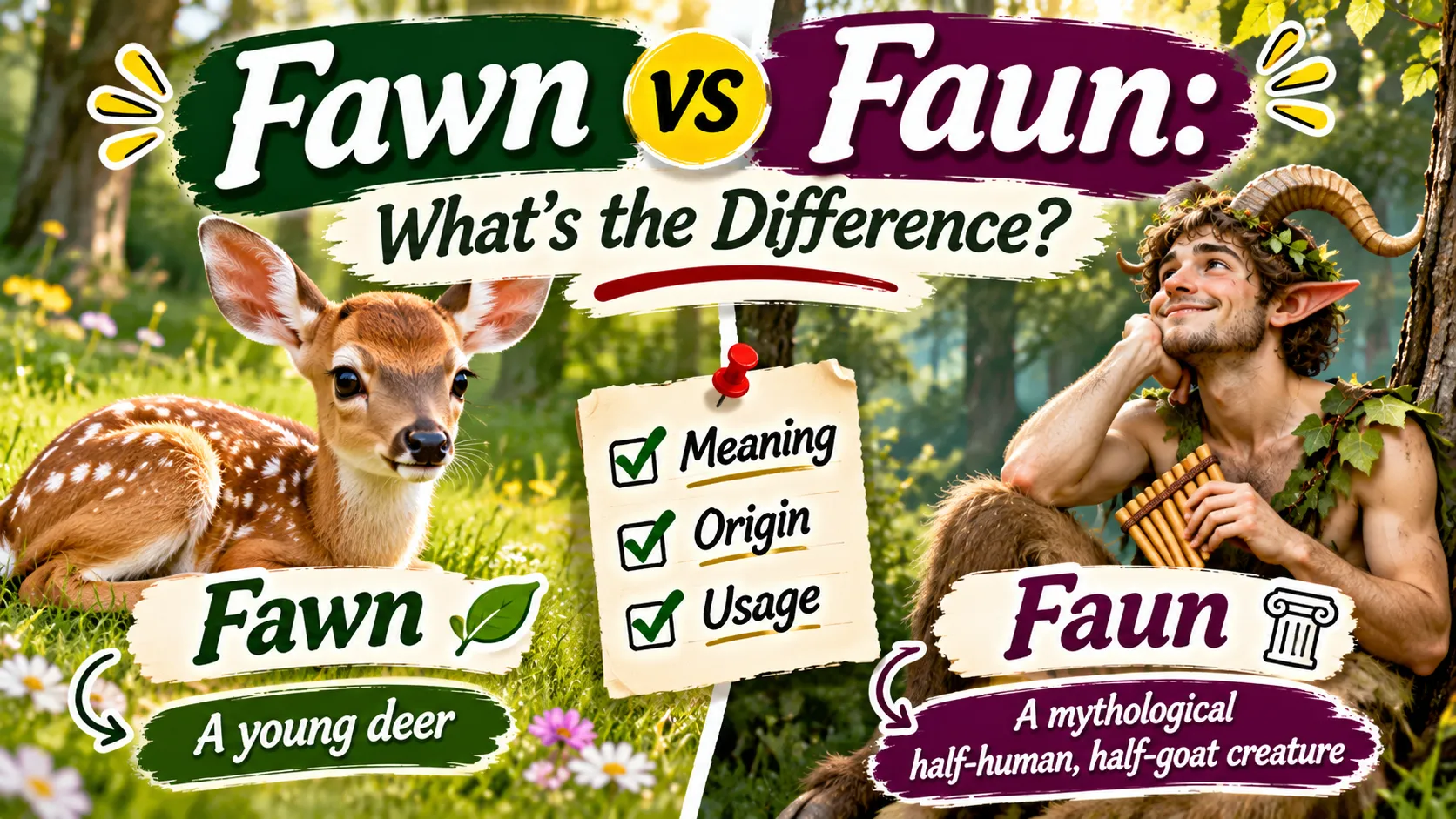
The words “fawn” and “faun” sound identical, differ by just one letter, and appear in contexts ranging from wildlife to mythology. The fawn vs faun confusion ranks among the most common homophone errors in English writing, appearing in everything from nature articles to fantasy fiction.
“Fawn” is a noun referring to a young deer, and as a verb means to show excessive flattery or affectionate behavior. “Faun” is a noun referring to a mythological creature—half human, half goat—from Roman mythology. These words share identical pronunciation but no shared meaning. This comprehensive guide explains the difference, explores their origins, provides practical examples, and helps you choose the correct word every time you write.
Quick Answer
“Fawn” refers to a young deer or the act of flattering someone excessively, as in “a spotted fawn” or “fawn over a celebrity.” “Faun” refers to a mythological creature from Roman mythology, half human and half goat, associated with nature and fertility. Remember: a fawn is a baby deer; a faun is a mythical being. They sound the same but mean completely different things.
Meaning Overview Table
| Aspect | Meaning |
|---|---|
| Definition | Fawn: a young deer; to flatter excessively. Faun: a mythological half-human, half-goat creature |
| Pronunciation | Both: /fɔːn/ |
| Part of Speech | Fawn: noun and verb. Faun: noun |
| Usage | “The fawn followed its mother” vs. “The faun played a flute in the forest” |
| Context | Fawn: wildlife, nature, behavior. Faun: mythology, fantasy, literature |
Main Meaning
Definition
Fawn functions as both a noun and a verb. As a noun, it refers to a young deer, especially one still dependent on its mother. As a verb, it means to show exaggerated flattery, affection, or servility toward someone. Faun is a noun referring to a mythological creature from Roman mythology, depicted as half human and half goat, often associated with forests, fertility, and nature.
Origin
“Fawn” comes from the Old French faon, meaning “young animal,” which traces to the Latin fetus, meaning “offspring.” The noun entered English in the 14th century. The verb sense of flattering developed from the behavior of a dog showing affection, from the Old English fægnian, meaning “to rejoice” or “to flatter.”
“Faun” comes from the Latin Faunus, a Roman god of the forest, fields, and herds. Faunus was equivalent to the Greek god Pan. The word entered English in the 14th century through Latin and French, always referring to the mythological creature.
Context
The distinction matters across several contexts:
- Wildlife and Nature Writing: “Fawn” appears in discussions of deer, forests, and animal behavior
- Behavior and Social Contexts: “Fawn” as a verb describes flattering or overly affectionate behavior
- Mythology and Fantasy: “Faun” appears in discussions of Roman mythology, fantasy literature, and art
- Everyday Writing: Confusing the two creates embarrassing errors in emails, essays, and social media posts
Modern Usage
Today, “fawn” appears frequently in nature writing, wildlife photography, and behavioral descriptions. “Faun” appears in discussions of mythology, fantasy fiction, and art history. The most famous modern faun is Mr. Tumnus from C.S. Lewis’s The Chronicles of Narnia. The confusion between the two persists because they sound identical and spell-check often fails to catch the error.
Detailed Explanation
Literal Meaning
Literally, “fawn” means a young deer. “Faun” literally means a mythological creature with human and goat features. These literal meanings remain the primary definitions of both words.
Common Meaning
Commonly, people use “fawn” to describe a young deer or to describe someone who flatters excessively. They use “faun” when discussing mythology, fantasy, or classical art.
Wildlife Meaning
In nature, a fawn is a young deer, typically less than one year old. Fawns have spotted coats that provide camouflage in forests and fields. Does (female deer) protect their fawns fiercely. Fawn birthing season occurs in spring.
Behavioral Meaning
As a verb, “fawn” means to show excessive flattery, affection, or servility. Someone who “fawns over” a celebrity showers them with praise and attention. The verb carries a slightly negative connotation of insincere or excessive flattery.
Mythological Meaning
In Roman mythology, a faun is a creature with the upper body of a human and the lower body of a goat, often depicted with horns and a tail. Fauns are associated with forests, fertility, music, and nature. They are similar to Greek satyrs but generally gentler and more playful.
Literary Meaning
In literature, fauns appear in classical poetry, Renaissance art, and modern fantasy. C.S. Lewis’s Mr. Tumnus in The Lion, the Witch and the Wardrobe is the most famous modern literary faun.
Examples Table
| Example | Meaning |
|---|---|
| The fawn followed its mother through the forest. | A young deer |
| She fawned over the famous actor. | Showed excessive flattery |
| The faun played a flute in the clearing. | A mythological creature |
| The spotted fawn hid in the tall grass. | A young deer |
| He fawns on his boss to get promotions. | Flatters excessively |
| The statue depicted a faun dancing. | A mythological creature |
| A doe protected her fawn from predators. | A young deer |
| Fans fawned over the pop star at the airport. | Showed excessive attention |
| The faun had goat legs and human torso. | A mythological creature |
| The fawn’s spots faded as it grew older. | A young deer |
Related Meanings Table
| Related Term | Meaning |
|---|---|
| Fawn | A young deer; to flatter excessively |
| Faun | A mythological half-human, half-goat creature |
| Doe | A female deer; mother of a fawn |
| Buck | A male deer |
| Stag | A male deer, especially with antlers |
| Satyr | A Greek mythological creature similar to a faun |
| Pan | Greek god of the wild, similar to Faunus |
| Faunus | Roman god of the forest; origin of “faun” |
| Deer | The broader animal family that includes fawns |
| Nymph | A female nature spirit in mythology |
| Flatter | To praise excessively; similar to fawn (verb) |
| Adulate | To praise excessively; similar to fawn (verb) |
| Spotted | Having spots, like a fawn’s coat |
| Antlers | Bony growths on male deer |
| Forest | A common habitat for both deer and fauns |
Common Uses
People use “fawn” and “faun” across numerous contexts:
Wildlife and Nature Writing: Nature writers describe fawns in forests, meadows, and wildlife reserves. Wildlife photographers capture images of fawns with their mothers.
Behavior and Social Contexts: People describe flattering behavior as “fawning.” “She fawned over the CEO” means she showed excessive flattery.
Mythology and Fantasy: Fauns appear in fantasy fiction, role-playing games, and art. The most famous modern faun is Mr. Tumnus from Narnia.
Art History: Classical and Renaissance art often depicts fauns. Sculptures, paintings, and mosaics feature these mythological creatures.
Everyday Speech: “Fawn over” appears constantly in celebrity gossip and social media. “The color fawn” (a pale yellowish-brown) also appears in fashion and design.
Common Mistakes
| Mistake | Correction |
|---|---|
| Writing “faun over a celebrity” | Write “fawn over a celebrity” (show excessive flattery) |
| Writing “a young faun in the forest” | Write “a young fawn in the forest” (a deer) |
| Writing “the fawn played a flute” | Write “the faun played a flute” (mythological creature) |
| Writing “a spotted faun” | Write “a spotted fawn” (a deer) |
| Writing “the mythological fawn” | Write “the mythological faun” (a creature) |
| Writing “the faun’s mother protected it” | Write “the fawn’s mother protected it” (a deer) |
| Assuming spell-check will catch the error | Spell-check often misses homophones; proofread manually |
| Writing “half-goat fawn” | Write “half-goat faun” (mythological creature) |
| Writing “faun-colored coat” | Write “fawn-colored coat” (pale yellowish-brown) |
| Writing “Narnia’s fawn” | Write “Narnia’s faun” (Mr. Tumnus) |
Related Questions
Is it “fawn” or “faun”?
It depends on meaning. Use “fawn” for a young deer or the act of flattering. Use “faun” for the mythological creature.
What does “fawn” mean?
“Fawn” refers to a young deer, or as a verb, the act of showing excessive flattery or affection.
What does “faun” mean?
“Faun” refers to a mythological creature from Roman mythology, half human and half goat.
What is the difference between “fawn” and “faun” in a sentence?
“Fawn” relates to deer or flattering behavior. “Faun” relates to mythology and fantasy.
What is the most famous faun in literature?
Mr. Tumnus from C.S. Lewis’s The Chronicles of Narnia is the most famous modern literary faun.
Can “fawn” be a verb?
Yes. “Fawn” as a verb means to show excessive flattery or affection, as in “fawn over a celebrity.”
Why do people confuse “fawn” and “faun”?
They sound identical and differ by only one letter. Spell-check often misses homophones, so the error persists in written communication.
FAQs
What does “fawn” mean?
“Fawn” refers to a young deer, or as a verb, the act of showing excessive flattery or affection. It also describes a pale yellowish-brown color.
What does “faun” mean?
“Faun” refers to a mythological creature from Roman mythology, half human and half goat, associated with forests and nature.
Is it “fawn over” or “faun over”?
The correct phrase is “fawn over.” Fawn means to show excessive flattery.
Is it “a young fawn” or “a young faun”?
The correct phrase for a young deer is “a young fawn.” “Faun” refers to a mythological creature.
What is the difference between a faun and a satyr?
Fauns come from Roman mythology and are generally gentler and more playful. Satyrs come from Greek mythology and are often wilder and more associated with revelry.
Can “fawn” describe a color?
Yes. “Fawn” describes a pale yellowish-brown color, often used in fashion and design.
How can I remember the difference?
Remember: “fawn” has “aw” like “deer” (a young deer). “Faun” has “au” like “myth” (a mythological creature). If you’re talking about a baby deer or flattery, use fawn. If you’re talking about mythology, use faun.
What is the origin of “faun”?
“Faun” comes from the Latin Faunus, a Roman god of the forest and fields, equivalent to the Greek god Pan.
Conclusion
Mastering the fawn vs faun distinction protects your writing from embarrassing homophone errors. “Fawn” refers to a young deer or the act of showing excessive flattery. “Faun” refers to a mythological creature from Roman mythology, half human and half goat. Remember the simple rule: a fawn is a baby deer; a faun is a mythical being. Whether you’re writing a nature article, a fantasy story, or a social media post, choosing the correct word ensures your meaning is clear. Practice using “fawn” for deer and flattery, and “faun” for mythology and fantasy, and your readers will understand exactly what you intend. Small distinctions like this separate careful writers from careless ones.

Natalie Brooks is a content researcher and writer with a strong interest in word meanings, dream interpretations, symbolism, and cultural insights. She is passionate about creating clear, informative, and easy-to-understand content that helps readers discover the deeper meanings behind words, names, dreams, and symbols. Through her work at Meanzly, Natalie aims to make knowledge accessible and valuable for readers around the world.