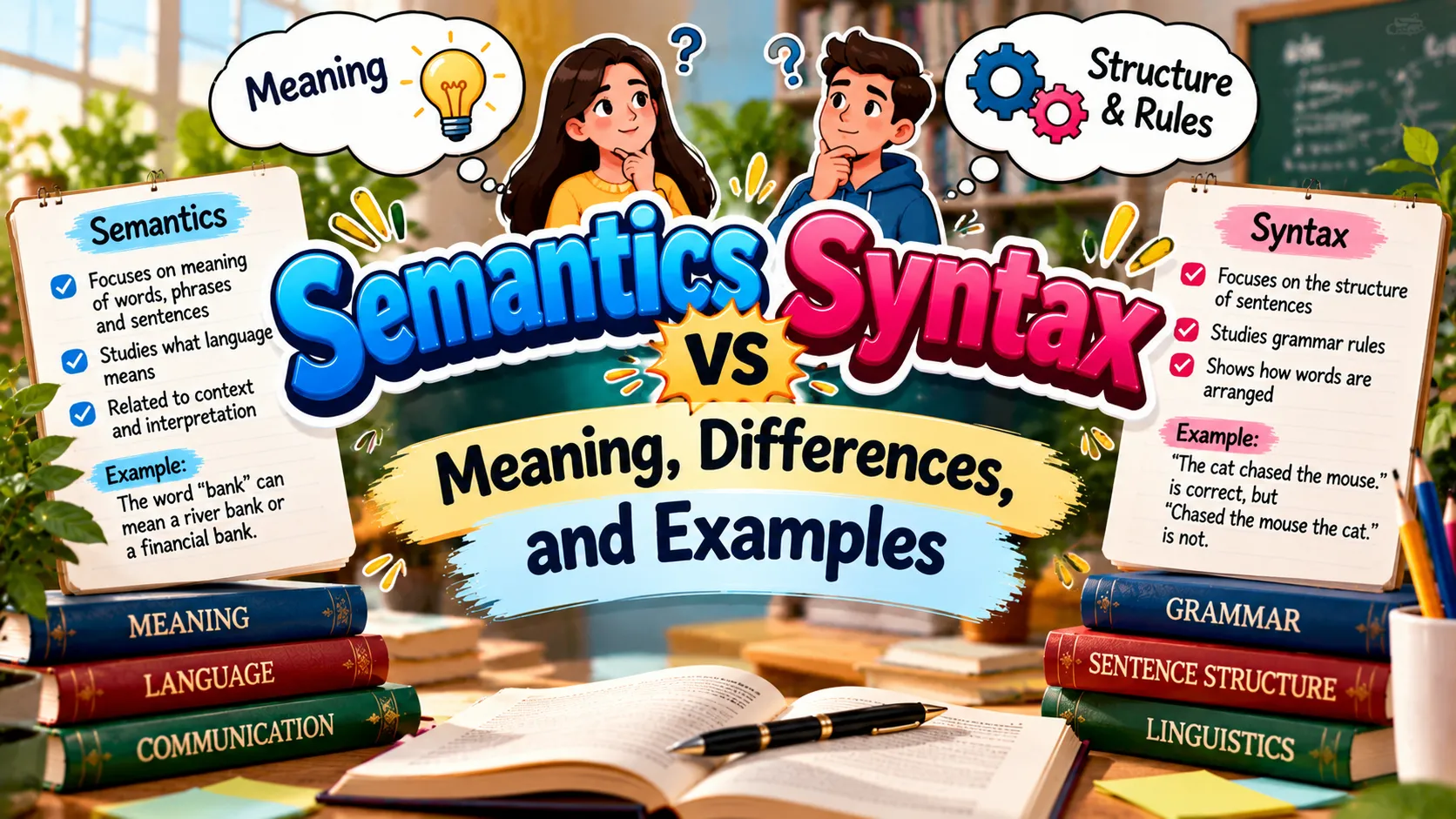
Understanding semantics vs syntax is essential for learning English grammar, improving writing skills, studying linguistics, and understanding how language communicates meaning. Although these two concepts are closely related, they describe different aspects of language. Syntax focuses on how words are arranged to form grammatically structured phrases and sentences, while semantics focuses on the meaning those words, phrases, and sentences convey.
For example, the sentence “The cat chased the mouse” follows a standard English sentence structure and communicates a clear meaning. If you rearrange the words to say “Mouse the chased cat the,” the sentence becomes difficult to interpret because its syntax is incorrect for ordinary English. However, a sentence can follow correct grammatical rules and still communicate an unusual or illogical idea. For instance, “The stone ate the sandwich” has a recognizable grammatical structure, but its meaning is unusual because stones do not ordinarily eat.
Understanding the difference between syntax and semantics helps you identify grammatical errors, interpret sentences accurately, and communicate ideas more effectively. In this guide, you will learn what syntax and semantics mean, explore their key differences, examine practical examples, and discover how both concepts work together in English and other fields.
📖 What Does Syntax Mean?
Syntax refers to the rules and patterns that govern how words combine to form phrases, clauses, and sentences. It determines the grammatical arrangement of words and helps establish relationships between different parts of a sentence.
In English, a standard declarative sentence often follows a subject-verb-object pattern. For example, “Maria reads books” contains a subject (Maria), a verb (reads), and an object (books). Changing the order of these words can affect grammatical correctness or alter the sentence’s meaning.
Syntax also covers more complex structures, including questions, subordinate clauses, compound sentences, and the placement of modifiers. Learning these patterns helps writers construct sentences that readers can understand.
Examples of Syntax in English
- Correct: The boy kicked the ball.
- Incorrect: Boy the ball the kicked.
- Correct: She is reading a book.
- Incorrect: She reading is a book.
- Correct: Although it was raining, we went outside.
- Incorrect: Although raining it was, outside went we.
These examples illustrate how word order and grammatical patterns affect sentence structure.
Main Elements of Syntax
Word order: Syntax determines the usual arrangement of subjects, verbs, and objects. “The dog chased the cat” has a different structure from “The cat chased the dog,” and the two sentences communicate different events.
Phrases: A phrase is a group of words that functions as a unit. Examples include the tall building, under the table, and has been working.
Clauses: A clause contains a subject and a predicate. Independent clauses can stand alone as sentences, while dependent clauses rely on other clauses to complete their grammatical role.
Sentence structure: Syntax governs how clauses combine to create simple, compound, complex, and compound-complex sentences.
Modifiers: Syntax influences where descriptive words and phrases appear. Incorrect placement can create ambiguity or make a sentence difficult to understand.
In short, syntax provides the structural framework that allows words to form organized expressions.
💡 What Does Semantics Mean?
Semantics is the study of meaning in language. It examines how words, phrases, sentences, and other linguistic expressions communicate information.
For example, the word book refers to a type of written or printed work, while the sentence “The book is on the table” communicates a relationship between the book and its location. Semantics considers how the meanings of individual words combine to produce the meaning of a complete sentence.
Semantics also examines relationships between words, including synonyms, antonyms, ambiguity, and multiple meanings. The word bank, for instance, can refer to a financial institution or the land beside a river. The surrounding language helps readers determine which meaning is intended.
Examples of Semantics in English
- Sentence: The baby is sleeping.
Meaning: A baby is currently asleep. - Sentence: The glass is full.
Meaning: The glass contains liquid up to its capacity or near it, depending on context. - Sentence: The light is bright.
Meaning: The light produces a strong level of illumination. - Sentence: He has a cold heart.
Meaning: He is emotionally unkind or lacks sympathy; the phrase is figurative rather than literal. - Sentence: She visited the bank.
Meaning: The sentence is ambiguous without additional context because bank can have different meanings.
These examples show that semantics concerns what language expresses, including literal meanings and certain conventional figurative meanings.
Main Elements of Semantics
Word meaning: Semantics studies what individual words mean and how those meanings relate to other words.
Sentence meaning: It examines how words and grammatical relationships combine to express a complete idea.
Synonyms and antonyms: Synonyms have similar meanings, while antonyms express contrasting meanings. For example, happy and joyful are synonyms in many contexts, while happy and sad are antonyms.
Ambiguity: A word or sentence may have more than one possible interpretation. Semantics helps identify these different meanings.
Literal and figurative meaning: Words can communicate direct meanings or established figurative meanings, as in “She has a heart of gold.”
Semantics helps explain what a sentence communicates rather than simply how its words are arranged.
⚖️ Semantics vs Syntax: Key Differences
The main difference between semantics and syntax is that syntax concerns structure, while semantics concerns meaning. Syntax determines how words and phrases are organized, whereas semantics examines what those expressions mean.
| Feature | Syntax | Semantics |
|---|---|---|
| Main focus | Grammatical structure | Meaning |
| Main question | How are words arranged? | What do the words communicate? |
| Studies | Word order, phrases, clauses, sentence patterns | Word meanings, sentence meanings, ambiguity, meaning relationships |
| Common errors | Incorrect word order or sentence construction | Confusing, contradictory, or unusual meanings |
| Example | “The dog chased the cat” follows a standard structure. | The sentence describes a dog pursuing a cat. |
| Importance | Helps form grammatically organized sentences | Helps communicate and interpret ideas |
Consider the sentence “The green ideas sleep furiously.” Its grammatical arrangement is recognizable in English: a noun phrase followed by a verb phrase, with words in familiar positions. However, its meaning is unusual because abstract ideas are not ordinarily green or capable of sleeping furiously.
This example illustrates how a sentence can have a recognizable syntactic structure while presenting a semantic challenge. Whether a sentence is meaningful can also depend on metaphor, fiction, or a specialized context, so unusual meaning does not automatically make a sentence incorrect.
📝 Examples of Syntax and Semantics Working Together
Syntax and semantics are different, but they work together whenever people speak, read, or write. Syntax helps establish grammatical relationships, while semantics helps people interpret the resulting expression.
Example 1: A Clear Sentence
Sentence: The teacher explained the lesson.
- Syntax: The sentence follows a common subject-verb-object pattern: the teacher is the subject, explained is the verb, and the lesson is the object.
- Semantics: The sentence communicates that a teacher provided an explanation of a lesson.
Both the structure and the meaning are straightforward.
Example 2: A Change in Word Order
Sentence A: The dog chased the boy.
Sentence B: The boy chased the dog.
Both sentences follow standard English syntax, but their meanings differ. In Sentence A, the dog performs the chasing. In Sentence B, the boy performs the chasing.
This example demonstrates that syntax can help establish meaning by identifying the grammatical roles of words.
Example 3: A Grammatically Structured but Unusual Sentence
Sentence: The refrigerator wrote a poem.
- Syntax: The sentence follows a recognizable English structure.
- Semantics: The meaning is unusual in ordinary circumstances because refrigerators do not write poems.
The sentence could still make sense in a fantasy story or as personification. Its unusual meaning does not mean that its syntax is necessarily wrong.
Example 4: A Sentence With Multiple Meanings
Sentence: I saw the man with the telescope.
This sentence has a recognizable grammatical structure, but it can be interpreted in more than one way. The speaker might have used a telescope to see the man, or the man might have had the telescope.
The ambiguity arises because the phrase with the telescope can be associated with different parts of the sentence. Syntax and semantics both contribute to interpreting the possible meanings.
🔍 What Is the Difference Between Syntax, Semantics, and Pragmatics?
Syntax and semantics are often discussed alongside pragmatics, another important area of linguistics. Pragmatics studies how people interpret language in context, including the speaker’s intentions, shared knowledge, and social circumstances.
For example, if someone says, “It’s cold in here,” the literal meaning describes the temperature. Depending on the situation, the speaker may also be indirectly asking someone to close a window or turn up the heat. Pragmatics helps explain that contextual interpretation.
| Concept | Main focus | Example question |
|---|---|---|
| Syntax | Sentence structure | Is the sentence grammatically organized? |
| Semantics | Linguistic meaning | What does the sentence mean? |
| Pragmatics | Meaning in context | What does the speaker intend in this situation? |
These concepts address different but connected aspects of communication. Syntax explains how an expression is structured, semantics examines its linguistic meaning, and pragmatics considers how context influences interpretation.
Understanding all three provides a more complete picture of how language works.
🚫 Common Mistakes When Comparing Semantics and Syntax
Although syntax and semantics are related, treating them as interchangeable terms can lead to confusion.
Assuming syntax and semantics mean the same thing.
Incorrect understanding: Both words refer only to grammar.
Correct understanding: Syntax concerns grammatical structure, while semantics focuses on meaning.
Assuming a grammatically correct sentence must make sense.
A sentence can follow recognizable grammatical rules but express an unusual or contradictory idea. For example, “The square circle rolled away” has a familiar sentence structure, but the phrase square circle presents a conceptual contradiction under ordinary geometric definitions.
Assuming every unusual sentence is grammatically incorrect.
Figurative language, fantasy, poetry, and creative writing often use expressions that depart from ordinary expectations. A sentence may be syntactically well formed even when its literal interpretation seems unusual.
Confusing meaning with context.
Semantics examines linguistic meaning, while pragmatics focuses on how context and communicative intentions influence interpretation. The two areas overlap, but they are not identical.
Assuming word order never affects meaning.
English often relies on word order to identify subjects and objects. “The child hugged the mother” and “The mother hugged the child” use the same words but describe different actions because the grammatical roles have changed.
Recognizing these distinctions makes it easier to analyze sentences and explain why particular expressions are clear, ambiguous, or unusual.
🧠 Easy Ways to Remember Semantics vs Syntax
A simple memory trick can help you distinguish these two concepts.
Syntax = structure. Think of syntax as the arrangement of words that creates a grammatically organized sentence. For example, “The student answered the question” follows a familiar English pattern.
Semantics = meaning. Think of semantics as the message communicated by the sentence. In the same example, the meaning is that a student responded to a question.
You can remember the difference by asking two questions:
- Syntax: Are the words arranged according to a recognizable grammatical pattern?
- Semantics: What does the expression mean, and is that meaning clear in the given context?
For an additional comparison, imagine building a house. Syntax resembles the arrangement of the building’s components, while semantics resembles what the completed design communicates or represents. The analogy is not exact, but it offers a helpful way to remember the distinction.
💻 Syntax vs Semantics in Programming
The terms syntax and semantics are also widely used in computer science. Although their application differs from natural-language linguistics, the central distinction remains similar: syntax concerns form, while semantics concerns meaning or behavior.
Syntax in programming refers to the rules that determine how code must be written. These rules include punctuation, keywords, operators, and the order in which elements appear.
Semantics in programming concerns what valid code means or does when interpreted or executed. A program can contain syntactically valid instructions that do not produce the intended result.
For example, a programming language may reject a statement because it lacks a required symbol. That is a syntax error. A program that runs successfully but calculates the wrong result may contain a logical or semantic problem, depending on the specific issue.
| Feature | Programming syntax | Programming semantics |
|---|---|---|
| Main concern | Valid code structure | Meaning and behavior of code |
| Example problem | Missing closing parenthesis | An expression produces an unintended result |
| Main question | Does the code follow the language’s grammar? | What does the code do? |
| Typical example | An invalid statement that the parser rejects | A valid statement that performs the wrong calculation |
The distinction is useful when learning programming languages, debugging applications, and understanding how computers interpret instructions.
❓ Frequently Asked Questions
What is the main difference between semantics and syntax?
Syntax concerns the rules and patterns used to arrange words into phrases and sentences. Semantics concerns the meanings conveyed by those words and sentences. In simple terms, syntax is about structure, while semantics is about meaning.
Can a sentence be syntactically correct but semantically incorrect?
A sentence can follow grammatical rules while expressing an unusual, contradictory, or implausible meaning. For example, “The refrigerator wrote a poem” has a recognizable grammatical structure, but its literal meaning is unusual in ordinary circumstances. In linguistics, this is often described as a semantic anomaly rather than necessarily a grammatical error.
Can a sentence be meaningful but syntactically incorrect?
Yes. Readers can sometimes understand the intended meaning of a sentence even when its grammar is incorrect. For example, “Yesterday she go to school” communicates an understandable idea, but the verb tense is not standard. The intended meaning remains recoverable despite the syntactic error.
Is semantics part of grammar?
Semantics is closely related to grammar, but linguistics distinguishes it from syntax. Syntax studies grammatical structure, while semantics studies meaning. Both contribute to how people produce and understand language.
What is an example of syntax?
“The children played outside” is an example of a sentence with a standard English structure. It contains a subject, the children, and a verb, played. The word outside adds information about where the action occurred.
What is an example of semantics?
In the sentence “The baby is sleeping,” semantics concerns the meaning that a baby is currently asleep. It focuses on the information communicated by the sentence rather than simply the order of its words.
What is the difference between syntax and pragmatics?
Syntax concerns sentence structure, while pragmatics concerns how context influences interpretation. For example, “Can you open the window?” is grammatically a question about ability, but in an ordinary conversation it often functions as a polite request.
Why are syntax and semantics important?
Syntax helps people construct organized sentences, while semantics helps them express and interpret meaning. Both are important in language learning, writing, reading comprehension, linguistics, translation, and programming.
✅ Conclusion
The difference between semantics vs syntax comes down to structure and meaning. Syntax explains how words are arranged to form grammatical phrases and sentences, while semantics examines what those expressions communicate. A sentence may have a recognizable grammatical structure but still express an unusual or ambiguous idea, showing why these two concepts must be considered separately.
Remember this simple rule: syntax is how language is structured, and semantics is what language means. Pragmatics adds another layer by explaining how context and a speaker’s intentions influence interpretation. Together, these concepts help us understand how language communicates ideas, how readers interpret sentences, and how writers can express themselves more clearly.

Natalie Brooks is a content researcher and writer with a strong interest in word meanings, dream interpretations, symbolism, and cultural insights. She is passionate about creating clear, informative, and easy-to-understand content that helps readers discover the deeper meanings behind words, names, dreams, and symbols. Through her work at Meanzly, Natalie aims to make knowledge accessible and valuable for readers around the world.