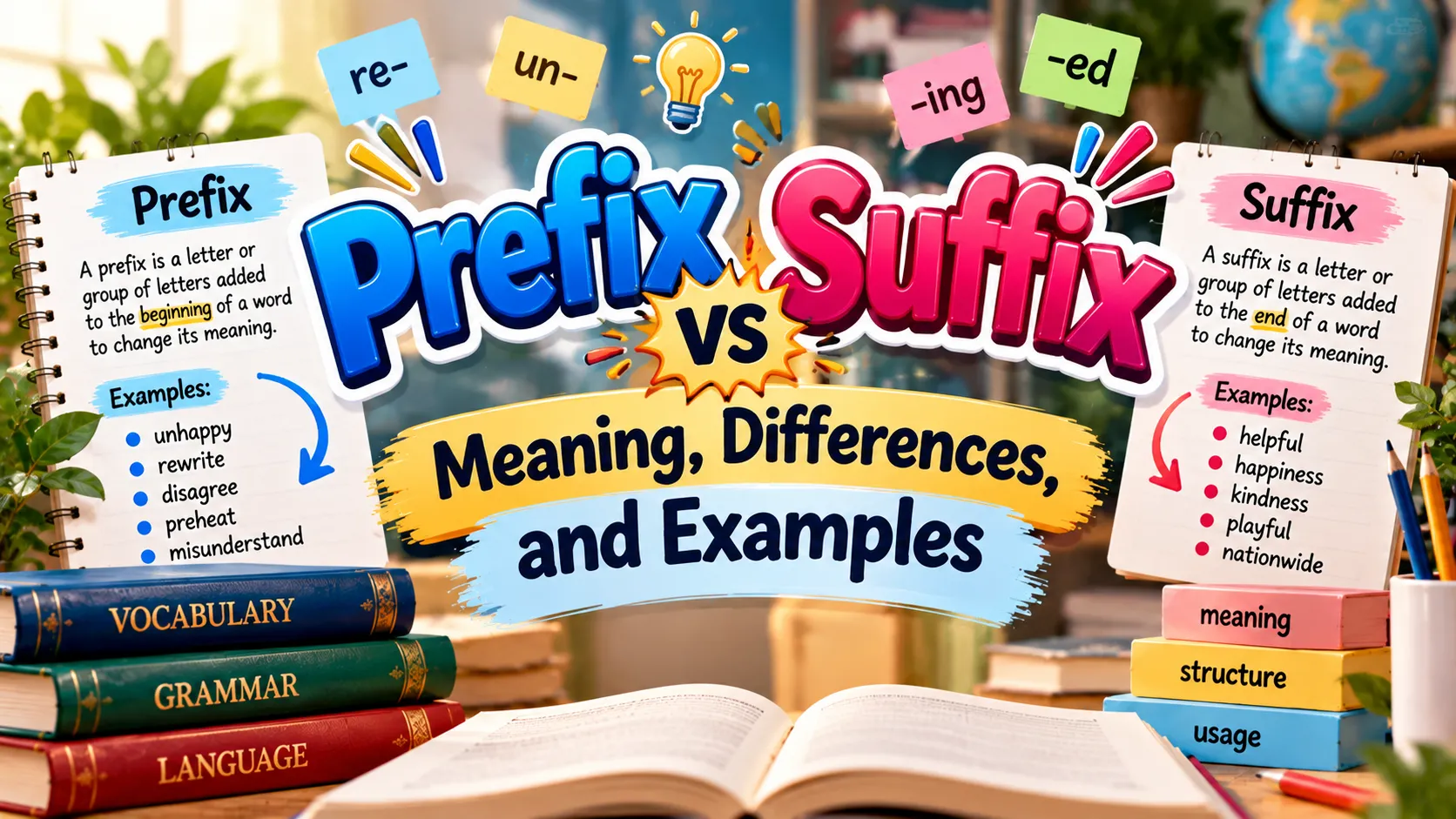
Understanding prefix vs suffix is an important part of learning English vocabulary, spelling, and word formation. Prefixes and suffixes are types of affixes, which are word parts added to a base word to change its meaning or grammatical function. Although both help create new words, they appear in different positions and often serve different purposes.
A prefix is added to the beginning of a word, while a suffix is added to the end. For example, adding un- to happy creates unhappy, meaning not happy. Adding -ness to happy creates happiness, a noun that describes the state of being happy. These small word parts can help you understand unfamiliar vocabulary and recognize relationships between words.
Learning the difference between prefixes and suffixes can improve your reading comprehension, writing skills, and ability to understand complex words. In this guide, you will discover what prefixes and suffixes mean, explore common examples, compare their functions, and learn how to identify and use them correctly.
📖 What Is a Prefix?
A prefix is a group of letters added to the beginning of a base word or root to create a new word or modify its meaning. Prefixes commonly change a word’s meaning by expressing negation, repetition, time, position, degree, or relationships between ideas.
For example, adding the prefix un- to kind creates unkind, which means not kind. Adding re- to write creates rewrite, meaning to write something again. In both examples, the prefix appears before the base word and changes its meaning.
Prefixes generally do not change a word’s grammatical category. For instance, happy and unhappy are both adjectives, while write and rewrite are both verbs. However, the grammatical effect of a prefix depends on the particular word and its usage.
Examples of Prefixes in English
- Un- + happy = unhappy: Not happy.
- Re- + read = reread: Read again.
- Pre- + view = preview: View something beforehand.
- Dis- + agree = disagree: Have a different opinion or not agree.
- Mis- + understand = misunderstand: Understand incorrectly.
- Over- + cook = overcook: Cook for too long.
- Under- + estimate = underestimate: Estimate something as less than it actually is.
- Non- + fiction = nonfiction: Writing about real people, events, or information rather than invented stories.
- Anti- + social = antisocial: Opposed to or avoiding social interaction, depending on context.
- Sub- + marine = submarine: An underwater vessel; sub- relates to being under.
These examples show how prefixes help expand vocabulary by adding specific meanings to familiar words.
🔤 What Is a Suffix?
A suffix is a group of letters added to the end of a base word or root. Suffixes can change a word’s grammatical category, indicate tense or number, or modify its meaning.
For example, adding -ness to kind creates kindness, a noun describing the quality of being kind. Adding -ful to hope creates hopeful, an adjective meaning full of hope.
Unlike most prefixes, many suffixes play an important role in English grammar. They can turn adjectives into nouns, verbs into nouns, and nouns into adjectives. Other suffixes indicate grammatical information, such as past tense or plural number.
Examples of Suffixes in English
- Kind + -ness = kindness: The quality of being kind.
- Hope + -ful = hopeful: Feeling or expressing hope.
- Care + -less = careless: Not giving sufficient attention.
- Teach + -er = teacher: A person who teaches.
- Quick + -ly = quickly: In a quick manner.
- Create + -ive = creative: Able to produce original ideas or work.
- Develop + -ment = development: The process of developing.
- Walk + -ed = walked: The past-tense form of walk.
- Book + -s = books: More than one book.
- Child + -hood = childhood: The period when someone is a child.
Suffixes allow writers to create related words and express different grammatical meanings without introducing entirely new vocabulary.
⚖️ Prefix vs Suffix: Key Differences
The main difference between a prefix and a suffix is their position in a word. A prefix appears before the base word, while a suffix appears after it. Their functions can also differ, particularly when a suffix changes a word’s grammatical category.
| Feature | Prefix | Suffix |
|---|---|---|
| Position | Beginning of a word | End of a word |
| Main function | Often modifies meaning | Can modify meaning or grammatical function |
| Example | Un + fair = unfair | Fair + ness = fairness |
| Common purpose | Negation, repetition, time, position | Word formation, tense, number, grammatical category |
| Changes word class? | Usually does not | Frequently does |
| Example sentence | It was an unfair decision. | Fairness matters in every decision. |
Consider the base word help. Adding the prefix un- does not normally create a standard word in the same way that adding -ful or -less does. By contrast, adding -ful creates helpful, while adding -less creates helpless. These suffixes produce adjectives with different meanings.
The key is to examine both the position and the function of the added letters. Not every sequence of letters that appears at the beginning or end of a word is a productive prefix or suffix.
🧩 Common Types of Prefixes and Their Meanings
English uses many prefixes to communicate specific ideas. Recognizing them can help you infer the meanings of unfamiliar words, although context and the history of a word still matter.
| Prefix | Meaning | Examples |
|---|---|---|
| Un- | Not or opposite of | Unfair, unhappy, unclear |
| Re- | Again or back | Rewrite, reread, rebuild |
| Pre- | Before | Preview, prepay, prehistoric |
| Dis- | Not, opposite, or reversal | Disagree, disconnect, disapprove |
| Mis- | Incorrectly or badly | Misread, misunderstand, misplace |
| Over- | Too much or above | Overcook, overwork, overestimate |
| Under- | Too little or below | Underpay, underestimate, underground |
| Non- | Not or absence of | Nonfiction, nonverbal, nonessential |
| Anti- | Against or opposed to | Antisocial, antiwar, antibacterial |
| Inter- | Between or among | Interact, international, interconnected |
| Sub- | Under or below | Submarine, substandard, subcategory |
| Super- | Above, beyond, or exceptionally | Superhuman, supermarket, supercharge |
How Prefixes Change Meaning
Prefixes often modify the meaning of the original word without changing its basic grammatical role.
For example, possible and impossible are both adjectives, but they express opposite meanings. Similarly, regular and irregular are adjectives with contrasting meanings.
Prefixes can also communicate time or repetition. Preheat means to heat something beforehand, while reheat means to heat it again. Understanding these patterns can make unfamiliar vocabulary easier to interpret.
However, prefix meanings are not always completely predictable. For example, in- can express negation in inaccurate, but its meaning and pronunciation vary across words. Always consider the complete word and its context.
📝 Common Types of Suffixes and Their Meanings
Suffixes serve several functions in English. Some create new words with different grammatical roles, while others modify a word to express grammatical information.
| Suffix | Common function | Examples |
|---|---|---|
| -ness | Forms nouns from adjectives | Kindness, darkness, happiness |
| -ful | Forms adjectives | Helpful, careful, hopeful |
| -less | Forms adjectives expressing absence | Careless, hopeless, harmless |
| -ly | Often forms adverbs from adjectives | Quickly, slowly, carefully |
| -er | Can identify a person or comparative form | Teacher, worker, faster |
| -ment | Forms nouns | Development, movement, agreement |
| -tion | Often forms nouns | Education, information, celebration |
| -able | Forms adjectives expressing possibility or suitability | Readable, washable, comfortable |
| -ive | Often forms adjectives | Creative, active, effective |
| -ed | Often marks past tense or a participle | Walked, finished, painted |
| -ing | Marks participles or forms gerunds | Running, learning, writing |
| -s / -es | Often marks plurals or third-person singular verbs | Books, boxes, runs |
How Suffixes Change Words
Suffixes can transform a word’s grammatical category. For example, teach is a verb, but teacher is a noun referring to someone who teaches. Likewise, happy is an adjective, while happiness is a noun describing a state or quality.
Some suffixes do not change a word’s basic category. The suffix -ed, for example, can mark the past tense of a verb: walk becomes walked. The suffix -s can mark plural nouns, as in book and books, or third-person singular verbs, as in run and runs.
The correct suffix depends on the intended meaning, the grammatical role of the word, and spelling rules.
🔍 Prefix vs Suffix Examples in Sentences
Seeing prefixes and suffixes in complete sentences makes their functions easier to understand.
Prefix Examples
- The teacher asked us to rewrite the paragraph.
- It was impossible to finish the task in one minute.
- Please preview the presentation before the meeting.
- I misunderstood the instructions.
- The company plans to rebuild the damaged office.
- We should avoid making unfair assumptions.
- She decided to disconnect her phone during the exam.
- The chef had to reheat the soup.
In these sentences, the prefixes modify the meanings of the base words by indicating repetition, negation, incorrectness, or reversal.
Suffix Examples
- Her kindness made everyone feel welcome.
- He is a talented teacher.
- Please read the instructions carefully.
- The team celebrated its achievement.
- The children played in the garden.
- This material is washable.
- She gave a helpful explanation.
- Their friendship has lasted for years.
These examples demonstrate how suffixes can form nouns, adjectives, and adverbs or indicate grammatical information.
🧠 Root Words, Prefixes, and Suffixes
A root or base word provides the central meaning to which prefixes and suffixes can be attached. Understanding how these elements work together makes it easier to break down complex words.
Consider the word unhelpfulness. It contains the base help, the prefix un-, and the suffixes -ful and -ness. The base relates to assistance, helpful describes something that provides assistance, and unhelpfulness refers to the quality of not being helpful.
Here are more examples:
| Base word | Prefix or suffix | New word | Meaning |
|---|---|---|---|
| Happy | Un- | Unhappy | Not happy |
| Happy | -ness | Happiness | The state of being happy |
| Agree | Dis- | Disagree | Not agree |
| Kind | -ness | Kindness | The quality of being kind |
| Read | Re- | Reread | Read again |
| Care | -less | Careless | Lacking sufficient care |
| Use | Mis- | Misuse | Use incorrectly |
| Help | -ful | Helpful | Providing help |
Not all words can accept any prefix or suffix. Word formation follows established patterns, and adding an affix does not always produce a standard English word.
🚫 Common Mistakes With Prefixes and Suffixes
Learners sometimes confuse prefixes and suffixes or assume that they always work in the same way.
Confusing their positions.
A prefix appears at the beginning of a word, as in unhappy. A suffix appears at the end, as in happiness.
Assuming prefixes always reverse meaning.
Some prefixes express negation, such as un- in unfair. Others indicate repetition, such as re- in rewrite, or position, such as sub- in submarine.
Assuming suffixes always change a word’s grammatical category.
Some suffixes create new grammatical forms, such as kind to kindness. Others mark grammatical information without changing the word category, such as walk to walked.
Adding an affix to every word.
Not every prefix or suffix combines naturally with every base word. For example, a word may have a standard negative form with un-, in-, im-, or another prefix, and the choice depends on established usage.
Ignoring spelling changes.
Adding a suffix can change the spelling of a base word. For example, happy becomes happiness, with y changing to i. Similarly, make becomes making, with the final e dropped.
Learning common patterns and checking unfamiliar words in a dictionary can help you avoid these mistakes.
💡 Easy Ways to Remember Prefix vs Suffix
A simple memory trick can help you remember where each affix belongs.
Prefix = before. The prefix comes before the base word. For example, re- comes before write to create rewrite.
Suffix = after. The suffix comes after the base word. For example, -er comes after teach to create teacher.
You can also remember these examples:
- Unhappy: The prefix un- appears before happy.
- Happiness: The suffix -ness appears after happy, with a spelling change.
- Rewrite: The prefix re- means again.
- Careless: The suffix -less means without or lacking.
When analyzing an unfamiliar word, identify the base first. Then look at the beginning and end to see whether a recognizable prefix or suffix contributes to its meaning.
❓ Frequently Asked Questions
What is the main difference between a prefix and a suffix?
A prefix is added to the beginning of a base word, while a suffix is added to the end. Prefixes often modify meaning, whereas suffixes can change meaning, grammatical category, or grammatical form.
Is unhappy a prefix or a suffix?
Unhappy contains a prefix. The prefix un- appears before the base word happy and gives it a negative meaning.
Is happiness a prefix or a suffix?
Happiness contains the suffix -ness. It appears at the end of the base happy and forms a noun. The spelling changes from happy to happi- before the suffix is added.
Can a word have both a prefix and a suffix?
Yes. For example, unhelpful contains the prefix un- and the suffix -ful, both attached to the base help. Some longer words contain multiple affixes.
Do prefixes and suffixes change the meaning of a word?
Both can affect meaning. Prefixes often add ideas such as negation, repetition, or position. Suffixes may change meaning or create a new grammatical form, as in kind and kindness.
What are the most common prefixes in English?
Common prefixes include un-, re-, pre-, dis-, mis-, over-, under-, and non-. Their meanings vary depending on the word in which they appear.
What are the most common suffixes in English?
Common suffixes include -ness, -ful, -less, -ly, -er, -ment, -tion, -able, -ed, and -ing. They help form new words and grammatical forms.
What is the difference between a root word and an affix?
A root or base provides the central meaning of a word. An affix is an element attached to the base, either at the beginning or the end. Prefixes and suffixes are two types of affixes.
✅ Conclusion
The difference between prefix vs suffix is mainly their position and function in a word. A prefix appears at the beginning and often modifies the original meaning, while a suffix appears at the end and can change a word’s meaning, grammatical category, or grammatical form.
Remember this simple rule: a prefix comes before the base word, and a suffix comes after it. For example, rewrite uses the prefix re-, while kindness uses the suffix -ness. Recognizing these word parts can help you understand unfamiliar vocabulary, improve spelling, and develop stronger English reading and writing skills.

Natalie Brooks is a content researcher and writer with a strong interest in word meanings, dream interpretations, symbolism, and cultural insights. She is passionate about creating clear, informative, and easy-to-understand content that helps readers discover the deeper meanings behind words, names, dreams, and symbols. Through her work at Meanzly, Natalie aims to make knowledge accessible and valuable for readers around the world.