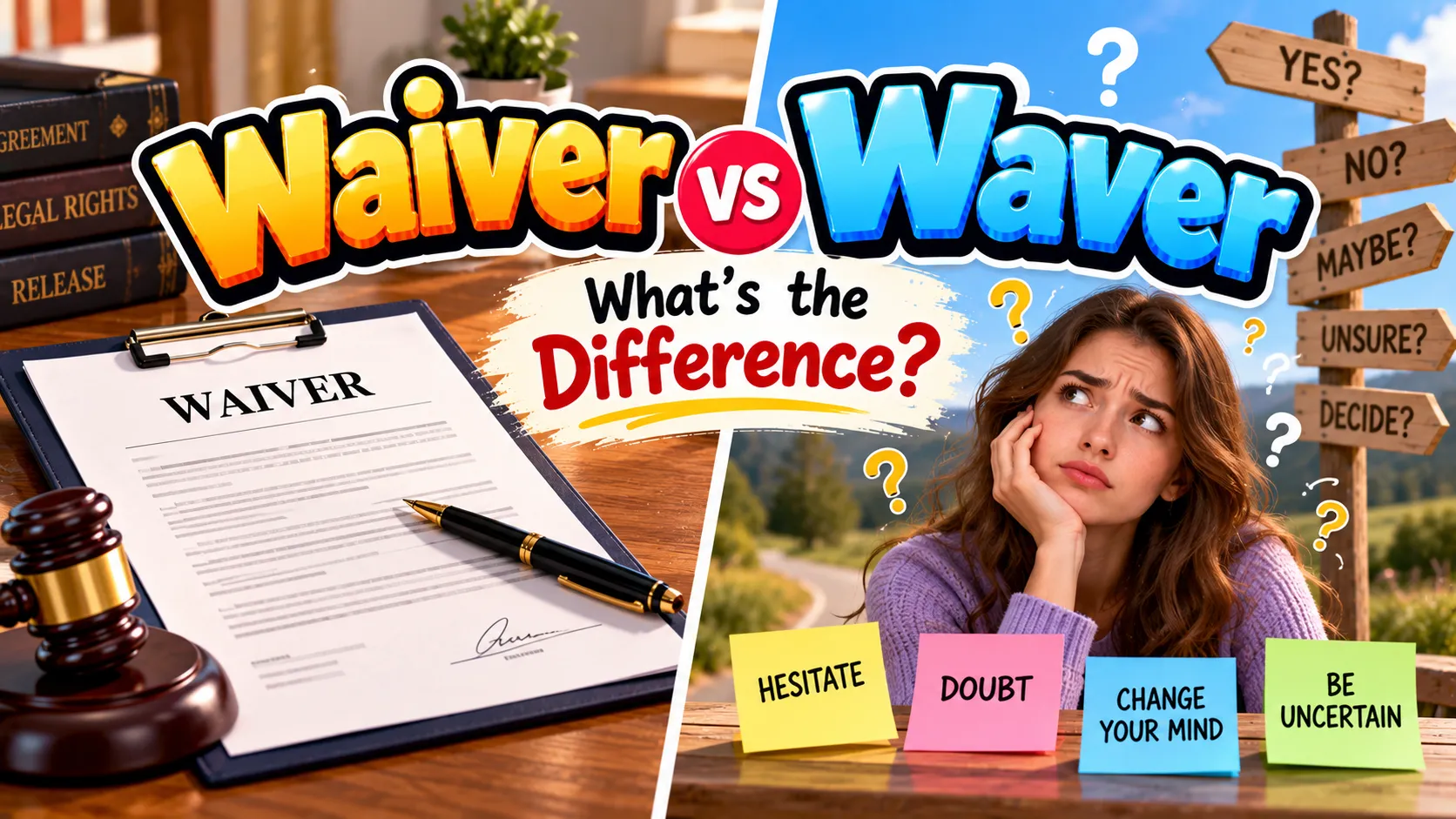
The words “waiver” and “waver” sound identical when spoken aloud, yet they carry completely different meanings and functions. This homophone pair causes confusion in legal documents, business contracts, and everyday writing. Understanding the waiver vs waver distinction is essential for anyone who wants to communicate precisely.
A “waiver” is a document or act of giving up a right or claim. To “waver” means to hesitate, tremble, or become unsteady. One is a noun rooted in legal language; the other is a verb describing uncertainty. A waiver is a noun—a formal document or act of relinquishing a right. Waver is a verb—the act of hesitating or fluctuating. This comprehensive guide breaks down the difference with clear definitions, practical examples, and memory tricks to help you choose the correct word every time.
Quick Answer
A waiver is a noun meaning the intentional surrender of a right, claim, or privilege, often documented in writing. To waver is a verb meaning to hesitate, show uncertainty, or move unsteadily. Use “waiver” when referring to a legal document or the act of giving up a right. Use “waver” when describing hesitation or unsteady movement.
Meaning Overview Table
| Aspect | Meaning |
|---|---|
| Definition | Waiver: a document or act of relinquishing a right. Waver: to hesitate or move unsteadily |
| Pronunciation | Both: /ˈweɪvər/ |
| Part of Speech | Waiver: noun. Waver: verb |
| Usage | “Sign the liability waiver” vs. “Don’t waver in your decision” |
| Context | Waiver: legal, business, sports, insurance. Waver: everyday speech, literature, decision-making |
Main Meaning
Definition
A waiver is a noun that refers to the voluntary relinquishment or surrender of a known right, claim, or privilege. It can also refer to the document that records this surrender. In legal contexts, a waiver signifies that a person chooses not to enforce a right they legally possess.
To waver is a verb that means to hesitate between choices, to show indecision, to tremble or quiver, or to move unsteadily. It describes a lack of firmness, whether in decision-making, voice, or physical stability.
Origin
“Waiver” derives from the Anglo-French word weyver, meaning “to abandon” or “renounce.” It entered English legal language in the Middle Ages through Old French gaiver or weiver. The word shares roots with “waif” and originally carried the sense of abandoning something or leaving it unclaimed.
“Waver” comes from the Middle English waveren, meaning “to flicker” or “to fluctuate.” It likely derives from the Old Norse vafra, meaning “to move unsteadily.” The word has always carried the sense of unsteady movement or indecision, whether physical or mental.
Context
The distinction matters across several contexts:
- Legal Documents: Contracts, liability forms, and insurance policies use “waiver” to describe the relinquishment of rights
- Sports and Recreation: Participants sign waivers before engaging in risky activities
- Business: Companies may grant waivers of fees, deadlines, or contractual obligations
- Decision-Making: People “waver” when uncertain about choices
- Physical Description: Voices, flames, and legs can “waver” when unsteady
Modern Usage
Today, “waiver” appears frequently in legal, business, and sports contexts. Gym members sign liability waivers. Insurance companies grant waivers for certain requirements. “Waver” appears in everyday speech and literature to describe hesitation or unsteadiness. The confusion between the two persists because they sound identical and spell-check often misses the error.
Detailed Explanation
Literal Meaning
Literally, a “waiver” is the act of giving up a right or the document recording that act. To “waver” literally means to move back and forth unsteadily, like a flame in the wind.
Common Meaning
Commonly, people encounter “waiver” when signing forms that release others from liability. They encounter “waver” when describing someone who cannot make up their mind or whose voice shakes with emotion.
Legal Meaning
In law, a waiver is the intentional relinquishment of a known right. Courts examine whether a person knowingly and voluntarily gave up their right. A waiver can be express (written or spoken) or implied (through conduct). Common examples include liability waivers, waivers of rights in criminal proceedings, and contractual waivers of deadlines.
Emotional Meaning
To “waver” emotionally means to experience doubt or indecision. A person might waver in their commitment, waver between two options, or waver in their confidence. The word captures the human experience of uncertainty.
Physical Meaning
“Waver” also describes physical unsteadiness. A voice can waver with emotion. A flame can waver in the breeze. A person’s legs can waver after a long run. The word captures any movement that lacks steadiness.
Examples Table
| Example | Meaning |
|---|---|
| Please sign the liability waiver before participating. | A document relinquishing the right to sue |
| She didn’t waver in her decision to resign. | She didn’t hesitate or show uncertainty |
| The company granted a fee waiver for the application. | The company gave up its right to collect the fee |
| His voice wavered as he gave the speech. | His voice trembled with emotion |
| The insurance waiver covered the rental car. | A document relinquishing the need for additional insurance |
| The committee didn’t waver in its support for the plan. | The committee remained firm |
| The athlete signed a waiver allowing the team to use his image. | A document giving up image rights |
| The flame wavered in the wind. | The flame moved unsteadily |
| The deadline waiver gave students an extra week. | The deadline requirement was relinquished |
| I wavered between the two job offers. | I hesitated between choices |
Related Meanings Table
| Related Term | Meaning |
|---|---|
| Waive | The verb form meaning to relinquish a right |
| Waiver | The noun form or document recording the relinquishment |
| Waver | To hesitate, tremble, or move unsteadily |
| Wavering | The act of hesitating or trembling |
| Waverer | A person who hesitates or fluctuates |
| Unwavering | Firm, steady, not hesitating |
| Waif | A homeless or abandoned person; shares root with waiver |
| Release | A document relinquishing claims, similar to a waiver |
| Disclaimer | A statement relinquishing responsibility |
| Forfeit | To lose a right as a penalty |
| Relinquish | To voluntarily give up a right |
| Renounce | To formally give up a claim or belief |
| Hesitate | To pause in uncertainty (synonym of waver) |
| Fluctuate | To rise and fall irregularly (synonym of waver) |
| Flicker | To move unsteadily, like a flame (synonym of waver) |
| Consent form | A document similar to a waiver granting permission |
Common Uses
People use “waiver” and “waver” across numerous contexts:
Sports and Recreation: Gyms, ski resorts, and adventure parks require participants to sign liability waivers. These documents protect businesses from lawsuits related to injuries.
Legal and Insurance: Insurance companies grant waivers for certain requirements. Courts examine waivers of legal rights. Contracts may contain waiver clauses.
Business and Employment: Companies may waive fees, deadlines, or contractual requirements. Employment agreements may include waivers of certain claims.
Decision-Making: People describe themselves as “wavering” when uncertain. “She wavered between accepting the offer and staying at her current job.”
Physical Description: Writers describe “wavering flames,” “wavering voices,” and “wavering steps.” These phrases capture unsteadiness and fluctuation.
Common Mistakes
| Mistake | Correction |
|---|---|
| Writing “waver” when referring to a legal document | Use “waiver” for the document or act of relinquishing a right |
| Writing “waiver” when describing hesitation | Use “waver” for hesitation or unsteadiness |
| Signing a “liability waver” | Sign a “liability waiver” |
| Saying “don’t waiver in your decision” | Say “don’t waver in your decision” |
| Writing “fee waver” | Write “fee waiver” |
| Writing “her voice waiver” | Write “her voice wavered” |
| Confusing the verb and noun forms | “Waive” is the verb; “waiver” is the noun; “waver” is a separate verb |
| Assuming spell-check will catch the error | Spell-check often misses homophones; proofread manually |
| Writing “unwaivering support” | Write “unwavering support” |
| Using “waver” in legal documents | Use “waiver” in all legal contexts |
Related Questions
Is it waiver or waver?
It depends on meaning. Use “waiver” when referring to a document or the act of giving up a right. Use “waver” when describing hesitation or unsteadiness.
What is a waiver?
A waiver is a legal document or act by which a person voluntarily gives up a known right, claim, or privilege.
What does it mean to waver?
To waver means to hesitate between choices, to show uncertainty, or to move unsteadily.
What is the difference between waive and waver?
“Waive” is a verb meaning to relinquish a right. “Waver” is a verb meaning to hesitate or tremble. “Waiver” is the noun form of “waive.”
Is “waiver” always a legal term?
“Waiver” appears most often in legal and business contexts, but it can also describe any voluntary relinquishment of a right or requirement.
Can “waver” be a noun?
No. “Waver” is only a verb. The noun form is “wavering,” as in “His wavering cost him the deal.”
FAQs
What does waiver mean?
A waiver is a noun meaning the voluntary relinquishment of a right, claim, or privilege, or the document recording that relinquishment.
What does waver mean?
To waver is a verb meaning to hesitate, show uncertainty, or move unsteadily.
Is it “liability waiver” or “liability waver”?
The correct phrase is “liability waiver.” A waiver is a document relinquishing the right to sue.
Is it “don’t waver” or “don’t waiver”?
The correct phrase is “don’t waver.” “Waver” is the verb meaning to hesitate.
What is a fee waiver?
A fee waiver is a document or decision that relinquishes the requirement to pay a fee.
Can waiver be used as a verb?
No. The verb form is “waive.” “Waiver” is the noun form.
What is the opposite of waver?
The opposite of “waver” is “persist,” “persevere,” or “remain steadfast.”
What is the opposite of waiver?
The opposite of “waiver” is “enforcement” or “assertion” of a right.
Conclusion
Mastering the waiver vs waver distinction protects your writing from embarrassing homophone errors. A “waiver” is a noun—a document or act of relinquishing a right. To “waver” is a verb—to hesitate, tremble, or move unsteadily. Remember the simple rule: waiver relates to rights; waver relates to hesitation. Whether you’re signing a gym membership, drafting a contract, or describing someone’s uncertainty, choosing the correct word ensures your meaning is clear. Practice using “waiver” for legal relinquishment and “waver” for indecision, and your readers will understand exactly what you intend.

Natalie Brooks is a content researcher and writer with a strong interest in word meanings, dream interpretations, symbolism, and cultural insights. She is passionate about creating clear, informative, and easy-to-understand content that helps readers discover the deeper meanings behind words, names, dreams, and symbols. Through her work at Meanzly, Natalie aims to make knowledge accessible and valuable for readers around the world.